Sports Vision Training: Measure First, Then Train
Vision starts almost every play — picking the ball out of a crowded background, judging how fast it is closing, knowing where everyone else is without turning your head. Those skills can be measured, and most of them respond to training. This page explains which ones matter, how we assess them, what training actually looks like, and what the research does and does not support.
What Sports Vision Training Is
Most athletes who reach this page already train everything else. They lift, they run, they take reps, they watch film. The one system almost nobody trains deliberately is the one that starts nearly every play: the visual system that finds the ball, judges it, and tells the body what to do about it.
Sports vision training is a structured program aimed at that system. It begins with a comprehensive evaluation of how an athlete's eyes focus, team, track and judge depth, read against the demands of their sport and their position. What comes out of it is a personal vision profile — a plain description of visual strengths, of the weaknesses worth working on, and of anything clinical that should be treated rather than trained. Training is then built on that profile rather than on a generic drill list.
Two athletes with identical 20/20 eyesight can have very different visual performance. Twenty-twenty is a measurement of how small a stationary letter you can identify in good light. It is a real number and a narrow one. It says nothing about how long you can hold a moving target, how accurately you judge closing speed, how quickly you shift focus from a pitcher's hand to a released ball, or how much of the field you are actually taking in.
We should say the hard part early, because the rest of this site is built on being straight about evidence. Sports vision training has weaker research behind it than the vision therapy we do for a diagnosed condition. The mechanism is plausible, the field-level reviews describe it that way, and the drills demonstrably improve the skills they train — but the leap from "better on the task" to "better in the game" is not well proven. We lay that out in full further down this page, and we would rather you read it before you book than after.
The Visual Skills That Matter in Sport
"Vision" in sport is not one skill. It is a stack of separable abilities, each measurable on its own, each with its own failure mode. These are the ones a sports vision program works on.
Dynamic Visual Acuity
How much detail you can still resolve when the target is moving, or you are — the version of "acuity" a moving ball actually asks for.
Eye Tracking
Smooth pursuits to stay with a moving target, and saccades to jump accurately between targets without hunting for them.
Peripheral Awareness
Picking up movement outside the point of focus — the teammate breaking free, the defender arriving from the blind side.
Depth Perception
Stereopsis: judging distance and closing speed from two slightly different images, which is what makes a ball arrive when you expect it to.
Visual Reaction Time
The gap between the eyes registering a change and the body acting on it — recognition and decision, not just muscle speed.
Eye-Hand & Eye-Body Coordination
Turning what the eyes deliver into an accurate, well-timed movement of a hand, a foot, a bat or the whole body.
Visual-Vestibular Integration
Keeping the world still and the eyes on target while the head and body are moving, turning or being hit.
Focusing & Eye Teaming
The unglamorous foundation: comfortable, accurate accommodation and vergence. When these are off, everything above is built on sand.
Dynamic visual acuity
Static acuity is what an eye chart measures: a letter that does not move, at a fixed distance, in controlled light. Sport almost never asks that question. It asks how much detail you can resolve while the target is moving, while you are moving, or both — the seams on a ball spinning toward you, the shift of a shoulder as a defender commits. Detail resolution falls off as relative motion increases, and how steeply it falls off differs between people. That is the skill worth knowing about, and it is not on the chart.
Eye tracking: pursuits and saccades
Tracking is two different skills wearing one name. Smooth pursuit is staying locked on something that is moving continuously — a ball in flight, a runner on a break. When pursuit is inefficient the eye falls behind and has to catch up with a jerk, and each catch-up is a moment where the image on the retina is smeared. Saccades are the fast jumps between fixed points: pitcher to release point, ball to first base, ball to teammate to defender. An inaccurate saccade undershoots or overshoots and needs a corrective hop to land, which costs time the athlete does not have. Our own overview of these skills is in eye tracking problems, and the Marsden ball is one of the oldest and still most useful ways to work on them.
Peripheral awareness and visual attention
Only a small central patch of the retina resolves fine detail. Everything else is built for motion and location — and in sport that periphery is doing an enormous amount of work. Reading a whole field or court without turning your head, sensing the defender arriving from the blind side, knowing where your teammates are while your eyes stay on the ball: all of that is peripheral processing plus the attention to use it. Attention is the part athletes underestimate. The periphery can be delivering the information perfectly well while attention stays locked on the ball, and the result looks identical to not having seen it.
Depth perception
Stereopsis is the brain's use of the small difference between the two eyes' images to build a three-dimensional world. It is what makes a ball arrive where and when you expected it. It is also not a fixed trait: normal stereoacuity sharpens through childhood, from roughly 100 arcseconds at age three to about 40 arcseconds by age seven (Birch et al., 2008). Better stereoacuity goes along with better fine-motor performance on laboratory tasks such as pegboards and bead threading (O'Connor et al., 2010), and reduced depth perception — the most common deficit in amblyopia — can affect coordination, sport and mobility (Levi et al., 2015). We wrote a longer piece on how depth perception develops.
Visual reaction time
What athletes call reaction time is really three things stacked: detecting a change, recognizing what it means, and initiating a response. Only the last is muscular. The first two are visual and cognitive, and they are where most of the variance between athletes lives. A hitter does not have time to watch a ball all the way in and then decide; the decision is made from early information, and the athletes who are good at this are extracting more from less. This is the skill sports vision training is most often sold on, and — as the evidence section explains — it is also the one where the "you got better at the test" problem bites hardest.
Eye-hand and eye-body coordination
Everything above only matters if it turns into movement. Eye-hand coordination is the hands and eyes working as one unit: catching, throwing, hitting, blocking, saving. Eye-body coordination is the same relationship scaled up to feet, hips and trunk — planting a foot where you looked, arriving at a spot on the field your eyes chose two seconds ago. Where this breaks down it often gets labelled clumsiness, which is why we wrote about vision problems that masquerade as poor coordination.
Visual-vestibular integration
The eyes do not work alone. The vestibular system in the inner ear tells the brain how the head is moving, and the vestibulo-ocular reflex uses that signal to counter-rotate the eyes so a target stays stable on the retina while the head turns. In sport the head is almost never still — running, cutting, tumbling, being hit — so nearly every visual task in competition is really a visual-vestibular task. When the two systems disagree, athletes describe it as the world lagging, or as feeling unsettled in fast, busy environments. This is also the system most disturbed after a head injury, which is why it sits at the join between this page and concussion rehabilitation.
Focusing and eye teaming: the foundation
Accommodation (focusing) and vergence (aiming both eyes at the same point) are the least glamorous items on this list and the most consequential. They are the skills that have to be comfortable and accurate before any of the others can be trained meaningfully. They are also the ones most likely to be quietly abnormal in an athlete who has never been told anything is wrong, because an eye chart does not test them. When we find a real convergence insufficiency or an accommodative problem in an athlete, that stops being performance training and becomes vision therapy — which is a good outcome, because that is where the evidence is strongest.
How These Skills Are Measured
Training only pays off when it is aimed at the right thing, so every program starts with measurement rather than a drill.
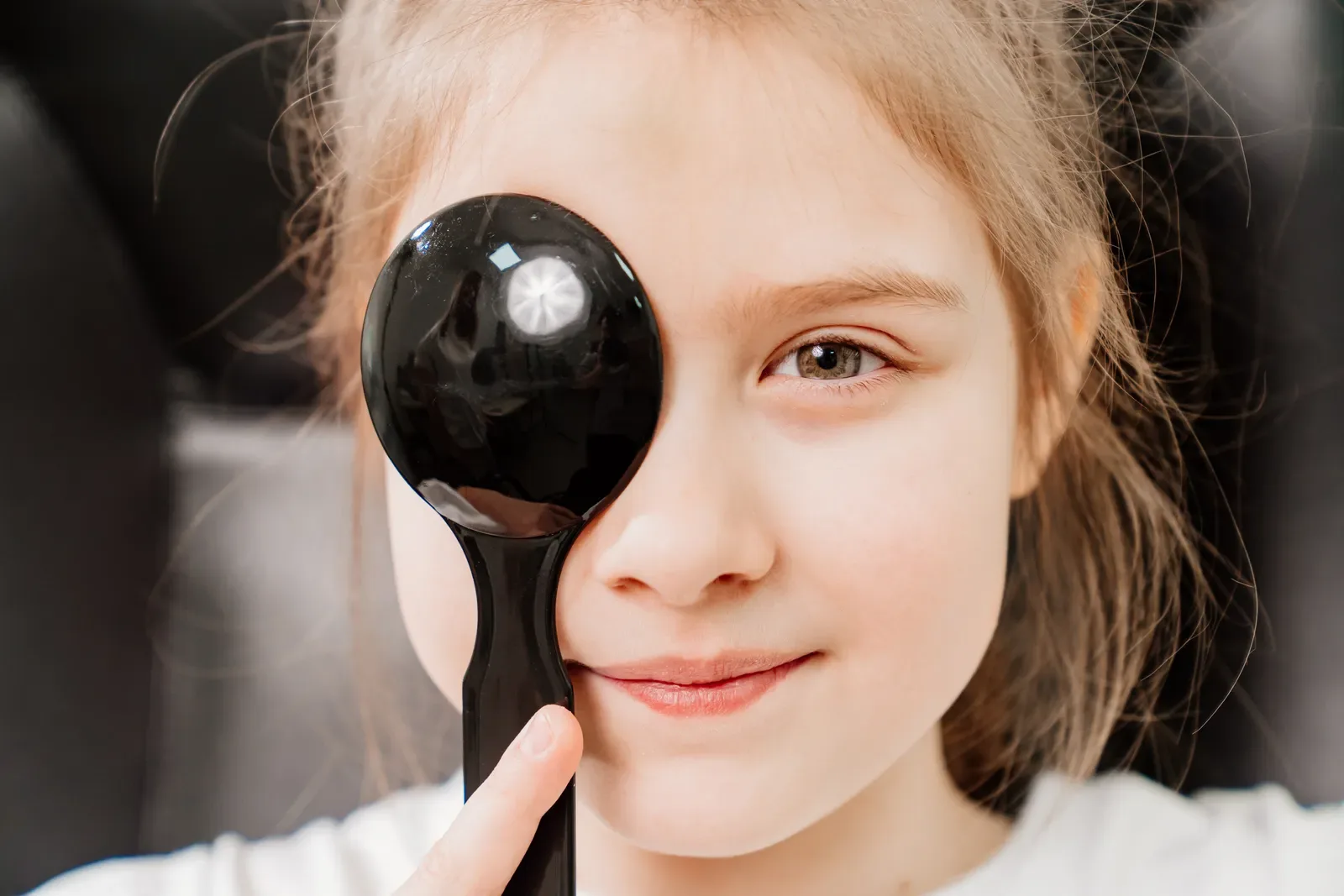
A sports vision evaluation is a comprehensive developmental vision evaluation with an athletic question attached. We start where any eye examination starts — refraction and ocular health, because an uncorrected prescription is the most common and most fixable finding in an athlete who feels something is off. From there we measure the functional skills: how far in the eyes can converge and hold, how quickly and accurately focus shifts between distances and how long it stays comfortable, how smoothly the eyes pursue a moving target and how accurately they jump between targets, how fine a depth judgement the athlete can make, and how well vision guides the hands and body under time pressure.
Then the doctor assesses visual performance as it pertains to the particular sport and position played, because the same finding means different things to different athletes. A slightly receded near point of convergence matters more to a hitter reading a release point than to a distance runner. Reduced stereoacuity matters more to a goalkeeper than to a swimmer.
You leave with the profile explained in plain language: what was measured, what the numbers mean, what we would work on, and — where it applies — the honest recommendation that nothing needs doing. Our examinations page walks through the general evaluation, and the symptom checklist is a reasonable place to start if you are not sure there is anything to look at.
What Training Looks Like, Session by Session
Comprehensive Evaluation First
Before anything is trained, we measure. Refraction, ocular health, accommodation, vergence, tracking, depth perception and visual-motor performance — the same battery as a developmental vision evaluation, read through the demands of the athlete's sport and position.
Sport- and Position-Specific Assessment
What a goalkeeper relies on is not what a point guard, a pitcher or a golfer relies on. The doctor assesses visual performance as it pertains to the particular sport and position played, and asks what the athlete actually feels going wrong.
A Personal Vision Profile
The findings become a written profile: which visual skills are strengths, which are vulnerabilities, and which — if any — are clinical findings that need treating rather than training.
Treat Anything Clinical, Then Train
If the evaluation turns up an uncorrected refractive error, an eye-teaming problem such as convergence insufficiency, or a tracking disorder, that gets addressed first through vision therapy or lenses. Performance work layered on top of an untreated problem is wasted effort.
Progressive, Measured Training
Sessions start where the athlete can succeed and get harder along defined dimensions — speed, distance, complexity, load, distraction, fatigue. We re-measure along the way so progress is objective rather than a feeling.
Carry It Into the Sport
The last phase deliberately moves the skill toward the athlete's own environment: on their feet, under time pressure, with the head and body moving, with noise and decisions attached. Skill that only shows up in the therapy room has not finished the trip.
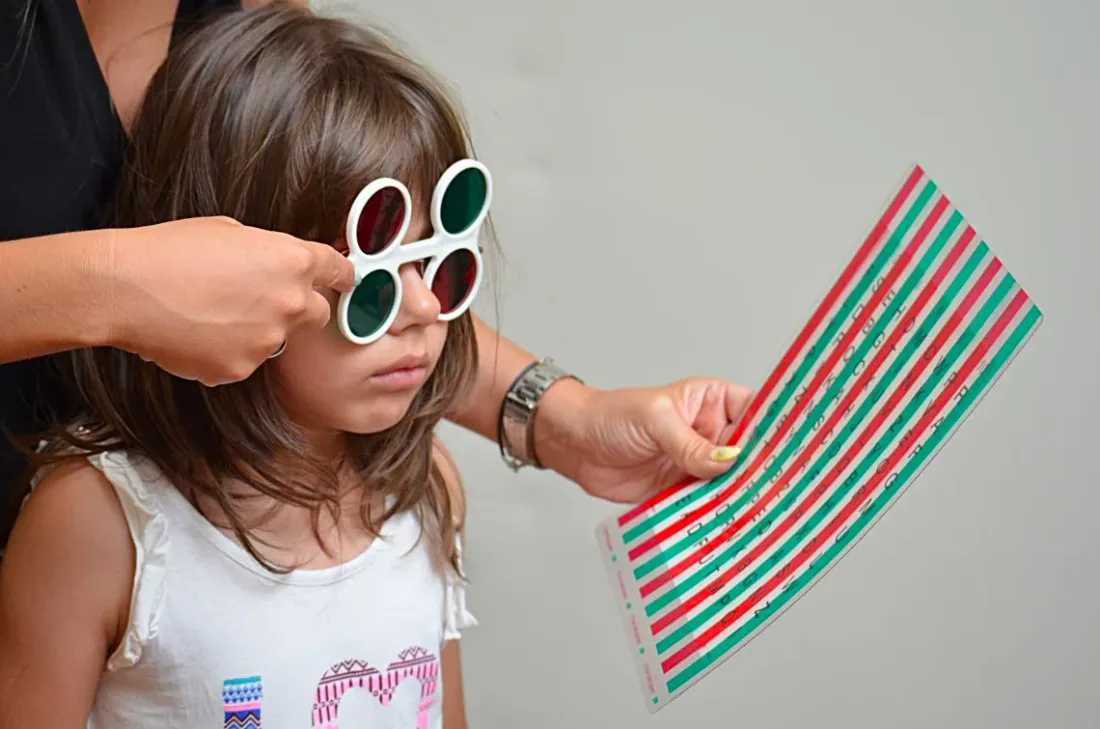
Inside a session the shape is consistent. An activity is introduced at a level the athlete can actually do, because a task that cannot be completed trains frustration rather than skill. Then it gets loaded along one dimension at a time: faster, further, smaller, with more targets, with a decision attached, while standing on one leg, while the head is moving, while someone is calling numbers at you. The point of adding load is not difficulty for its own sake — it is to keep the visual skill working when the conditions stop being ideal, which is the only condition sport ever offers.
Sessions are one-on-one with a therapist and supervised by the doctor, the same structure as our vision therapy programs, and work between visits matters for the same reason it matters in every other kind of training: a skill practiced once a week is a skill being learned slowly. How often, how long, and for how many weeks are questions the evaluation answers — we would rather give you a specific plan afterwards than a number from a website beforehand. Our post on how long vision therapy takes explains how we think about program length generally.
Progress is re-measured, not assumed. The same tests run at the start get run again, so improvement is a number rather than an impression — and so a program that is not working can be changed or stopped rather than continued out of momentum.
What the Demands Actually Look Like
Every sport loads the visual system differently, and the position within the sport changes it again. These are the patterns we see most often in South Florida athletes. They are descriptions of visual demand, not a promise about anyone's statistics.
Baseball and softball: hitting
Hitting may be the most visually punishing task in mainstream sport. The hitter has a fraction of a second to pick the ball out of a background that includes a moving pitcher, a crowd and often a bright Florida sky; to identify spin and therefore pitch type from very early information; to judge closing speed accurately enough to start a swing before the ball has finished travelling; and to hold all of that while the head and body are already loading. The visual load is front-heavy — most of what decides the outcome happens in the first few metres of ball flight, when the ball is furthest away and smallest. Tracking, dynamic acuity, depth judgement and early recognition all cash out here. Softball compresses the same problem into a shorter distance and a rising ball, which shortens the decision window further. Fielding is a different visual task again: a fly ball is a depth-and-trajectory problem solved while running backwards, which is where eye-body coordination and visual-vestibular integration take over.
Basketball
Basketball is the peripheral-awareness sport. A guard bringing the ball up is tracking a defender in central vision while monitoring four teammates and three more defenders in the periphery, and the pass that looks like anticipation is usually peripheral information being used well. Shooting adds a precise depth-and-distance judgement to a moving, fatigued body, and free throws add the opposite problem: a static task where fixation stability and a repeatable visual routine matter more than speed. Rebounding is trajectory prediction plus body positioning — depth perception and eye-body coordination in a crowd.
Tennis, pickleball and racquet sports
Racquet sports demand tracking at extremes of speed and angle, with the ball changing direction abruptly and the athlete having to read it from an opponent's body before it is struck. Anticipation in tennis is famously not about watching the ball — it is about reading shoulder, hip and racquet-face cues early, which is a visual-attention skill. The serve return compresses everything into a few hundred milliseconds. Pickleball, now enormously popular with adult recreational athletes across South Florida, substitutes a shorter court and a slower ball for a much tighter reaction window at the net, which shifts the load toward saccadic accuracy and peripheral pick-up.
Soccer, and goalkeeping in particular
Field play in soccer is a wide-field scanning sport: the ball is at the feet, so the eyes are constantly dropping to it and lifting to read the field, and the players who look composed are usually the ones scanning most efficiently between touches. A goalkeeper's job is almost a different sport visually. It is depth perception and trajectory prediction under maximum time pressure, often through a crowd of bodies that occlude the ball for part of its flight, with the head and body already committing to a dive. Judging a curling ball's flight, deciding whether to come for a cross, and setting position from the angle of an approaching striker are all binocular, depth-heavy tasks.
Football
Football splits into visual jobs by position more sharply than most sports. A quarterback is running a fast sequence of saccades across progressions while tracking a collapsing pocket in the periphery, and the pass that arrives before the receiver turns is prediction from partial information. A receiver has to locate a ball against sky or stadium lights, judge its arrival, and reconcile that with a defender and a sideline — often with the head turning hard, which puts visual-vestibular integration squarely in the middle of it. Defensive backs live on reading hips and shoulders in the periphery while never quite committing central vision. Linemen work in a compressed, crowded space where peripheral pick-up and reaction to a first movement matter more than distance acuity.
Golf
Golf is the self-paced end of the spectrum, and that changes what matters. Nothing is moving toward you, so dynamic acuity and reaction time drop down the list. What rises is fixation stability during the swing, accurate depth and distance judgement at range, and — on the green — the ability to read subtle slope, which is a visual-perceptual task involving contrast, spatial judgement and consistent head position. Alignment is a visual-spatial problem: many golfers aim where they think they are aiming and are measurably not. Eye dominance and how the head is positioned over the ball interact with all of this.
Esports and competitive gaming
Competitive gaming is a genuine visual-performance sport and an unusual one, because the demands are sustained near work rather than distance tracking. Hours of fixed-focus screen time at a constant distance load accommodation and vergence heavily — the exact systems that produce headaches, blur and eye fatigue when they are inefficient. Players also depend on rapid saccades across a busy interface, peripheral monitoring of minimaps and health bars, and reaction to small, low-contrast changes. When a gamer describes their performance falling away after two hours, that is frequently a focusing or eye-teaming problem showing up under sustained load rather than a concentration problem. It is also the population where the boundary between performance work and treating digital eye strain is thinnest.
What the Research Honestly Supports
The credibility of everything else on this site rests on us being straight about evidence, so here is the straight version.
The premise is reasonable and the field says so carefully. A 2018 review of the field describes sports vision training as resting on the idea that demanding visual, perceptual and oculomotor tasks can improve the ability to process and respond to what is seen, surveys the digital and perceptual-learning approaches in use, and reviews the supporting research "where available" — a phrase that is itself telling (Appelbaum & Erickson, 2018). A 2024 systematic review covering literature from 1950 to 2023 concluded that developing visual skills can support performance and injury prevention, while stating plainly that sample sizes were not statistically representative, that the studies frequently lacked control groups, and that the field has no standardized performance measure (Buscemi et al., 2024).
Training does improve the trained skills. A 2025 meta-analysis pooling 33 randomized trials and 1,048 participants found significant improvements in visual attention, reaction time, decision-making and eye-hand coordination (Guo et al., 2025).
And here is the catch, from the same paper. That review's central finding was a split: studies whose outcome test resembled the training task reported far larger effects than studies that measured something different. Reaction time improved with a standardized effect of 2.66 when the test looked like the drill versus 0.50 when it did not; visual attention 1.65 versus a non-significant 0.07; decision accuracy 1.46 versus 0.62. There were too few eye-hand coordination trials for the authors to test the split there at all. In plain terms: a lot of the measured improvement is people getting better at the drill. That is not nothing — skill is skill — but it is not the same as getting better at the sport.
The on-field studies are small and not randomized. The best-known result is a university baseball team whose batting average rose from .251 to .285 after a six-week program — one team, compared against conference rivals, with no randomization and, in the authors' own words, no controls, in a season that also brought an NCAA aluminium-bat change the authors say cannot be dismissed as a confound (Clark et al., 2012). A second baseball report found improved chart acuity, fewer strikeouts and more runs created after perceptual learning — again a single team, again no random assignment, with untrained pitchers controlling the acuity measures and other conference players the batting ones (Deveau et al., 2014).
Visual ability does track with performance — but that is not the same claim. Among 252 professional baseball players, scores on a sensorimotor test battery predicted on-base percentage, walk rate and strikeout rate (Burris et al., 2018). That study measured abilities athletes already had. It did not test whether training those abilities changes anything.
Compare that with the evidence for treating a diagnosed condition. In the 221-child Convergence Insufficiency Treatment Trial, office-based vergence and accommodative therapy produced a successful or improved outcome in 73% of children versus 35% on placebo therapy (CITT, 2008), and a Cochrane network meta-analysis of 12 trials and 1,289 participants confirmed the advantage over placebo in children (Scheiman et al., 2020). That is a randomized, replicated, placebo-controlled body of work. Sports vision training does not have anything like it, and pretending otherwise would be dishonest.
Our clinical view at Vision & Learning Center: sports vision training is worth doing for athletes who want to build visual skill deliberately and will do the work — and the most valuable thing we can do for many athletes is simply find and treat the vision problem nobody had looked for. Anyone promising you a measurable jump in your statistics is going past what the evidence supports.
What Sports Vision Training Is Not
What is fair to say
- The visual skills sport depends on are measurable, and most of them respond to structured practice.
- Training reliably improves performance on the trained tasks, and reviews of the field describe the premise as a reasonable one.
- An uncorrected or undiagnosed vision problem in an athlete is common, treatable, and worth finding whether or not any performance training follows.
- Athletes who enjoy the work and do it consistently get more out of it than athletes who are sent.
- Everything we find gets explained to you in plain language, including the parts that argue against doing this.
What it is not
- A substitute for coaching. Technique, tactics and repetition in the sport itself are what make athletes better at their sport. Nothing here replaces a coach.
- A substitute for strength, conditioning or skill work. Visual skill is one input into performance among many, and usually not the largest.
- A guaranteed jump in your statistics. The published on-field studies are small, single-team and not randomized. Anyone quoting you a percentage improvement in your numbers is going past the evidence.
- A concussion treatment, or a return-to-play clearance. That is a separate evaluation and a separate conversation.
- A diagnosis. If training is the wrong answer because something clinical is going on, the evaluation is what tells us.
Results vary, and they vary for ordinary reasons: what the starting profile looked like, how consistently the athlete does the work, how much of their performance problem was visual in the first place, and how much of it was technique, decision making, conditioning or nerves. An honest evaluation sometimes concludes that the visual system is not where the problem is. That is a useful answer too, and we will give it to you.
Athletes, Parents, Coaches
If you are the athlete
You are the one who knows what is actually going wrong, and that description is worth more to us than any single test. "The ball gets on me late." "I lose it against the lights." "I see the pass a beat after it was there." "My eyes are fine for an hour and then everything gets soft." "I know where he is until I turn my head." Those sentences point at different systems, and they shape what we measure. Come prepared to describe the failure in your own words, in your own sport, and to be honest about how much work you are willing to do between sessions — because this is training, and training you do not do does not work.
If you are the parent
Two things are worth separating. The first is whether your athlete has an actual vision problem, which is a clinical question with a clear answer and a well-evidenced treatment path. The second is whether performance training is a good use of your family's time and money, which is a judgement call and depends on your athlete's motivation as much as anything. We will give you a straight answer on the first and an honest opinion on the second, including when the answer is no.
It is also worth knowing that the same visual skills show up in the classroom. A young athlete who struggles to sustain reading, loses their place, gets headaches with homework or avoids near work may have an eye-teaming or focusing problem that is costing them in both places at once — see learning-related vision problems or run through the symptom checklist. And if your athlete plays a contact or projectile sport, the eyewear conversation matters: choosing glasses for a child covers lens material and protection.
If you are a coach, athletic director or athletic trainer
You are usually the first person to notice the pattern — the outfielder who misjudges fly balls, the player who is late on everything after contact, the student who cannot get through a film session without a headache. What we would want from you is that observation, and what you would want from us is a straight answer about whether it is visual.
There is no team package advertised on this page, because what would make sense depends entirely on the program. What we can discuss is what a group arrangement would realistically involve: what could be measured and what a measurement would and would not tell you; which parts have to happen at one of our offices, since a comprehensive evaluation is not something that can be done properly on a sideline; how findings would be communicated to families, since anything clinical belongs to the athlete and their parents rather than to the program; how an athlete flagged with something clinical would be referred; and how it would fit around a season. If your program already has an athletic trainer or a concussion protocol, the most useful conversation is usually about where a vision evaluation fits into what you already do.
The most valuable thing we can offer a program is probably the least glamorous: a clear referral path for athletes whose symptoms after a head injury are not settling. That is covered below. To start any of these conversations, contact us — or if you want the professional-facing material first, our resources for professionals and referral page are the place to look.

The Concussion Crossover
Athletes are the population most likely to need concussion care, so this is the most important section on the page for some of the people reading it.
Vision problems are common after a sport-related concussion. Of 78 athletes tested about six days after one, roughly 42% had convergence insufficiency, and those athletes scored worse on reaction time and visual motor speed than those with a normal near point of convergence (Pearce et al., 2015). Vestibulo-ocular dysfunction was present in 28.6% of children and adolescents with acute sport-related concussion referred to one concussion program, and in 62.5% of those with post-concussion syndrome (Ellis et al., 2015) — a referral sample, so those numbers describe children who were sent to a specialist clinic, not every child who gets a concussion.
The joint clinical report from the American Academy of Pediatrics, the American Academy of Ophthalmology, AAPOS and AACO is the sane framing: most children recover on their own by about four weeks, and those who do not warrant a vision-specific history and examination covering acuity, alignment, pursuits, saccades, the vestibulo-ocular reflex, near point of convergence and accommodation (Master et al., 2022). Most athletes get better without any of this. The ones who do not are the ones this matters for.
If an athlete has taken a hit to the head and something still is not right — headaches with reading or screens, dizziness in busy environments, words moving on the page, light sensitivity, a delay getting back to full school work — that is a different appointment from this one. Start with concussion and vision for what to look for, or concussion rehabilitation for how the care itself works. Our neuro-optometric rehabilitation page covers brain injury more broadly, and what the research shows about vision after concussion is the evidence review.
Performance training is not a concussion treatment and is not a return-to-play clearance. Assessment first; training later, if it is still what the athlete wants.
The Athletes We See in South Florida
We see athletes at all our offices — Coconut Creek, Boynton Beach and West Palm Beach — which covers most of northern Broward and Palm Beach County within a reasonable drive. In a year-round outdoor sports climate, that tends to mean:
- Middle and high school athletes across Broward and Palm Beach County programs
- Club, travel and academy players whose season never really ends
- Collegiate athletes home for the summer or training locally
- Adult recreational athletes — tennis, golf, pickleball, cycling, martial arts, softball leagues
- Competitive gamers and esports players managing hours of sustained near work
Two practical South Florida notes. The first is sun and glare: outdoor athletes here are dealing with high ambient light most of the year, and how an athlete handles glare, contrast and rapid light changes is worth discussing at an evaluation. The second is scheduling. Club and travel seasons here overlap almost continuously, so if you are going to do this it is worth finding the least loaded stretch of the calendar rather than adding sessions to a competition week.
Addresses, hours and directions for every office are on the locations page, and everything else about the practice is on the FAQ. We work with athletes of any age and any level of play, and we do not claim affiliations with teams or programs we do not have.
Sports Vision FAQ
Does sports vision training actually improve athletic performance?
It reliably improves performance on the trained tasks. Whether that carries into the game is where the evidence thins out. A 2025 meta-analysis of 33 randomized trials found real gains in visual attention, reaction time, decision-making and eye-hand coordination — but where the comparison could be made, the gains were much smaller when the test did not resemble the training drill. Very few studies have connected training to real game statistics under controlled conditions. We present this as skill training with a plausible mechanism and incomplete evidence, not a guaranteed edge. The longer version, with the numbers →
Is sports vision training the same thing as vision therapy?
No, and the difference matters. Vision therapy treats a diagnosed condition — symptomatic convergence insufficiency, for example — and has randomized-trial support behind it. Sports vision training is performance work for an athlete whose visual system is already healthy. The activities can look similar from the doorway; the purpose, the plan and the strength of the evidence are different.
What happens at the first appointment?
A comprehensive evaluation. We check refraction and eye health, then measure focusing, eye teaming, tracking, depth perception and visual-motor performance, and go through what the athlete notices in their own sport. You leave knowing what was measured, what it means, and whether the honest recommendation is training, treatment, lenses, or nothing at all. What an evaluation involves →
How old does an athlete have to be?
There is no fixed age. Depth perception is still sharpening through childhood — normal stereoacuity moves from roughly 100 arcseconds at age three to about 40 arcseconds by age seven — so younger athletes are still developing the raw material. What matters more than age is whether the athlete can attend to a task, work at it consistently, and give honest feedback about what they are seeing.
How long does a program take, and what does it cost?
Both depend on what the evaluation finds, so we answer them after it rather than before. An athlete with a clean visual system and one skill to sharpen is a different plan from an athlete with an untreated eye-teaming problem. See cost and payment for how we handle the financial side generally.
My athlete has 20/20 vision. Is there anything to look at?
Possibly. Twenty-twenty describes how small a letter you can identify on a stationary chart in good light — a real measurement, and a narrow one. It says nothing about how well the eyes track a moving target, how accurately they judge distance, how fast they shift focus, or how comfortably they team. Two athletes with identical 20/20 acuity can have very different visual performance.
My athlete had a concussion. Should we start sports vision training?
Not first. Vision problems are common after concussion, and the joint clinical report from the American Academy of Pediatrics, the American Academy of Ophthalmology, AAPOS and AACO notes that most children recover on their own by about four weeks and recommends a vision-specific examination for those who do not. Assessment, and treatment if it is needed, come before performance training. Start at concussion and vision or concussion rehabilitation.
Do you work with teams, or only individual athletes?
Individual athletes are the everyday work, and every athlete we see starts with their own evaluation. Coaches, athletic directors and athletic trainers are welcome to call and talk through what a group arrangement could look like — what could be measured, what it would and would not tell you, and what would have to happen at our offices rather than at yours. That is a conversation, not a package on a shelf. Contact us →
Will my athlete need glasses or contacts?
Sometimes. An uncorrected refractive error is one of the most common findings in an athlete who feels something is off, and correcting it is often the single highest-value change we make. If sport eyewear is part of the answer, we will talk about lens material and protection as well as prescription. Choosing glasses for a child →
More on the practice FAQ, or see cost & payment and insurance.
Articles on Sports & Visual Performance
How Sports Vision Training Can Help Athletes
The evidence in full: what the meta-analyses found, and why the on-field studies are weaker than they look.
Depth Perception: How It Develops and What Affects It
Why stereopsis is not a fixed trait, how it matures through childhood, and what reduces it.
The Three Grades of Binocular Vision Explained
Simultaneous perception, fusion and stereopsis — the ladder that depth perception sits at the top of.
Vision Therapy Activity: Marsden Ball
One of the oldest tracking and localization tools in the room, and how it is actually used.
Vision Problems After Concussion: What the Research Shows
How often vision problems follow a concussion, which ones appear, and how long they tend to last.
Common Eye Problems in Teens (13–18)
Including sports eye injuries and the eyewear decisions that go with a contact sport.
Vision Problems Masquerading as Poor Coordination
When "clumsy" or "uncoordinated" is a visual problem wearing a motor costume.
Who Is a Good Fit for Vision Therapy?
Which findings point toward therapy rather than performance training, and where the support is strongest.
Where This Information Comes From
Every figure quoted on this page comes from one of the studies below, with its limitation attached. Where the research is weak, we have said so rather than left it out.
- Appelbaum LG, Erickson G (2018). Sports vision training: A review of the state-of-the-art in digital training techniques. International Review of Sport and Exercise Psychology; 11(1):160–189. — Review of the field: describes the premise of sports vision training and surveys digital, perceptual-learning and virtual-reality approaches, noting that supporting research is available only unevenly.
- Buscemi A, Mondelli F, Biagini I, Gueli S, D'Agostino A, Coco M (2024). Role of Sport Vision in Performance: Systematic Review. Journal of Functional Morphology and Kinesiology; 9(2):92. — Systematic review of 25 records from 1950–2023. Concludes visual-skill development can support performance and injury prevention, while flagging small samples, frequent lack of control groups and no standardized performance measure.
- Guo Y, Yuan T, Yang M, Qiu J (2025). Does the 'learning effect' caused by digital devices exaggerate sports visual training outcomes? A systematic review and meta-analysis. Frontiers in Physiology; 16:1664572. — 33 randomized trials, 1,048 participants. Training improved visual attention, reaction time, decision-making and eye-hand coordination — but effects were far larger when the outcome test resembled the training task (reaction time SMD 2.66 vs 0.50; visual attention 1.65 vs 0.07).
- Clark JF, Ellis JK, Bench J, Khoury J, Graman P (2012). High-performance vision training improves batting statistics for University of Cincinnati baseball players. PLoS ONE; 7(1):e29109. — Team batting average rose from .251 to .285 after a six-week program. One team, no randomization and, in the authors’ words, no controls; an NCAA aluminum-bat change landed in the same season.
- Deveau J, Ozer DJ, Seitz AR (2014). Improved vision and on-field performance in baseball through perceptual learning. Current Biology; 24(4):R146–R147. — University players who completed a perceptual-learning program showed better chart acuity, fewer strikeouts and more runs created. Short report, single team, no random assignment; 18 untrained pitchers controlled the acuity measures and 78 other conference players the batting ones.
- Burris K, Vittetoe K, Ramger B, Suresh S, Tokdar ST, Reiter JP, Appelbaum LG (2018). Sensorimotor abilities predict on-field performance in professional baseball. Scientific Reports; 8:116. — In 252 professional players, sensorimotor test scores predicted on-base percentage, walk rate and strikeout rate. Correlational: it measures abilities athletes already had, not the effect of training them.
- Birch E, Williams C, Drover J, et al. (2008). Randot Preschool Stereoacuity Test: normative data and validity. Journal of AAPOS; 12(1):23–26. — In 4,355 children aged 3–18, mean stereoacuity improved from about 100 arcseconds at age 3 to 60 by age 5 and 40 by age 7.
- O'Connor AR, Birch EE, Anderson S, Draper H; FSOS Research Group (2010). The functional significance of stereopsis. Investigative Ophthalmology & Visual Science; 51(4):2019–2023. — In 143 people aged 10–30, pegboard and bead-threading performance related to stereoacuity; those with normal stereoacuity performed best on every task.
- Levi DM, Knill DC, Bavelier D (2015). Stereopsis and amblyopia: A mini-review. Vision Research; 114:17–30. — Reduced stereoscopic depth perception is the most common deficit in amblyopia under ordinary binocular viewing, and can affect motor coordination, sport and mobility.
- Convergence Insufficiency Treatment Trial Study Group (2008). Randomized clinical trial of treatments for symptomatic convergence insufficiency in children. Archives of Ophthalmology; 126(10):1336–1349. — In 221 children aged 9–17, office-based vergence/accommodative therapy produced a successful or improved outcome in 73% versus 35% for office placebo at 12 weeks — the contrast class for how much stronger the evidence is for a diagnosed condition.
- Scheiman M, Kulp MT, Cotter SA, Lawrenson JG, Wang L, Li T (2020). Interventions for convergence insufficiency: a network meta-analysis. Cochrane Database of Systematic Reviews; 12:CD006768. — Across 12 trials and 1,289 participants, office-based therapy beat placebo in children (RR 3.04, 95% CI 2.32–3.98). Adult evidence is less clear.
- Pearce KL, Sufrinko A, Lau BC, Henry L, Collins MW, Kontos AP (2015). Near Point of Convergence After a Sport-Related Concussion. American Journal of Sports Medicine; 43(12):3055–3061. — Of 78 athletes tested about six days after a sport-related concussion, roughly 42% had convergence insufficiency, and those athletes scored worse on reaction time and visual motor speed.
- Ellis MJ, Cordingley D, Vis S, Reimer K, Leiter J, Russell K (2015). Vestibulo-ocular dysfunction in pediatric sports-related concussion. Journal of Neurosurgery: Pediatrics; 16(3):248–255. — Among 101 children and adolescents referred to a concussion program, vestibulo-ocular dysfunction was present in 28.6% of acute sport-related concussions and 62.5% of post-concussion syndrome cases. Referral sample.
- Master CL, Bacal D, Grady MF, et al.; AAP Section on Ophthalmology, AAO, AAPOS, AACO (2022). Vision and Concussion: Symptoms, Signs, Evaluation, and Treatment. Pediatrics; 150(2):e2021056047. — Joint clinical report: most children recover from concussion on their own by four weeks; those who do not warrant a vision-specific examination of acuity, alignment, pursuits, saccades, the vestibulo-ocular reflex, near point of convergence and accommodation.
Keep Exploring
More on Sports Vision
How the visual system works in sport, sport by sport — and how to protect it.
It Starts With Measuring What You Have
Before any training is worth doing, it helps to know whether an athlete's focusing, eye teaming, tracking and depth perception are where they should be. That is what the evaluation is for — at our Boynton Beach and Boca Raton offices.