Vision Therapy Activity: Marsden Ball
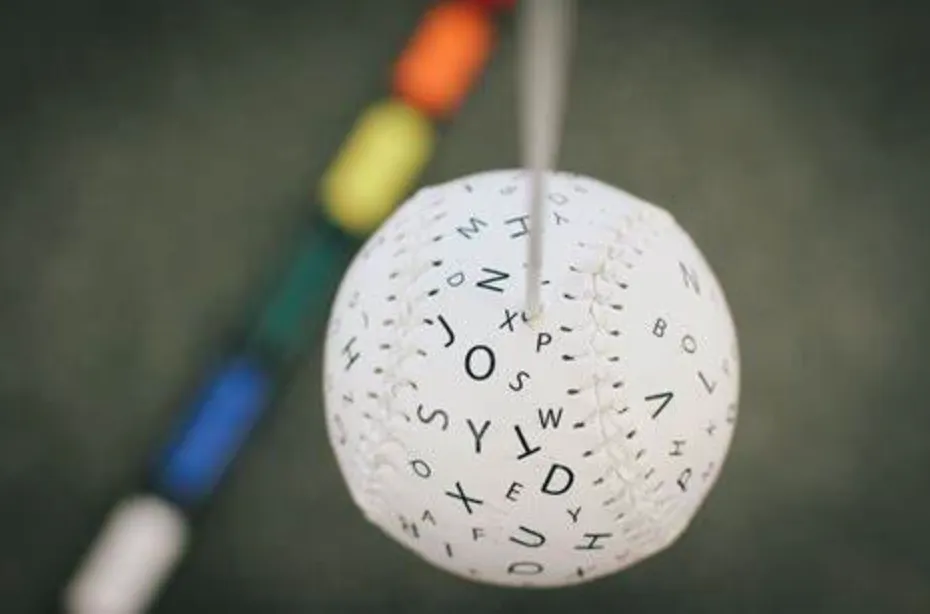
A soft ball on a string, hanging from the ceiling, is one of the least impressive-looking pieces of equipment in our therapy rooms. It is also one of the busiest.
The Marsden ball has been part of our vision therapy toolkit for as long as we can remember, because it does something a worksheet cannot: it puts a moving target in real space and asks the eyes, the brain and the hand to agree on exactly where that target is, right now. Here is how we set it up, what it works on, and an honest account of what the research does and does not show.
Key takeaways
- A Marsden ball is a light ball hung on a string at about the patient’s belly-button height, tapped back and forth between patient and therapist.
- The main target is localization, or knowing where a moving object is in space. Pursuits, eye-hand coordination and bilateral integration come along with it.
- We raise difficulty by shrinking the contact point, patching an eye, adding printed letters, a metronome, or a naming task.
- Depth perception is measurably linked to fine-motor performance (O’Connor et al., 2010), which is part of why we work on it, but no randomized trial has tested the Marsden ball on its own.
- What trials support is the whole office-based program with home reinforcement, for diagnoses such as symptomatic convergence insufficiency (CITT, 2008; Scheiman et al., 2020).
What it is and how we hang it
The ball is soft and light, roughly the size of a large orange, and many are printed with letters or numbers. It hangs from a hook or ceiling track on a string so it can swing freely.
We hang it at the patient’s belly-button height, and that is not arbitrary. At that height the ball sits where the hands naturally meet in front of the body: the patient can reach it without stretching overhead or stooping, posture stays upright, and the swing stays predictable. It also makes it obvious when a hand refuses to cross the body’s midline.
Localization: the main job
Localization is the skill we are usually after. The patient and the therapist tap the ball back and forth, and every tap asks the same question: where is that ball, and where does my hand have to be to meet it?
We start with the whole palm, which is forgiving enough to let the patient build a rhythm. The next level is three fingers: less contact area means less margin for error, so the movement has to be more precise. The hardest standard version is a single index finger, where the patient must judge both position and speed and time the hand to arrive at the same place at the same moment. That ladder is how we make the activity harder without changing the activity.
Other skills the ball pulls in
- Pursuits. Following the swinging ball with the eyes, rather than jerking the head after it, is smooth-pursuit work. We often ask patients to keep the head still and let the eyes travel.
- Eye-hand coordination and timing. The hand has to arrive where the ball will be, not where it was.
- Bilateral integration. Alternating hands, or requiring the right hand to meet a ball swinging left, asks the two sides of the body to cooperate across the midline.
- Attention. The ball never stops, so the activity quietly demands sustained focus. A patient who holds it for four taps and then drifts is telling us something.
Variations we use
- Patched or unpatched. Ball taps can be done with one eye covered to work each eye’s localization on its own, then unpatched once the eyes are ready to work together.
- Letters and numbers. With a printed ball, the patient calls out the letter facing them at the moment of contact, adding a recognition demand on top of the motor one.
- A metronome. A set beat forces a consistent rhythm and removes the option of waiting for a comfortable moment to swing.
- Loading. While tapping, we might ask the patient to name a color, recite the alphabet, or count backward by threes. The multitasking is the point: a skill that only works when nothing else is happening is not yet automatic.
What the research supports, and what it does not
No randomized trial has tested the Marsden ball by itself. The strongest evidence in our field is for complete office-based vergence and accommodative therapy programs with home reinforcement, in patients with a specific diagnosis. In the 221-child Convergence Insufficiency Treatment Trial, 73% of children in office-based therapy were successful or improved at 12 weeks versus 35% in office placebo (CITT, 2008). A Cochrane network meta-analysis of the pediatric trials rated this high-certainty evidence (RR 3.04, 95% CI 2.32-3.98 versus placebo), while noting that the evidence in adults is less clear (Scheiman et al., 2020). The same programs improved focusing amplitude (Scheiman et al., 2011). Just as important, the largest trial of the reading question found no advantage for vision therapy over placebo therapy on reading comprehension (CITT-ART, 2019). We do not promise reading gains from ball taps.
The skills themselves do relate to real-world function. In 143 people aged 10 to 30, pegboard and bead-threading scores tracked stereoacuity, and those with normal stereoacuity did best on every task (O’Connor et al., 2010). Depth perception is still maturing through childhood, from about 100 arcseconds at age 3 to 40 arcseconds by age 7 (Birch et al., 2008), and reduced stereo vision is the most common deficit in amblyopia, where it can affect coordination, sport and moving through space (Levi et al., 2015).
Eye-hand coordination can improve with training that includes this activity. In a non-randomized study of 70 students with low vision, a program that included bunting a Bernell-Marsden ball, alongside three other visual-motor tasks (36 sessions over three months), raised Frostig eye-hand coordination scores from 22.74 to 24.69, against 21.60 to 21.89 in untreated controls (P<0.05), while visual acuity did not change (Heravian Shandiz et al., 2018). Worth knowing, but the gain was small, the groups were not randomly assigned, and the participants were students with low vision rather than children with binocular vision problems.
Sports vision claims deserve caution. Ball-tapping looks like athletic training, and the premise is reasonable, but the leading review of these training techniques appraises the supporting research only where such research exists (Appelbaum & Erickson, 2018), and we read that as evidence that is patchy across approaches. The often-quoted baseball result, a team batting average rising from 0.251 to 0.285, came from a single team with no control group (Clark et al., 2012), and studies linking sensorimotor ability to on-field statistics are correlational (Burris et al., 2018). Our view is that this is worthwhile skill work, not a guaranteed edge.
Doing it safely at home
If your therapist has assigned ball taps for home, a few rules keep it simple. Hang the ball where a wide swing cannot reach lamps, screens, glasses or a sibling. Keep the string short enough that it cannot loop around a neck, and take it down between sessions. Clear the floor so nobody backs into furniture while watching the ball. Never leave a young child alone with a hanging ball. Home practice reinforces office work; it does not replace it.
Where it fits in a therapy program
The Marsden ball rarely works alone. It sits alongside other localization and visual-motor activities such as pointer straw, which trains the same skill with a static target in changing positions, and the pegboard, which adds tracking and fine motor control on a rotating board. How we sequence them, and how we decide when a skill has become automatic, is described in our overview of vision therapy goals and procedures.
Which activities belong in a program, and in what order, depends on what the testing shows. If tracking, depth perception or eye-hand coordination sounds like part of your child’s story, a comprehensive developmental vision evaluation is the place to start. Schedule an evaluation with our team in Coconut Creek, Boynton Beach or West Palm Beach.
Common Questions About This Topic
What is a Marsden ball?
It is a soft, lightweight ball hung from the ceiling on a string so it can swing freely. Many are printed with letters or numbers. In therapy we hang it at about the patient's belly-button height and use it as a moving target for tapping, batting and tracking tasks.
Why is the ball hung at belly-button height?
That height puts the ball in the working space where the hands naturally meet the body's midline, so the patient can reach it without stretching overhead or stooping. It keeps posture upright, keeps the swing predictable, and makes it easy to see whether a hand is crossing the midline or avoiding it.
What skills does the Marsden ball train?
Mainly localization, which is knowing where a moving object is in space. It also pulls in smooth pursuit eye movements, eye-hand coordination, timing, bilateral integration and sustained attention, depending on how the activity is set up and loaded.
Is there research proving the Marsden ball works?
Not for the ball on its own. No randomized trial has tested this single activity. What randomized trials support is the full office-based therapy program with home reinforcement for specific diagnoses, such as symptomatic convergence insufficiency. One non-randomized study of 70 students with low vision used a program that included bunting a Bernell-Marsden ball and found modestly improved eye-hand coordination scores. We present it as a well-established therapy procedure, not a proven cure.
Can we do Marsden ball activities at home?
Only if your therapist has assigned it and shown you the set-up. Hang it where nothing can be knocked over, clear the swing path, keep the string short enough that it cannot loop around a neck, and never leave a young child alone with a hanging ball. Home practice is meant to reinforce what happens in the office, not replace it.
Where This Information Comes From
- O'Connor AR, Birch EE, Anderson S, Draper H; FSOS Research Group (2010). The functional significance of stereopsis. Investigative Ophthalmology & Visual Science; 51(4):2019-2023. : In 143 people aged 10-30, pegboard and bead-threading performance was related to stereoacuity; those with normal stereoacuity performed best on all tasks.
- Birch E, Williams C, Drover J, et al. (2008). Randot Preschool Stereoacuity Test: normative data and validity. Journal of AAPOS; 12(1):23-26. : In 4,355 children aged 3-18, mean normal stereoacuity sharpened from 100 arcseconds at age 3 to 60 by age 5 and 40 by age 7.
- Levi DM, Knill DC, Bavelier D (2015). Stereopsis and amblyopia: A mini-review. Vision Research; 114:17-30. : Reduced stereoscopic depth perception is the most common deficit in amblyopia and can affect motor coordination, sport and mobility.
- Heravian Shandiz J, Riazi A, Azimi Khorasani A, Yazdani N, Torab Mostaedi M, Zohourian B (2018). Impact of Vision Therapy on Eye-hand Coordination Skills in Students with Visual Impairment. Journal of Ophthalmic & Vision Research; 13(3):301-306. : A therapy program that included bunting a Bernell-Marsden ball (36 sessions over 3 months) raised Frostig eye-hand coordination scores from 22.74 to 24.69, versus 21.60 to 21.89 in untreated controls (P<0.05); visual acuity did not change. Non-randomized, 70 students with low vision.
- Convergence Insufficiency Treatment Trial Study Group (2008). Randomized clinical trial of treatments for symptomatic convergence insufficiency in children. Archives of Ophthalmology; 126(10):1336-1349. : In 221 children aged 9-17, office-based vergence/accommodative therapy with home reinforcement produced a successful or improved outcome in 73% versus 35% with office placebo at 12 weeks.
- Scheiman M, Kulp MT, Cotter SA, Lawrenson JG, Wang L, Li T (2020). Interventions for convergence insufficiency: a network meta-analysis. Cochrane Database of Systematic Reviews; 12:CD006768. : Reviewed 12 trials and 1,289 participants; in the pediatric network meta-analysis, which drew on four CITT trials, office-based vergence/accommodative therapy beat placebo (RR 3.04, 95% CI 2.32-3.98, high certainty). Adult evidence is less clear.
- Scheiman M, Cotter S, Kulp MT, et al.; CITT Study Group (2011). Treatment of accommodative dysfunction in children: results from a randomized clinical trial. Optometry and Vision Science; 88(11):1343-1352. : 74% of CITT children with symptomatic convergence insufficiency also had accommodative dysfunction; office-based therapy raised accommodative amplitude 9.9 D versus 2.2 D with placebo.
- CITT-ART Investigator Group (2019). Effect of Vergence/Accommodative Therapy on Reading in Children with Convergence Insufficiency: A Randomized Clinical Trial. Optometry and Vision Science; 96(11):836-849. : In 310 children, reading comprehension improved 3.7 points with vision therapy versus 3.8 with placebo therapy: no reading advantage.
- Appelbaum LG, Erickson G (2018). Sports vision training: A review of the state-of-the-art in digital training techniques. International Review of Sport and Exercise Psychology; 11(1):160-189. : Review of the premise and methods of digital sports vision training; the authors provide critical review of supporting research only where such research is available.
- Clark JF, Ellis JK, Bench J, Khoury J, Graman P (2012). High-performance vision training improves batting statistics for University of Cincinnati baseball players. PLoS ONE; 7(1):e29109. : After a six-week preseason vision-training program, team batting average rose from 0.251 to 0.285. Single team, no randomization or control group.
- Burris K, Vittetoe K, Ramger B, Suresh S, Tokdar ST, Reiter JP, Appelbaum LG (2018). Sensorimotor abilities predict on-field performance in professional baseball. Scientific Reports; 8:116. : In 252 professional players, sensorimotor test scores predicted on-base percentage, walk rate and strikeout rate. Correlational: it measures abilities, not the effect of training them.
Care We Provide
More From the Blog
Wondering If This Sounds Like Your Family?
A developmental vision evaluation measures the skills a routine eye exam does not. Our team sees children and adults in Coconut Creek, Boynton Beach, Boca Raton and West Palm Beach.