Accommodative (Focusing) Disorders
Also called accommodative dysfunction — when the eyes cannot shift or hold focus, near work turns blurry, slow, and tiring.
When Focusing Tires
What to Know About Accommodative (Focusing) Disorders
Accommodation is the process that lets the eye focus on objects at varying distances, and it happens primarily through the lens inside the eye. When you view a close object, the ciliary muscle contracts, allowing the lens to become thicker and increase its focusing power; for distant objects, that muscle relaxes, the lens thins, and its focusing power drops. This change in lens shape is what projects a sharp image onto the retina, allowing clear vision at different distances.
Accommodation is a reflex, and it should occur instantaneously as the gaze shifts between distant and near objects. When that does not happen instantly, when the response is delayed, or when focus cannot be held, the person has an accommodative dysfunction — also called an accommodative disorder, or simply a focusing problem.
These problems are easy to miss, because distance acuity can still measure 20/20 on a wall chart. They are common in school-age children and in adults who spend hours at near, and they are a frequent cause of near-work discomfort and blur. (More on that: can a child have 20/20 vision and still struggle with reading?)
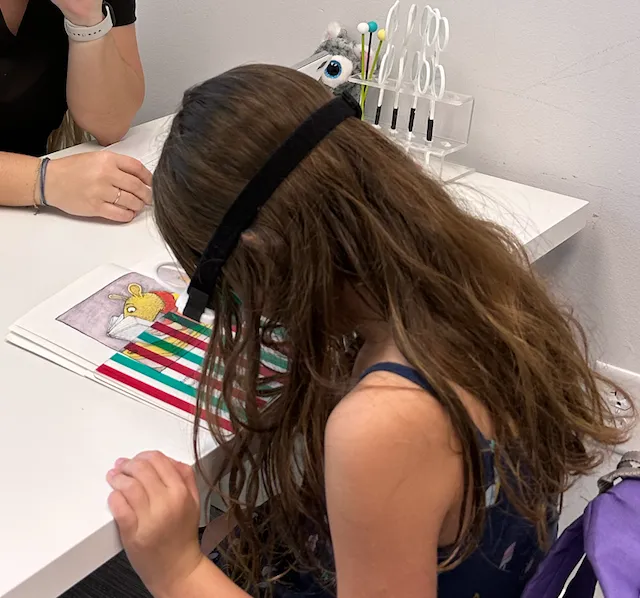
Types of accommodative dysfunction. Accommodative dysfunction refers to the inability of the eyes to focus clearly on objects, particularly at near — the focusing ability that reading and other close-up activities depend on. Several types are recognized:
1. Accommodative insufficiency. The most common type. It is characterized by the inability to focus on near objects, or to maintain focus for an extended period. Symptoms may include blurred vision, eye strain, headaches, difficulty concentrating, and avoidance of near tasks.
2. Accommodative infacility. Difficulty changing focus between near and far objects. Symptoms show up in the shift itself — moving from distance to near and back again, such as looking up at the board and then down to write notes in a classroom.
3. Accommodative spasm. An over-focusing, or "spasm," of the focusing muscle (the ciliary muscle) that causes the eyes to lock into a state of near focus. Shifting to distant objects becomes difficult, leading to blurred distance vision, eye strain, and headaches.
4. Ill-sustained accommodation. The inability to maintain focus on near objects for a prolonged period, even though initial focusing may be adequate. Reading starts clear and blurs, with discomfort or fatigue during long near tasks.
Treatment of accommodative dysfunctions. Accommodative dysfunctions are typically treated with a combination of the following approaches, selected from what the evaluation actually finds:
Corrective lenses. Glasses or contact lenses may be prescribed to correct refractive error, provide clearer vision, and reduce eye strain — especially for tasks like reading.
Vision therapy. A series of exercises aimed at improving the eyes' focusing ability and enhancing the communication between the eyes and the brain. Vision therapy activities build eye coordination, focusing flexibility, and visual processing skills; the near-far Hart chart is one familiar example.
Environmental modifications. Changes in lighting, working distance, and work/rest schedules can reduce visual stress. Ergonomic modifications — proper chair height, an appropriate reading angle — also help minimize strain.
Patient education. Understanding proper visual hygiene helps manage symptoms: take regular breaks from near work, and follow the 20-20-20 rule — for every 20 minutes of near work, look at something 20 feet away for 20 seconds.

Focusing rarely struggles on its own. When near work is uncomfortable we also check how the eyes team together (convergence insufficiency), how they track across a line of print (ocular motor dysfunction), and how the whole system holds up on screen-heavy days (computer vision syndrome). Not sure what you are seeing? Run through the symptom checklist, or read our plain-language guide to common vision problems.
Signs & Symptoms
- Blurred vision at near — or near work that starts clear and blurs
- Blur when shifting focus from the board to the desk (or back)
- Blurred distance vision after sustained close work
- Eye strain, headaches, or tired eyes with reading
- Difficulty concentrating during near tasks
- Avoids reading, homework, and other sustained near work
How We Help
Care starts with a comprehensive developmental and binocular vision evaluation that pinpoints exactly what's happening. From there, Dr. Murray builds an individualized plan — which may include lenses or prism, in-office vision therapy, and coordination with your other providers — at our Boynton Beach and Boca Raton offices.
Related Topics
More on Convergence Insufficiency & Eye Teaming
What happens when the eyes struggle to work together at reading distance, and the evidence behind treating it.
- Start hereConvergence Insufficiency: Symptoms, Diagnosis, TreatmentConvergence insufficiency makes near work uncomfortable. The signs we look for, how it is diagnosed, and what…
- What the CITT and CITT-ART Trials Actually FoundWhat the CITT and CITT-ART convergence insufficiency trials really showed about vision therapy - the strong…
- How Common Is Convergence Insufficiency? The DataEstimates for convergence insufficiency range from about 3% to 18%. Here is what school, clinic, adult and…
- The Brock String: What It Is and How It WorksA string and three beads is one of the oldest tools in vision therapy. How the Brock string trains eye…
- Ocular Motor Dysfunction: Eye Movements ExplainedFixations, saccades and pursuits in plain English: what ocular motor dysfunction looks like in reading and…
- Visual Fatigue: A Hidden Cause of Homework MeltdownsHomework meltdowns can be visual exhaustion rather than defiance. What visual fatigue is, why it peaks after…
- Why Reading Causes Headaches and Homework BattlesHeadaches, tired eyes and homework battles after reading can be a visual effort problem. What the research…
- Why Does My Child Lose Their Place While Reading?Skipping lines and rereading is a place-keeping problem. How saccades, return sweeps and landing accuracy…
- Prism Glasses vs Vision Therapy: What Is the Difference?Prism shifts the visual demand; vision therapy builds visual ability. What the trials actually found about…
Concerned About This?
An evaluation will tell you clearly whether this is what's going on — and what to do next.