Prism Glasses vs Vision Therapy: What Is the Difference?
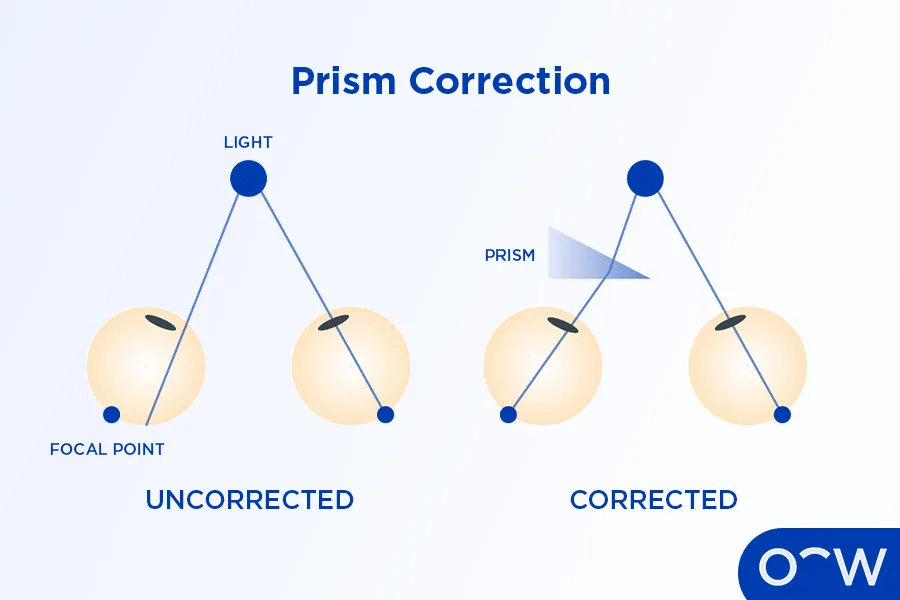
Prism glasses and vision therapy are both offered for binocular vision problems, and they are often talked about as if they were two versions of the same treatment. They are not.
Here is the short version. Prism changes what the eyes are asked to do. Vision therapy tries to change what the eyes are able to do. Sometimes one is clearly the better fit, sometimes both have a role, and which one is right depends entirely on the diagnosis. Below is what each treatment does, what the published trials found about each — including the results that are less flattering — and how we think about the choice.
Key takeaways
- Prism bends light before it reaches the eye so there is less misalignment for the eyes to overcome (Cossack & Salini, StatPearls, 2023). It compensates; it does not retrain.
- Office-based vergence and accommodative therapy is the best-evidenced treatment for symptomatic convergence insufficiency in children (CITT, 2008; Cochrane review, 2020).
- Base-in reading prism did not beat placebo glasses in children with convergence insufficiency (Scheiman et al., 2005), but it did beat placebo in presbyopic adults (Teitelbaum et al., 2009). The prism evidence is age-dependent.
- Vertical prism is the usual first choice for a vertical deviation (AOA guideline, 2010), but the widely quoted results for prism programs marketed as treatment for binocular vision dysfunction come from uncontrolled retrospective case series.
- Neither treatment has been shown to raise reading-comprehension scores. The largest and best-designed trial of therapy for convergence insufficiency found no reading benefit over placebo (CITT-ART, 2019). The one prism finding that touches reading is on a reading-speed test, not a measure of reading achievement (O’Leary & Evans, 2006).
What prism glasses are designed to do
A prism is a wedge of lens material that bends light before it reaches the eye. If the two eyes are not pointing at exactly the same place, a correctly oriented prism moves the image to where the eye is already aimed, so the fusion system has less work to do. Clinical references list ocular misalignment, convergence insufficiency, nystagmus and hemianopia among the conditions treated with prism, and note that base-in prism makes convergence easier (Cossack & Salini, StatPearls, 2023).
That is why prism can relieve symptoms quickly. If someone is uncomfortable because their eyes are fighting to hold alignment, reducing that fight can help within minutes, and for double vision it is sometimes the only practical answer. But it is compensation, not rehabilitation. Take the glasses off and the underlying finding is unchanged.
Prism also has a limitation patients rarely hear about: the visual system adapts. The AOA’s clinical guideline on accommodative and vergence dysfunction states that adaptation to prismatic correction limits its effectiveness, that most of the resulting change in fusional amplitudes occurs within the first 15 minutes of wearing the prism, and that when prism adaptation occurs, prism therapy is contraindicated because the prism will not permanently neutralize the deviation (AOA, 2010). That is a large part of why prism needs to be trialed and re-checked rather than simply prescribed.
How we measure and trial it is covered on our prism lenses page.
What vision therapy is designed to do
Vision therapy is a supervised, progressive program of sensory and motor activities aimed at changing how the eyes and brain work together — convergence, focusing, eye movements, binocular stability, suppression control and visual stamina. It is measured against clinical signs, not against how a new pair of glasses feels on day one.
For symptomatic convergence insufficiency in children, this is one of the better-evidenced treatments in eye care. In the 221-child Convergence Insufficiency Treatment Trial, 73% of children were successful or improved after 12 weeks of office-based vergence and accommodative therapy with home reinforcement, compared with 35% who received office-based placebo therapy, 43% with home pencil push-ups and 33% with a home computer program (CITT, 2008). Among children who became asymptomatic, 84.4% of the office-therapy group were still asymptomatic a year later (CITT, 2009). A Cochrane network meta-analysis of 12 trials and 1,289 participants reached the same conclusion for children (risk ratio 3.04 versus placebo) and found the adult evidence less clear (Scheiman et al., 2020).
Focusing problems travel with it. Three-quarters of the children in CITT also had an accommodative dysfunction, and accommodative amplitude improved by 9.9 diopters with office-based therapy versus 2.2 diopters with placebo (Scheiman et al., 2011).

We also say plainly what therapy has not been shown to do. In CITT-ART, 311 children were treated for 16 weeks: near point of convergence improved 10.4 cm with therapy versus 6.2 cm with placebo and fusional vergence 23.2 versus 8.8 prism diopters, but symptom scores improved about the same in both groups (CITT-ART, 2019). In the companion reading paper, reading comprehension improved 3.7 points with therapy versus 3.8 with placebo (CITT-ART, 2019). Vision therapy for convergence insufficiency is not a reading intervention, and we do not sell it as one — we set the wider picture out in does vision therapy actually work.
How these approaches differ
Prism shifts the visual demand. Vision therapy tries to build visual ability. That does not make prism a lesser option, only a different one: prism acts on the optics in front of the eye, therapy on the control system behind it. The AOA guideline lists vision therapy, prism and lens therapy together as legitimate management options for accommodative and vergence dysfunction, matched to the diagnosis — it calls vision therapy the treatment of choice for convergence insufficiency, and vertical prism the usual treatment of choice for a vertical deviation (AOA, 2010).
What the evidence says about prism, specifically
In children with convergence insufficiency, prism did not beat placebo
Seventy-two children aged 9 to 17 with symptomatic convergence insufficiency were randomly assigned to base-in prism reading glasses or identical-looking placebo glasses. Symptom scores fell in both groups — 31.6 to 16.5 with prism, 28.4 to 17.5 without — with no significant difference on any measure (Scheiman et al., 2005). The AOA guideline draws the blunt conclusion: the trial demonstrates the potentially powerful placebo effect of prescribing any eyeglasses to children in this age range.
In presbyopic adults, prism did help
The picture flips with age. In a randomized crossover trial, 29 symptomatic presbyopes aged 45 to 68 wore base-in prism progressives and placebo progressives for three weeks each; mean symptom score fell from 30.21 to 13.38 with prism versus 23.62 without (Teitelbaum et al., 2009).
Aligning prism can change reading rate — in the right patient
A double-masked, randomized trial recruited 80 patients who each had a measurable aligning prism on the near Mallett unit, then compared each patient’s reading rate wearing that aligning prism against the same patient’s rate wearing a control lens. In exophoric patients, an aligning prism of 2 prism diopters or more predicted a 5% or greater gain in reading rate with 67% sensitivity and 79% specificity — and symptoms did not predict who would benefit (O’Leary & Evans, 2006). Two caveats belong with that result: the test used measures reading speed, not comprehension or reading achievement, and the group mixed exophoria, esophoria and vertical phoria. It is still an argument for measuring rather than guessing.
Vertical prism and binocular vision dysfunction: what the evidence actually supports
For a genuine vertical deviation the AOA guideline is direct: vertical prism is the usual treatment of choice, though vision therapy can also be effective and may suit patients whose deviation differs at distance and near, who want contact lenses, or who adapt to prism (AOA, 2010).
The frequently quoted figures for “binocular vision dysfunction” prism programs are a different matter. They come from retrospective, uncontrolled series published by the one private practice that developed both the treatment approach and the questionnaire used to measure it: a 71.8% drop in subjective symptom burden in 43 patients with traumatic brain injury (Doble et al., 2010), and reductions of 19.1% to 60.8% on headache, dizziness and anxiety measures in 38 post-concussion patients (Rosner et al., 2016). There is no control group and no masking, and we are not aware of independent replication. We take small vertical misalignments seriously and measure them carefully — see our page on vertical heterophoria — but by the usual standards for grading evidence, retrospective uncontrolled series sit near the bottom.
When a prism may be considered
Prism may be considered when a patient has:
- double vision that needs to stop now
- a small to moderate comitant deviation, especially a vertical one
- decompensated binocular symptoms in an adult with a long-standing finding
- a measurable aligning prism on associated-phoria testing
- persistent visual discomfort where reducing the demand is the realistic goal
- limited capacity for a therapy program because of time, cost or cognitive load — a situation the AOA guideline addresses directly, noting prism may then be the only viable treatment for convergence insufficiency, but should be used with caution (AOA, 2010)
One detail from that guideline explains why we trial prism rather than assume it. In a study of prism prescribed to eliminate fixation disparity, 73% of symptomatic exophoric patients and 90% of symptomatic esophoric patients preferred the prism glasses, but 86% of asymptomatic patients rejected them (AOA, 2010). Prism helps systems that are struggling and bothers systems that are not.

When therapy may be considered
Vision therapy may be considered when the goal is to change the underlying function rather than only support it optically. The first two situations below rest on randomized trials; the rest describe how we use therapy in clinical practice, where the published evidence is thinner. In practice that often means patients with:
- symptomatic convergence insufficiency — the diagnosis with the strongest trial support (Cochrane review, 2020)
- accommodative dysfunction, frequently alongside convergence insufficiency (Scheiman et al., 2011)
- ocular motor and eye-tracking problems
- binocular instability or intermittent suppression
- visual discomfort with sustained reading or screen work
- selected amblyopia- and strabismus-related functional deficits, depending on the case
Adults deserve a separate note. In a randomized trial of 46 adults aged 19 to 30 with convergence insufficiency, only the office-based therapy group changed the clinical signs — near point of convergence from 12.8 cm to 5.3 cm, fusional vergence from 11.3 to 29.7 prism diopters — yet symptom elimination was reached by 42% with therapy versus 31% with placebo, and more than half of treated patients remained symptomatic (Scheiman et al., 2005). Adults improve, but the published effect is smaller and less certain than in children, and we say so before anyone starts. Our vision therapy page explains how a program is structured and reviewed.
Our own perspective sits here. In children, many binocular findings belong to a still-developing system, and the one placebo-controlled trial of reading prism in that group was negative while therapy beat placebo. So we usually prefer to treat the dysfunction in a child rather than compensate for it, unless a specific finding makes prism clearly the better choice. That is our clinical judgment, offered as such, not a research conclusion.
Can a patient use both?
Yes, and often the sequence matters more than the choice.
Prism can carry a patient through the first uncomfortable weeks while therapy does the slower work, confirm diagnostically that a small deviation really is driving the symptoms, or finish off a residual deviation that therapy has reduced but not resolved. The AOA guideline describes this combination for patients after head injury, where prism or surgery may be needed to supplement vision therapy (AOA, 2010).
So the useful question is not “prism or therapy?” It is: what is the diagnosis, what is the goal, and which tool matches that goal today?
Why the evaluation comes first
Two patients can arrive with the same complaint — headaches, reading discomfort, words that slide — and have entirely different findings: convergence insufficiency, an accommodative problem, a small vertical deviation, or an eye-movement problem with normal teaming. Those are four different treatment decisions, and only one of them is likely to respond well to a prism.
Standard vision screening is not designed to sort them out. The AOA’s pediatric examination guideline reports that acuity testing alone missed 75.5% of children who were later found to have binocular and oculomotor problems on a complete examination (AOA, 2017). Passing the eye chart says very little about how the two eyes hold up over 40 minutes of homework. For a fuller explanation of the tests involved, see our guide to convergence insufficiency.

Prism glasses and vision therapy are both real tools with real evidence behind them, and that evidence points in different directions depending on age, diagnosis and goal. Prism reduces the workload; therapy tries to raise the capacity. Neither can be chosen sensibly from a symptom list alone.
If reading, screen work or driving has become uncomfortable — for you or for your child — the first step is a comprehensive developmental vision evaluation that measures alignment, convergence, focusing and eye movements together. Schedule an evaluation or see what our examinations include.
Common Questions About This Topic
Are prism glasses and vision therapy the same thing?
No. Prism is an optical treatment that bends light before it reaches the eye, so the eyes have less misalignment to overcome. Vision therapy is a supervised program of neurosensory and neuromuscular activities intended to change how the eyes and brain work together. One shifts the demand; the other aims to build the ability.
Do prism glasses fix the problem?
Prism compensates; it does not retrain. Sometimes that is exactly what a patient needs, and sometimes it is a bridge. Two limits are worth knowing. In a randomized trial of 72 children with symptomatic convergence insufficiency, base-in reading prism was no better than placebo reading glasses. And the AOA guideline notes that many patients adapt to a prism over time, which can blunt its effect. Whether prism is the right long-term answer is a clinical judgment made after a full binocular evaluation.
Is vision therapy better than prism glasses?
Not automatically - they do different jobs. For symptomatic convergence insufficiency in children, office-based vergence and accommodative therapy has by far the strongest randomized evidence, including a Cochrane network meta-analysis. For a vertical deviation, the AOA guideline calls vertical prism the usual treatment of choice. For an adult who mainly needs double vision to stop today, prism can act faster than any therapy program.
Why are you more cautious with prism in children?
Partly evidence and partly philosophy. The one placebo-controlled trial of base-in reading prism in children with convergence insufficiency was negative, while office-based therapy beat placebo in the same population. At Vision & Learning Center we therefore usually prefer to treat the underlying dysfunction in a growing visual system rather than compensate for it, unless a specific finding makes prism the better choice.
Are prism glasses more reasonable for adults?
Often, yes. Base-in prism progressive lenses did outperform placebo progressives in a crossover trial of symptomatic presbyopes aged 45 to 68. The AOA guideline also notes that prism may be the only viable option for a patient who cannot commit to a therapy program because of time, cost or cognitive limits. The right answer still depends on the diagnosis, not on age alone.
Where This Information Comes From
- Cossack M, Salini B (2023). Prism Glasses. StatPearls. Treasure Island (FL): StatPearls Publishing. : Clinical reference: prism lenses are used for ocular misalignment, convergence insufficiency, nystagmus and hemianopia; base-in prism makes convergence easier.
- American Optometric Association; Cooper JS (principal author) (2010). Care of the Patient with Accommodative and Vergence Dysfunction. Optometric Clinical Practice Guideline. St. Louis: AOA (approved 1998, revised December 2010). : Guideline calls vision therapy the treatment of choice for convergence insufficiency and vertical prism the usual treatment of choice for vertical deviation, and warns that prism adaptation limits prism therapy.
- Scheiman M, Cotter S, Rouse M, Mitchell GL, Kulp M, Cooper J, Borsting E; CITT Study Group (2005). Randomised clinical trial of the effectiveness of base-in prism reading glasses versus placebo reading glasses for symptomatic convergence insufficiency in children. British Journal of Ophthalmology; 89(10):1318-1323. : In 72 children, base-in prism reading glasses were no better than placebo glasses on symptoms, near point of convergence or fusional vergence.
- Teitelbaum B, Pang Y, Krall J (2009). Effectiveness of base in prism for presbyopes with convergence insufficiency. Optometry and Vision Science; 86(2):153-156. : In 29 presbyopes aged 45-68, mean symptom score fell from 30.21 to 13.38 with base-in prism progressives versus 23.62 with placebo progressives.
- O'Leary CI, Evans BJW (2006). Double-masked randomised placebo-controlled trial of the effect of prismatic corrections on rate of reading and the relationship with symptoms. Ophthalmic and Physiological Optics; 26(6):555-565. : In 80 patients, an aligning prism of 2 prism diopters or more in exophoria predicted a 5% or greater gain on a reading-speed test with 67% sensitivity and 79% specificity; symptoms did not predict who benefited.
- Convergence Insufficiency Treatment Trial Study Group (2008). Randomized clinical trial of treatments for symptomatic convergence insufficiency in children. Archives of Ophthalmology; 126(10):1336-1349. : In 221 children, 73% were successful or improved after 12 weeks of office-based vergence/accommodative therapy versus 35% with office placebo therapy.
- Convergence Insufficiency Treatment Trial Study Group (2009). Long-term effectiveness of treatments for symptomatic convergence insufficiency in children. Optometry and Vision Science; 86(9):1096-1103. : Among children who became asymptomatic, 84.4% of the office-therapy group were still asymptomatic one year later.
- Scheiman M, Kulp MT, Cotter SA, Lawrenson JG, Wang L, Li T (2020). Interventions for convergence insufficiency: a network meta-analysis. Cochrane Database of Systematic Reviews; 12:CD006768. : Across 12 trials and 1289 participants, office-based therapy with home reinforcement beat placebo in children (RR 3.04); adult evidence is less clear.
- CITT-ART Investigator Group (2019). Treatment of Symptomatic Convergence Insufficiency in Children Enrolled in the Convergence Insufficiency Treatment Trial-Attention & Reading Trial. Optometry and Vision Science; 96(11):825-835. : Clinical signs improved far more with therapy than placebo, but symptom scores improved similarly in both groups.
- CITT-ART Investigator Group (2019). Effect of Vergence/Accommodative Therapy on Reading in Children with Convergence Insufficiency. Optometry and Vision Science; 96(11):836-849. : Reading comprehension improved 3.7 points with therapy versus 3.8 with placebo - no reading benefit.
- Scheiman M, Cotter S, Kulp MT, et al.; CITT Study Group (2011). Treatment of accommodative dysfunction in children: results from a randomized clinical trial. Optometry and Vision Science; 88(11):1343-1352. : 74% of children with symptomatic CI also had accommodative dysfunction; amplitude rose 9.9 D with office therapy versus 2.2 D with placebo.
- Scheiman M, Mitchell GL, Cotter S, et al. (2005). A randomized clinical trial of vision therapy/orthoptics versus pencil pushups for the treatment of convergence insufficiency in young adults. Optometry and Vision Science; 82(7):583-595. : In 46 adults, only office-based therapy changed the clinical signs, but 42% reached symptom elimination versus 31% with placebo.
- Doble JE, Feinberg DL, Rosner MS, Rosner AJ (2010). Identification of binocular vision dysfunction (vertical heterophoria) in traumatic brain injury patients and effects of individualized prismatic spectacle lenses. PM&R; 2(4):244-253. : Retrospective uncontrolled series of 43 TBI patients: 71.8% fall in subjective symptom burden after individualized prism.
- Rosner MS, Feinberg DL, Doble JE, Rosner AJ (2016). Treatment of vertical heterophoria ameliorates persistent post-concussive symptoms. Brain Injury; 30(3):311-317. : Retrospective series of 38 patients: 19.1-60.8% reductions on headache, dizziness and anxiety measures after prism; no control group.
- American Optometric Association (2017). Evidence-Based Clinical Practice Guideline: Comprehensive Pediatric Eye and Vision Examination. St. Louis: AOA. : The guideline reports that Snellen acuity screening alone missed 75.5% of children later found to have binocular and oculomotor problems on a full examination.
Care We Provide
More From the Blog
Wondering If This Sounds Like Your Family?
A developmental vision evaluation measures the skills a routine eye exam does not. Our team sees children and adults in Coconut Creek, Boynton Beach, Boca Raton and West Palm Beach.