Does Insurance Cover Vision Therapy? An Honest Answer
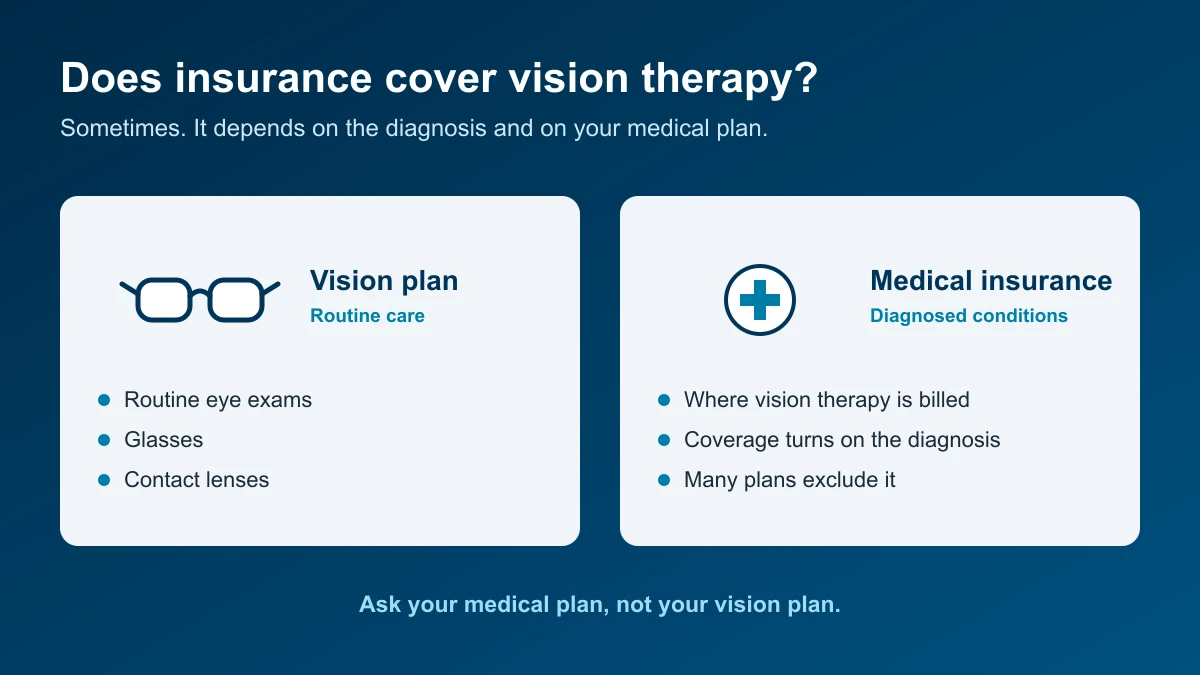
Parents usually ask this before they ask anything else, and they deserve a straight answer: sometimes, and often not. Whether insurance covers vision therapy depends on your child’s diagnosis and on the wording of your particular plan. Two families with the same insurer can get two different answers.
This post explains why, what to ask your insurer before you start, and how payment works at our offices.
Key takeaways
- When vision therapy is covered at all, it is usually through medical insurance, not a vision plan.
- Coverage turns on the diagnosis and the plan’s exclusions. Convergence insufficiency has the strongest research behind it (CITT, 2008; Scheiman et al., 2020). Many plans exclude therapy they class as “educationally related.”
- Vision & Learning Center is out-of-network. You pay at the time of service, and we give you the paperwork to ask your plan for reimbursement.
- Some families are reimbursed. Many are not. Plan around the fee, not around a check that may never arrive.
- HSA and FSA funds, payment plans, CareCredit and Florida’s FES-UA scholarship are other ways families pay.
Vision plan or medical insurance?
Most families carry two different kinds of coverage and think of them as one.
A vision plan is generally built around routine care: a yearly eye exam and an allowance toward glasses or contact lenses. It is not designed to pay for treatment of a medical condition.
Medical insurance is the plan that pays for diagnosing and treating health conditions. Vision therapy for a diagnosed problem, such as an eye teaming or focusing disorder, is a medical service. If any plan is going to pay toward it, this is the one. Any claim for therapy goes to your medical insurer.
So the vision card in your wallet usually does not answer the question. The benefits booklet for your medical plan does.
Why the diagnosis matters
Insurers do not cover “vision therapy” in general. They cover, or decline to cover, a specific treatment for a specific diagnosis.
The diagnosis with the best research support is convergence insufficiency, a condition in which the eyes struggle to turn in and stay aimed together up close. In a randomized trial of 221 children, 73% of those given office-based therapy with home reinforcement were successful or improved after 12 weeks, compared with 35% of those given a placebo therapy (CITT, 2008). A Cochrane review of 12 trials reached the same conclusion for children (Scheiman et al., 2020). Plans that cover vision therapy at all are most likely to cover it for this diagnosis. Our guide to convergence insufficiency explains the condition.
For other diagnoses the picture is less favorable. In our experience, not many insurance companies cover the cost of vision therapy, and most exclude it as “educationally related,” even when the diagnosis is a medical one. If your plan document excludes therapy for learning problems, a claim tied to schoolwork is likely to be denied.
One thing we will not do is change a diagnosis to fit a policy. The diagnosis and the codes on your paperwork describe what we found at the evaluation, nothing more. If the accurate diagnosis is one your plan excludes, the honest result is a denial.
What “out-of-network” means
An in-network provider has a contract with your insurer and bills the insurer directly. An out-of-network provider has no contract. You pay the provider, then ask your plan to pay you back.
Not every plan has out-of-network benefits. Some pay nothing outside their network. Plans that do pay usually apply a separate out-of-network deductible first, then pay a percentage of what they call the “allowed amount,” which can be lower than the fee you paid. HealthCare.gov notes that out-of-network coinsurance usually costs you more than in-network coinsurance.
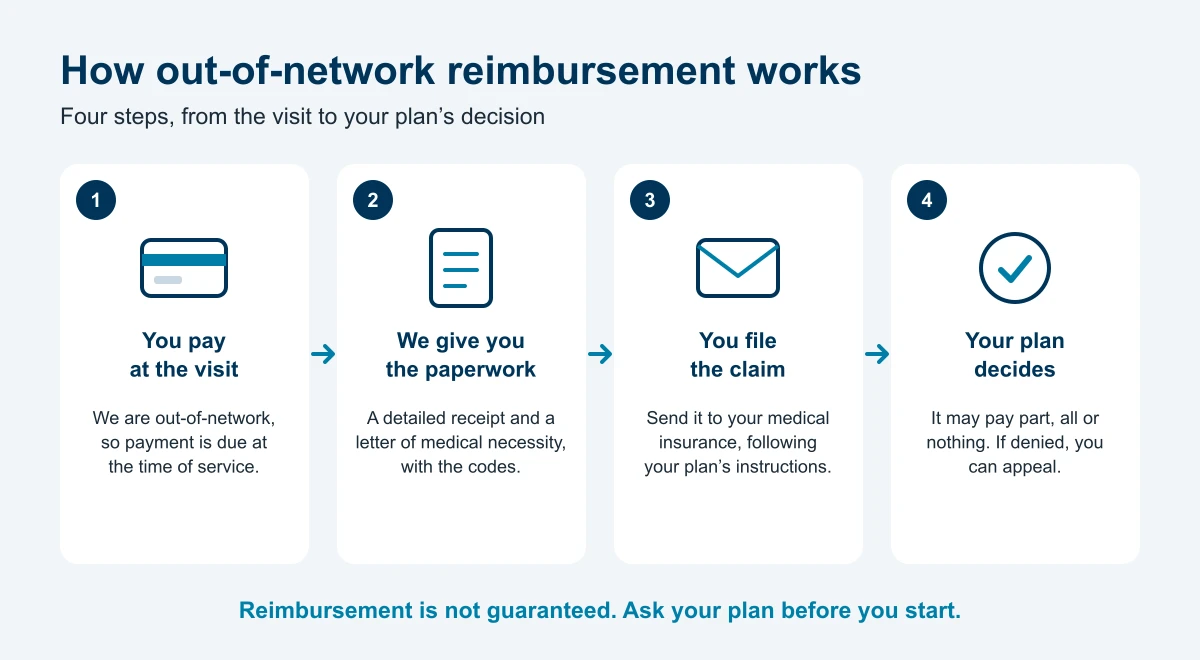
Reimbursement generally works in four steps:
- You pay the practice at the time of the visit.
- The practice gives you an itemized receipt, often called a superbill, with the diagnosis and procedure codes.
- You submit it to your plan, usually with the plan’s own claim form.
- Your plan processes the claim and pays you whatever your out-of-network benefits allow, if anything.
What to ask your insurer
Call the member services number on your medical insurance card before you start therapy. Write down the date, the name of the person you spoke with and a reference number for the call.
- Is orthoptic or vision therapy a covered benefit under my plan?
- Do I have out-of-network benefits for optometric services?
- Which diagnoses qualify, and are there exclusions for learning-related or developmental conditions?
- Is pre-authorization required before therapy begins?
- What is my out-of-network deductible and coinsurance, and how much of the deductible have I met this year?
- How is reimbursement calculated? What is the allowed amount?
- Is there a limit on the number of visits, or a dollar cap?
- What documentation do you need with the claim?
Ask for the answers in writing if you can. What a representative tells you on the phone is not a guarantee of payment. The claim decision is made later, against the plan document.
HSA and FSA funds
A Health Savings Account or a Flexible Spending Account lets you set money aside before tax for medical expenses. Many families use one for vision therapy.
IRS Publication 502 defines medical expenses as the costs of diagnosis, cure, mitigation, treatment or prevention of disease. Its list includes eye examinations and therapy received as medical treatment. Vision therapy generally qualifies as a medically necessary service, but your plan administrator makes the decision and may ask for documentation. Check your plan rules before you count on it.
If you have an FSA through an employer, look at the yearly election deadline. It can be worth timing an evaluation so you know what to set aside for the following year.
Payment plans, medical credit and scholarships
Insurance is not the only way to make therapy affordable.
- Payment plans. Many practices spread the cost of a program over monthly payments.
- Medical credit. Healthcare credit cards such as CareCredit offer promotional financing. The terms are set by the lender, and promotional offers can charge interest back to the purchase date if the balance is not paid in time. Read them carefully.
- Florida’s FES-UA scholarship. The Family Empowerment Scholarship for Students with Unique Abilities is administered through Step Up For Students. It is an Education Savings Account for Florida residents aged 3 to 22, or through grade 12, who have a qualifying diagnosis, and families can spend it on approved expenses that include therapists and specialists (Step Up For Students). Eligibility is decided by the program, not by us. If your child already has the scholarship, ask whether your provider accepts it.
If your claim is denied
A denial is common, and it is not always the last word.
Start with the denial letter or the Explanation of Benefits. It should state the reason. A denial for missing paperwork is a different problem from a denial under a plan exclusion.
You have the right to an internal appeal, and after that to an external review by an independent third party (HealthCare.gov). HealthCare.gov says an internal appeal must be filed within 180 days of receiving the denial notice. Check your own letter for the deadline and the address to use.
Send the appeal with a letter of medical necessity from the doctor. That letter states the diagnosis, the findings that support it, the treatment recommended and why it is needed. Include the evaluation report, and keep copies of everything you send.
Be realistic about the outcome. If the plan document excludes the service outright, an appeal may not change the answer. Some families do everything right and are still not reimbursed.
How it works at Vision & Learning Center
Here is exactly what to expect from us.
We are out-of-network. We are not a participating provider on any plan. Payment is due at the time of service, and we do not bill your insurer for you.
We give you the paperwork. For vision therapy you receive a detailed receipt and a letter of medical necessity with all procedure and diagnosis codes, so you can file a claim with your medical insurance. If a medical diagnosis is found at the evaluation, we provide those codes for you to submit.
We cannot promise reimbursement. Your plan decides what it pays, if anything, and we cannot quote an amount in advance. Families who are reimbursed are the exception rather than the rule. Our insurance information page explains our position in full.
The fees are published. The Developmental Vision Evaluation is $550 and takes about 100 minutes. Vision therapy sessions are $110 to $200. Programs for binocular vision and visual processing problems usually run about 18 to 24 weeks, and programs for amblyopia, strabismus and brain injury often take longer. Most patients come for one 45-minute session or two 30-minute sessions a week. Every plan is individual, so we do not quote a program before we have examined your child. See cost and price for all evaluation fees.
There are several ways to pay. We accept HSA and FSA cards, CareCredit and structured payment plans, and families who pay in full receive a 5–10% discount on the therapy session portion. For eligible families we accept Florida’s FES-UA scholarship through Step Up For Students. The details are on our payment options page.
You hear the cost before anything starts. At the evaluation we explain what we found, what we recommend, what it costs and which payment routes fit your family. You decide after that.
Where to start
Do not let the insurance question decide whether your child is examined. The evaluation is what tells you whether there is a diagnosis at all, and without one there is nothing for a plan to cover or deny.
For more on price, read how much vision therapy costs and what changes the price and what a developmental vision evaluation costs. On why coverage is so uneven in the first place, see the case for expanding access to vision therapy. Our vision therapy and examinations pages describe the care itself.
Therapy is provided at our Coconut Creek, Boynton Beach, Boca Raton and West Palm Beach offices. Evaluations are scheduled at Boynton Beach and Boca Raton. Call (561) 462-1245, send us a message, or schedule an evaluation online.
Common Questions About This Topic
Does insurance cover vision therapy?
Sometimes, and often not. When it is covered, it is usually through medical insurance rather than a vision plan, and the decision depends on the diagnosis and the wording of your plan. In our experience most plans exclude it, so call your insurer before you start and plan around the fee rather than around a reimbursement.
Is vision therapy billed to my vision plan or my medical insurance?
Medical insurance. Vision plans are generally built around a routine eye exam and an allowance toward glasses or contact lenses. Therapy for a diagnosed condition such as convergence insufficiency is a medical service, so any claim goes to your medical plan.
How much does vision therapy cost without insurance?
At Vision & Learning Center, the Developmental Vision Evaluation is $550 and therapy sessions are $110 to $200 each. Programs for binocular vision and visual processing problems usually run about 18 to 24 weeks, with one 45-minute or two 30-minute office sessions a week. Every plan is individual, and we explain the cost at the evaluation before anything starts.
Can I use an HSA or FSA for vision therapy?
Many families do. IRS Publication 502 lists eye examinations and therapy received as medical treatment among medical expenses, and vision therapy generally qualifies as a medically necessary service. Your plan administrator makes the final call and may ask for documentation, so check your plan rules first.
What can I do if my insurer denies the claim?
Read the denial letter for the stated reason, then file an internal appeal with the letter of medical necessity and the evaluation findings. HealthCare.gov says an internal appeal must be filed within 180 days of the denial notice, and that you can then ask for an independent external review. An appeal is worth making, but it can still end in a no.
Where This Information Comes From
- Convergence Insufficiency Treatment Trial Study Group (2008). Randomized clinical trial of treatments for symptomatic convergence insufficiency in children. Archives of Ophthalmology; 126(10):1336-1349. : In 221 children aged 9-17, 73% were successful or improved after 12 weeks of office-based vergence and accommodative therapy versus 35% with office placebo.
- Scheiman M, Kulp MT, Cotter SA, Lawrenson JG, Wang L, Li T (2020). Interventions for convergence insufficiency: a network meta-analysis. Cochrane Database of Systematic Reviews; 12:CD006768. : Across 12 trials and 1,289 participants, office-based therapy with home reinforcement beat placebo in children (RR 3.04); outcomes were symptoms and clinical signs, not academic performance, and adult evidence is less clear.
- Internal Revenue Service. Publication 502 (2025), Medical and Dental Expenses. : Defines medical expenses as the costs of diagnosis, cure, mitigation, treatment, or prevention of disease, and lists eye examinations and therapy received as medical treatment among the expenses that can be included.
- HealthCare.gov. Out-of-network coinsurance (glossary). : Defines out-of-network coinsurance as the percentage you pay of the allowed amount for covered services from providers who do not contract with your plan, and notes it usually costs more than in-network coinsurance.
- HealthCare.gov. Internal appeals. : States that an internal appeal must be filed within 180 days of receiving notice that a claim was denied, and lists the records to keep, including the Explanation of Benefits.
- HealthCare.gov. How to appeal an insurance company decision. : Describes the right to an internal appeal and to an external review by an independent third party.
- Step Up For Students. Unique Abilities (Family Empowerment Scholarship for Students with Unique Abilities). : Describes FES-UA as an Education Savings Account for Florida residents aged 3 to 22 (or through grade 12) with a qualifying diagnosis, usable for expenses that include therapists and specialists.
Care We Provide
More From the Blog
Wondering If This Sounds Like Your Family?
A developmental vision evaluation measures the skills a routine eye exam does not. Our team sees children and adults in Coconut Creek, Boynton Beach, Boca Raton and West Palm Beach.