One Set of Skills. Three Levels of Care.
Recovering after a concussion, reading without a fight, and reacting a fraction faster than the person opposite you are not three different fields. They are the same visual skills, measured against three different targets.
Almost everyone who walks into our offices arrives convinced they are an unusual case. The parent whose child is bright but cannot get through a page. The adult who has not felt right since a car accident. The athlete who is doing everything in training and still reacting late.
They are all being limited by the same short list of visual skills. What separates them is not which skills are involved — it is where those skills are starting from, and how high they need to go.
That is the whole idea behind how we organize care. Rehabilitation restores skills to functional. Vision therapy builds them to optimal for everyday life. Sports vision refines them to the highest level a person can reach.
Rehabilitation — Getting Back to Functional
Starting point: skills that used to work have been disrupted.
After a concussion, a traumatic brain injury or a stroke, the visual system often stops doing quietly what it used to do automatically. Reading a screen brings on a headache. A busy supermarket aisle is overwhelming. Turning the head makes the room lag behind. Nothing about the eyes themselves has necessarily changed — the coordination has.
The goal at this level is not performance. It is function: getting a person back to work, back to school, back to driving, back to a normal evening without paying for it the next day. Sessions are often short and carefully limited, because at this level effort itself can provoke symptoms. Progress is measured in tolerance — how long an activity can be sustained before the system gives out.
This is also the level with the clearest medical context. Care is usually co-managed with whoever is already treating the injury, and we report back to them.
Concussion & TBI rehabilitation → What post-concussion vision problems look like → Vision rehabilitation →

Vision Therapy — Building to Optimal for Everyday Life
Starting point: skills that never developed efficiently.
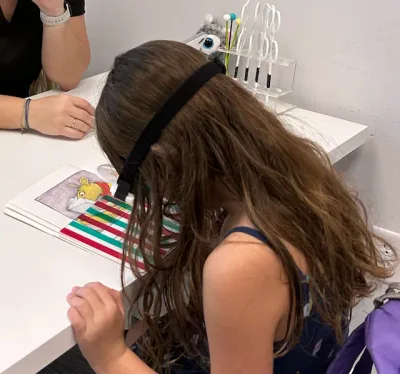
This is most of what we do, and most of it is children. Nothing has been lost, because the skill was never comfortable in the first place. The eyes can see the letters — the system just cannot hold the work steady long enough to make reading feel easy. So the child compensates: reads slowly, loses the place, skips lines, avoids homework, or gets through the page and remembers nothing.
The goal here is not to reach a bare minimum. It is optimal for the demands of an ordinary life — a full school day, a chapter book, a spreadsheet, a driving test, an evening of screens — done comfortably and without a cost that shows up later as a headache or a meltdown.
Adults belong at this level too, and often arrive convinced it is too late. It is not. The demands are simply different: a workday of screens rather than a school day of print.
Vision therapy → Learning-related vision → Take the symptom checklist →
Sports Vision — Refining to the Highest Level
Starting point: skills that already work well.
An athlete arriving for performance work usually has nothing wrong. They pass every standard test, and they should — they are often better than average before we start. That is exactly what makes this level different. There is no deficit to correct, so the work is not restorative at all. It is refinement.
At this level the margins are small and the conditions are hard: decisions made in fractions of a second, under fatigue, under pressure, while moving. Training targets speed and accuracy rather than mere capability — how fast the eyes acquire a target, how reliably the system holds up in the fourth quarter, how well vision and body stay coordinated when both are tired.
We are careful about what we claim here. The evidence base for sports vision training is genuinely thinner than for a condition like convergence insufficiency, and we would rather say so than sell certainty we do not have.
The Skills Behind All Three
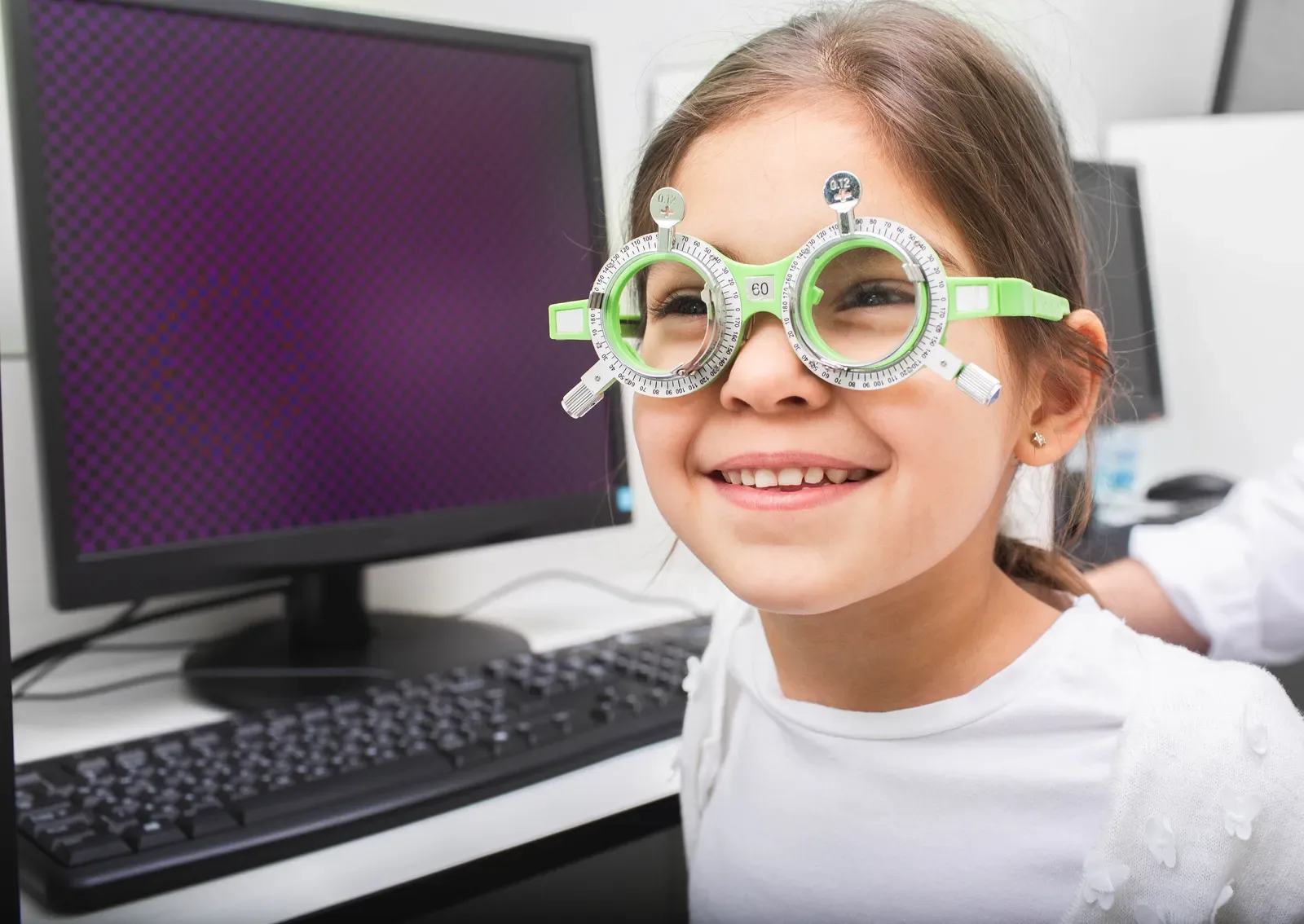
Every level trains the same short list. Only the target moves.
Eye teaming
Both eyes pointing at the same place at the same time, and holding it. When this slips, print doubles, blurs or swims.
Focusing
Changing focus between distances and sustaining it. When this tires, reading gets harder the longer it goes on.
Tracking
Moving the eyes accurately along a line, between words, or onto a moving object. Weak tracking loses your place — or the ball.
Visual processing
Making sense of what the eyes deliver: direction, sequence, memory, and how quickly a decision follows.
Visual-motor integration
Turning what you see into what your hands and body do — handwriting, catching, balance, knowing where you are in a space.
Visual-vestibular integration
Vision working with the balance system. When these disagree, the result is dizziness, motion sensitivity, or feeling off in busy places.
You Do Not Have to Know Which Level You Are In
People sort themselves into the wrong level all the time. Athletes come in for performance work and turn out to have had an eye-teaming problem since childhood. Someone recovering from a concussion assumes they will never be more than functional again, and finishes the restorative work with room to keep going. Parents book a reading evaluation and mention, in passing, a head injury from two years ago that nobody connected to anything.
That is what the evaluation is for. We measure the same skills for everyone, then compare the results against what you actually need to do — which is why the same number can be unremarkable for one person and the whole problem for another.
About the Three Levels
Is it really the same therapy at every level?
The underlying skills are the same, and many of the activities look similar from the outside. What differs is the starting point, the target, and the pace. A person recovering from a concussion is often working in short, carefully limited sessions because effort itself provokes symptoms. An athlete is working at speed, under load, against a clock. Calling both "vision therapy" is accurate but not very informative — which is why we describe them as different levels.
Can someone move between levels?
Yes, and it is common. Someone who comes in after a concussion may finish the restorative work and then decide to keep going, because the skills that carried them through daily life comfortably are not yet the skills they want back on the field. The reverse happens too: an athlete being assessed for performance sometimes turns out to have a longstanding eye-teaming problem that was never diagnosed.
How do you know which level someone belongs in?
The evaluation, not the presenting story. We measure the same visual skills for everyone, then compare the results against what that person actually needs to do. The same measurement can be a red flag for a student and unremarkable for a retiree, or perfectly normal for most people and a real limitation for a hitter facing a fastball.
Does insurance treat these levels differently?
Often, yes. Care that follows a medical event such as a concussion is sometimes handled differently from care aimed at reading comfort or athletic performance. Coverage varies by plan and we cannot promise what yours will do, so we go through it with you before a program starts rather than after.
More on Whether It Is Right for You
Who vision therapy suits, who it does not, and how it differs from the other options families are weighing.
- Start hereWho Is a Good Fit for Vision Therapy?Which symptoms and exam findings point toward vision therapy, where the research support is strongest for…
- When Vision Therapy Is Not Recommended (At Least Not Yet)Vision therapy is not the right next step for everyone. What the research says about dyslexia, reading…
- Prism Glasses vs Vision Therapy: What Is the Difference?Prism shifts the visual demand; vision therapy builds visual ability. What the trials actually found about…
- Vision Therapy vs Occupational Therapy: The DifferenceVision therapy and occupational therapy overlap on handwriting and coordination but solve different problems.…
- Vision Therapy vs Tutoring: Which Problem Does Each Solve?Tutoring builds reading and math skills. Vision therapy treats how the eyes work. What the research shows…
- Comprehensive vs Developmental Eye Exam: The DifferenceA comprehensive eye exam checks sight and eye health. A developmental vision evaluation measures how the eyes…
Start With an Evaluation
Whichever level you belong in, the first step is the same: measure the skills, then compare them against your life. We see children and adults in Coconut Creek, Boynton Beach, Boca Raton and West Palm Beach.