Double Vision (Diplopia)
Seeing two of one thing can come from a single eye or from the two eyes not working together — and that difference decides the treatment.
Watch: a short video
Double vision: urgent or eye teaming?
What to Know About Double Vision (Diplopia)
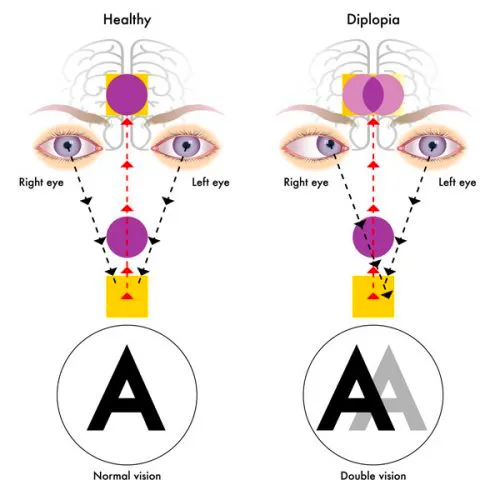
Double vision — diplopia — is a vision disorder in which a person perceives two images of a single object. It can happen with one eye (monocular diplopia) or with both eyes open (binocular diplopia). Sorting out which one you have is the first job of an evaluation, because the two have different causes and different treatments.
Sudden, new, or persistent double vision should always be evaluated promptly to rule out medical causes. Once anything urgent has been addressed, the next question is whether the doubling is coming from inside one eye or from the way the two eyes aim together.
Monocular Diplopia: Double Vision in One Eye
- The doubling is still there when the other eye is closed.
- It is usually caused by a structural difference in the eye itself — astigmatism, keratoconus, a pterygium, or a cataract.
- Monocular diplopia is addressed by treating that underlying eye condition, not by retraining eye teaming.
Binocular Diplopia: Double Vision With Both Eyes Open
- The doubling happens with both eyes open and resolves when one eye is closed.
- It is often due to a misalignment of the eyes: the eyes do not aim at the same point, so the brain receives two images instead of fusing them into one.
- Causes include strabismus, nerve damage such as a cranial nerve palsy, muscle weakness, or problems with the brain such as a stroke or tumor.
- Treatment may involve addressing the underlying cause, prism glasses to realign the two images, vision therapy to coordinate the eyes and the brain, or surgery in some cases.
Causes of Double Vision
- Neurological. Multiple sclerosis, strokes, or brain tumors can cause double vision by affecting the nerves that control the eye muscles.
- Muscular. Conditions like myasthenia gravis affect the muscles controlling eye movement, leading to double vision.
- Nerve. Guillain-Barré syndrome, diabetes, or a cranial nerve palsy can affect the nerves that control the eye muscles. A third, fourth, or sixth nerve palsy may also show up as a drooping eyelid, a habitual head tilt, or an eye that will not turn outward.
- Eye conditions. Cataracts, refractive-surgery complications, or irregularities in the cornea or lens can lead to double vision in one eye.
- Trauma. Injury to the eye, the orbit, or the brain can lead to double vision — one reason it is a common complaint after a concussion and a focus of vision rehabilitation.
- Graves’ disease. This autoimmune disorder can cause swelling of the muscles and tissues around the eyes, leading to double vision.
Diagnosis and Treatment
A binocular vision evaluation is what identifies the cause. It looks at how each eye sees on its own, how the two eyes align and team at distance and near, and whether the doubling persists when one eye is covered — the finding that separates monocular from binocular diplopia.
Treatment follows the cause. It may mean managing an underlying medical or eye condition, prism glasses to bring the two images together, vision therapy to build the eye-teaming and focusing control that holds a single image, or surgery in some cases. When the double vision follows a stroke, brain injury, or neurological condition, that work is part of vision rehabilitation, coordinated with your medical team.
Not sure whether what you are noticing counts? Our symptom checklist is a quick way to organize what you are seeing, and Problems We Solve connects everyday complaints to the visual skills behind them. For plain-language reading, see Double Vision in Children, Prism Glasses vs. Vision Therapy, and one patient’s story of overcoming double vision and headaches.
Signs & Symptoms
- Seeing two overlapping images of one object
- Double vision that comes and goes, or worsens when tired
- Closing or covering one eye for relief
- A head tilt or head turn that seems to keep images single
- Doubling that is still there with one eye closed (monocular)
- Eye strain, headaches, or trouble judging depth
How We Help
Care starts with a comprehensive developmental and binocular vision evaluation that pinpoints exactly what's happening. From there, Dr. Murray builds an individualized plan — which may include lenses or prism, in-office vision therapy, and coordination with your other providers — at our Boynton Beach and Boca Raton offices.
Related Topics
More on Binocular Vision Dysfunction
How a small misalignment between the eyes produces headaches, dizziness and reading difficulty, and what can be done about it.
- Start hereBinocular Vision Dysfunction: The Complete GuideWhat binocular vision dysfunction means, the conditions inside the umbrella, how it is diagnosed, and what…
- BVD in School-Aged Children: A Guide for ParentsHow binocular vision dysfunction shows up in school-aged children, what the research does and does not…
- How BVD Affects Adults at Work and Behind the WheelWhy binocular vision dysfunction leaves adults drained at the screen and uneasy driving at night, what the…
- Anxiety in Crowded Places: Could Vision Be a Factor?Feel dizzy or anxious in grocery stores and malls? How binocular vision dysfunction, visual vertigo and PPPD…
- Migraines and Binocular Vision Dysfunction: The LinkCan an eye-teaming problem set off migraines? What the research really shows about binocular vision, visual…
- Motion Sickness and Dizziness: Is It a Vision Problem?Carsick kids and dizziness in busy stores: how vision and balance interact, what studies actually show about…
- The Three Grades of Binocular Vision ExplainedSimultaneous perception, fusion and stereopsis are the three grades of binocular vision. How each one…
- Depth Perception: How It Develops and What Affects ItHow depth perception develops from infancy, what amblyopia, strabismus and eye-teaming problems do to it, and…
- Double Vision in Children: What It Means and What to DoWhat double vision in children usually means, the red flags that need same-day care, and how a binocular…
- BVD Symptoms Checklist: What the Evidence SaysThe symptoms linked to binocular vision dysfunction, what validated questionnaires can and cannot tell you,…
- Prism Lenses for BVD: What the Evidence ShowsPrism glasses for binocular vision dysfunction, reviewed honestly: what the randomized trials, the Cochrane…
- Adult Strabismus and Double Vision: Treatment OptionsAdult eye turns and double vision explained: causes, urgent red flags, and what prism, vision therapy,…
Concerned About This?
An evaluation will tell you clearly whether this is what's going on — and what to do next.