Prism Lenses for BVD: What the Evidence Shows
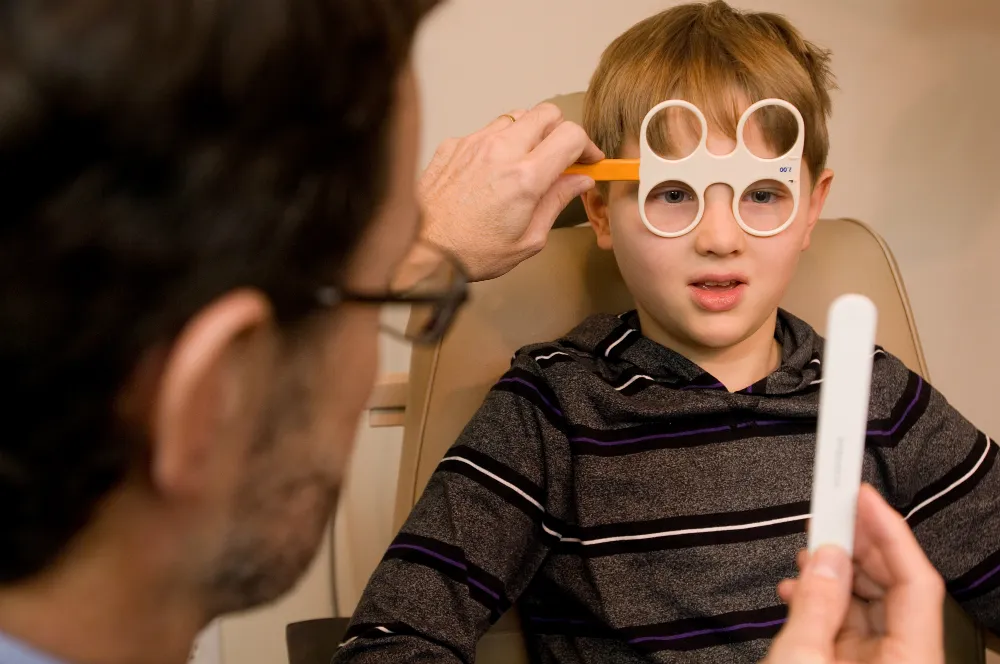
Prism glasses are marketed hard to people with binocular vision dysfunction, usually with dramatic before-and-after stories and very little about what was measured. Prism is a legitimate optical treatment. It is also one of the most unevenly evidenced tools in our field. It helps in some situations. In others it is no better than a placebo pair of glasses. And in the situation it is advertised for most, the support comes mainly from uncontrolled case series. Here is our honest read of that literature, and how it shapes what we recommend at Vision & Learning Center.
Key takeaways
- A prism does not strengthen or retrain anything. It bends light so the eyes have less misalignment to overcome (Cossack & Salini, 2023).
- In children with symptomatic convergence insufficiency, base-in reading prism was no better than placebo reading glasses (Scheiman et al., 2005 (children, prism)).
- In presbyopic adults with convergence insufficiency, base-in prism progressives did beat placebo progressives in a small crossover trial (Teitelbaum et al., 2009).
- Prism for vertical heterophoria rests almost entirely on retrospective, uncontrolled series from a single private practice (Doble et al., 2010; Rosner et al., 2016).
- Prism adaptation is a real limit: the visual system can quietly reset behind the lens (AOA, 2010).
- The decision is made from measurements, not from a symptom quiz.
What a prism actually does
A prism is a wedge of lens material that uses refraction to change the direction of light passing through it. Its power is given in prism dioptres — the deflection it produces, in centimetres, at a distance of 100 centimetres. How far the light bends depends on the lens material and on how the prism sits in the frame (Cossack & Salini, 2023).
Clinically, that means the image arrives at the eye already shifted, so the eye has less work to do to line it up. Nothing about the eye muscles or the brain’s control of them has changed.
Horizontal prism
Base-in and base-out prism shift images sideways. Clinicians prescribe horizontal prism to reduce the fusional vergence demand — the eye-turning work needed to hold one single, comfortable image — and so relieve eye strain. Two measurements usually guide the amount. The first is Sheard’s criterion, a rule of thumb about how far the fusional reserve, meaning the spare turning power the eyes can call on, should exceed the demand placed on it. The second is fixation disparity: a tiny misalignment that persists while the eyes are still fusing the image, and which prism can neutralise (AOA, 2010). Base-in is the version used for convergence insufficiency, because it reduces how far the eyes must turn inward to read.
Vertical prism
Vertical prism compensates for one eye sitting slightly higher than the other. The AOA clinical guideline states plainly that “vertical prism is the usual treatment of choice for vertical deviation.” The guideline also notes that vision therapy has helped in small samples, and that it may suit some patients better. That includes people whose deviation is not comitant: a comitant eye turn measures the same in every direction of gaze, and theirs changes depending on where they look. Contact lens wearers, and people who adapt to prism, are on that list too (AOA, 2010).
Yoked prism
Yoked prism means both lenses have their bases pointing the same way. The whole visual world shifts, rather than the two eyes being realigned relative to each other. It is used in some neuro-optometric and rehabilitation settings for spatial and posture-related concerns. We are not aware of placebo-controlled trials establishing its benefit. So we treat it as a clinical tool some patients respond to, not as an evidence-based prescription.
Children with convergence insufficiency: prism did not beat placebo
This is the clearest result in the whole prism literature, and it is negative. In a double-masked randomised trial, 72 children aged 9 to under 18 with symptomatic convergence insufficiency wore either base-in prism reading glasses or placebo reading glasses. Symptom scores improved substantially in both groups: 31.6 to 16.5 with prism, 28.4 to 17.5 with placebo. After six weeks of wear there was no significant difference between the groups on symptoms, on near point of convergence or on fusional vergence (Scheiman et al., 2005 (children, prism)).
Two lessons follow. Base-in reading prism is not the treatment for childhood convergence insufficiency. And giving a child any pair of glasses produced a large improvement in reported symptoms within six weeks. That is exactly why testimonials, ours included, cannot substitute for controlled trials.
In the same population, office-based vergence and accommodative therapy produced a successful or improved outcome in 73 percent of children, versus 35 percent with office-based placebo therapy (CITT, 2008). Among the children who became asymptomatic, 84.4 percent of the office-therapy group were still asymptomatic a year later (CITT, 2009). We report the limits alongside that. In the later, larger CITT-ART trial, clinical signs improved far more with therapy than with placebo, but symptom scores improved similarly in both groups (CITT-ART, 2019). Therapy also produced no reading benefit over placebo (CITT-ART reading, 2019).
Adults: where prism has done better
The adult picture differs. In a randomised crossover trial, 29 symptomatic presbyopes aged 45 to 68 wore progressive lenses with base-in prism for three weeks. In a separate three-week period, the same people wore placebo progressives. Mean scores on the Convergence Insufficiency Symptom Survey fell from 30.21 at baseline to 13.38 with prism, versus 23.62 with placebo (Teitelbaum et al., 2009). It is a small, short trial. It is also a real placebo-controlled result in adults.
A word about that survey, because the numbers above only mean something alongside it. The Convergence Insufficiency Symptom Survey is the standard symptom questionnaire in this literature. Its familiar cut-off is 21 points or more, with 97.8 percent sensitivity and 87 percent specificity for symptomatic convergence insufficiency. That cut-off was validated in adults aged 19 to 30 (Rouse et al., 2004), not in presbyopes, and the presbyopic trial above enrolled anyone scoring 16 or more. Scores travel between studies more easily than the thresholds attached to them.
A second adult finding is useful for a different reason. A double-masked, placebo-controlled trial enrolled 80 patients with heterophoria. In exophoria, an aligning prism of 2 prism dioptres or more predicted a 5 percent or greater gain on a standard rate-of-reading test, with 67 percent sensitivity and 79 percent specificity. Symptoms did not identify who would benefit (O’Leary & Evans, 2006). In other words, the measurement predicted the response better than the complaint did. That is an argument for testing, not for prescribing from a checklist.
The AOA guideline also summarises a study of what patients preferred. Seventy-three percent of symptomatic exophoric patients and 90 percent of symptomatic esophoric patients preferred prismatic glasses to non-prism glasses, while 86 percent of asymptomatic patients rejected them (AOA, 2010). Prism helps people who have something for it to correct.
Vertical heterophoria: the evidence is thinner than the marketing
Most sites selling “prism glasses for BVD” are describing treatment of vertical heterophoria. Here is what actually exists.
One retrospective analysis covered 43 traumatic brain injury patients with persistent post-concussive symptoms. It reported a 71.8 percent fall in subjective symptom burden after individualised prismatic lenses (Doble et al., 2010). A later retrospective series of 38 post-concussion patients reported reductions of 19.1 to 60.8 percent on validated headache, dizziness and anxiety measures (Rosner et al., 2016). The same group’s Binocular Vision Dysfunction Questionnaire was validated in 126 of their own patients, with good internal consistency and test-retest reliability (Feinberg et al., 2021).
Those numbers are large. They are also uncontrolled, unblinded and retrospective. And they were produced by the single private practice that developed both the questionnaire and the treatment approach. There is no placebo arm, and the childhood prism trial above showed how large a placebo response to new glasses can be.
Motion sickness has been studied as well. In a non-clinical study of 43 adults, the size of a person’s vertical phoria correlated with how sick they felt reading inside a rotating optokinetic drum. A phoria of 0.75 prism dioptres discriminated best between low and high symptom scores. But the researchers then used prism to artificially increase the phoria in 12 low-phoria subjects, and symptoms worsened in only one. Their conclusion: the association is real but “may not be causal” (Jackson & Bedell, 2012).
Our position: vertical heterophoria is a measurable finding worth taking seriously, and vertical prism is a reasonable treatment for a measured vertical deviation. The published support for dramatic symptom resolution is low-quality evidence, and we say so before anyone spends money.
What the Cochrane review adds
The most rigorous synthesis available pooled 12 trials and 1289 participants — six trials in children and six in adults, analysed as two separate networks (Scheiman et al., 2020). That split matters, because prism came out differently on each side of it.
In children, office-based vergence and accommodative therapy with home reinforcement was more effective than placebo for a successful outcome, with a relative risk of 3.04 (95% CI 2.32 to 3.98) (Scheiman et al., 2020). One pediatric trial tested base-in prism reading glasses. Compared with placebo reading glasses, the reviewers found no evidence of a difference on near point of convergence, on positive fusional vergence or on symptom scores.
In adults the review found the opposite for prism. One trial of base-in glasses prescribed for near work reported fewer symptoms than placebo glasses at three months (mean difference -8.9 points, 95% CI -11.6 to -6.3). The same trial found no difference in near point of convergence or fusional vergence. Taken as a whole, though, the adult evidence base is thinner. The six adult trials randomised 321 participants between them, and the reviewers rated only one of the six at low risk of bias. That is why they conclude that in adults the evidence for these non-surgical treatments is less clear (Scheiman et al., 2020). It fits the adult therapy trial, in which 42 percent of patients reached symptom elimination versus 31 percent on placebo (Scheiman et al., 2005 (adults, therapy)).
So the honest one-line summary is not “prism works” or “prism does not work.” Base-in prism failed against placebo in the one childhood trial, and beat placebo in the adult trial the review found. Both results rest on small numbers. Which of them is the relevant one for you depends on your age and your measurements, not on the label on the website selling the lenses.
The limit nobody mentions in the ads: prism adaptation
The visual system adapts to prism. The AOA guideline describes adaptation as a genuine constraint. When it happens, the prism will not permanently neutralise the deviation, and prism therapy is contraindicated. Most people adapt faster and more completely to base-out than to base-in prism, and much of the shift happens within the first 15 minutes of wear. Prism compensation works only when there is a significant deviation with minimal vergence adaptation (AOA, 2010).
How we decide: prism, therapy, or both
We start from the measurements, not the label. A full binocular workup gives us cover test findings at distance and near, near point of convergence, and fusional vergence ranges. It also gives us accommodative amplitude and facility, and any vertical component. Then:
- A measured vertical deviation points toward vertical prism first, in line with the AOA guideline. We usually trial it with press-on Fresnel prisms before anything is ground into a lens (Cossack & Salini, 2023).
- Symptomatic convergence insufficiency in a child points toward office-based vergence and accommodative therapy, because that is what beat placebo and prism did not.
- An adult who needs relief now is a reasonable prism candidate. So is an adult who cannot commit to a therapy program because of time, cost or cognitive constraints. The AOA guideline names exactly that situation, with the caution that adaptation may limit it.
- Both, sometimes. Prism can carry someone through the working day while therapy builds the underlying ability. The AOA guideline notes that vision therapy may be used to decrease prism adaptation, and to reduce the need for future increases in prism correction (AOA, 2010).
- Neither, sometimes. If the measurements are normal, we say so and help you look elsewhere rather than sell you a lens.
Related reading: prism glasses versus vision therapy, the complete guide to binocular vision dysfunction, how BVD affects adults at work and while driving, and vision therapy for motion sickness or dizziness. Our condition pages on prisms, vertical heterophoria and convergence insufficiency cover the clinical basics.
If headaches, double vision, dizziness or eye strain are shaping your day, the useful next step is a measurement, not a purchase. See what a full workup involves on our examinations page, or Schedule an evaluation at our Boynton Beach or Boca Raton office.
Common Questions About This Topic
Do prism glasses work for binocular vision dysfunction?
It depends on which problem sits under the label. For a measurable vertical deviation, the AOA clinical guideline calls vertical prism the usual treatment of choice, and small retrospective series report large symptom reductions. But those series come from one private practice and had no control group. For convergence insufficiency in children, base-in reading prism was no better than placebo glasses in a randomized trial. Prism is a real tool with a narrow and uneven evidence base, not a general answer to every binocular complaint.
Why did prism help my friend and not me?
Prism compensates for a specific misalignment. If your measurements do not show that misalignment, or if the trouble is mainly an inability to sustain focus and convergence over time, prism has nothing to compensate for. The trials reflect this. In one study summarized by the AOA guideline, symptomatic exophoric and esophoric patients preferred prism glasses, while 86 percent of asymptomatic patients rejected them.
What is prism adaptation, and does it mean the prism will stop working?
Prism adaptation is the visual system quietly resetting to the new prism, so the deviation reappears behind it. The AOA guideline describes this as a real limit on prism therapy. Most people adapt faster and more completely to base-out than to base-in prism, and much of the shift happens in the first 15 minutes of wear. It does not happen to everyone. It is one reason we retest rather than assume a prescription is permanent.
Should we try prism before vision therapy for my child?
For symptomatic convergence insufficiency in children, the evidence points the other way. Base-in prism reading glasses matched placebo glasses in a randomized trial. Office-based vergence and accommodative therapy beat placebo therapy in the CITT and in the children's arm of a Cochrane network meta-analysis. The same review found the opposite for prism in adults, so this is a starting point for children specifically. We adjust it when the examination shows something prism handles better, such as a vertical deviation.
Can prism glasses help dizziness or motion sickness?
There is an association between vertical phoria and visually induced motion sickness. But the study that measured it concluded the relationship may not be causal: artificially increasing the phoria worsened symptoms in only 1 of 12 people tested. Dizziness has many causes, several of them vestibular or neurological. We evaluate the eyes, and we say plainly when the answer is likely to be found elsewhere.
Where This Information Comes From
- Cossack M, Salini B (2023). Prism Glasses. StatPearls. Treasure Island (FL): StatPearls Publishing. : Clinical reference: a prism uses refraction to change the direction of light, is measured in prism dioptres (deflection in cm at 100 cm), and is used for ocular misalignment, convergence insufficiency, nystagmus and hemianopia; Fresnel press-on prisms allow a trial before grinding.
- American Optometric Association; Cooper JS (principal author) (2010). Care of the Patient with Accommodative and Vergence Dysfunction. Optometric Clinical Practice Guideline. St. Louis: AOA (approved 1998, revised December 2010). : Guideline: prism is prescribed to reduce fusional vergence demand; vertical prism is the usual treatment of choice for vertical deviation; prism adaptation limits prism therapy; prism may be the only viable option when therapy is not feasible.
- Scheiman M, Cotter S, Rouse M, Mitchell GL, Kulp M, Cooper J, Borsting E; CITT Study Group (2005). Randomised clinical trial of the effectiveness of base-in prism reading glasses versus placebo reading glasses for symptomatic convergence insufficiency in children. British Journal of Ophthalmology; 89(10):1318-1323. : In 72 children aged 9 to under 18, symptom scores fell in both groups (prism 31.6 to 16.5; placebo 28.4 to 17.5) with no significant difference on any outcome after 6 weeks of wear.
- Teitelbaum B, Pang Y, Krall J (2009). Effectiveness of base in prism for presbyopes with convergence insufficiency. Optometry and Vision Science; 86(2):153-156. : Crossover trial in 29 symptomatic presbyopes aged 45-68: mean CISS fell from 30.21 to 13.38 with base-in prism progressives versus 23.62 with placebo progressives (p=0.001).
- O'Leary CI, Evans BJW (2006). Double-masked randomised placebo-controlled trial of the effect of prismatic corrections on rate of reading and the relationship with symptoms. Ophthalmic and Physiological Optics; 26(6):555-565. : In 80 people with heterophoria, an aligning prism of 2 prism dioptres or more in exophoria predicted a 5 percent or greater gain on the Wilkins Rate of Reading Test (67% sensitivity, 79% specificity); symptoms did not identify who benefited.
- Jackson DN, Bedell HE (2012). Vertical heterophoria and susceptibility to visually-induced motion sickness. Strabismus; 20(1):17-23. : In 43 non-clinical subjects, vertical phoria (0 to 2.13 prism dioptres) correlated with optokinetic-drum motion sickness scores, but adding prism to increase the phoria worsened symptoms in only 1 of 12 subjects, so the authors conclude the relationship may not be causal.
- Doble JE, Feinberg DL, Rosner MS, Rosner AJ (2010). Identification of binocular vision dysfunction (vertical heterophoria) in traumatic brain injury patients and effects of individualized prismatic spectacle lenses in the treatment of postconcussive symptoms: a retrospective analysis. PM&R; 2(4):244-253. : Retrospective, uncontrolled series of 43 TBI patients: subjective symptom burden fell 71.8 percent after individualized prism lenses.
- Rosner MS, Feinberg DL, Doble JE, Rosner AJ (2016). Treatment of vertical heterophoria ameliorates persistent post-concussive symptoms: a retrospective analysis utilizing a multi-faceted assessment battery. Brain Injury; 30(3):311-317. : Retrospective series of 38 post-concussion patients: 19.1-60.8 percent reductions on validated headache, dizziness and anxiety measures after prism; no control group and no masking.
- Feinberg DL, Rosner MS, Rosner AJ (2021). Validation of the Binocular Vision Dysfunction Questionnaire (BVDQ). Otology & Neurotology; 42(1):e66-e74. : In 126 patients diagnosed with vertical heterophoria the BVDQ showed Cronbach's alpha 0.91 and good test-retest reliability; it was developed and validated by the same practice that provides the treatment.
- Scheiman M, Kulp MT, Cotter SA, Lawrenson JG, Wang L, Li T (2020). Interventions for convergence insufficiency: a network meta-analysis. Cochrane Database of Systematic Reviews; 12:CD006768. : Twelve trials, 1289 participants, analysed separately by age: in children office-based vergence/accommodative therapy beat placebo (RR 3.04, 95% CI 2.32-3.98) and base-in prism reading glasses showed no evidence of a difference from placebo reading glasses; in adults one trial found base-in prism glasses gave fewer symptoms than placebo glasses at three months (MD -8.9, 95% CI -11.6 to -6.3), while the adult evidence overall is less clear.
- Convergence Insufficiency Treatment Trial Study Group (2008). Randomized clinical trial of treatments for symptomatic convergence insufficiency in children. Archives of Ophthalmology; 126(10):1336-1349. : In 221 children, 73 percent were successful or improved after 12 weeks of office-based therapy versus 35 percent with office-based placebo therapy.
- Convergence Insufficiency Treatment Trial Study Group (2009). Long-term effectiveness of treatments for symptomatic convergence insufficiency in children. Optometry and Vision Science; 86(9):1096-1103. : Among children who became asymptomatic, 84.4 percent of the office-therapy group were still asymptomatic one year later.
- CITT-ART Investigator Group (2019). Treatment of symptomatic convergence insufficiency in children enrolled in the Convergence Insufficiency Treatment Trial-Attention & Reading Trial: a randomized clinical trial. Optometry and Vision Science; 96(11):825-835. : Clinical signs improved far more with therapy than placebo (NPC 10.4 vs 6.2 cm), but symptom scores improved similarly in both groups (11.8 vs 10.4 points, p=.21).
- CITT-ART Investigator Group (2019). Effect of vergence/accommodative therapy on reading in children with convergence insufficiency: a randomized clinical trial. Optometry and Vision Science; 96(11):836-849. : Reading comprehension improved 3.7 points with therapy versus 3.8 points with placebo - no reading benefit.
- Scheiman M, Mitchell GL, Cotter S, Kulp MT, Cooper J, Rouse M, Borsting E, London R, Wensveen J (2005). A randomized clinical trial of vision therapy/orthoptics versus pencil pushups for the treatment of convergence insufficiency in young adults. Optometry and Vision Science; 82(7):583-595. : In 46 adults aged 19-30, only office-based therapy changed the clinical signs; 42 percent reached symptom elimination versus 31 percent with placebo, and more than half remained symptomatic.
- Rouse MW, Borsting EJ, Mitchell GL, Scheiman M, Cotter SA, Cooper J, Kulp MT, London R, Wensveen J; CITT Group (2004). Validity and reliability of the revised convergence insufficiency symptom survey in adults. Ophthalmic and Physiological Optics; 24(5):384-390. : In adults aged 19-30, mean CISS was 37.3 with symptomatic CI versus 11.0 in normals; a cut-off of 21 gave 97.8 percent sensitivity and 87 percent specificity.
Care We Provide
More From the Blog
Wondering If This Sounds Like Your Family?
A developmental vision evaluation measures the skills a routine eye exam does not. Our team sees children and adults in Coconut Creek, Boynton Beach, Boca Raton and West Palm Beach.