Convergence Insufficiency
One of the most common — and most commonly missed — eye-teaming problems, and one of the most treatable.
Watch: short videos
Words that move
School problems eased
Glasses help clarity. Therapy trains skills.
Convergence Insufficiency, Explained
What to Know About Convergence Insufficiency
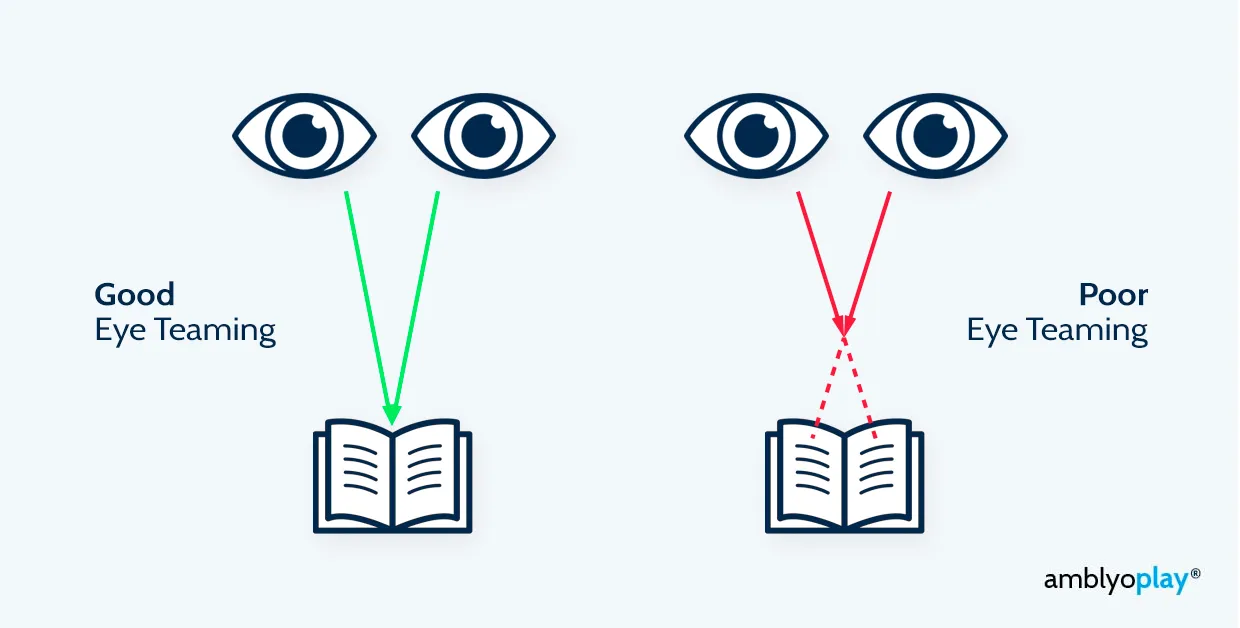
Convergence insufficiency (CI) is a binocular vision disorder in which the two eyes cannot work together properly on a near target. To read, or to look at anything close, the eyes have to turn inward together — to converge — and hold that position to keep a single, clear image. In convergence insufficiency that inward turning is inadequate and the eyes tend to drift outward, so the visual system overworks just to keep the page single and clear.
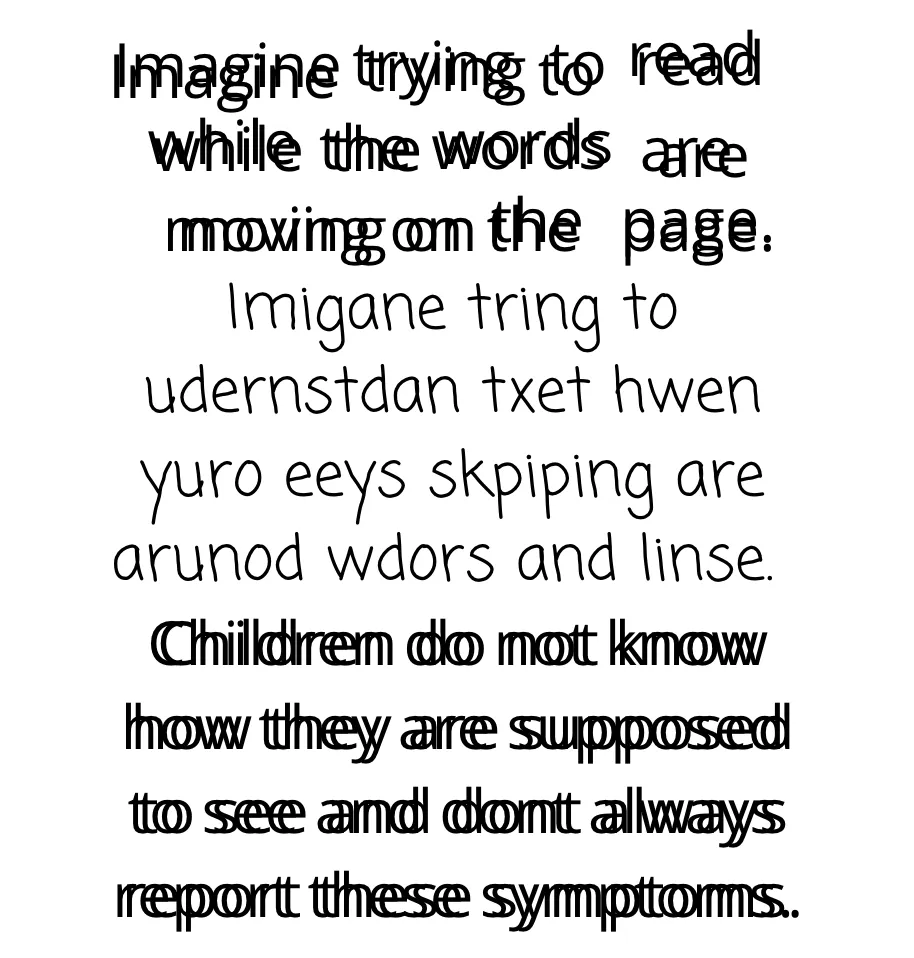
Symptoms. People with convergence insufficiency may experience double vision (diplopia), eye strain, fatigue, headaches, difficulty reading, blurred vision at near, difficulty concentrating, and avoidance of near work or reading. Children rarely name any of it: they do not know how they are supposed to see, so they do not always report these symptoms — it shows up as behaviour instead.
Parents often describe it as eyes not tracking together, or as double vision when reading. Strictly, eye tracking problems (ocular motor dysfunction) are a separate skill, but the two often turn up together, and an evaluation measures both. Convergence insufficiency is one form of binocular vision dysfunction, and the treatment with the strongest evidence is office-based convergence therapy (vision therapy aimed at convergence) with practice at home.
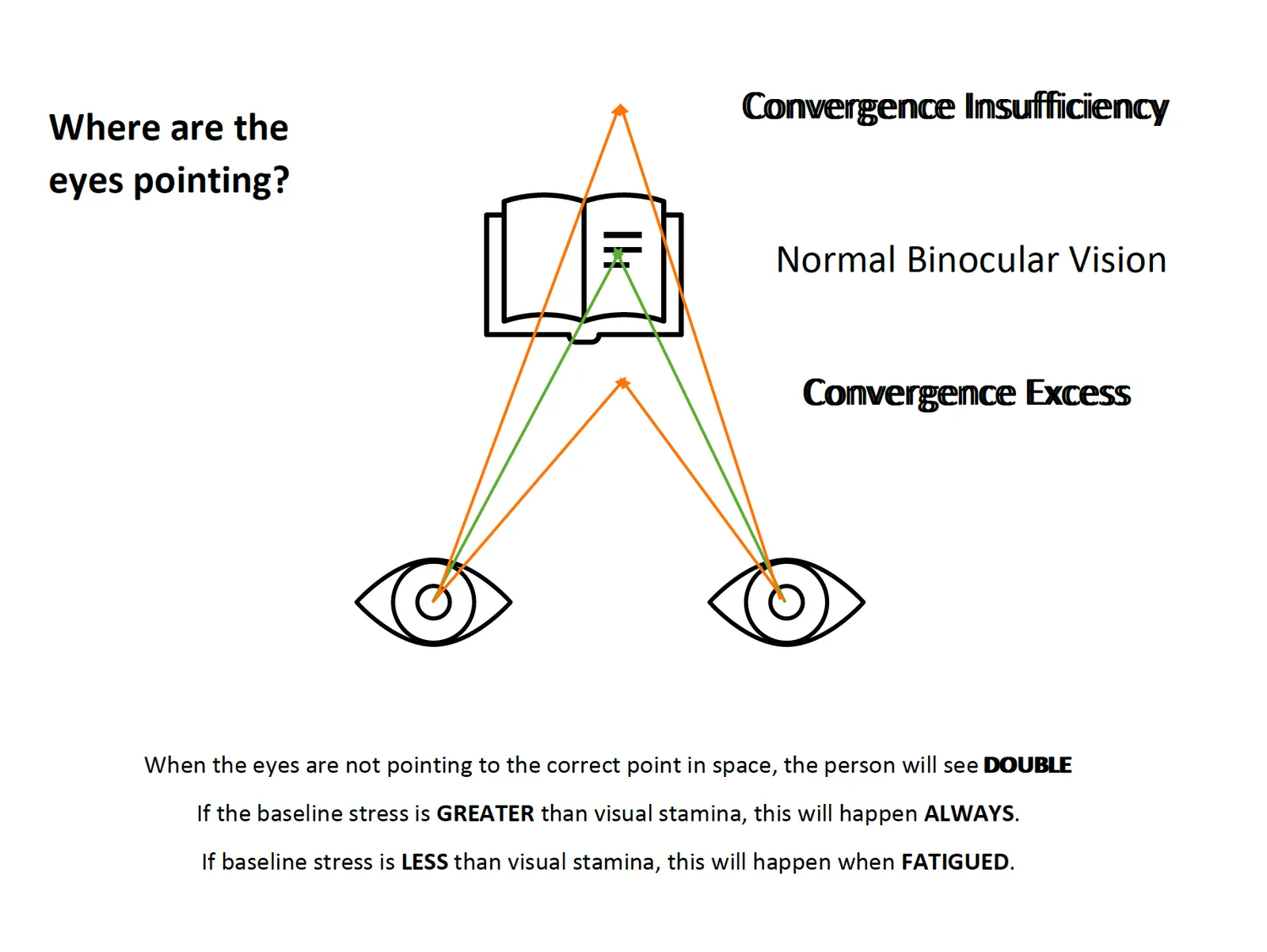
Where the eyes are pointing decides what you see. With normal binocular vision both lines of sight meet on the page. With convergence insufficiency they meet beyond the page; with convergence excess they cross in front of it. When the eyes are not pointing at the correct point in space, the person sees double — always, when the demand outstrips their visual stamina, and only when fatigued when it does not.
Prognosis. The outlook for treating convergence insufficiency with vision therapy is very good, and it has some of the strongest research behind it of any condition we treat. At Vision & Learning Center, every year since 2020, between 88% and 96% of our patients who completed their program said they were successful in meeting their goals (our practice records, not a research study). Four outcomes come up again and again, in our patients and in the published research:
Symptomatic relief. Many patients experience significant or complete relief of symptoms — less eye strain, fewer headaches, no more doubling — after a course of vision therapy.
Improved convergence. Therapy builds the ability to turn the eyes inward together and hold it, and often resolves the convergence difficulty itself rather than just easing the symptoms.
Enhanced academic performance. Better convergence means more comfort and efficiency in reading and other close work, which for a student can show up as better performance in school.
Sustained improvement. Studies have found that the gains made in vision therapy for convergence insufficiency are usually sustained long term, and once a program is complete the benefits typically last. What a completed program cannot do is prevent the visual effects of a later concussion, traumatic brain injury or stroke.
Individual variation. How much someone improves, and how long it takes, varies from person to person. It depends on the severity of the convergence insufficiency, the type of activities prescribed and how consistently they are done, the age of the patient, and any co-existing conditions. What we can shape is how the program is run — and four things matter most:
Consistent therapy. Performing the prescribed activities consistently is crucial to getting the best result.
Regular monitoring. Regular follow-up with your eye care provider, so progress is measured and the plan is adjusted as you go.
Combination therapy. In-office therapy paired with at-home reinforcement generally yields the best results.
Addressing co-existing conditions. Conditions such as amblyopia or strabismus need to be addressed too, because they affect how effective therapy for convergence insufficiency can be.
Research support. The Convergence Insufficiency Treatment Trial (CITT), a randomized trial funded by the National Eye Institute, compared four treatments in children aged 9 to 17. After 12 weeks, 73% of children in office-based vision therapy with home practice were successful or improved, compared with 35% on placebo therapy — about twice the rate. Home pencil push-ups and home computer exercises did no better than placebo (CITT, 2008). A trial gives every participant the same fixed 12-week protocol so the results can be compared; in our office, each program is customized to the patient’s evaluation, for children and adults alike, and continues until goals are met. Sometimes more than one thing is going on, and when a patient does not reach full resolution, we make appropriate referrals. Our office figure and the trial figure measure different things — one is what patients who finished their program told us, the other is a measured result against placebo — but they point the same way.
Individual outcomes vary, but vision therapy is a well-established and clinically supported approach to managing convergence insufficiency, and many people who complete a program experience significant and lasting improvement. Our longer read on convergence insufficiency covers the research and what a program looks like week to week.
Not sure whether this is what you are seeing? Our symptom checklist takes about two minutes, the problems we treat page groups symptoms by what parents actually notice, and an evaluation at our Boynton Beach and Boca Raton offices will measure convergence directly.
Signs & Symptoms
- Double vision (diplopia), especially during reading or screen work
- Eye strain and tired, achy eyes with near work
- Fatigue or sleepiness when reading
- Headaches during or after sustained near work
- Difficulty reading — losing place, re-reading, slow progress
- Blurred vision at near; words that blur, swim, or double on the page
- Difficulty concentrating during reading and homework
- Avoidance of near work or reading
How We Help
Care starts with a comprehensive developmental and binocular vision evaluation that pinpoints exactly what's happening. From there, Dr. Murray builds an individualized plan — which may include lenses or prism, in-office vision therapy, and coordination with your other providers — at our Boynton Beach and Boca Raton offices.
Related Topics
More on Convergence Insufficiency & Eye Teaming
What happens when the eyes struggle to work together at reading distance, and the evidence behind treating it.
- Start hereConvergence Insufficiency: Symptoms, Diagnosis, TreatmentConvergence insufficiency makes near work uncomfortable. The signs we look for, how it is diagnosed, and what…
- What the CITT and CITT-ART Trials Actually FoundWhat the CITT and CITT-ART convergence insufficiency trials really showed about vision therapy - the strong…
- How Common Is Convergence Insufficiency? The DataEstimates for convergence insufficiency range from about 3% to 18%. Here is what school, clinic, adult and…
- The Brock String: What It Is and How It WorksA string and three beads is one of the oldest tools in vision therapy. How the Brock string trains eye…
- Ocular Motor Dysfunction: Eye Movements ExplainedFixations, saccades and pursuits in plain English: what ocular motor dysfunction looks like in reading and…
- Visual Fatigue: A Hidden Cause of Homework MeltdownsHomework meltdowns can be visual exhaustion rather than defiance. What visual fatigue is, why it peaks after…
- Why Reading Causes Headaches and Homework BattlesHeadaches, tired eyes and homework battles after reading can be a visual effort problem. What the research…
- Why Does My Child Lose Their Place While Reading?Skipping lines and rereading is a place-keeping problem. How saccades, return sweeps and landing accuracy…
- Prism Glasses vs Vision Therapy: What Is the Difference?Prism shifts the visual demand; vision therapy builds visual ability. What the trials actually found about…
Concerned About This?
An evaluation will tell you clearly whether this is what's going on — and what to do next.