The Brock String: What It Is and How It Works
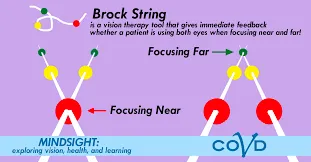
Almost every vision therapy room has one: a length of white cord with three colored beads on it. It costs a few dollars, has no screen and no moving parts, and it is still one of the most useful tools we have for teaching two eyes to point at the same place at the same time. Here is what it is, how we use it, and what the research actually shows.
Key takeaways
- The Brock string is a cord with three beads that gives you instant, honest feedback about where your two eyes are aimed.
- The “X” you see at the bead is the signal. An X in front of the bead means you are aiming too near; an X behind it means you are aiming too far.
- Seeing only one string instead of two usually means one eye is being tuned out, which is why the string is also used to build suppression awareness.
- It is one procedure inside a larger program, not a treatment on its own. Office-based vergence therapy with home reinforcement is the best-supported approach for symptomatic convergence insufficiency in children (Scheiman et al., 2020).
- Eye-teaming therapy improves eye-teaming measures. It has not been shown to improve reading scores (CITT-ART, 2019).
Who was Brock, and why a string?
Frederick W. Brock was born in Switzerland in 1899 and came to the United States in 1921 to study at the Columbia School of Optometry. He spent his career working out how people with turned eyes actually see, and built simple tools to change it (Barry, 2011).
The string was one of them. One end anchors to a doorknob or wall hook; the other rests against the bridge of your nose so the cord runs straight out from between your eyes. Three beads sit at different distances along it. That is the whole instrument.

The X is the whole point
When you look at one bead, your two eyes have to turn inward by exactly the right amount to land on it together. The string tells you instantly whether they did.
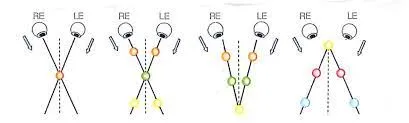
Because both eyes are open, the parts of the string that are nearer and farther than the bead you are fixating fall on non-matching parts of each retina. Your brain reports two strings. This is called physiological diplopia, and it is normal. The two strings appear to cross precisely at the bead you are aiming at, making an X.
- X on the bead: both eyes are aimed where you think they are.
- X in front of the bead: you are over-converging, aiming nearer than the target.
- X behind the bead: you are under-converging, aiming beyond the target.
- Only one string: one eye’s information is probably being suppressed.
That last line is why the string does double duty. Suppression is quiet by nature; nobody notices an eye being switched off. The string makes it visible. Brock himself was cautious about drills that made patients aware of physiological diplopia in everyday viewing, and Susan Barry notes the irony that his most popular tool does exactly that, under controlled conditions, to show a patient where the eyes are pointing (Barry, 2011).
How we use it in the therapy room
The string usually appears in programs for convergence insufficiency, an eye-teaming problem in which the eyes do not hold their inward posture comfortably at near. It is common: about 13% of fifth- and sixth-graders in one school-based study met a high-suspect or definite definition (Rouse et al., 1999). It also shows up in post-concussion care, which we cover below.
Bead jumping
With the far end anchored and the near end on the nose, the patient jumps fixation from bead to bead. On each one, the goal is a clean X centered on that bead, held for a beat, before moving on. This trains the eyes to change aim quickly and land accurately, and it makes drifting obvious the moment it happens.
Bead sliding
Here we use a single bead. Starting at a comfortable middle distance, the patient holds the X on the bead while sliding it slowly toward the nose, then slowly back out. The demand differs depending on whether the eyes sit in an exo (drifting out) or eso (turning in) posture, so the starting distance, speed and range are set for the individual. Done well, it builds the flexibility to move smoothly between aiming near and aiming far while staying single.
The string is rarely used alone. In published office-based vergence/accommodative therapy protocols it sits alongside vectograms, computer orthoptics and other techniques in a staged program (Alvarez et al., 2024). You can see how it fits with the rest of our approach in our vision therapy goals and procedures, and how a different tool trains a different skill in our post on the Hart chart.
Common mistakes at home
- Chasing the bead instead of the X. Being able to see the bead is not the goal. A clean X at the bead is the goal.
- Going fast. Speed hides sloppy aiming. Slow and accurate first, faster later.
- Slack or crooked string. The cord must be taut and running straight out from between the eyes, not off to one side.
- Skipping the prescribed glasses. If lenses were prescribed for near work, wear them for the exercise unless told otherwise.
- Pushing through pain. Mild effort is expected; headache, nausea or worsening double vision means stop and tell us.
- Practicing without a diagnosis. The setup differs for exo and eso patterns, and new or sudden double vision needs an examination before any exercise.
What the evidence shows
For convergence insufficiency in children, the strongest data support the whole program, not any single tool. In the 221-child Convergence Insufficiency Treatment Trial, 73% of children doing office-based vergence/accommodative therapy with home reinforcement were successful or improved at 12 weeks, versus 35% with office placebo (CITT, 2008). A Cochrane review of 12 trials and 1289 participants reached the same conclusion for children (RR 3.04), while noting the adult evidence is less clear (Scheiman et al., 2020).
For the string specifically, the most direct evidence comes from concussion. A 2025 randomized trial gave 50 people aged 11-30 either twice-daily home Brock string exercises or usual care within 10 days of injury. Near point of convergence improved 8.9 cm with the string versus 3.8 cm with usual care (Trbovich et al., 2025). That is a real result, and a modest one: the study was small, single-blind, short, and measured a clinical sign rather than symptoms or return to school.
Context matters after a concussion. Vision problems are common in referral samples, with 69% of adolescents in one concussion program carrying a vision diagnosis (Master et al., 2016). But most children recover on their own. Of 67 children with abnormal convergence after concussion, 46% recovered with standard care and only 13% went on to office-based vision therapy (Storey et al., 2017). The AAP and AAO joint clinical report takes the same position: expect recovery by about four weeks, and examine vision specifically when it does not happen (Master et al., 2022).
What the string will not do
It will not teach reading. In CITT-ART, the largest and best-designed test of that question, 310 children with symptomatic convergence insufficiency gained 3.7 points in reading comprehension with therapy and 3.8 points with placebo therapy (CITT-ART, 2019). The same trial found that eye-teaming signs improved more with therapy while symptom scores improved about equally in both groups (CITT-ART, 2019).
Our clinical view at Vision & Learning Center, offered as a practice perspective rather than a research finding, is that comfortable eye teaming is worth having on its own terms. When holding a book at 16 inches stops costing effort, near work tends to get easier to sustain. That is a fair claim. “Vision therapy raises reading scores” is not.
Who knew a string and three beads could ask so much of the visual system? If sore eyes, doubling, losing your place or dread of homework sound familiar, the useful next step is not a string bought online but an evaluation that finds out what is actually happening. Learn what to expect at a comprehensive developmental vision evaluation, read more about our vision therapy program and the full picture of convergence insufficiency, or Schedule an evaluation with our team in Coconut Creek, Boynton Beach or West Palm Beach.
Common Questions About This Topic
What does the Brock string actually train?
It trains convergence (aiming both eyes at the same point up close) and gives you moment-to-moment feedback about where your eyes are pointing. Because you view the string with both eyes at once, it also makes it obvious when one eye is being tuned out.
How long should my child practice with a Brock string?
Follow the schedule your therapist gives you rather than a number from the internet. In the 2025 concussion trial that tested it, participants did prescribed Brock string exercises twice a day for one to two weeks. Short, accurate, daily sessions beat long, sloppy ones.
Can I just buy a Brock string online and skip the exam?
We would not recommend it. The string is used differently for an eyes-drifting-out (exo) pattern than for an eyes-turning-in (eso) pattern, and some conditions get worse with the wrong exercise. New or sudden double vision needs an eye exam first, not a home exercise.
Does the Brock string help reading or grades?
There is no good evidence that it does. The largest trial of vergence therapy in children with convergence insufficiency found no reading-comprehension advantage over placebo therapy. What eye-teaming work can do is make near work more comfortable and sustainable.
Why do I see two strings instead of one?
That is normal and it is the point. It is called physiological diplopia: the string in front of and behind the bead you are looking at falls on non-corresponding parts of the two retinas, so your brain reports two of it. Seeing only one string usually means one eye is being suppressed.
Where This Information Comes From
- Barry SR (2011). The Work & Wisdom of Dr. Frederick W. Brock. Journal of Behavioral Optometry; 22(3):59-63. : Biography of Frederick W. Brock (born in Switzerland in 1899, came to the US in 1921 for the Columbia School of Optometry) and an account of how the string method uses physiological diplopia to show a patient where the eyes are aimed.
- Convergence Insufficiency Treatment Trial Study Group (2008). Randomized clinical trial of treatments for symptomatic convergence insufficiency in children. Archives of Ophthalmology; 126(10):1336-1349. : In 221 children aged 9-17, office-based vergence/accommodative therapy with home reinforcement produced a successful or improved outcome in 73%, versus 35% for office placebo and 33-43% for home programs.
- CITT-ART Investigator Group (2019). Treatment of symptomatic convergence insufficiency in children enrolled in the CITT-ART: a randomized clinical trial. Optometry and Vision Science; 96(11):825-835. : Near point of convergence improved 10.4 cm with therapy versus 6.2 cm with placebo, but symptom scores improved similarly in both groups (11.8 vs 10.4 points, p=.21).
- CITT-ART Investigator Group (2019). Effect of vergence/accommodative therapy on reading in children with convergence insufficiency: a randomized clinical trial. Optometry and Vision Science; 96(11):836-849. : In 310 children, reading comprehension improved 3.7 points with therapy versus 3.8 with placebo; therapy was no better than placebo for reading.
- Scheiman M, Kulp MT, Cotter SA, Lawrenson JG, Wang L, Li T (2020). Interventions for convergence insufficiency: a network meta-analysis. Cochrane Database of Systematic Reviews; 12:CD006768. : Across 12 trials and 1289 participants, office-based vergence/accommodative therapy with home reinforcement beat placebo in children (RR 3.04, 95% CI 2.32 to 3.98); adult evidence is less clear.
- Rouse MW, Borsting E, Hyman L, et al.; CIRS Group (1999). Frequency of convergence insufficiency among fifth and sixth graders. Optometry and Vision Science; 76(9):643-649. : In 453 fifth- and sixth-graders, 4.2% had definite and 8.8% high-suspect convergence insufficiency (about 13% combined).
- Alvarez TL, Scheiman M, Gohel S, et al. (2024). Effectiveness of treatment for concussion-related convergence insufficiency: the CONCUSS study protocol for a randomized clinical trial. PLoS One; 19(11):e0314027. : Published office-based vergence/accommodative therapy protocol that names the Brock string among the phase-2 gross convergence and fusional vergence techniques; the trial itself is a protocol, with no results yet.
- Trbovich AM, Zynda AJ, Togashi T, et al. (2025). Randomized controlled trial of Brock string vision therapy for receded near point of convergence following concussion. Journal of Neurotrauma; 42(19-20):1708-1718. : In 50 participants aged 11-30 within 10 days of concussion, twice-daily home Brock string exercises improved near point of convergence by 8.9 cm versus 3.8 cm with usual care.
- Storey EP, Master SR, Lockyer JE, Podolak OE, Grady MF, Master CL (2017). Near point of convergence after concussion in children. Optometry and Vision Science; 94(1):96-100. : Of 67 children with abnormal near point of convergence after concussion, 46% recovered with standard care and only 13% needed office-based vision therapy.
- Master CL, Bacal D, Grady MF, et al.; AAP, AAO, AAPOS, AACO (2022). Vision and concussion: symptoms, signs, evaluation, and treatment. Pediatrics; 150(2):e2021056047. : Joint clinical report: visual symptoms are common after concussion, most children recover by four weeks, and those who do not warrant a vision-specific examination including near point of convergence and accommodation.
- Master CL, Scheiman M, Gallaway M, et al. (2016). Vision diagnoses are common after concussion in adolescents. Clinical Pediatrics; 55(3):260-267. : Among 100 adolescents in a concussion program, 69% had a vision diagnosis, including convergence insufficiency in 49%.
Care We Provide
More From the Blog
Wondering If This Sounds Like Your Family?
A developmental vision evaluation measures the skills a routine eye exam does not. Our team sees children and adults in Coconut Creek, Boynton Beach, Boca Raton and West Palm Beach.