Concussion Care for the Part of Recovery That Is Visual.
Most people recover from a concussion without us. When headaches, dizziness, light sensitivity or reading fatigue are still there weeks later, the visual system is one of the most common places the trouble is still sitting — and one of the few that can be measured, treated and re-measured.
Watch: short videos
After concussion, don't wait
Concussion hides in the eyes
Light sensitivity after concussion
Recently Concussed? This Is the Order to Do Things In.
Concussion is time-sensitive, and the internet is a bad place to work out what to do next. Here is the sequence, and the point at which a vision evaluation actually helps.
A vision evaluation is one step in concussion care, and it is not the first one. Read the emergency list below before anything else on this page.
Some symptoms mean emergency care, not an appointment. After a head injury, a sudden severe or steadily worsening headache, repeated vomiting, worsening confusion or drowsiness, a seizure, new weakness or numbness, or any loss of consciousness means immediate medical attention — call 911 or go to the nearest emergency department. That is not an optometry appointment, and it is not something to watch at home. We are a vision service; the head injury itself is managed by your medical team.
Get medically assessed first
A concussion is a brain injury, and the first assessment belongs to an emergency department, urgent care, your primary care physician, or the sports-medicine clinician or athletic trainer on site. We are a vision service. We do not manage the injury itself and we are never the first stop.
Know which symptoms mean the emergency department
Some symptoms after a head injury need immediate medical care rather than any kind of appointment. They are listed in the notice below. Do not use a website to decide whether a head injury is serious.
Reduce visual load in the early days
The 2022 clinical report from the American Academy of Pediatrics, the American Academy of Ophthalmology, AAPOS and AACO recommends learning accommodations such as larger font, preprinted notes and temporary use of audio books while symptoms settle (Master et al., 2022). Less near work, fewer screens, printed pages instead of a monitor.
Come to us sooner if vision itself changed
Double vision, a new blind spot or loss of side vision, or a visible change in eye alignment should be looked at promptly rather than watched for a month. Call the office at (561) 462-1245 and say it follows a head injury.
Otherwise, be examined at about four weeks
The same clinical report states that most children and adolescents recover on their own by about four weeks, and that those who do not warrant a vision-specific history and examination (Master et al., 2022). That four-week mark is the point at which a vision evaluation stops being premature and starts being useful.
Include vision before a full return to school, work or sport
Reading, screen work and fast-moving sport all load the visual system harder than resting at home does. Symptoms that only appear under load are worth measuring before the load is restored. See sports vision for the athlete side of that assessment.
A Concussion Injures the System That Aims and Focuses the Eyes
A large share of the brain's wiring is devoted to vision, so a blow to the head frequently disrupts how the eyes are aimed, focused and moved — even when eyesight itself measures 20/20. The symptoms turn up far from the eye chart: reading that becomes exhausting after ten minutes, screens that feel unbearable, dizziness in a grocery aisle, a headache that builds through the school day.
In specialty concussion clinics these findings are the rule rather than the exception. Among 100 adolescents aged 11 to 17 seen in a comprehensive concussion program, 69% had at least one vision diagnosis — accommodative disorders in 51%, convergence insufficiency in 49% and saccadic dysfunction in 29% — and 46% had more than one (Master et al., 2016). Of 113 adolescents examined four to twelve weeks after injury, 70% still carried an oculomotor diagnosis (Scheiman et al., 2021). In a subspecialty pediatric concussion program, 378 of 432 children (88%) presented with a vision or vestibular problem (Master et al., 2018), and among 220 adults seen at a vision-rehabilitation clinic after acquired brain injury, 90% of the traumatic brain injury group had an oculomotor dysfunction (Ciuffreda et al., 2007).
The honest caveat runs through every one of those numbers: they come from people whose symptoms were bad enough to get them referred to a specialty clinic. They describe what is likely in that population. They do not mean that 88% of everyone who hits their head will have a vision problem.
Adults are affected too, and are more often missed. In 103 adults examined two to six months after concussion, 20.4% had symptomatic convergence insufficiency — and the two vision questions on the Rivermead questionnaire, the screen many clinics rely on, could not detect it (Nisted et al., 2024). Light sensitivity usually settles: pooled across 75 publications it ran at 30.5% one week after injury, 19.3% between one week and one month, and 13.5% between one and three months, staying higher than in uninjured controls through twelve months (Merezhinskaya et al., 2021). Those are pooled estimates across studies that differ a great deal, so treat them as the shape of the curve rather than a prediction for one person.
What We Actually Measure
Near Point of Convergence
How close both eyes can hold a single target before one drifts. A receded near point was present in about 42% of athletes examined a mean 5.8 days after a sport-related concussion (Pearce et al., 2015), in a study with no uninjured comparison group.
Fusional Vergence Ranges
How much eye-teaming demand the system absorbs before it breaks down. This, with the near point of convergence, was the primary outcome in the only randomized trial of office-based therapy conducted in concussed patients.
Accommodative Amplitude & Facility
Focusing power, and how quickly and comfortably focus can be changed and held. 79% of participants in that trial had an accommodative disorder alongside their eye-teaming problem (Scheiman et al., 2026).
Saccades & Pursuits
The accuracy of the quick jumps between words and the smooth tracking of a moving target — the eye movements reading and driving depend on. Saccadic dysfunction was found in 29% of adolescents in a hospital concussion program (Master et al., 2016).
Vestibulo-Ocular Reflex & Motion Sensitivity
The reflex that holds vision steady while the head moves, and tolerance of visual motion. On the VOMS screen these were the two strongest discriminators between concussed patients and controls, with odds ratios of 3.89 and 3.37 (Mucha et al., 2014).
Refraction, Eye Health & Visual Field
After a brain injury an old prescription is not assumed to still be the right one, and a field defect has to be ruled out rather than presumed absent. Eye health assessment is part of the same visit.
A Written Symptom Record
Symptoms recorded in writing at the evaluation and again later, so change is something you can see rather than an impression at the end of a program. Our symptom checklist is a good way to arrive with that already organized.
Tolerance to Visual Load
How the measurements hold up under sustained near work, because a system that tests normally for thirty seconds and fails after twenty minutes is the pattern families describe most often.
Sources for the figures in the cards above: receded near point of convergence in athletes (Pearce et al., 2015); accommodative disorder frequency in the CONCUSS trial (Scheiman et al., 2026); saccadic dysfunction in adolescents (Master et al., 2016); the VOMS odds ratios (Mucha et al., 2014). Each is a referral or clinic sample without an uninjured control group.
A screen is not an examination. The Vestibular/Ocular Motor Screening used at the point of care is a good triage tool — 61% of concussed patients in its original study reported symptom provocation on at least one item (Mucha et al., 2014) — but it is a screen. When physicians screened adolescents four to twelve weeks after concussion, they detected only 63% of abnormal near points of convergence, 43% of reduced accommodative amplitudes and 48% of positive symptom surveys compared with a full optometric examination (Scheiman et al., 2021). A normal screen and 20/20 distance acuity together do not rule out a treatable near-vision problem.
Vestibulo-ocular findings also carry information about the road ahead. Among 101 children and adolescents referred to a concussion program, vestibulo-ocular dysfunction was present in 28.6% of those with acute sport-related concussion and 62.5% of those with post-concussion syndrome, and raised the adjusted odds of developing post-concussion syndrome (odds ratio 4.10, 95% confidence interval 1.04 to 16.16 — a wide interval, in a referral sample) (Ellis et al., 2015). That is useful for planning school load and expectations. It is not a verdict.
Which evaluation you book depends on age and on what else is going on — see the examinations page for what each one includes, how long it takes and what it costs, or take the symptom checklist first and bring the summary with you.
What Treatment Looks Like
Evaluation and findings review
A one-hour binocular vision evaluation is the usual starting point after a head injury — the evaluation the practice lists for traumatic brain injury, concussion and vestibular disorders. A student who is also struggling with reading and schoolwork may need the fuller two-hour developmental vision evaluation instead. Our coordinator confirms which one to book; both are described, with current fees, on the examinations page.
Optical management where it applies
Sometimes the first useful change is a lens, not a therapy program: an updated refraction, near support for reading, or prism to relieve a misalignment. Following a brain injury the visual system is not what it was, so wearing a previously prescribed pair of glasses can make symptoms worse rather than better.
Office-based vergence and accommodative therapy
The active part of the program, and the treatment tested in the concussion-specific randomized trial described below. Sessions are 30 or 45 minutes, one to three times a week, one-to-one with a trained therapist and supervised by the doctor. It works the way our general vision therapy program does, with the pacing set for a recovering brain rather than a developing one.
Home reinforcement between visits
Short daily practice is what makes a new response stick. The Brock string is one of the standard tools, and the only post-concussion home exercise with a randomized trial behind it.
Re-measurement, not reassurance
Near point of convergence, fusional ranges, accommodative amplitude and the symptom score are repeated during the program. If the numbers are not moving we change the plan or stop, and we tell you which.
Return to reading, screens, work and play
We write the visual findings and any classroom or workplace accommodations into a report for your school, employer and referring clinician. Decisions about clearance for sport belong to the medical team managing the concussion, not to us — we supply the visual half of the picture.
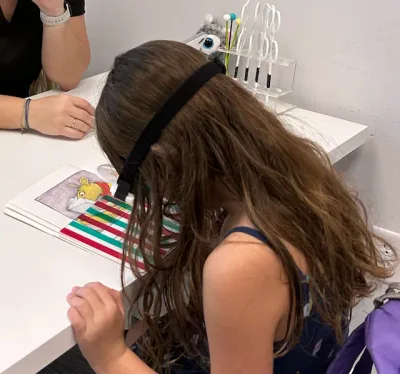
Therapy is active and progressive. Each session builds on what the visual system could do the week before, and the plan is adjusted as symptoms settle rather than run to a fixed script. Between visits, short daily practice is what turns a response the therapist coaxed out in the office into one that holds up in a classroom.
We coordinate with the rest of your team — the neurologist, sports-medicine physician, physical therapist, occupational therapist and primary care physician — so that vestibular work and visual work are not pulling against each other. Our referral network lists the therapists we work alongside across Broward and Palm Beach counties.
What the Research Supports, and What It Does Not
This is where claims get inflated, so here is the field as it actually stands. Every figure below is paired with its limitation.
Most people recover without any of this
The 2022 joint clinical report from the American Academy of Pediatrics, the American Academy of Ophthalmology, AAPOS and AACO concludes that most children and adolescents with visual symptoms after concussion recover on their own by about four weeks, and recommends a vision-specific examination for those who do not (Master et al., 2022). The recovery data agree. Of 275 children with concussion, 67 had an abnormal near point of convergence; 46% of them recovered with standard care at a median of 4.5 weeks, 41% recovered after vestibular therapy that included convergence exercises at a median of 11 weeks, and only 13% were referred for office-based vision therapy, recovering at a median of 23 weeks after injury (Storey et al., 2017). That study was retrospective, and its message is the one we lead with: office-based therapy is for the persistent minority, not for everyone with a headache after a fall.
Randomized evidence now exists — for one specific problem
The CONCUSS trial randomized 104 people aged 11 to 25 who still had symptoms and convergence insufficiency four to twenty-four weeks after a concussion, either to immediate office-based vergence and accommodative therapy or to the same therapy delayed by six weeks. At six weeks, 46 of 52 (88%) in the immediate group were successful or improved on the primary measure — a composite of near point of convergence and positive fusional vergence — against 4 of 52 (8%) in the delayed group, and symptoms improved in 79% versus 13% (Alvarez et al., 2026). A secondary analysis of the same trial found accommodative amplitude improved by about 4.7 diopters in the right eye and 5.1 in the left with immediate therapy, against about 1.0 with six weeks of watchful waiting (Scheiman et al., 2026).
Three limits keep that from being the last word. The comparison group waited rather than receiving a sham therapy, so expectation effects are not ruled out. The primary endpoint was eye-teaming measurements, not overall concussion recovery or return to play. And once the delayed group had completed the same 16 sessions, the two groups' outcomes were equivalent — which is what the investigators mean when they say starting sooner shortens the time spent symptomatic rather than changing where you end up.
One small trial supports a specific home exercise
In 50 people aged 11 to 30 tested within ten days of concussion, home Brock string exercises improved the near point of convergence by 8.9 cm against 3.8 cm with usual care (Trbovich et al., 2025). It was small, single-blind, followed people for only one to two weeks, and measured the clinical sign rather than symptoms, school performance or return to sport. A crossover study of 12 adults with mild traumatic brain injury similarly found oculomotor training improved vergence responses where placebo training changed nothing (Thiagarajan & Ciuffreda, 2013) — a placebo-controlled design, but far too small to generalize from.
The case series are encouraging and uncontrolled
In 218 post-concussion records from two optometric practices, 82% had an oculomotor diagnosis; of the 54% who completed therapy, 85% of the convergence-insufficiency patients were classified successful and 15% improved (Gallaway et al., 2017). In a brain-injury series, 90% of 33 traumatic brain injury completers showed marked or total improvement in at least one symptom and one sign (Ciuffreda et al., 2008). Neither had a control group and both report only on the people who finished — in the first, nearly half did not.
A Cochrane review of five randomized trials with 116 participants concluded that the evidence was insufficient to inform decisions about treating eye-movement disorders after acquired brain injury (Rowe et al., 2018). That review closed before the concussion-specific trials above, so it describes the field as it stood in 2018 — but it is the reason we describe this treatment as supported for particular diagnoses rather than proven in general.
Prism helps some people, on weak evidence
Retrospective series from a single private practice report a 71.8% fall in subjective symptom burden with individualized prism in 43 traumatic brain injury patients (Doble et al., 2010) and reductions of 19.1% to 60.8% on validated headache, dizziness and anxiety measures in 38 post-concussion patients (Rosner et al., 2016). Both are uncontrolled, unmasked, and come from the group that developed both the questionnaire and the treatment. We use prism where the measurements call for it and we describe the evidence for it as low quality, because it is.
Borrowed evidence, and tinted lenses
The strongest trial of this therapy anywhere, CITT, found a successful or improved outcome in 73% of children against 35% on placebo — but those children were uninjured (CITT Study Group, 2008). It is a reasonable starting point, not proof of the same result after a brain injury. On tints: in a chart review of 62 adults with mild traumatic brain injury and photosensitivity, half showed reduced photosensitivity over time, mostly after the first year, and tinted-lens use was associated with persistence rather than recovery (Truong et al., 2014). That association came from a retrospective series with no control group and did not reach conventional statistical significance, so it is a reason to treat tints as a short-term coping tool rather than a treatment — not a reason to forbid them.
What we will not say
We will not tell you that vision therapy cures a concussion, shortens the injury, or gets an athlete back on the field faster. No trial has used overall concussion recovery or return to play as its primary endpoint. We treat the visual functions we can measure, we re-measure them, and we report what we find. The rest belongs to the people managing the injury.
What We Assess, What We Send Back, How to Refer
Most of our concussion patients arrive by referral from pediatricians, neurologists, sports-medicine physicians, urgent care, physical and occupational therapists, athletic trainers and school nurses.
What we assess
Near point of convergence, fusional vergence ranges, accommodative amplitude and facility, saccades and pursuits, vestibulo-ocular reflex and visual motion sensitivity, refraction, ocular health, visual fields, and a written record of symptoms.
What you get back
A written report and treatment plan after the evaluation, in the diagnostic terms you use — convergence insufficiency, accommodative insufficiency, oculomotor dysfunction — with the measured values behind each one, what we recommend, and the school or work accommodations we suggest. Progress updates while a therapy program runs.
How to refer
Send the form from our referral page, fax a hard copy, or call the office. Patients may also self-refer; with their permission we still report back to you. We co-manage rather than take over — the concussion stays yours.
When to send a patient. The AAP clinical report recommends a vision-specific history and examination when visual symptoms have not resolved by about four weeks (Master et al., 2022). Refer sooner for diplopia, a new visual field complaint, or a change in ocular alignment. A normal VOMS or bedside screen is worth knowing about but does not settle the question: physician screening detected 63% of abnormal near points of convergence and 43% of reduced accommodative amplitudes against a full optometric examination (Scheiman et al., 2021).
What we do not do. We do not manage the concussion, order neuroimaging, or make return-to-play decisions. We characterize the visual and oculomotor findings, treat the ones that respond to optical or therapeutic management, and hand the measurements back to you. If the findings point somewhere else — vestibular, neurological, psychological — we say so.
Patients are seen at our Coconut Creek, Boynton Beach, Boca Raton and West Palm Beach offices, which keeps travel manageable for families across Broward and Palm Beach counties.
Concussion & Vision FAQ
How soon after a concussion should I have my vision examined?
The 2022 AAP clinical report states that most children and adolescents recover on their own by about four weeks, and recommends a vision-specific history and examination for those who do not (Master et al., 2022). So four weeks of persistent symptoms is the usual trigger. Come sooner if there is double vision, a new loss of side vision, or a visible change in eye alignment.
Do I need a referral to be seen?
No. Most concussion patients reach us by referral from a physician, therapist or athletic trainer, but you can book directly. With your permission we send the report back to whoever is managing your recovery. Providers can use our referral page.
Will vision therapy speed up my concussion recovery?
We will not claim that. No trial has used overall concussion recovery or return to play as its primary endpoint. What a randomized trial does show is that office-based vergence and accommodative therapy improves eye teaming, focusing and visual symptoms in people whose convergence insufficiency is still present weeks after a concussion (Alvarez et al., 2026). We treat the visual functions we can measure and change, and we say so in those terms.
My child passed the sideline screen and sees 20/20. Could there still be a problem?
Yes. A distance eye chart measures clarity, not focusing stamina, eye teaming at near or eye-movement accuracy. When physicians screened adolescents four to twelve weeks after concussion, they detected 63% of abnormal near points of convergence, 43% of reduced accommodative amplitudes and 48% of positive symptom surveys compared with a full optometric examination (Scheiman et al., 2021).
How long does a post-concussion program take?
The doctor gives you a session count and a timeline after the evaluation, not before it. For context, the therapy programs in the randomized trial ran to 16 sessions, and the two groups came out equivalent once both had completed them (Alvarez et al., 2026). Our sessions are 30 or 45 minutes, one to three times a week.
Do you clear athletes for return to play?
No. We assess and report the visual findings so they can be part of the return-to-activity decision. The decision itself belongs to the physician or sports-medicine clinician managing the concussion.
Is this covered by insurance?
Vision & Learning Center is out of network on all medical insurance plans. If a medical diagnosis is found we provide the procedure and diagnosis codes so you can submit them to your plan for possible reimbursement. See insurance information and cost & payment.
The Research, in Longer Form
Vision Problems After Concussion: What Research Shows
The full evidence review behind this page — prevalence, natural recovery, what screening misses, and what treatment has and has not been shown to do.
Can Vision Therapy Help After a Brain Injury?
The same questions for more serious traumatic brain injury and stroke, where the visual findings are often broader.
Motion Sickness and Dizziness: Is It a Vision Problem?
Why grocery aisles, scrolling and busy hallways provoke symptoms when the visual and vestibular systems disagree.
Migraines and Binocular Vision Dysfunction: The Link
Headache, light sensitivity and eyes that are not working together — a pattern that often outlasts the injury.
Prism Glasses vs Vision Therapy
When a lens relieves the symptom, when therapy rebuilds the skill, and what the evidence supports for each.
Anxiety in Crowded Places: Could Vision Be a Factor?
Visual motion sensitivity is one of the least recognized post-concussion complaints, and one of the most disabling.
Where to Go Next
Concussion & Vision
The condition page: what post-concussion visual dysfunction is, the signs to look for, and who else belongs on the care team.
Vision Rehabilitation
The wider neuro-optometric program for acquired brain injury and stroke, including visual field loss.
Sports Vision
Assessment and training for athletes, including the visual side of returning to competition.
The Three Levels of Care
Where this sits: rehabilitation restores function, vision therapy reaches everyday comfort, sports vision refines past it.
Symptom Checklist
About three minutes at the kitchen table, and a summary you can bring to the appointment.
Examinations
What each evaluation includes, how long it takes and what it costs.
For Referring Providers
The referral form, the fax route, and what we send back after the evaluation.
Still Not Right, Weeks After the Injury?
An evaluation tells you whether vision is part of what is left — and whether it is the part that can be retrained. If it is not, we will say so.