Therapies & Tools

Prism Glasses & Microprisms

Prism and microprism lenses bend light so the eyes can align more comfortably — they can correct double vision (diplopia) and ease other visual misalignments. What they can't do is build visual skills. Here is what prism does, when Dr. Murray prescribes it, and when it only quiets the symptoms.

Children & adults Fresnel & ground-in prism Coconut Creek · Boynton Beach · Boca Raton · West Palm Beach
Overview

What Prism and Microprism Lenses Do

Prism glasses have prismatic lenses that help with binocular vision problems — situations where the two eyes do not align or work together properly. A prism bends light and “moves” where the image lands, so the eyes don't have to work as hard to line up. Microprisms are small amounts of prism built into the lens that redirect the light path to the retinas, allowing the eyes to work together more effectively.

Used well, prism can relieve symptoms from conditions like vertical heterophoria, double vision and post-concussion visual dysfunction. Patients commonly report less:

  • double vision
  • pulling or strain
  • headaches
  • nausea or dizziness
  • the feeling that the “eyes can't keep up”
  • fatigue at reading and screen distance

What prism does not do: it does not train eye teaming, tracking, focusing stamina or visual processing skills. It is a compensatory strategy, not skill-building. And because the brain can adapt to prism over time — a known phenomenon in binocular vision — the amount of prism required can change.

Prism may be used on its own or alongside vision therapy, depending on the diagnosis and goals. Careful binocular testing during a developmental vision evaluation determines whether prism helps and, if so, how much.
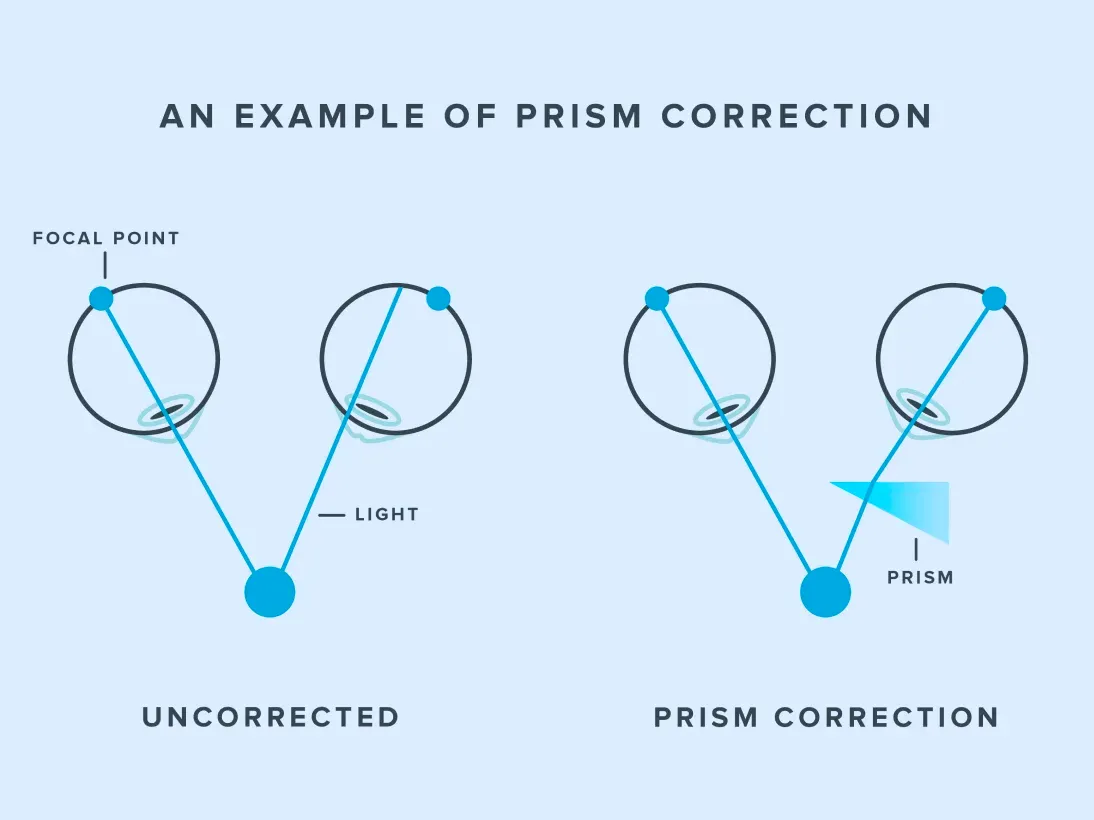
An example of prism correction: uncorrected, light from a single object reaches a different focal point in each eye; with a prism in front of one eye the light is bent so both eyes' images land in matching positions.
Prism redirects the path of light so the image lands where both eyes can use it together.
Indications

When Prism Is Prescribed

Microprisms and prism glasses are prescribed for specific binocular vision problems. These are the most common.

A developmental optometrist typically prescribes prism glasses after a thorough eye examination and an assessment of the individual's visual needs. The decision to prescribe microprisms — or prism in general — is based on the type and severity of the binocular vision problem, the patient's symptoms, and their visual demands at school, at work and behind the wheel.

Types of Prismatic Correction

Fresnel vs. Ground-In Prism

Temporary · trial

Fresnel Prisms

Thin, lightweight plastic prisms that adhere to the back surface of the glasses. They are often used temporarily to determine the appropriate amount of prismatic correction before anything permanent is made.

Because they can deliver a smaller amount of correction, Fresnel prisms essentially act as “microprisms” — useful while a prescription is still being refined.

Permanent

Ground-In Prisms

Prism that is incorporated into the lens itself during the lens-making process. Ground-in prism is usually used when a permanent prism correction is needed.

Once the right amount has been confirmed — often after a trial with Fresnel prism — the correction is built into the finished lenses.

Dr. Murray's Perspective

Why I'm Cautious With Prism Glasses (and Use Them Selectively)

Prism lenses can be very helpful in the right situation. They can also become an expensive, ongoing workaround that reduces symptoms without improving the underlying visual skills that caused the symptoms in the first place. That's why, in my practice, prism is a tool, not the default plan.

Children

Why I Don't Use Prism as a Primary Plan for Children

  1. Children's visual systems are highly adaptable

    That's a good thing for learning, but it can also mean the brain “accepts” the prism and doesn't develop the missing skills as efficiently — especially if the child's issues are fundamentally developmental (tracking, vergence stamina, accommodative control, visual-motor integration).

  2. For convergence insufficiency, prism reading glasses did no better than placebo

    For one of the most common scenarios — symptomatic convergence insufficiency — a placebo-controlled trial found that base-in prism reading glasses were no more effective than a placebo for symptom improvement in children.

    That doesn't mean prism is “bad,” but it does mean: if a child's issue is skill-based, prism is often not the most direct path to durable improvement.

  3. Prism can “quiet” symptoms while school struggles continue

    This is the part that matters most to families. A child may feel some relief, yet still struggle with:

    • stamina for reading
    • losing their place or skipping lines
    • slow, effortful comprehension
    • avoidance behaviors
    • handwriting and spacing issues
    • reduced confidence

    When the core issue is a functional visual skill deficit, the academic cost can continue — just with a different coping strategy. Our problems guide and free symptom checklist walk through what those struggles look like.

  4. Prescriptions change, frames break, lenses scratch

    Kids change prescriptions. Frames break. Lenses get scratched. Symptoms shift with growth and demands. Prism often means repeat visits, remakes and adjustments over time.

Close-up of an optometric trial frame, the adjustable frame used to test lens and prism prescriptions during an eye examination.
A trial frame — how a prism prescription is tested before it is ever ground into a lens.
Adults

Why I'm Cautious With Prism for Adults (Especially High Prism)

Adults are different: prism can be genuinely helpful for certain stable patterns of diplopia and alignment issues, and professional guidance often includes prism as an option for symptomatic diplopia management.

I see many adults who arrive in prism with a history that looks like this:

1

Mild symptoms → prism gives relief

The first prescription lowers the demand on the eyes and the symptoms ease.

2

More stress, screen time or fatigue → symptoms return

The demands of life go up, and the same prism no longer keeps the symptoms away.

3

Prism is increased → relief again

A stronger prescription buys another stretch of comfort.

4

Repeat…

Each cycle supports the system a little more without rebuilding it.

This can happen because prism reduces demand, but doesn't increase capacity (fusional reserves, flexibility, stamina). If the system is decompensating, you can keep “supporting” it without rebuilding it.

A randomized study in young adults with convergence insufficiency found prism lenses reduced symptoms, but did not significantly improve several objective clinical measures (for example, near point of convergence and fusional vergence) — underscoring the “symptom relief vs. skill change” gap.

Compensation vs. Long-Term Solutions

The Hidden Cost Isn't Just Money — It's Lifestyle Limitation

Adults with unresolved functional vision issues often compensate by:

avoiding night driving
limiting screen time (or paying for it afterward)
declining promotions or advanced coursework
reducing reading for pleasure
pushing through headaches and fatigue as “normal”

Prism may make this tolerable. But tolerable is not the same as fixed.

The Right Tool

When Prism Is Appropriate (and I Will Recommend It)

I do use prism when it's the right tool — especially when the goal is immediate functional relief, or when the deviation pattern is not realistically trainable. Common examples:

Prism can be part of a thoughtful plan. The issue is using it as the only plan when the true problem is skill-based. See how prism stacks up against the other options on our comparisons page.

Our Approach

When Symptoms Persist, Here Is My Preference

Especially with reading, attention, headaches, fatigue, dizziness or avoidance.

1

Confirm eye health and the prescription

Necessary, but not sufficient. A healthy eye with the right glasses can still be a poorly coordinated visual system.

2

Measure functional vision

Eye teaming, tracking, focusing, stamina, suppression and more — the skill layer a routine exam does not test. See what our evaluation covers.

3

Use the right tool

Lenses when appropriate; targeted therapy or rehabilitation when skills are the limiter; and prism only when it truly matches the problem.

This is also why many patients who were told “everything looks normal” still struggle: a standard exam can miss the functional skill layer that drives day-to-day performance.

Common Questions

Prism Glasses FAQ

I already wear prism glasses. Should I stop wearing them?

Important: don't discontinue prism abruptly without clinician guidance, especially if you've worn it for a long time or you have constant diplopia. Depending on your pattern, the correct plan may be to keep prism temporarily, evaluate the underlying function, reduce prism strategically if and when the system improves — or maintain prism if it is genuinely the best long-term tool for you. Bring your current glasses to your evaluation so we can measure with and without them.

Does prism train the eyes or fix the underlying problem?

No. Prism moves where the image lands so the eyes do not have to work as hard to line up. It does not train eye teaming, tracking, focusing stamina or visual processing — it reduces the demand on the visual system rather than increasing its capacity. That is why it is a compensatory strategy, and why vision therapy is the tool we reach for when the problem is skill-based.

Why did my prism prescription keep increasing?

The brain can adapt to prism over time — a known phenomenon in binocular vision — so the amount of prism required can change. In adults we often see a cycle: mild symptoms, prism gives relief, more stress or screen time brings the symptoms back, the prism is increased, and the cycle repeats. If the system is decompensating, prism can keep supporting it without rebuilding it.

Can prism and vision therapy be used together?

Yes. Prism may be used on its own or alongside vision therapy, depending on the diagnosis and goals. A common approach is a bridge strategy: short-term prism for symptom relief while therapy or rehabilitation addresses the underlying system, then reducing the prism strategically as function improves.

Our Commitment

We Stand Behind Our Care

We don't just “support” symptoms — we work to change the system. That's why we offer a money-back guarantee when attendance and home program requirements are met (details are provided in your program agreement).

Most workarounds can't offer that, because they aren't designed to create lasting change.

Not Sure Whether Prism Is the Right Plan?

An evaluation measures the functional skill layer a standard exam can miss — then gives you an honest answer about whether lenses, prism, therapy or a combination fits your pattern, at our Boynton Beach and Boca Raton offices.