Dyslexia & Vision
Dyslexia is not caused by the eyes — but an untreated vision problem can make a dyslexic child work even harder to read.
Watch: a short video
Dyslexia and vision: check both
Dyslexia and Vision: Why Check Both
What to Know About Dyslexia & Vision
Dyslexia is a language-based learning difference, and vision therapy is not a treatment for dyslexia itself. We want to be clear about that, because it matters.
What we can do is rule a vision problem in or out. Many children carry both a dyslexia diagnosis and an undetected eye-teaming, tracking, or focusing problem. When that second problem goes unaddressed, it adds a layer of effort and fatigue on top of the reading difficulty — so even excellent reading instruction has to fight uphill.
A developmental vision evaluation tells you whether vision is adding to the load. If it is, building those visual skills removes a real obstacle so tutoring, reading programs and classroom support can work better.
Why a Bright Child May Not Learn to Read
Most bright children — about eight out of ten — practically teach themselves to read. It doesn’t matter much which reading program is used; the child rapidly masters the skills. Dyslexia is the term used when a child does not respond to a standard reading program and has to be guided one tiny step at a time. It is a catch-all for any condition that makes it difficult for an otherwise bright child to learn to read, and different children have different reasons — or combinations of reasons — for not learning. These are a few of the more common ones.
- Language problems. The child may not understand the meaning of the words, or may not be familiar with the language. If you read an age-appropriate story aloud and the child does not understand it, a language problem is very likely tied to the reading problem. If the child understands easily when read to, the most serious obstacle to reading comprehension is probably not present.
- Phonemic awareness. The child cannot hear a stream of sound and break it into its parts — that doghouse is made of dog and house, or that coat is the “k” sound plus oat. Children who do not hear the sounds inside words have difficulty with typical phonics programs, because they cannot hear the sounds they are being asked to match to letters.
- Automatic naming. The child is very slow to look at a symbol, remember what to call it, and get the sound out. Poor automatic naming makes sounding out words slow going; the better that child’s ability to recognize whole words, the quicker reading becomes.
- Visualization. The child either cannot picture words in his mind or has never been taught to picture them. He sounds out a word in one line and does not recognize the same word in the next. A child who pictures words easily may have a good sight vocabulary and still be unable to sound out a word seen for the first time — and when it comes to comprehension rather than decoding, a child who has not learned to picture the story being read is at a disadvantage.
- Spatial perception and eye-teaming. The child is confused by symbols when they are crowded together. He can recognize a word with the letters large and well spaced on a flashcard, but not the same word small and crowded into a line of print. That confusion can come from print doubling and running together because of eye-teaming problems such as convergence insufficiency. We describe the same pattern on our Vision in the Classroom page.
- Directionality. The ability to understand right and left in space. A young child has two directions: “toward me” and “away from me.” A b and a d are both a line with a half-circle, and the circle goes outward, or away from me — so the child does not understand how a b is different from a d. That is a different problem from simply not remembering which letter is which: to this child, b and d look the same, and the usual tricks for teaching the difference may not work until the directionality problem is addressed.
What a Developmental Vision Evaluation Is For
The purpose of our Developmental Vision Evaluation is to get to the heart of what is causing the reading problem. It could be any or all of the reasons above. Only a reading specialist is trained to work around the reasons children do not learn to read — but if the reasons themselves are removed, there is far less to work around. Once a child can comfortably look at the parts of a word, picture the parts of a word in his mind, and hear the parts of the word, the learning rate should increase, and it becomes relatively easy to go back to the beginning and fill in the missing reading skills.
The review process is still necessary, because our vision therapy programs do not teach missing phonics skills. The difference is that the review can generally now be done by a good tutor, a home educator or a reading specialist — because the child no longer has to sound out the same word in one line that he already sounded out in the line before.
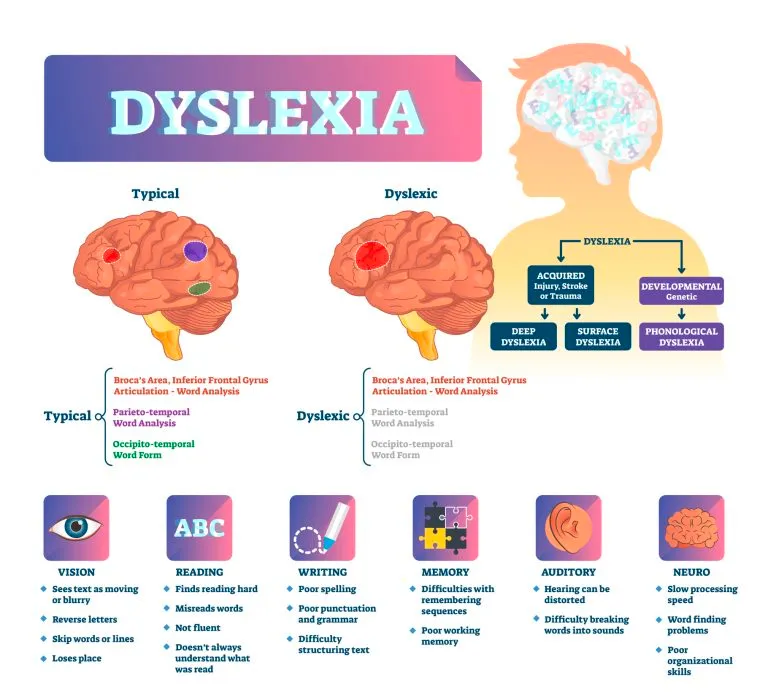
The Phonetic and Eidetic Processes of Reading
Learning to read requires both phonetic and eidetic processes — the two cognitive routes we use to decode and encode words. Visual skill deficits can interfere with both, in a host of different ways. Vision problems can affect sight recognition, reading comprehension, memorization, recall, fluency, speed and rhythm, and how long a child can keep reading or writing before quitting.
To explain how a developmental optometrist can help identify and manage vision-related learning difficulties in dyslexic individuals, it helps to walk briefly through some of the categories of dyslexia.
The terms below are here for your information, but the label is not what matters (though sometimes a label is necessary to begin the right treatment and management). What is important is what can be done about the difficulties the child is having, to make learning easier. Don’t let the labels and terms make you forget the child.
Three Common Types of Dyslexia
- Dysphonesia. The primary problem is letter–sound integration: these readers are unable to identify words or letters with their accompanying phonetic sounds, so they cannot attack an unfamiliar word using phonics, syllabication or structural analysis. It is a decoding problem, and dysphonetic readers rely on eidetic coding instead — essentially memorizing words rather than sounding them out, the way most of us store pneumonia or mnemonics. They may recognize familiar words but cannot efficiently decode unfamiliar, multisyllabic ones: taught the word deal, they may still have difficulty with seal, or not know how to read dealing. These children tend to need educational help more than optometric remediation — though remediating any vision problem that is adding to the difficulty is always helpful.
- Dyseidesia. The opposite pattern: a whole-word problem. Words are normally recognized by their shape and configuration, and dyseidetic readers lack the ability to take a whole word in as a unit symbol, or gestalt. They can use phonetics, syllabication and structural analysis, so what they lack is whole-word recognition. It is more of an encoding problem: they have trouble storing information, which involves sequential memory (knowing the right order of things), so retrieval is difficult too. Relying on phonetic coding instead often shows up as spelling that sounds right and is wrong. Researchers have found deficits here in short-term visual memory (recalling what was seen), visual discrimination (telling visual patterns apart), visual figure–ground (picking one thing out of a busy field, as in Where’s Waldo) and visual sequential memory (visualizing in a particular order). These are the skills visual perceptual training addresses, and building them can support reading and comprehension — alongside proper reading instruction, never instead of it.
- Dysnemkinesia. A dysfunction involving memory and motor movement, distinguished by an abnormally high frequency of letter reversals. It is the type most people picture when they hear the word dyslexia, and it is really a developmental issue: poor development of the visual-spatial skills known as laterality and directionality. Symbol orientation is the sticking point — p, b, q and d are all the same symbol turned different ways, and these readers do not see them as different letters. They tend to transpose letters and syllables, show faulty eye movements and excessive reversals, and have spatial difficulties. Sight recognition is often poor and a sight vocabulary is hard to build, so reading is slow and difficult and they read and spell phonetically. Of the three, dysnemkinesia is the subtype most directly related to the visual-spatial skills a developmental optometrist evaluates and treats.
Want the evidence rather than our word for it? Our vision & dyslexia study library collects 38 peer-reviewed papers published between 1990 and 2018, with their abstracts, on how visual function and reading difficulty overlap.
Two related reads: Are letter reversals always a sign of dyslexia? and Anthony’s vision therapy journey. If reading and schoolwork are the concern, our Vision in the Classroom page and the two-minute symptom checklist are useful next steps, and signs of a vision problem is a good place to start if you are not sure what you are seeing.
Signs & Symptoms
- Reading is slow and exhausting beyond what the dyslexia diagnosis explains
- Loses place, skips lines, or re-reads
- Recognizes a word on a well-spaced flashcard but not in a crowded line of print
- Sounds out a word in one line and does not recognize the same word in the next
- Confuses b and d (or p and q) long after most children have sorted them out
- Slow to name letters, numbers or familiar words on sight
- Headaches or eye strain with sustained reading
- Avoids near work even with appropriate reading support in place
How We Help
Care starts with a comprehensive developmental and binocular vision evaluation that pinpoints exactly what's happening. From there, Dr. Murray builds an individualized plan — which may include lenses or prism, in-office vision therapy, and coordination with your other providers — at our Boynton Beach and Boca Raton offices.
Want a deeper read? See Learning-Related Vision Problems, Explained.
Related Topics
More on Vision & Learning/Reading
The visual skills reading depends on, and what it looks like when they are not working.
- Start hereVision and Learning: How Visual Skills Affect SchoolHow eye teaming, focusing, tracking and visual processing support reading, writing and math - what screenings…
- Can a Child Have 20/20 Vision and Still Struggle to Read?Yes. 20/20 measures sharpness only. A child with 20/20 vision but struggling with reading may have eye…
- Everything Looks Normal, So Why Is My Child Struggling?Told the eye exam looks normal but your child still struggles with reading? Here is what screenings and…
- Struggling With Reading? It Might Be VisionThe signs that a struggling reader's eyes are part of the problem, what a school screening misses, and how to…
- The Vision Problem Behind School StrugglesA child can pass every school vision screening and still fight their eyes through homework. Here is how…
- Are Letter Reversals Always a Sign of Dyslexia?Backwards b's and d's are normal in early writers. Here is why young brains mirror letters, what dyslexia…
- Spelling Struggles: When Vision Plays a RoleSpelling is mainly a language skill, but eye teaming, focusing and visual-motor skills can add to the…
- Why Your Child's Handwriting Isn't ImprovingHandwriting has a large visual component that practice alone does not train. What the research shows about…
- How We Measure Eye Movements During ReadingInfrared recording shows where a child's eyes stop, jump and backtrack while reading. What fixations,…
- What School Vision Screenings MissSchool vision screenings catch some problems and miss others. Here is what the screening research shows, and…
- Vision Problems vs ADHD: How to Tell the DifferenceSome vision problems look like inattention during reading and homework. See what the research shows about…
- Vision Therapy and Executive Function: What We KnowPlanning, focus and working memory are brain skills, not eye skills. Here is where visual effort fits in, and…
Concerned About This?
An evaluation will tell you clearly whether this is what's going on — and what to do next.