How We Measure Eye Movements During Reading
When a child reads, the eyes do not glide smoothly along the line. They stop, jump, stop again, and every so often go backwards. Almost all of the reading happens during the stops.
We can record that pattern. Your child wears a lightweight infrared recorder — ours is a ReadAlyzer — that sits in front of the eyes like a pair of goggles, and reads a passage at their level, silently, at their own pace. Afterwards we ask questions about what they read. Putting the eye-movement record next to the comprehension score is far more informative than either one alone.
Key takeaways
- Reading is built from fixations (stops), saccades (forward jumps) and regressions (backward jumps). All three are recorded.
- The report gives fixations and regressions per 100 words, average fixation duration, reading rate and comprehension.
- Slower readers reliably make more and longer fixations, shorter jumps and more regressions — but that pattern is largely a result of reading being hard, not proof of its cause.
- Vision therapy has not been shown to raise reading scores. We use this test to find eye-teaming, focusing and tracking problems worth treating on their own merits.
- The recording is one piece of a full developmental vision evaluation, never a diagnosis by itself.
What the recorder is actually measuring
Stops, jumps and backtracks
A fixation is the brief pause when the eyes are still and the brain is decoding a word. In skilled readers a fixation averages roughly 250 milliseconds (Degno & Liversedge, 2020). A saccade is the jump to the next landing spot, covering something like six to ten letter spaces in adult readers (Rayner et al., 2010). A regression is a jump backwards to re-read something. Everyone makes them; they are part of normal reading, not a defect.
None of these are fixed personal traits. Fixation durations and jump lengths shift from moment to moment with how difficult the text is and how well it is being understood — the central finding of decades of reading research (Rayner, 1998).
How much you take in on each stop
On a single fixation you are not reading one letter. In skilled readers of English, useful information comes from about three to four letter spaces to the left of the landing point and fourteen to fifteen to the right. That window is called the perceptual span, and in the same research slow readers had a smaller span than fast readers, along with shorter saccades and longer fixations (Rayner et al., 2010).
A quick demonstration. Read the sentence below once, at normal speed, and count the letter F.
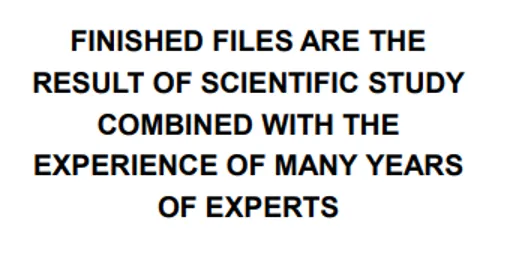
There are six. Most readers count three — the F’s in FINISHED, FILES and SCIENTIFIC — and miss all three in the word “of.” Part of that is word skipping: how likely a word is to be skipped rather than fixated depends strongly on its length and how predictable it is (Rayner et al., 2011), and short, highly predictable words like “of” are prime candidates. Part of it is probably not visual at all — the F in “of” is pronounced like a V. We use the puzzle as an illustration, not as a test, but it makes the point neatly: what your eyes land on and what you think you read are not the same thing.
Reading the report
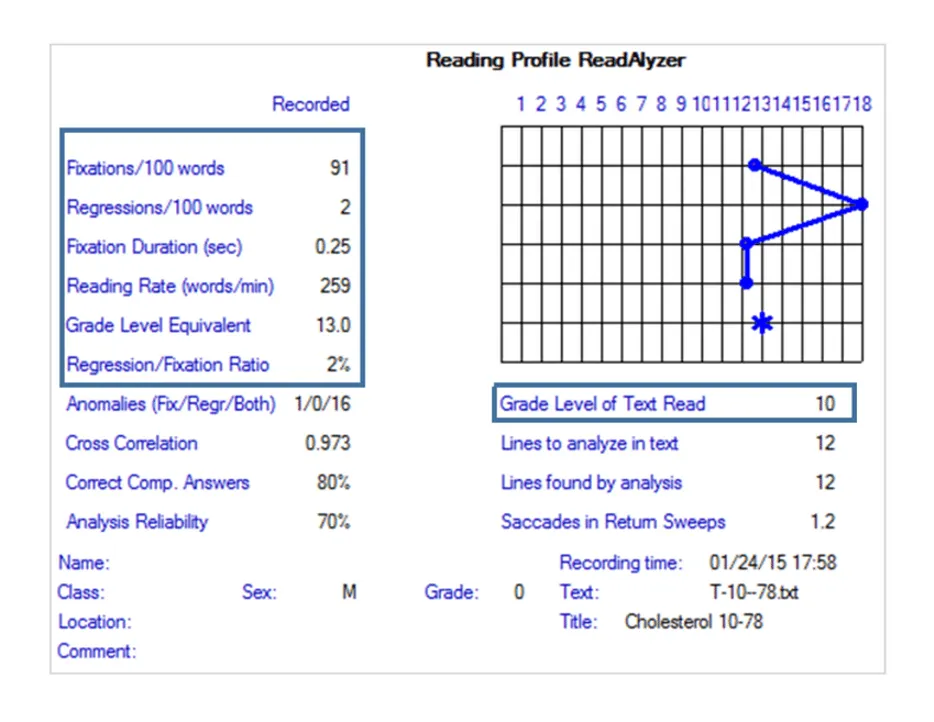
The printout looks technical, but only a handful of rows do the work:
- Fixations per 100 words — how many stops it took to get through the passage. More stops means slower going.
- Regressions per 100 words — how often the eyes went back. Frequent backtracking usually signals that something was not held on the first pass.
- Fixation duration — how long each stop lasted, in seconds.
- Reading rate — words per minute, which follows directly from the first three.
- Grade level of the text and grade-level equivalent — the difficulty of the passage read, and the grade whose norms this record most resembles.
- Comprehension — the percentage of questions answered correctly.
Comprehension is the anchor. A tidy, efficient record with poor comprehension points away from the visual system and towards decoding, vocabulary or attention. A laboured record with good comprehension tells us a child is buying comprehension with effort, which is exactly the child who melts down over a twenty-minute homework page. For context, typical reading runs at about 250 words per minute, and pushing far past that costs comprehension (Rayner et al., 2016).
About the grade-level norms
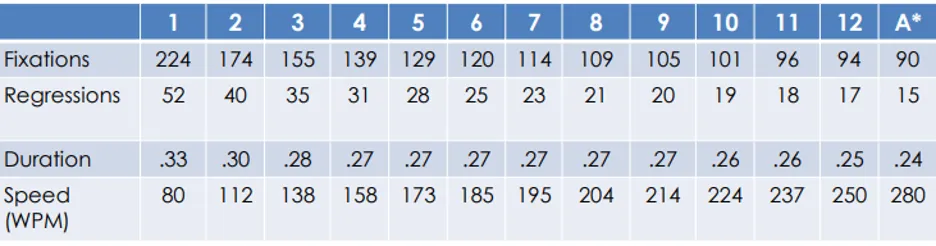
Manufacturer-supplied grade norms (Taylor, Educational Developmental Laboratories). These are vendor reference values, not peer-reviewed published norms.
These are the norms this instrument compares a record against. The shape of the table is the useful part: as reading develops, fixations and regressions fall, fixation duration shortens and speed climbs. Read the individual cells loosely. These tables are old, the samples behind them are not published alongside the instrument, individual variation between children is wide, and a single number never earns a diagnosis.
The limit that matters most
Eye movements during reading largely reflect the reading. Fixation durations and regressions rise when text is harder or comprehension is slipping (Rayner, 1998; Degno & Liversedge, 2020). So an inefficient record tells us a child is struggling with this passage — it does not, by itself, tell us the eyes are why.
Two findings mark the boundary. In 5,822 children aged 7 to 9, four of every five with severe reading impairment had entirely normal ophthalmic function, and no association was found with convergence or accommodation (Creavin et al., 2015). And the largest trial to test the reading question head-on found vergence and accommodative therapy no better than a placebo program for reading comprehension, at 3.7 points of improvement versus 3.8 (CITT-ART, 2019).
We lay out the full evidence, including where the professional bodies disagree, in binocular vision and reading: what is and isn’t proven.
What we do with the result
Our position is deliberately narrow. We do not treat dyslexia, and we do not promise better grades from a therapy program. What we do is use the recording as one input alongside convergence, focusing, tracking and visual processing testing in a full developmental vision evaluation.
If that workup turns up a treatable binocular or focusing problem, we treat it because near work is uncomfortable, not because a reading score is low. Symptomatic convergence insufficiency is the best-supported condition we treat, and the trial record behind it, including the parts that complicate it, is set out in what the trials show. You can read how we structure that work in our vision therapy goals and procedures, and more about the eye movements themselves in our guide to ocular motor dysfunction.
If the workup is clean, we say so plainly and point you towards the reading specialist, teacher or pediatrician who can help. For the wider picture, see our overview of vision and learning and our page on reading difficulties.
What to expect at the appointment
The recording takes only a few minutes. There are no drops, nothing touches the eye and there is nothing to fail. We go through the printout with you and explain which numbers we think matter and which we are setting aside.
If reading is a fight in your house and you want to know whether the visual system is part of it, a comprehensive developmental vision evaluation is the place to find out. Schedule an evaluation at our Boynton Beach or Boca Raton office.
Common Questions About This Topic
Does the eye-movement recording hurt, or use drops?
No. Your child wears a lightweight recorder that sits in front of the eyes like a pair of goggles and reads a passage silently. Nothing touches the eye, no drops are used and there is no bright light to tolerate. Most children finish in a few minutes.
Does my child have to read out loud?
No. The passage is read silently at your child's own pace, then we ask comprehension questions about what they just read. Reading silently is what we want to measure, because that is how most schoolwork actually happens.
Do poor eye movements cause dyslexia?
No. Dyslexia is a language-based reading disorder, and eye-movement patterns during reading largely reflect how hard the text is for the reader rather than the state of the eyes. We use this test to find eye-teaming, focusing and tracking problems that are worth treating in their own right, not to diagnose or treat a reading disability.
What does a slow reading rate on the report actually tell you?
On its own, very little. Reading rate is a combined result of decoding, vocabulary, comprehension and eye-movement efficiency all at once. That is why we read the rate alongside the comprehension score, the rest of the binocular vision examination and what you and your child's teachers are seeing.
Will you repeat the test later?
Yes, when it is useful. Repeating the recording at a progress evaluation and at the end of a therapy program gives you a side-by-side picture of what changed. We interpret any change carefully, because reading practice at school changes these numbers too.
Where This Information Comes From
- Rayner K (1998). Eye movements in reading and information processing: 20 years of research. Psychological Bulletin; 124(3):372-422. : Landmark review concluding that eye-movement data reflect moment-to-moment cognitive processing during reading.
- Degno F, Liversedge SP (2020). Eye Movements and Fixation-Related Potentials in Reading: A Review. Vision (Basel); 4(1):11. : Fixations in reading last on average about 250 ms, and fixation duration is widely accepted to reflect online cognitive processing.
- Rayner K, Slattery TJ, Belanger NN (2010). Eye movements, the perceptual span, and reading speed. Psychonomic Bulletin & Review; 17(6):834-839. : The perceptual span in skilled readers spans 3-4 letters left and 14-15 letter spaces right of fixation; slow readers had a smaller span, shorter saccades and longer fixations than fast readers.
- Rayner K, Slattery TJ, Drieghe D, Liversedge SP (2011). Eye movements and word skipping during reading: effects of word length and predictability. Journal of Experimental Psychology: Human Perception and Performance; 37(2):514-528. : Word length and predictability both had strong effects on how likely a word was to be skipped rather than fixated.
- Rayner K, Schotter ER, Masson MEJ, Potter MC, Treiman R (2016). So Much to Read, So Little Time: How Do We Read, and Can Speed Reading Help? Psychological Science in the Public Interest; 17(1):4-34. : Typical reading runs about 250 words per minute, and doubling or tripling that without losing comprehension is unlikely; language skill is the main driver of reading speed.
- Creavin AL, Lingam R, Steer C, Williams C (2015). Ophthalmic abnormalities and reading impairment. Pediatrics; 135(6):1057-1065. : In 5,822 children aged 7-9, four of five with severe reading impairment had normal ophthalmic function and no association was found with convergence or accommodation.
- CITT-ART Investigator Group (2019). Effect of Vergence/Accommodative Therapy on Reading in Children with Convergence Insufficiency: A Randomized Clinical Trial. Optometry and Vision Science; 96(11):836-849. : In 310 children, reading comprehension improved 3.7 points with office-based therapy versus 3.8 points with placebo therapy.
Care We Provide
More From the Blog
Wondering If This Sounds Like Your Family?
A developmental vision evaluation measures the skills a routine eye exam does not. Our team sees children and adults in Coconut Creek, Boynton Beach, Boca Raton and West Palm Beach.