Learning & Reading

Vision, ADD & ADHD

Vision problems and ADD/ADHD share a long list of symptoms. Before you assume it is attention, it is worth ruling out a binocular vision disorder.

Children & teens We do not diagnose or treat ADHD Coconut Creek · Boynton Beach · Boca Raton · West Palm Beach

Watch: a short video

Watch

Is It ADD/ADHD, or Is It Vision?

Overview

How Can Vision Problems Contribute to ADD/ADHD Symptoms?

Attention and vision are deeply linked. If a child's eyes do not team or focus efficiently, sustaining near work becomes genuinely tiring — and a tired visual system pulls attention away from the task.

The tell is often where the attention problem shows up. A child who can focus for an hour on a movie or a video game but falls apart during reading and homework may have a vision problem driving the near-work struggle, not a general attention disorder.

We do not diagnose or treat ADHD. We evaluate whether a vision problem is contributing, and treat that when it is — frequently alongside the child's pediatrician, psychologist, or school team.

Watch

Is Your Child's ADHD Linked to Vision?

How a child's eyes can affect their ability to focus, and what a functional vision problem looks like in the classroom.

Is Your Child's ADHD Linked to Vision? (about 6 minutes)
What the Guidelines Say

Ruling Other Causes Out Is Part of the Process

The diagnostic guidance for ADHD already asks that other explanations be excluded first — and names vision testing among them.

The Centers for Disease Control and Prevention state on their website that, to determine whether a child has ADHD:

“One step of the process involves having a medical exam, including hearing and vision tests, to rule out other problems with symptoms like ADHD. …”

“The health professional should also determine whether the child has another condition that can … explain the symptoms better…”

— Centers for Disease Control and Prevention

Before a child is diagnosed with ADHD it is vital to rule out a binocular vision disorder, due to the similarity in symptoms to ADHD.

There is a second reason this matters. According to the Diagnostic and Statistical Manual of Mental Disorders (DSM-V), the symptoms must be present in two or more settings for six months or longer. When a student has a binocular vision disorder, the symptoms will also be present in multiple settings — because they occur whenever the student is trying to read. Meeting the "two or more settings" criterion, on its own, does not distinguish one from the other.

Why a Screening Isn't Enough

A 20/20 Result Does Not Rule Vision Out

The key point: when children struggle to pay attention in school, acuity is often checked — and vision is then incorrectly ruled out.

Acuity is measured at 20 feet. Reading happens at 18 inches.

When children struggle to pay attention in school, visual acuity is often checked and vision is then incorrectly ruled out as a possible cause. Acuity is strictly a measure of how clearly one can see the letters on an eye chart 20 feet away. Reading takes place within arm's distance — around 18 inches.
There are 17 visual skills required for academic performance.

Seeing the letters on the eye chart is just one of them. Vision screenings are not designed to test all of these skills, yet if a child is missing even one of them, academic performance can be negatively impacted.

Most children with a binocular vision disorder have excellent acuity.

A 20/20 result does not mean the visual system is working well. It means the eyes resolve detail at distance — which is not the demand reading places on them.

Binocular vision disorders include problems with eye coordination, eye tracking and eye focusing — which can make print look blurry, double, and often appear to move on the page. Children can lose their place when reading and often have difficulty remembering or comprehending what they have read. Reading fluency often suffers as well.

Where the Symptoms Overlap

The Same Behaviors, Two Different Causes

Inattention, distractibility, avoiding schoolwork and trouble finishing near work appear on both lists — which is exactly why one gets mistaken for the other.

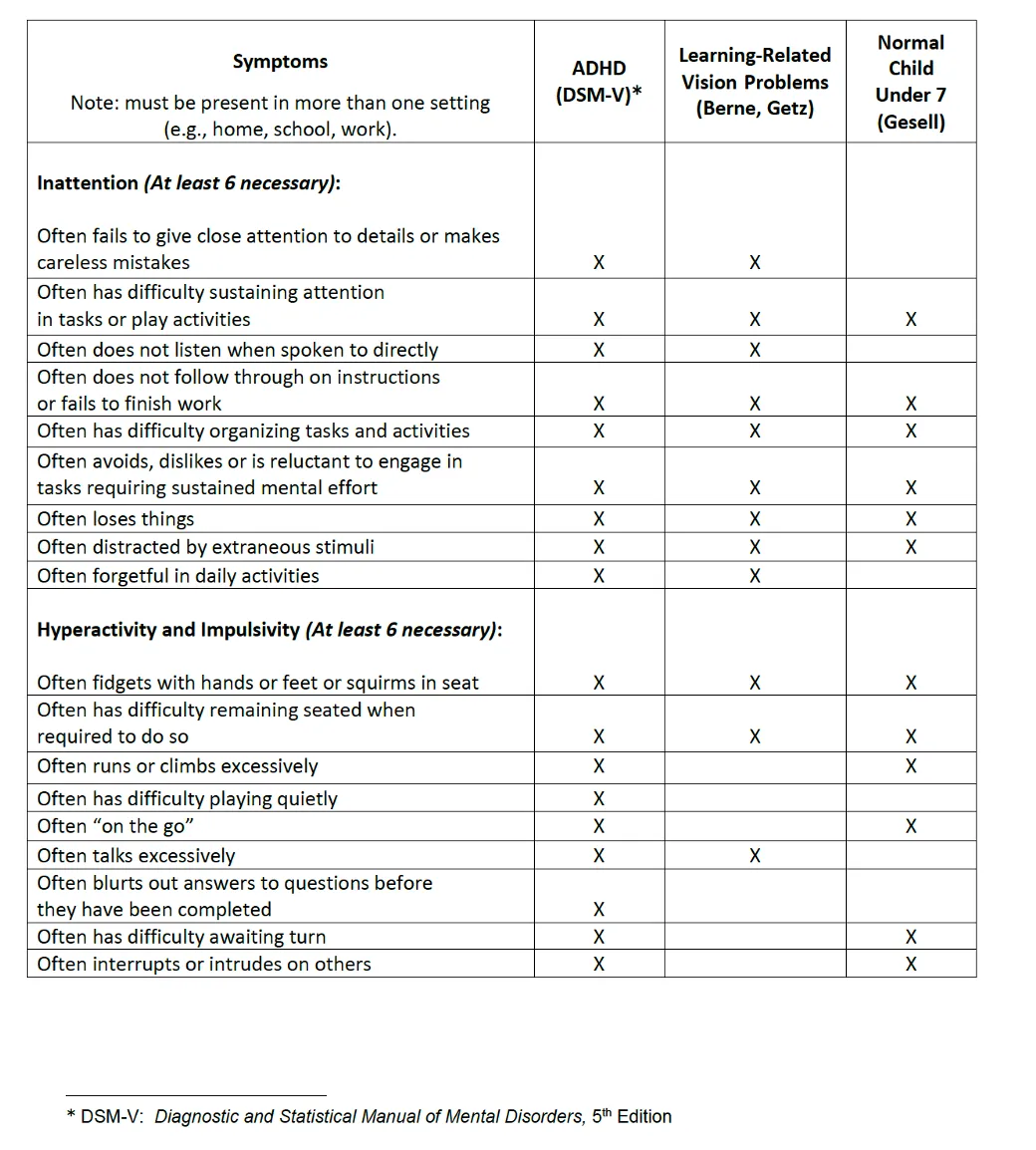
The chart below sets the eighteen DSM-V symptoms of ADHD beside the same behaviors as they are described in learning-related vision problems (after Berne and Getz) and in the normally developing child under the age of seven (after Gesell). A check mark means that column's list includes that behavior.

Two things stand out. Almost every inattention symptom appears in all three columns — so the behavior alone does not tell you which explanation fits. And read the third column carefully: a great many of these behaviors are simply where a child under seven is developmentally, which is one more reason a symptom list on its own does not settle the question.

Note: symptoms must be present in more than one setting (e.g. home, school, work).

Symptom ADHD (DSM-V) Learning-Related Vision Problems (Berne, Getz) Normal Child Under 7 (Gesell)
Inattention (at least 6 necessary)
Often fails to give close attention to details or makes careless mistakes Yes Yes No
Often has difficulty sustaining attention in tasks or play activities Yes Yes Yes
Often does not listen when spoken to directly Yes Yes No
Often does not follow through on instructions or fails to finish work Yes Yes Yes
Often has difficulty organizing tasks and activities Yes Yes Yes
Often avoids, dislikes or is reluctant to engage in tasks requiring sustained mental effort Yes Yes Yes
Often loses things Yes Yes Yes
Often distracted by extraneous stimuli Yes Yes Yes
Often forgetful in daily activities Yes Yes No
Hyperactivity and Impulsivity (at least 6 necessary)
Often fidgets with hands or feet or squirms in seat Yes Yes Yes
Often has difficulty remaining seated when required to do so Yes Yes Yes
Often runs or climbs excessively Yes No Yes
Often has difficulty playing quietly Yes No No
Often “on the go” Yes No Yes
Often talks excessively Yes Yes No
Often blurts out answers to questions before they have been completed Yes No No
Often has difficulty awaiting turn Yes No Yes
Often interrupts or intrudes on others Yes No Yes

DSM-V: Diagnostic and Statistical Manual of Mental Disorders, 5th Edition. The learning-related vision column follows Berne and Getz; the under-seven column follows Gesell.

The original comparison chart, transcribed in the table above.
Signs & Symptoms

What Parents Tend to Notice

None of these confirms a vision problem on its own — but together they are a good reason to have the visual system measured.

  • Focus is fine for distance or preferred tasks but fails during reading and near work
  • Fidgets, looks away, or rushes to finish close work
  • Loses their place when reading; skips words or lines
  • Difficulty remembering or comprehending what was just read
  • Reading fluency suffers — slow, choppy, or frequent re-reading
  • Print looks blurry, doubled, or seems to move on the page
  • Complaints of tired eyes, headaches, or words swimming
The Bottom Line

Before You Assume It's ADD or ADHD

It is vital that you rule out the possibility that a binocular vision problem may be contributing to the child's difficulties. An evaluation either finds a treatable visual cause — or removes one more unknown, so the rest of the team can move forward with confidence.

Common Questions

Vision, ADD & ADHD FAQ

Should vision be checked before an ADHD diagnosis?

The CDC describes ruling out other problems as part of the diagnostic process, and specifically names vision testing: "One step of the process involves having a medical exam, including hearing and vision tests, to rule out other problems with symptoms like ADHD." Because a binocular vision disorder produces overlapping symptoms, ruling one in or out before assuming ADD or ADHD is worthwhile.

My child passed the school vision screening — can vision still be involved?

Yes. A screening checks how clearly the eyes see an eye chart 20 feet away. Reading happens at about 18 inches, and there are 17 visual skills required for academic performance — acuity is only one of them. Most children who struggle with a binocular vision disorder have excellent acuity. Read more about what school vision screenings miss.

ADHD symptoms have to show up in more than one setting. Doesn't that rule vision out?

Not by itself. The DSM-V requires that symptoms be present in two or more settings for six months or longer. When a student has a binocular vision disorder, the symptoms are present in multiple settings too — because they occur whenever the student is trying to read, at school and at home alike.

Do you diagnose or treat ADHD?

No. We do not diagnose or treat ADHD. We evaluate whether a vision problem is contributing to the difficulties, and treat that when it is — frequently working alongside the child's pediatrician, psychologist or school team. If vision is not the issue, you have ruled out one hidden cause and can move forward with confidence.

Rule Vision In or Out

An evaluation tells you clearly whether a binocular vision disorder is part of what you are seeing — and what to do about it if it is.