Vision Problems vs ADHD: How to Tell the Difference
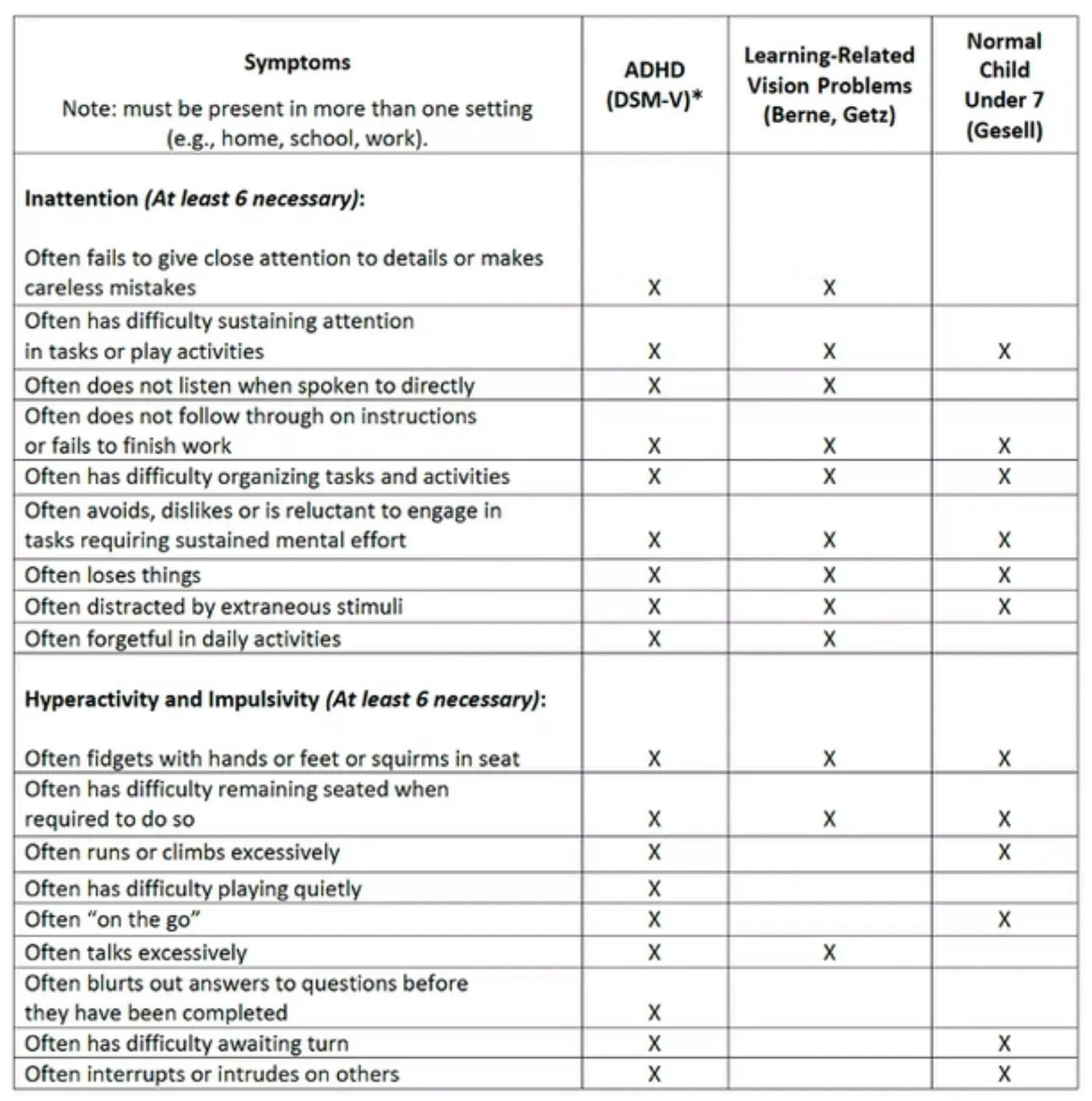
A legacy reference chart kept from the original version of this post. Its columns are attributed to Berne and Getz for learning-related vision problems, and to Gesell for typical development under age 7. It is a teaching aid used in our field, not a research finding, and it is not a diagnostic tool.
Parents ask us this question almost every week, and it is a fair question.
A child who avoids reading, drifts off during homework, complains of headaches, rereads the same line four times, or melts down over a worksheet can look inattentive from across the room. Sometimes that is exactly what it is. Sometimes the visual system is making close work far harder than it should be, and the behavior we see is the child’s response to that effort.
Both can also be true at the same time. Our job is not to talk anyone out of an ADHD evaluation. It is to make sure the visual side of the picture actually gets looked at before a family settles on a single explanation.
Key takeaways
- Convergence insufficiency, a common near-vision problem, causes trouble concentrating, headaches, tired eyes and losing your place while reading. You can have perfect eyesight and still have it (National Eye Institute, 2024).
- ADHD and functional vision problems occur together more often than chance would predict (Granet et al., 2005; DeCarlo et al., 2016; Bellato et al., 2023). That is an association, not evidence that one causes the other.
- Vision therapy is not a treatment for attention. In the largest trial to test the question, office-based therapy for convergence insufficiency did not improve attention any more than placebo therapy did (CITT-ART, 2021).
- What vision therapy does have strong evidence for is narrower: treating symptomatic convergence insufficiency in children (CITT, 2008; Scheiman et al., 2020).
- In the later CITT-ART trial, the clinical signs improved more with therapy. Symptom scores improved about equally in the therapy and placebo groups (CITT-ART, 2019).
- Pediatric/ophthalmology bodies and optometric bodies take different positions on vision and learning. We think families deserve to hear both.
Why this question comes up so often
Reading is one of the hardest jobs we ask the visual system to do. A child has to keep print clear, aim both eyes at the same word, move accurately across a line, and jump back to the start of the next one. Then they have to sustain all of that for twenty or thirty minutes. When that process is inefficient or uncomfortable, children do what anyone does with an uncomfortable task: they rush it, avoid it, take breaks, fidget, or shut down.
From the outside, that looks like inattention.
The National Eye Institute lists trouble concentrating, headaches, tired or sore eyes, blurry vision and double vision among the symptoms of convergence insufficiency. It also states plainly that “you can have perfect vision and still have convergence insufficiency,” and that “that’s why a regular eye exam won’t catch it” (NEI, 2024).
It is also not a rare finding. In a school-based US study of fifth- and sixth-graders, about 13% met a high-suspect or definite definition of convergence insufficiency. Nearly four out of five children with three-sign CI also had an accommodative (focusing) problem alongside it (Rouse et al., 1999).
At the same time, ADHD is a real neurodevelopmental condition with its own careful diagnostic process. The CDC states there is “no single test to diagnose ADHD.” It notes that many other problems can look similar, including “sleep disorders, anxiety, depression, and certain types of learning disabilities.” That is why the diagnostic process asks parents, teachers and other caregivers about a child’s behavior at home, at school and with peers (CDC, 2026).
Symptoms that overlap
Avoidance of close work
Children with visual discomfort tend to avoid the exact tasks that create the strain: reading, worksheets, writing, copying from the board, screen-based schoolwork. Avoidance reads as a behavior problem. Sometimes it is a child trying to get away from something that physically does not feel good.
Attention that drops mainly during near work
Some children hold attention beautifully during conversation, building projects, sports or listening to a story, and lose it only at the desk. That pattern is a clue worth following. If attention falls off a cliff specifically when the visual demand rises, vision deserves a closer look.
Headaches and eye strain
Headaches are not part of the core ADHD symptom list. But the National Eye Institute does list headaches — along with tired or sore eyes, blurry vision and double vision — among the symptoms of convergence insufficiency (NEI, 2024). In our offices, regular headaches, sore eyes or blur that show up after reading or screen time are worth taking seriously as a possible visual contributor.
Rereading, skipping lines, losing place
The National Eye Institute notes that people with convergence insufficiency may lose their place, read slowly, or feel like the words move or float around on the page (NEI, 2024). In our offices we also hear about skipping lines and rereading the same sentence. Those behaviors are easy to mistake for carelessness.
What the research actually shows
This is where we want to be careful, because the honest answer is more interesting than the marketing version.
The two conditions do travel together
A pediatric ophthalmology chart review found that 9.8% of 266 patients with convergence insufficiency carried an ADHD diagnosis. CI turned up in 15.9% of the records of patients with ADHD, roughly three times the expected rate. The authors described this as an association and recommended CI evaluation in children with ADHD (Granet et al., 2005).
At population scale, the pattern holds. The 2011-2012 National Survey of Children’s Health covered 75,171 children aged 4 to 17. ADHD was reported in 15.6% of children with a vision problem that glasses or contact lenses could not correct, versus 8.3% of children without one. The association survived statistical adjustment (odds ratio 1.8) (DeCarlo et al., 2016). That is the survey’s own definition, so it does not describe children who simply need glasses. Both the diagnoses and the vision status were parent-reported, and the survey is a snapshot in time.
The largest synthesis to date pooled 42 studies, 35 of them in meta-analyses covering about 3.25 million participants. It found ADHD associated with astigmatism, hyperopia, strabismus and convergence problems. It also found greater lag and variability in the focusing response and more self-reported vision difficulty, but no structural differences in the eye itself (Bellato et al., 2023).
Two smaller studies add texture. Parents reported ADHD in 16% of 212 children with symptomatic CI, versus 6% of 49 children with normal binocular vision. Children with CI but no ADHD still had more school-behavior problems than the comparison group (Rouse et al., 2009). In a small preliminary study, 24 children with symptomatic CI or accommodative dysfunction and no prior ADHD diagnosis scored above normative values on parent-rated inattention and hyperactivity scales (Borsting et al., 2005). That was 24 children with no control group, so treat it as a reason to investigate, not a finding to lean on.
What that does not mean
Every one of those studies shows co-occurrence. None shows direction. Vision problems could make a child look more inattentive; inattention could make near tasks and vision testing harder; or something else could drive both. The defensible conclusion is the modest one: when a child has ADHD-type difficulties, a comprehensive vision evaluation is a reasonable part of the workup — not a substitute for one.
Vision therapy is not an attention treatment
We want to state this as plainly as the trial did. CITT-ART randomized 310 children aged 9 to 14 with symptomatic convergence insufficiency to 16 weeks of office-based vergence and accommodative therapy or to placebo therapy. Attention was measured with the SWAN scale, a homework problems checklist and the d2 Test of Attention. It improved substantially in both groups, with no significant difference between them. The investigators put that down to nonspecific effects of an intensive therapy program. They concluded that clinicians “should not suggest that such treatment will lead to improvements in attention when compared with placebo treatment” (CITT-ART, 2021).
The same trial found the same pattern for reading: comprehension improved 3.7 points with therapy and 3.8 points with placebo (CITT-ART, 2019). Clinical signs did improve more with real therapy — near point of convergence by 10.4 cm versus 6.2 cm — but symptom scores improved similarly in both groups (CITT-ART, 2019).
What therapy does have solid evidence for is treating the vision problem. The original CITT randomized 221 children with symptomatic CI to different treatments. After 12 weeks, 73% of those given office-based therapy with home reinforcement were successful or improved, against 35% given office placebo (CITT, 2008). A Cochrane network meta-analysis of 12 trials and 1,289 participants reached the same conclusion for children (Scheiman et al., 2020).
Where the professional bodies disagree
The American Academy of Pediatrics, American Academy of Ophthalmology, AAPOS and AACO hold jointly that vision problems can interfere with learning but do not cause dyslexia. The same statement holds that the evidence does not support eye exercises, behavioral vision therapy or tinted lenses as treatments for learning disabilities (joint statement, 2009; reaffirmed 2014). The American Optometric Association and American Academy of Optometry hold that vision problems can and often do interfere with learning. In their position, optometric care belongs inside a multidisciplinary plan aimed at improving visual function and relieving symptoms (AOA/AAOpt, 1997).
Our clinical perspective at Vision & Learning Center sits with the optometric position, with the trial results kept firmly in view: we treat vision problems. We do not treat ADHD, and we do not treat dyslexia. Comfortable, efficient near vision is worth having on its own terms — and a child who is not fighting their eyes is a child whose other supports have a fairer chance to work. You can read more about how we separate these questions in our overview of vision, ADD and ADHD and our page on attention and focus.
What vision-related effort looks like at home
Visual strain rarely announces itself as “my eyes hurt.” More often it looks like:
- Needing constant breaks during reading
- Comprehending far better when listening than when reading independently
- Getting through homework only with one-on-one supervision
- Becoming silly, restless or oppositional specifically during near work
- Rubbing an eye, closing one eye, tilting the head, or shifting position constantly
- Calling schoolwork “boring” when the real experience may be visual fatigue
None of that proves a vision problem exists. It means attention is not the only possible explanation.
What a developmental vision evaluation adds
A developmental vision evaluation asks a different question than the eye chart does. Not “can this child see clearly?” but “how comfortably and efficiently does this child use their vision over twenty minutes of reading?”
That means measuring eye teaming and convergence, focusing accuracy and stamina, eye movements and tracking, and how all of it holds up under sustained near demand. The AOA’s pediatric guideline recommends a comprehensive examination before first grade and annually thereafter. It also summarizes evidence that acuity testing alone missed 75.5% of children later found to have binocular and oculomotor problems on a complete examination (AOA, 2017). That is the guideline’s summary of the studies it cites, not our own data, and it is the reason a passed school screening does not settle the question. We walk through that gap in more detail in what school vision screenings miss and in our guide to binocular vision dysfunction in school-aged children.
When it makes sense to evaluate both
Consider a developmental vision evaluation when a child:
- Struggles most during reading, homework, copying or screen-based schoolwork
- Complains of headaches, eye strain, blurred or double vision
- Loses place, rereads, skips lines or reads unusually slowly
- Seems sharp in conversation but falls apart at the desk
- Passed a screening or sees 20/20, but something still does not add up
Pursue an ADHD evaluation when the concerns are broader than near work:
- Attention difficulties across many settings, not only reading and homework
- Persistent impulsivity, disorganization, forgetfulness or hyperactivity
- Symptoms that affect home, school and other environments over time
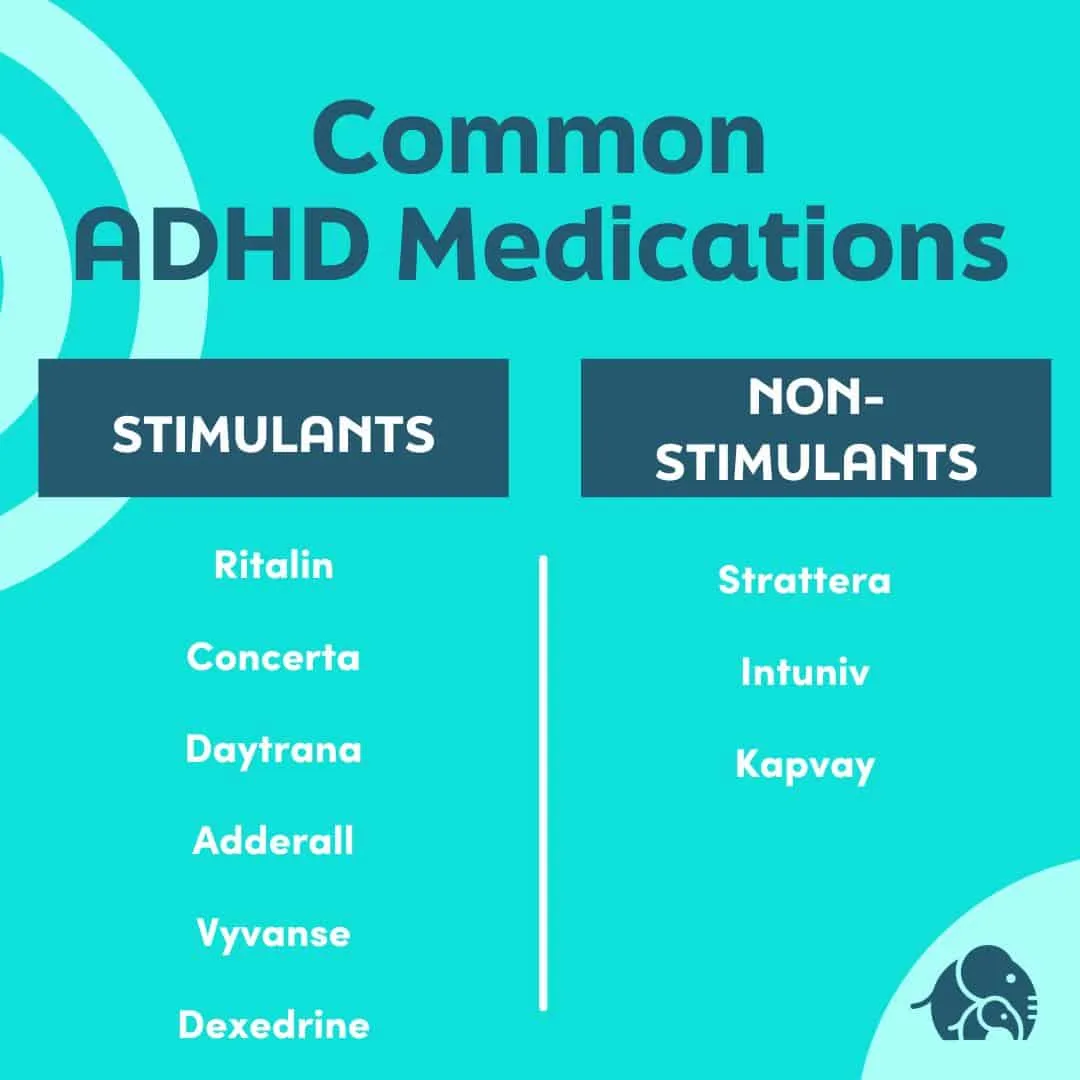
Medication is one of the options a family may discuss after an ADHD evaluation. Prescribing and managing these medicines belongs to your child’s physician or psychiatrist — we do not prescribe them. This chart is included only so the terms are familiar.
And sometimes the right answer is both. Working through one evaluation does not cancel the other, and no family should have to force every symptom into a single box. If you are weighing how these pieces fit together, our post on vision therapy and executive function and our vision and learning guide are good next reads.
The better question
When a child struggles with attention, reading or schoolwork, it is tempting to decide early what kind of problem it is. The more useful question is simpler: what is making this particular task so hard for this particular child?
If the answer clusters around close work — reading, homework, copying, screens — then vision belongs in the investigation. A comprehensive developmental vision evaluation can tell you whether a treatable vision problem is adding to the difficulty. That way your family can spend its energy on the supports that actually match the problem. Schedule an evaluation at any of our Coconut Creek, Boynton Beach or West Palm Beach offices, or read more about what our examinations include.
Common Questions About This Topic
Can a vision problem look like ADHD?
It can. The National Eye Institute lists trouble concentrating, headaches, tired or sore eyes, blurry vision, double vision and losing your place while reading among the symptoms of convergence insufficiency. Those symptoms cluster around close work such as reading and homework.
Does this mean vision problems cause ADHD?
No. ADHD is a separate neurodevelopmental condition, and the research linking it to vision is association only. Studies show the two occur together more often than expected, but no study shows that one causes the other.
Can vision therapy treat ADHD or improve attention?
No, and we will not tell you otherwise. In the CITT-ART randomized trial of 310 children, office-based vergence and accommodative therapy did not improve attention any more than placebo therapy did. The authors concluded that clinicians should not suggest such treatment improves attention.
Can my child have both ADHD and a vision problem?
Yes, and this is common enough that it is worth checking. In a national survey of more than 75,000 children, ADHD was reported in 15.6 percent of those whose parents reported a vision problem that glasses or contact lenses could not correct. Among children without such a problem it was 8.3 percent. Finding one explanation does not rule out the other.
If my child sees 20/20, can vision still be part of the problem?
Yes. The National Eye Institute states that you can have perfect vision and still have convergence insufficiency, and that a regular eye exam will not catch it. Acuity tells you how small a letter a child can identify, not how comfortably the two eyes work together over a page.
Where This Information Comes From
- National Eye Institute (2024). Convergence Insufficiency. NIH. : Lists trouble concentrating, headaches, tired eyes, blur and double vision as CI symptoms; states you can have perfect vision and still have CI and a regular eye exam will not catch it.
- Centers for Disease Control and Prevention (2026). Diagnosing ADHD. : States there is no single test to diagnose ADHD and that sleep disorders, anxiety, depression and some learning disabilities can produce similar symptoms.
- Rouse MW, Borsting E, Hyman L, et al.; CIRS Group (1999). Frequency of convergence insufficiency among fifth and sixth graders. Optometry and Vision Science; 76(9):643-649. : About 13% of 453 school children met a high-suspect or definite CI definition, and 78.9% of three-sign CI children also had accommodative insufficiency.
- Granet DB, Gomi CF, Ventura R, Miller-Scholte A (2005). The relationship between convergence insufficiency and ADHD. Strabismus; 13(4):163-168. : Of 266 CI patients 9.8% carried an ADHD diagnosis, and CI was found in 15.9% of ADHD records — roughly three times the expected rate; the authors call it an association, not causation.
- DeCarlo DK, Swanson M, McGwin G, Visscher K, Owsley C (2016). ADHD and Vision Problems in the National Survey of Children's Health. Optometry and Vision Science; 93(5):459-465. : Among 75,171 children aged 4-17, ADHD was reported in 15.6% of those with a vision problem not correctable with glasses or contact lenses versus 8.3% without one (adjusted OR 1.8); parent-reported and cross-sectional.
- Bellato A, Perna J, Ganapathy PS, Solmi M, Zampieri A, Cortese S, Faraone SV (2023). Association between ADHD and vision problems. A systematic review and meta-analysis. Molecular Psychiatry; 28(1):410-422. : Across 42 studies (35 meta-analysed, about 3.25 million participants) ADHD was associated with astigmatism, hyperopia, strabismus, convergence problems and accommodative lag and variability, but not with structural eye differences.
- Rouse M, Borsting E, Mitchell GL, et al.; CITT Study Group (2009). Academic behaviors in children with convergence insufficiency with and without parent-reported ADHD. Optometry and Vision Science; 86(10):1169-1177. : Parents reported ADHD in 16% of 212 children with symptomatic CI versus 6% of 49 children with normal binocular vision; CI children without ADHD still had more school-behavior problems than normals.
- Borsting E, Rouse M, Chu R (2005). Measuring ADHD behaviors in children with symptomatic accommodative dysfunction or convergence insufficiency: a preliminary study. Optometry; 76(10):588-592. : 24 children with symptomatic CI or accommodative dysfunction and no prior ADHD diagnosis scored above normative values on Conners inattention, hyperactivity and ADHD index; very small, uncontrolled.
- CITT-ART Investigator Group (2021). Effect of Vergence/Accommodative Therapy on Attention in Children with Convergence Insufficiency: A Randomized Clinical Trial. Optometry and Vision Science; 98(3):222-233. : In 310 children, attention measures improved in both groups but showed no significant difference between office-based therapy and placebo; authors say clinicians should not suggest the treatment improves attention.
- CITT-ART Investigator Group (2019). Effect of Vergence/Accommodative Therapy on Reading in Children with Convergence Insufficiency: A Randomized Clinical Trial. Optometry and Vision Science; 96(11):836-849. : Reading comprehension improved 3.7 points with therapy versus 3.8 points with placebo in 310 children — therapy was no better than placebo for reading.
- CITT-ART Investigator Group (2019). Treatment of Symptomatic Convergence Insufficiency in Children Enrolled in CITT-ART: A Randomized Clinical Trial. Optometry and Vision Science; 96(11):825-835. : Clinical signs improved more with therapy than placebo (near point of convergence 10.4 vs 6.2 cm), but symptom scores improved similarly in both groups.
- Convergence Insufficiency Treatment Trial Study Group (2008). Randomized clinical trial of treatments for symptomatic convergence insufficiency in children. Archives of Ophthalmology; 126(10):1336-1349. : In 221 children, 73% were successful or improved after 12 weeks of office-based vergence/accommodative therapy versus 35% with office placebo.
- Scheiman M, Kulp MT, Cotter SA, Lawrenson JG, Wang L, Li T (2020). Interventions for convergence insufficiency: a network meta-analysis. Cochrane Database of Systematic Reviews; 12:CD006768. : Across 12 trials and 1,289 participants, office-based therapy with home reinforcement beat placebo for a successful outcome in children (RR 3.04); adult evidence is less clear.
- AAP Section on Ophthalmology, AAO, AAPOS, AACO (2009). Joint statement - Learning disabilities, dyslexia, and vision. Pediatrics; 124(2):837-844. : Holds that vision problems can interfere with learning but do not cause dyslexia, and that evidence does not support eye exercises, behavioral vision therapy or tinted lenses for learning disabilities.
- American Academy of Ophthalmology, AAP, AAPOS, AACO (2014). Joint Statement: Learning Disabilities, Dyslexia, and Vision - Reaffirmed 2014. : The 2014 reaffirmation states vision problems are not the cause of primary dyslexia or learning disabilities and that vision therapy is not endorsed for educational performance.
- American Academy of Optometry; American Optometric Association (1997). Vision, learning and dyslexia. Journal of the American Optometric Association; 68(5):284-286. : The optometric position holds that vision problems can and often do interfere with learning and that optometric care is one part of a multidisciplinary approach.
- American Optometric Association (2017). Evidence-Based Clinical Practice Guideline: Comprehensive Pediatric Eye and Vision Examination. : Recommends comprehensive exams before first grade and annually thereafter, and summarizes evidence that acuity testing alone missed 75.5% of children with binocular and oculomotor problems.
Care We Provide
More From the Blog
Wondering If This Sounds Like Your Family?
A developmental vision evaluation measures the skills a routine eye exam does not. Our team sees children and adults in Coconut Creek, Boynton Beach, Boca Raton and West Palm Beach.