A Teacher's Guide to Classroom Signs of Vision Problems
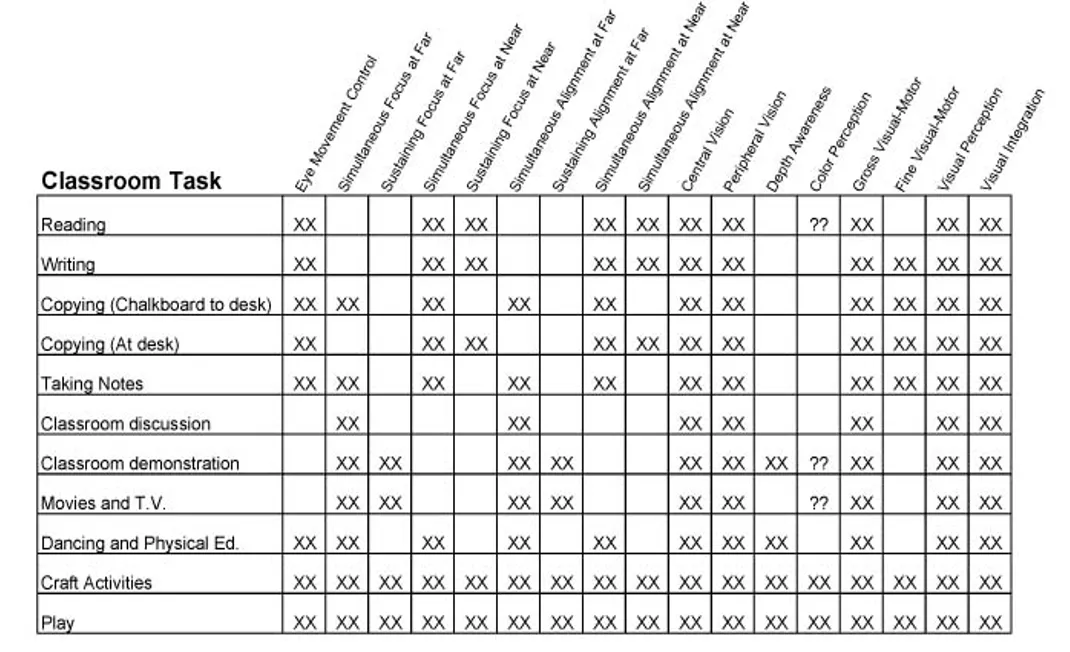
Teachers watch children do close work for hours a day, which makes a classroom one of the best places to spot the signs of vision problems. A parent sees twenty minutes of homework. You see the same child copy from the board, read aloud, fill in worksheets and fade by early afternoon, five days a week, next to twenty-odd classmates for comparison.
This guide is for teachers. It covers what the signs of a vision problem in the classroom look like, why some of them are easy to mistake for attention or behavior, a printable checklist, what you can do in the room, and how to raise it with parents. October is ADHD Awareness Month, so we also cover the overlap, and what vision treatment does well.
Key takeaways
- Look for patterns tied to near work: losing place, covering one eye, eye rubbing, headaches after reading, slow copying from the board, and work that deteriorates as the day goes on.
- Eye-teaming problems are not rare. In a US school-based study, 13% of fifth and sixth graders met a high-suspect or definite definition of convergence insufficiency (Rouse et al., 1999).
- Some vision problems look like inattention. Children with convergence insufficiency and no reported ADHD still had more parent-rated school-behavior problems than children with normal eye teaming (Rouse et al., 2009).
- Treatment works on the eye-teaming problem itself. In the CITT trial, 73% of children with convergence insufficiency were successful or improved after 12 weeks of office-based therapy, against 35% with placebo therapy (CITT, 2008). The follow-up CITT-ART trial found no reading-comprehension or attention benefit (CITT-ART, 2019; CITT-ART, 2021).
- Your job is to notice and describe, not diagnose. Specific observations passed to parents are the most useful thing a teacher can contribute.
Why teachers are well placed to notice
Most school vision screenings check how clearly a child reads a chart across the room. That matters, but much of the school day happens at reading distance, where the two eyes have to aim together, hold focus and move accurately along a line of print. The American Optometric Association’s pediatric guideline reports that distance acuity testing alone missed 75.5% of children later found to have binocular and eye-movement problems on a full examination (AOA, 2017). We explain why in what school vision screenings miss.
Teachers are also reasonably good observers when they are trained to screen. A 2026 meta-analysis found that teacher-conducted vision screening identified 70% of the children that eye care professionals identified, with 96% specificity (Umesh et al., 2026). That study was about formal screening, not casual observation, but it supports something teachers already know: sustained, repeated observation picks up things a one-off check does not.
What are the signs of a vision problem in the classroom?
The most useful signs cluster around specific tasks. Here is what each one tends to look like.
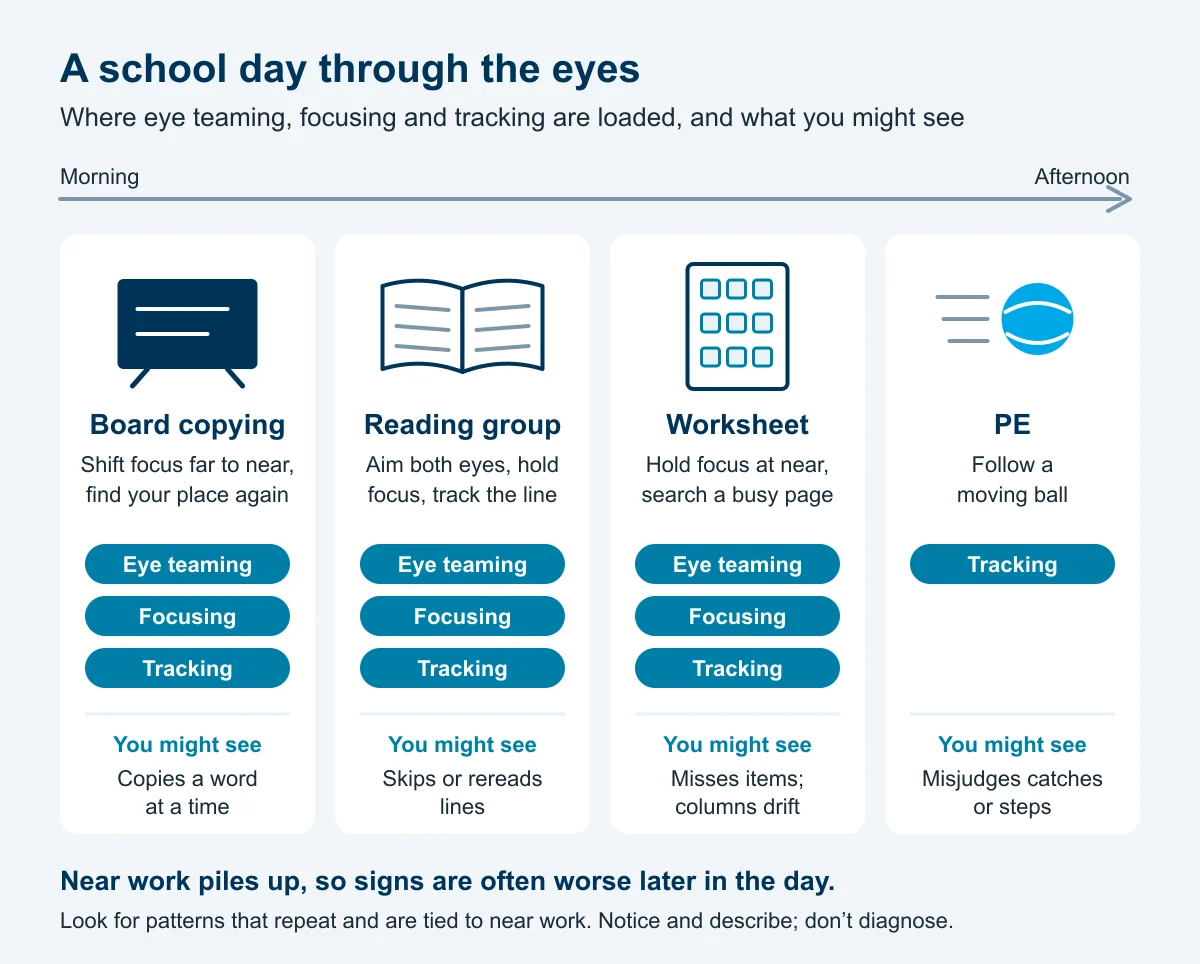
Copying from the board
- Looks up and down many times to copy a short line, or copies a word at a time
- Loses place when looking back down at the page
- Squints, leans forward or asks to move closer
- Copies accurately from a paper on the desk but not from the board, or the other way round
The second and fourth patterns are especially informative: they point to difficulty shifting focus between distance and near, or to blur at one distance.
Reading aloud and silent reading
- Skips lines or rereads the same line
- Omits or substitutes small words, especially later in a passage
- Keeps a finger or marker on the line long after classmates have dropped it
- Holds the book unusually close, tilts the head, or closes or covers one eye
- Reads fluently for a paragraph or two, then slows and stumbles
That last pattern, fine at first and worse with time, is typical of focusing and eye-teaming problems. Our guide to why children lose their place while reading goes into the mechanics.
Writing, worksheets and math
- Letters and numbers drift off the line; columns in math problems wander
- Uneven spacing between words
- Misses items on a crowded worksheet, or answers one question in the wrong box
- Much better on a sparse page than a busy one
Tests, stamina and the time of day
- Starts well, then work quality drops steeply
- Complains of headaches, tired eyes or blurry print in the afternoon or after reading
- Rubs eyes, blinks hard or yawns during reading but not during discussion
Away from the desk
- Misjudges catches or steps, or seems clumsier than classmates in PE
- Avoids activities that need close visual detail while happily joining others
None of these proves a vision problem. Children lose their place because they are bored, anxious or still learning to decode. What makes a pattern worth reporting is consistency and a link to near work.
A printable classroom vision checklist
Print this, keep it on a clipboard for a week or two, and tick what you observe. Dates and context make it far more useful to the parent and the eye doctor than a general impression.
| Observation | Seen? | How often (rarely / weekly / daily) | During which task |
|---|---|---|---|
| Loses place, skips or rereads lines | |||
| Uses finger or marker to keep place (beyond the age when peers stopped) | |||
| Covers or closes one eye, or tilts head to read | |||
| Holds work very close, or leans far over the desk | |||
| Rubs eyes, blinks hard or squints during near work | |||
| Headaches or tired eyes after reading or late in the day | |||
| Says words blur, move or double | |||
| Slow or error-filled copying from the board | |||
| Reading or writing gets worse as the task goes on | |||
| Letters or math columns drift, uneven spacing | |||
| Avoids reading or close work but engages well in discussion | |||
| Attention drops mainly during reading and writing, not other activities | |||
| Does not wear prescribed glasses, or says they do not help |
If several rows are ticked on a regular basis, share the sheet with the family. The practice’s own symptom checklist is a parent-facing version they can complete at home.
When a vision problem looks like an attention problem
A child who finds reading physically uncomfortable does what any of us would do with an uncomfortable task: fidgets, looks away, finds reasons to get up, or stops. From the front of the room, that looks like inattention.
The research shows that the two overlap, not that one causes the other. When the CITT group surveyed parents, children with symptomatic convergence insufficiency and no parent-reported ADHD scored 11.7 on a 24-point academic behavior scale, against 8.7 for children with normal binocular vision (Rouse et al., 2009). Those were parent ratings, and many children have both conditions.
One practical clue is where the difficulty shows up. An ADHD diagnosis requires that several symptoms appear in two or more settings, and clinicians are advised to gather reports from school staff and to rule out other conditions with similar symptoms (CDC, 2026). Your observations feed straight into that process. It is worth noting in your report whether the child’s attention drops mainly during sustained reading and writing and holds up in discussion, hands-on work and play, or whether it is poor across the board.
We cover the overlap in depth, including where the professional bodies disagree, in vision problems vs ADHD. The short version for teachers: a vision evaluation can rule a visual contributor in or out, and it never replaces an attention or learning evaluation.
What treatment does well
For symptomatic convergence insufficiency, office-based vergence and accommodative therapy has strong trial evidence for treating the eye-teaming problem itself. In the 221-child CITT, 73% were successful or improved after 12 weeks, against 35% with placebo therapy (CITT, 2008). In the larger CITT-ART, the eye-teaming measurements, how close the eyes can converge and how much fusional range they have, improved much more with real therapy than with placebo, and symptom scores improved in both groups (CITT-ART, 2019). In practice, that means eyes that can hold together at reading distance for longer; in the earlier CITT, symptoms also improved more with real therapy than with placebo (CITT, 2008).
CITT-ART also asked the question teachers care about most. Among 310 children aged 9 to 14, reading comprehension rose 3.7 standard-score points with therapy and 3.8 with placebo (CITT-ART, 2019), and parent and teacher attention ratings improved substantially in both groups, with no difference between them (CITT-ART, 2021). So therapy is a treatment for eye-teaming function, and for the symptoms CITT showed it relieves, not a reading or attention intervention; the medical and ophthalmology bodies likewise state that vision problems can interfere with learning but do not cause dyslexia or learning disabilities (AAP et al., 2009). Our full reading of these trials is in what the CITT and CITT-ART trials actually found.
Glasses are a slightly different story. In a Baltimore trial of 2,304 students in grades 3 to 7, providing school-based eye exams and glasses produced a small one-year gain in reading scores, larger for students in special education and those who started in the lowest quartile, but no sustained effect at two years (Neitzel et al., 2021). In preschoolers, uncorrected moderate farsightedness has been linked with lower early-literacy scores (VIP-HIP Study Group, 2016). The takeaway for a teacher: a child who needs glasses and is not wearing them is worth a word with the family.
What a teacher can do in the classroom
While the family looks into it, a few low-cost adjustments reduce the visual load. They are accommodations, not treatment.
- Seat for sight lines. A clear, straight-on view of the board, away from glare.
- Put a copy on the desk. A printed copy of board work removes the distance-to-near shift for children who struggle with it.
- Build in short breaks from continuous reading and writing, and let the child look across the room between tasks.
- Reduce clutter. Fewer items per worksheet page, larger type and wider spacing where possible.
- Encourage glasses. If a child has a prescription, a quiet, matter-of-fact reminder helps more than you might think.
- Keep reading instruction going. A vision finding never replaces phonics, fluency work or learning support.
Our guide to binocular vision dysfunction in school-aged children lists further classroom supports.
How to talk to parents about a possible vision problem
Parents hear “vision problem” and often think “glasses”, or worry that a teacher is hinting at something bigger. A calm, specific conversation works best.
Lead with observations, not labels. “During reading groups, [child’s name] covers one eye and loses her place about halfway down the page. It happens most days, mostly in the afternoon.” That is far more useful than “I think your child has a tracking problem.”
Explain why it might be vision. “Your child passed the school screening, but that mostly checks distance vision. It might be worth a full eye exam to rule out anything at reading distance.”
Frame it as ruling something out. “It may be nothing visual at all, but it’s one of the easier things to check.”
Avoid promises and diagnoses. Do not suggest that glasses or therapy will raise grades or settle attention; leave treatment questions to the eye doctor.
Hand over your notes. A copy of the checklist, with dates, gives the eye doctor something concrete to work from. The practice’s page for families referred by a teacher explains what happens next from the parent’s side.
Our clinical perspective
In our experience, teachers’ notes are among the most useful things a family brings to an evaluation. “Loses place after the first paragraph, worse after lunch” tells us exactly where to look. When we examine a child, we measure the things a screening does not: eye teaming, focusing, eye movements and visual processing at reading distance, alongside eye health and prescription. Often we find a clear, treatable problem. Sometimes we find nothing visual, and that is useful too, because it points the family back toward reading, attention or other support without a question hanging over them.
When we do find an eye-teaming or focusing problem, it usually responds well to treatment. In our practice we regularly see children who used to fade after a page read with more comfort and stamina, stop rubbing their eyes and complaining of headaches, and approach close work with more confidence. Families often tell us homework stopped ending in headaches and rubbed eyes. You can read some of their own accounts on our success stories page. Treating the vision problem can make reading more comfortable; the reading and attention support you provide still does its own work.
If you have a student in mind, share this page and the checklist with the family. They can learn about learning-related vision care, see what a comprehensive examination includes, find an office on our locations page, or schedule an evaluation.
Common Questions About This Topic
What are the most common classroom signs of a vision problem?
Look for a pattern tied to near work: losing place or skipping lines, using a finger to track long after classmates stopped, covering or closing one eye, rubbing eyes, headaches after reading, slow or error-filled copying from the board, and work that falls apart as the day goes on. One sign on one day means little. The same signs, repeated during reading and writing, are worth passing on to parents.
Can a vision problem look like ADHD in the classroom?
Some can. A child who finds close work uncomfortable may fidget, drift off or avoid the page. In one trial cohort, parents of children with convergence insufficiency and no reported ADHD still rated more school-behavior problems than parents of children with normal eye teaming. The two conditions can also coexist, so a vision evaluation does not replace an attention evaluation.
Does treating a vision problem improve reading or attention scores?
Treatment works on the vision problem itself: in the CITT-ART trial of 310 children aged 9 to 14 with convergence insufficiency, office-based therapy clearly improved the eye-teaming measurements compared with placebo. Reading comprehension and attention ratings, including teacher ratings, improved about as much with placebo therapy, so treatment aims at eye-teaming function, and at the comfort benefit seen in the earlier CITT trial, rather than at test scores.
If a child passed the school vision screening, can they still have a vision problem?
Yes. Most school screenings check how clearly a child sees a chart at distance. They are not built to measure eye teaming, focusing stamina or eye-movement accuracy at reading distance, which is where many classroom signs come from. A pass is useful information, not a clean bill of visual health.
How should a teacher bring up a possible vision problem with parents?
Describe what you saw, when and how often, in plain words, and suggest a comprehensive eye examination as one thing worth ruling out. Avoid naming a diagnosis or promising that glasses or therapy will fix grades. Keep any reading or attention support going in the meantime, because a vision finding does not replace it.
Where This Information Comes From
- Rouse MW, Borsting E, Hyman L, Hussein M, Cotter SA, Flynn M, Scheiman M, Gallaway M, De Land PN; CIRS Group (1999). Frequency of convergence insufficiency among fifth and sixth graders. Optometry and Vision Science; 76(9):643-649. : School-based study: of 453 fifth and sixth graders with complete data, 13% met a high-suspect or definite definition of convergence insufficiency. Three US sites; eligibility excluded children with significant refractive error or strabismus.
- Rouse M, Borsting E, Mitchell GL, Kulp MT, Scheiman M, Amster D, Coulter R, Fecho G, Gallaway M; CITT Study Group (2009). Academic behaviors in children with convergence insufficiency with and without parent-reported ADHD. Optometry and Vision Science; 86(10):1169-1177. : Parents of 212 children with symptomatic convergence insufficiency and 49 with normal binocular vision completed a 24-point academic behavior survey. Children with CI and no parent-reported ADHD scored 11.7 versus 8.7 for normal binocular vision. Parent report only; ADHD status was not clinically confirmed.
- Convergence Insufficiency Treatment Trial Study Group (2008). Randomized clinical trial of treatments for symptomatic convergence insufficiency in children. Archives of Ophthalmology; 126(10):1336-1349. : 221 children aged 9-17; after 12 weeks, 73% of the office-based vergence/accommodative therapy group were successful or improved versus 35% with office placebo therapy.
- CITT-ART Investigator Group (2019). Treatment of Symptomatic Convergence Insufficiency in Children Enrolled in the Convergence Insufficiency Treatment Trial-Attention & Reading Trial: A Randomized Clinical Trial. Optometry and Vision Science; 96(11):825-835. : 311 children aged 9-14. Near point of convergence and fusional vergence improved significantly more with office-based therapy than placebo, but symptom scores improved similarly in both groups (11.8 versus 10.4 points).
- CITT-ART Investigator Group (2019). Effect of Vergence/Accommodative Therapy on Reading in Children with Convergence Insufficiency: A Randomized Clinical Trial. Optometry and Vision Science; 96(11):836-849. : 310 children aged 9-14 randomized 2:1 to 16 weeks of office-based therapy or placebo therapy. Reading comprehension improved 3.7 versus 3.8 standard-score points; no secondary reading outcome differed between groups.
- CITT-ART Investigator Group (2021). Effect of Vergence/Accommodative Therapy on Attention in Children with Convergence Insufficiency: A Randomized Clinical Trial. Optometry and Vision Science; 98(3):222-233. : Same 310 children. No between-group difference in parent- or teacher-rated attention; both groups improved substantially, which the investigators attribute to nonspecific effects of an intensive therapy regimen.
- Neitzel AJ, Wolf B, Guo X, Shakarchi AF, Madden NA, Repka MX, Friedman DS, Collins ME (2021). Effect of a Randomized Interventional School-Based Vision Program on Academic Performance of Students in Grades 3 to 7: A Cluster Randomized Clinical Trial. JAMA Ophthalmology; 139(10):1104-1114. : 2,304 Baltimore students given school-based eye exams and glasses. Small one-year gain in reading scores (effect size 0.09), larger in special education (0.25) and the lowest-performing quartile (0.28); no sustained effect at two years.
- VIP-HIP Study Group; Kulp MT, Ciner E, Maguire M, et al. (2016). Uncorrected Hyperopia and Preschool Early Literacy: Results of the Vision in Preschoolers-Hyperopia in Preschoolers (VIP-HIP) Study. Ophthalmology; 123(4):681-689. : Cross-sectional study of 492 four- and five-year-olds: uncorrected moderate farsightedness, especially with reduced near acuity or stereoacuity, was associated with lower early-literacy scores. Association, not proof of cause.
- Umesh U, Srinivasan K, Sherigar SS, Prabhu V (2026). Effectiveness of school vision screening by teachers - a systematic review and meta-analysis. BMC Public Health; 26(1):1794. : Nine studies reviewed, seven pooled: teacher-conducted vision screening had a pooled sensitivity of 0.70 and specificity of 0.96 compared with screening by eye care professionals.
- American Academy of Pediatrics, Section on Ophthalmology, Council on Children with Disabilities; American Academy of Ophthalmology; AAPOS; American Association of Certified Orthoptists (2009). Joint statement: learning disabilities, dyslexia, and vision. Pediatrics; 124(2):837-844. : States that vision problems can interfere with learning but are not the cause of primary dyslexia or learning disabilities, and that behavioral vision therapy is not supported for improving long-term educational performance.
- Centers for Disease Control and Prevention (last reviewed 2026). Clinical Care of ADHD in Children. : Advises clinicians to gather symptom reports from parents and school staff, notes that several symptoms must be present in two or more settings, and to rule out other conditions that can cause similar symptoms.
- American Optometric Association (2017). Evidence-Based Clinical Practice Guideline: Comprehensive Pediatric Eye and Vision Examination. : Optometric guideline approved February 2017. Reports that Snellen distance acuity used alone as a screen missed 75.5% of children found on full examination to have binocular and oculomotor problems.
Care We Provide
More From the Blog
Wondering If This Sounds Like Your Family?
A developmental vision evaluation measures the skills a routine eye exam does not. Our team sees children and adults in Coconut Creek, Boynton Beach, Boca Raton and West Palm Beach.