Homeschooling and Vision: What No Screening Will Catch
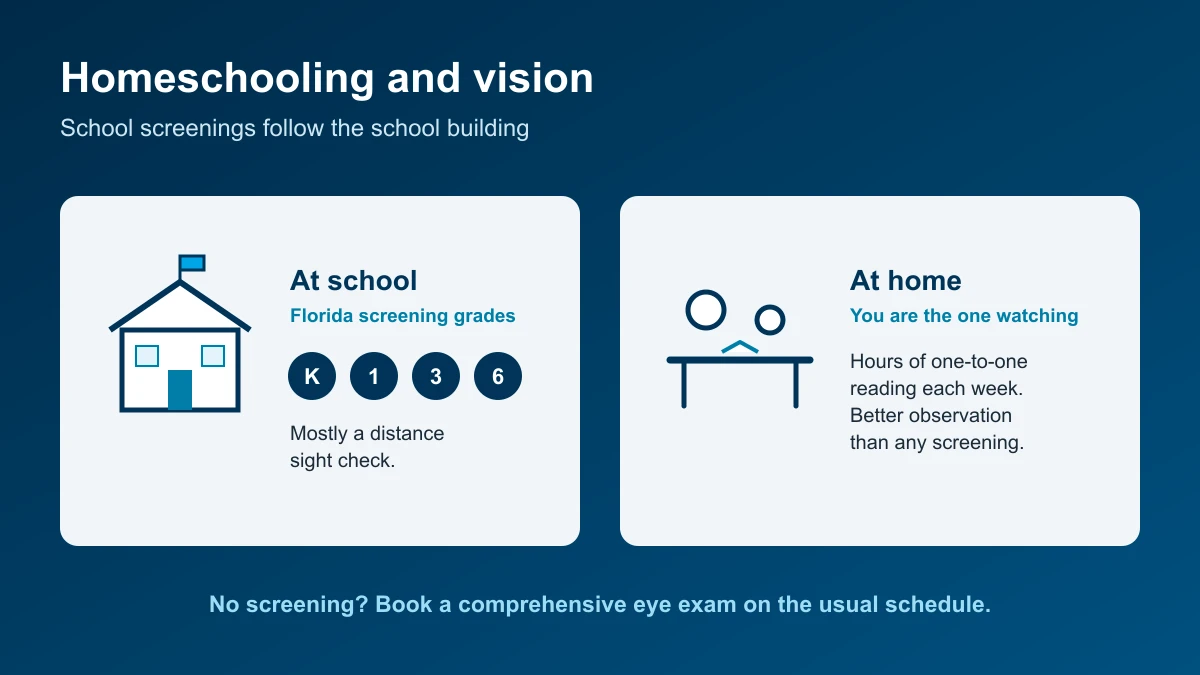
In a school, several adults see a child read every week, and a nurse or technician checks vision on a set schedule. At home, the person watching is you.
It means that the homeschool vision screening most families assume is happening somewhere usually is not happening at all. This article explains what Florida’s school screening covers, what it would have missed anyway, what to watch for during lessons and what to do if something looks off.
Most homeschooled children have no vision problem. We know of no research showing that homeschooling causes vision problems or raises the risk of one. The point here is narrower: a routine check that schools provide does not reach your child, so it is worth replacing with something better.
Key takeaways
- Florida’s school health rule requires vision screening in kindergarten and grades 1, 3 and 6 (Rule 64F-6.003). The program runs through schools, and home education students are usually not part of it.
- A school screening mostly checks distance sight. It does not measure eye teaming, focusing or tracking (AOA, 2017).
- You see your child read one-to-one for hours each week. That is better observation than any screening.
- The signs below are reasons to have vision measured. They are not diagnoses.
- Vision problems do not cause dyslexia, and vision therapy did not raise reading scores in the largest trial that tested it (CITT-ART, 2019).
Who screens a homeschooled child’s vision?
In Florida, usually no one, unless you arrange it.
The state’s school health rule says vision screening must be provided, at a minimum, to students in kindergarten and grades 1, 3 and 6, and to students entering Florida schools for the first time in kindergarten through grade 5 (Rule 64F-6.003).
That screening is part of the school health services program. Each county health department writes its plan together with the district school board, and a private school may ask to take part (Florida Statutes, s. 381.0056). The statute does not mention home education.
The home education statute, for its part, says a home education program is not a school district program, and it sets out no health screening (Florida Statutes, s. 1002.41).
So the screening follows the school building. To find out what is open to home education families where you live, ask your school district or county health department. We cannot speak for what each county offers.
What a school screening would have missed anyway
A typical school screening asks a child to read letters on a chart across the room. It is built to find children who see poorly at distance, and it does that job reasonably well.
Reading asks for different skills. The two eyes have to aim at the same word and stay there (eye teaming). They have to keep print clear at arm’s length for a long stretch (focusing). And they have to move accurately along a line and back to the start of the next one (tracking). A distance chart measures none of these.
The American Optometric Association’s pediatric guideline summarizes research in which acuity testing alone missed 75.5% of the children later found, on a complete examination, to have eye teaming and eye movement problems. The same guideline reports that only 38.7% of children who failed a screening went on to get follow-up care (AOA, 2017). Those figures summarize other researchers’ work, not our own data.
We cover this in more detail in what school vision screenings miss and in our comparison of a screening and a comprehensive eye exam. A child can also see 20/20 and still find reading uncomfortable, which we explain in 20/20 vision and reading struggles.
The advantage you have
A classroom teacher has twenty or more children and a few minutes of one-to-one reading with each. You sit beside one child, at reading distance, for hours every week.
You see where on the page the trouble starts. You see whether minute 5 looks different from minute 25. You hear the difference between a story read aloud to your child and the same text read alone. No screening captures any of that.
What to watch for during lessons
Watch for patterns that repeat over a few weeks, and write down when they happen.
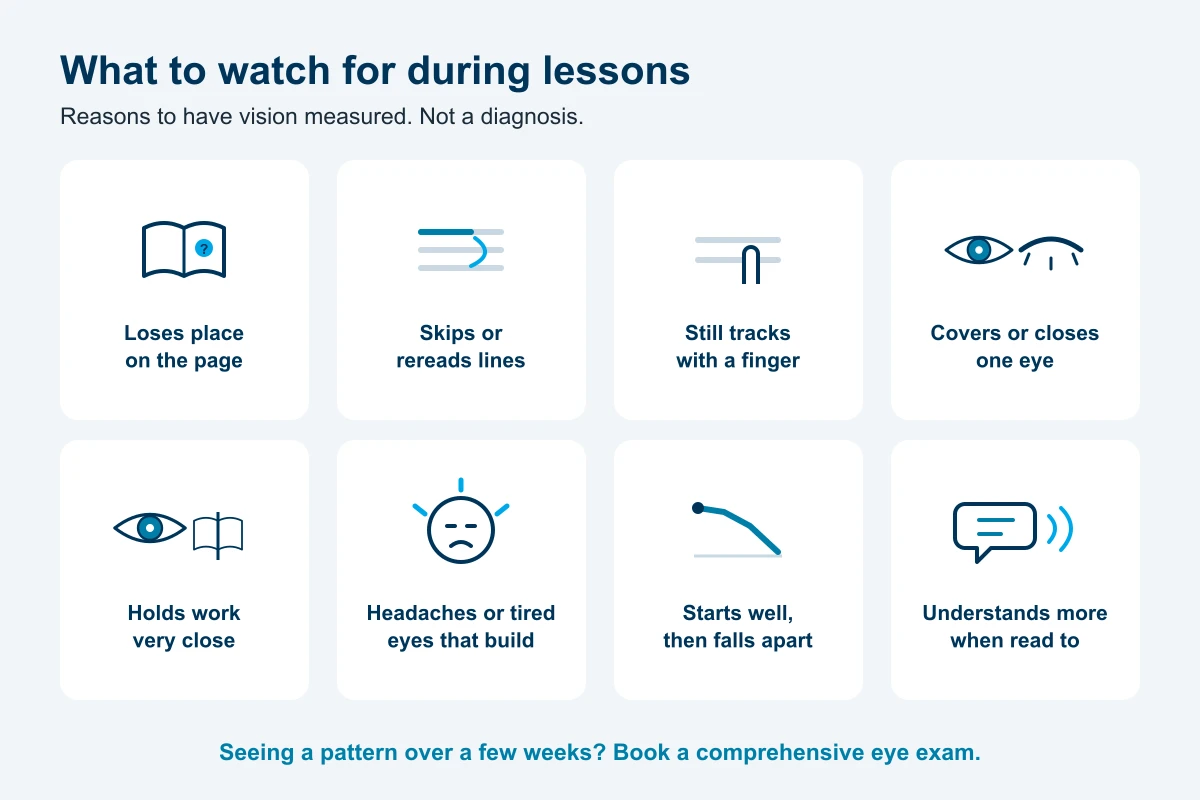
- Losing place. Your child often cannot find where they were after looking away.
- Skipping or rereading lines. A whole line is missed, or the same line is read twice.
- Finger tracking past the usual age. A finger or marker is still needed when reading is otherwise fluent.
- Covering or closing one eye. A hand over one eye, a tilted head or one eye squeezed shut.
- Holding work very close. The book creeps toward the face, or the head drops toward the desk.
- Headaches or tired eyes that build. Fine at the start of a lesson, rubbing eyes or complaining by the end.
- Work that starts well and falls apart. Neat and accurate at the top of the page, messy and full of errors at the bottom.
- Strong understanding when read to, weak when reading alone. The gap between listening and reading is wide.
- Avoiding reading. Negotiating, stalling or melting down when near work begins.
Every item on this list has other possible causes. These signs tell you that vision is worth measuring. They do not tell you what the measurement will show.
Our symptom checklist turns these into a form you can bring to an appointment.
How often should a homeschooled child have an eye exam?
The same schedule as any other child. The American Optometric Association recommends a comprehensive eye exam at 6 to 12 months of age, at least once between ages 3 and 5, before first grade and every year after that (AOA, 2017).
Put it on the family calendar, the way you would a dental visit. If you see the signs above, book sooner.
Adjusting the homeschool day for comfort
These are comfort measures and good practice. They are not treatment, and they will not fix an eye teaming or focusing problem. Most of them have not been tested in trials, so treat them as sensible habits.
- Shorter lessons with breaks. Split a long reading block into shorter ones. During a break, have your child look out a window or across the room.
- A comfortable reading distance. Sit your child upright with the book propped on a slanted surface, so the page does not creep toward the face.
- Even lighting. Light the page and the room, and keep glare off the page and the screen.
- Larger print. If small, crowded print causes trouble, choose a larger type size or fewer problems on a page. Note whether it helps. That is useful information for an eye doctor.
- Movement and outdoor time between near tasks. Homeschooling makes this easy. There is research support for one part of it: in a review of 25 studies, more time outdoors lowered a child’s risk of becoming nearsighted, though it did not slow nearsightedness that had already begun (Xiong et al., 2017).
If screens are a large part of your curriculum, our guide to screen time covers what the evidence does and does not say.
If the same signs keep returning after these changes, have vision measured.
What a developmental vision evaluation adds
A comprehensive eye exam checks eye health and whether your child needs glasses. A developmental vision evaluation goes further into the skills used for near work: how the eyes team, how well focus holds and shifts, how accurately the eyes move along print, and how visual information is processed.
The result is a set of measurements. Sometimes they are all in the expected range, and vision can come off your list of worries. Sometimes they point to a specific, treatable problem, described on our learning-related vision and reading pages.
Homeschooling parents often ask whether they can do the exercises at home themselves. Home practice is a real part of therapy, and in our offices it is recommended 3 to 5 days a week. The harder part is knowing which activity comes next. Our programs draw on more than 100 activities, done in the right order, at the right time, with the right amount of stress on the visual system. That takes an accurate diagnosis and someone trained to know what to do next. This is our clinical reasoning, not a trial result, and we go through the evidence in vision therapy at home: what works.
When therapy is recommended, programs for binocular vision and visual processing usually run about 18 to 24 weeks. Programs for amblyopia, strabismus and brain injury often take longer. Patients come for one 45-minute session or two 30-minute sessions a week. Our vision therapy page has more.
What vision care will not do for reading
Vision problems do not cause dyslexia. The joint statement from the American Academy of Pediatrics, the American Academy of Ophthalmology and two other eye care organizations says so, and it says the evidence does not support vision therapy as a treatment for learning disabilities (AAP/AAO/AAPOS/AACO, 2009). We agree.
Vision therapy also does not teach reading. In the CITT-ART trial, 310 children aged 9 to 14 with convergence insufficiency received office-based therapy or placebo therapy. Reading comprehension improved 3.7 points with therapy and 3.8 points with placebo (CITT-ART, 2019).
Treating a measured vision problem can make near work more comfortable. A child who is behind in reading still needs reading instruction. If decoding, spelling or sounding out words is the main difficulty, ask about a reading or psychoeducational evaluation as well. Our dyslexia page explains how the two fit together, and vision therapy vs tutoring explains which problem each one addresses.
A child can have both, and each needs its own help.
How Florida homeschool families pay
Our Developmental Vision Evaluation takes about 100 minutes and costs $550. We are out-of-network with insurance and give families the paperwork to request reimbursement. We accept HSA, FSA, CareCredit and payment plans.
Many Florida homeschool families with a qualifying diagnosis use the Family Empowerment Scholarship for Students with Unique Abilities (FES-UA), administered by Step Up For Students. It is open to Florida residents aged 3 to 22, or through grade 12, who have one of the listed diagnoses, and its uses include home education expenses, therapists and specialists (Step Up For Students). We accept FES-UA for eligible families. Step Up For Students decides what each account covers, so confirm with them before you count on it.
Details are on our cost and pricing and payment options pages.
Where to start
- Put a yearly comprehensive eye exam on the family calendar.
- Watch lessons for two or three weeks and note any of the signs above, with the time of day and the task.
- Fill in the symptom checklist.
- If the signs keep showing up, have the visual skills measured.
Dr. Christina Murray, OD, FOVDR, founded Vision & Learning Center in 2017. We have offices in Coconut Creek, Boynton Beach, Boca Raton and West Palm Beach, and evaluations are done at Boynton Beach and Boca Raton.
To book, schedule an evaluation or call (561) 462-1245.
Common Questions About This Topic
Do homeschooled children get vision screenings in Florida?
Not routinely. Florida's school health rule calls for vision screening of students in kindergarten and grades 1, 3 and 6, and the program is run through county health departments and school districts. State law says a home education program is not a school district program, so a homeschooled child is usually not included. Ask your school district or county health department what is open to your family.
How often should a homeschooled child have an eye exam?
The same schedule as any other child. The American Optometric Association recommends a comprehensive eye exam at 6 to 12 months, at least once between ages 3 and 5, before first grade and every year after that. A child with symptoms should be seen sooner.
My homeschooler struggles with reading. Could it be a vision problem?
It could be, and it is worth measuring, but most reading difficulty is not caused by the eyes. Signs such as losing place, covering an eye, headaches that build during a lesson or work that falls apart after a strong start are reasons to have vision checked. A reading difficulty also needs reading instruction and sometimes a reading or psychoeducational evaluation.
What does a school vision screening miss?
Most screenings check how clearly a child sees letters at distance. They do not measure eye teaming, focusing at near or tracking along a line of print. The American Optometric Association's guideline cites research in which acuity testing alone missed 75.5% of children later found to have eye teaming and eye movement problems.
Can Florida scholarship funds pay for a vision evaluation or vision therapy?
Some families use the Family Empowerment Scholarship for Students with Unique Abilities (FES-UA), administered by Step Up For Students. It is for Florida residents aged 3 to 22, or through grade 12, with a qualifying diagnosis, and home education students can use it. We accept FES-UA for eligible families. Confirm with Step Up For Students what your child's account will cover.
Where This Information Comes From
- Florida Administrative Code, Rule 64F-6.003. Screening (Department of Health, School Health Services Program). : Requires vision screening, at a minimum, for students in kindergarten and grades 1, 3 and 6 and for students entering Florida schools for the first time in kindergarten through grade 5.
- Florida Statutes, section 381.0056. School health services program. : Each county health department develops the school health services plan, which includes vision screening, jointly with the district school board; a nonpublic school may request to participate; the section does not mention home education.
- Florida Statutes, section 1002.41. Home education programs. : States that a home education program is not a school district program; the section contains no provision for health or vision screening.
- American Optometric Association (2017). Evidence-Based Clinical Practice Guideline: Comprehensive Pediatric Eye and Vision Examination. St. Louis: AOA. : Recommends comprehensive exams at 6 to 12 months, once at 3 to 5 years, before first grade and annually after; summarizes research that acuity screening alone missed 75.5% of children with binocular and eye movement problems and that 38.7% of screening failures received follow-up.
- CITT-ART Investigator Group (2019). Effect of Vergence/Accommodative Therapy on Reading in Children with Convergence Insufficiency: A Randomized Clinical Trial. Optometry and Vision Science; 96(11):836-849. : In 310 children aged 9 to 14, reading comprehension improved 3.7 points with office-based therapy and 3.8 points with placebo therapy, so therapy was no better than placebo for reading.
- American Academy of Pediatrics, American Academy of Ophthalmology, AAPOS, AACO (2009). Joint statement - Learning disabilities, dyslexia, and vision. Pediatrics; 124(2):837-844. : Holds that vision problems can interfere with learning but do not cause dyslexia, and that the evidence does not support vision therapy as a treatment for learning disabilities.
- Xiong S, Sankaridurg P, Naduvilath T, et al. (2017). Time spent in outdoor activities in relation to myopia prevention and control: a meta-analysis and systematic review. Acta Ophthalmologica; 95(6):551-566. : Time outdoors lowered the risk of becoming nearsighted (risk ratio about 0.54 in trials and 0.57 in cohort studies) but did not slow progression in eyes that were already nearsighted.
- Step Up For Students. Unique Abilities (Family Empowerment Scholarship for Students with Unique Abilities). : Describes FES-UA as open to Florida residents aged 3 to 22, or through grade 12, with a listed diagnosis, and usable for expenses that include home education, therapists and specialists.
Care We Provide
More From the Blog
Wondering If This Sounds Like Your Family?
A developmental vision evaluation measures the skills a routine eye exam does not. Our team sees children and adults in Coconut Creek, Boynton Beach, Boca Raton and West Palm Beach.