Vision Screening vs Eye Exam: What the Data Says
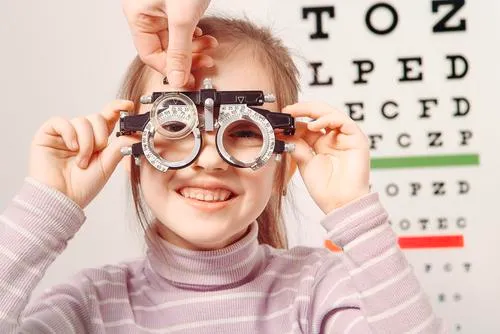
Every fall, families arrive at our Coconut Creek, Boynton Beach and West Palm Beach offices with a version of the same story. Their child passed the school vision screening, so they assumed the eyes were fine, and yet reading is still a fight. Sometimes the screening was right and the answer lies elsewhere. Sometimes it was not.
A vision screening and a comprehensive eye examination are not two sizes of the same thing. One is a fast filter built to flag a short list of conditions across a large group of children. The other is a diagnostic examination that ends with findings, a diagnosis and a plan. Here is what the published data says about each, including where the major professional bodies disagree.
Key takeaways
- A screening is a pass/fail filter; an eye exam is a diagnosis. They answer different questions.
- Under research conditions the best preschool screening tests found only about 61 to 64 percent of children with any targeted condition, though the same tests found 80 to 90 percent of the children with the conditions the investigators rated most important to detect (Schmidt et al., 2004).
- Screenings are built to catch amblyopia, eye turns and significant refractive error. They generally do not measure eye teaming, focusing stamina or eye-movement accuracy.
- Professional bodies disagree on schedules. The AOA recommends comprehensive exams on a set schedule; the AAO holds that a healthy, asymptomatic child who passed a good screening does not need one.
- Symptoms outrank screening results. If a child is uncomfortable, avoidant or inefficient with near work, that deserves an examination regardless of a pass.
What a vision screening is designed to do
Screening is a public-health tool. Its job is to sort a large population quickly and cheaply so that the children most likely to have a problem get sent on for real testing.
The US Preventive Services Task Force recommends vision screening at least once in all children aged 3 to 5 years to detect amblyopia or its risk factors, and concludes the evidence is insufficient to recommend screening under age 3 (USPSTF, 2017). The American Academy of Pediatrics describes a schedule that starts in the newborn nursery with inspection and a red reflex, adds instrument-based screening between 12 months and 3 years, moves to direct acuity testing from about age 4, and refers children who fail (Donahue and Nixon, 2016).
Those are sensible recommendations, and we support them. Screening finds amblyopia and eye turns at ages when they respond best to treatment, and both are common enough to be worth looking for. In a population-based Los Angeles study of African American and Hispanic/Latino children aged 6 to 72 months, amblyopia was found in 1.5 percent of the African American children and 2.6 percent of the Hispanic/Latino children, strabismus in 2.5 and 2.4 percent, and 78 percent of the amblyopia was attributable to refractive error (MEPEDS, 2008).
How accurate are screenings? The numbers
The Vision in Preschoolers study is the cleanest test of screening accuracy we have. Licensed eye care professionals administered 11 screening tests to 2,588 Head Start children aged 3 to 5. At 90 percent specificity, the best performers, noncycloplegic retinoscopy, the Retinomax and SureSight autorefractors and the Lea Symbols acuity test, detected 61 to 64 percent of children with a targeted condition; stereo tests reached 42 to 44 percent (Schmidt et al., 2004).
Both halves of that result matter, and it is worth reading them together rather than picking the one that suits your argument. Under ideal conditions, with trained eye doctors doing the screening, roughly one in three children with a targeted condition still passed. But the study’s own conclusion is more favorable than that number alone suggests: sensitivity for the conditions the investigators rated most important to detect was 80 to 90 percent for the two autorefractors and noncycloplegic retinoscopy, so the best tests found close to 90 percent of the children with the most serious problems.
Two things about that study are easy to miss. The targeted conditions were amblyopia, strabismus, significant refractive error and reduced acuity, not eye teaming, focusing or eye-movement problems, which the screenings were never designed to find. And the Head Start sample was deliberately enriched for vision problems, so these are best-case numbers produced by eye doctors under research conditions.
A different question is how screening performs when non-specialists run it. A 2026 systematic review and meta-analysis pooled seven studies of teacher-conducted school screening, mostly acuity-based programs in low- and middle-income settings, and compared what the teachers found against screening by eye care professionals. Pooled sensitivity was 0.70 and specificity 0.96, and the review’s own conclusion is that trained teachers are an effective way to identify visual impairment early (Umesh et al., 2026). Those numbers are not comparable with the Vision in Preschoolers figures: different comparator, different tests, different countries. What the two share is the direction. Any screening, however it is delivered and by whom, is a filter with a known miss rate.
Two more numbers frame the practical gap. The AOA’s pediatric guideline cites a study of public school children in which only 38.7 percent of those who failed the vision screening received follow-up care (AOA, 2017). And in a national survey of 4,237 US children aged 3 to 6, only 64.9 percent had ever had vision testing by any health provider (Kemper et al., 2011). A screening only helps if it happens and if the referral is completed.
Two professional positions, presented side by side
This is where families get confused, so we will be direct about the disagreement.
The ophthalmology position
The American Academy of Ophthalmology’s Pediatric Eye Evaluations Preferred Practice Pattern states plainly that “comprehensive eye examinations are not necessary for healthy asymptomatic children who have passed an acceptable vision-screening test, have no subjective visual symptoms, and have no personal or familial risk factors for eye disease” (Hutchinson et al., 2023). In that framework, periodic screening throughout childhood is the standard, and the exam is reserved for children who fail, who have symptoms, or who carry risk factors.
Notably, the same document says that testing the near point of accommodation and convergence “can be helpful in children with reading concerns,” and reports convergence insufficiency in 2 to 6 percent of fifth and sixth graders. Even the more conservative guideline treats symptoms at near as a reason to test beyond acuity.
The optometric position
The American Optometric Association’s evidence-based pediatric guideline recommends a comprehensive eye and vision examination at 6 to 12 months of age, at least once between ages 3 and 5, and before first grade with annual examinations thereafter (AOA, 2017). For adults, the AOA recommends an exam at least every two years from 18 through 64 and annually from 65 (AOA). The guideline’s argument for the schedule is precisely the sensitivity problem above, plus evidence it cites that acuity screening alone missed 75.5 percent of children later found to have binocular and oculomotor problems on a complete examination.
Our clinical perspective
We are a developmental optometry practice, so our instinct runs toward examining rather than screening, and you should weigh what we say with that in mind. The honest framing for parents is this: the disagreement is not about whether screenings miss things, because both sides accept that they do. It is about whether what they miss is worth the cost and time of examining every child. Our answer, in a practice that sees the children who were missed, is that a comprehensive exam before first grade is a reasonable investment. Your pediatrician may weigh it differently, and that is a legitimate difference of professional judgment rather than one side being wrong.
What screenings do not measure
Most screenings answer one question well: can this child see a letter of a given size at a given distance? Reading and homework depend on more. They depend on the two eyes converging accurately and holding that convergence for twenty minutes, on the focusing system responding quickly and staying put, and on the eyes making accurate small movements across a line of text.
Those skills are testable, and problems with them are common enough to matter. About 13 percent of 453 fifth- and sixth-graders in a US school-based study met a high-suspect or definite convergence insufficiency definition, and 78.9 percent of the three-sign cases also had accommodative insufficiency (Rouse et al., 1999). In a study of 461 high-school students identified as poor readers, 80 percent were inadequate or weak in near fusion ranges, accommodative facility or near point of convergence, while only 17 percent had acuity of 20/40 or worse, the usual screening threshold (Grisham et al., 2007). Uncorrected moderate farsightedness is also associated with lower early-literacy scores in preschoolers (Kulp et al., 2016), and farsightedness is easy for a distance-acuity screening to miss entirely.
The honest counterweight
We will not overstate what an examination can do. A population cohort of 5,822 children aged 7 to 9 found that four of every five children with severe reading impairment had entirely normal ophthalmic function, and the authors concluded there was no evidence that vision-based treatment would help that group (Creavin et al., 2015). So the defensible claim here is narrow and worth making anyway: an examination can find a treatable near-vision problem that a screening cannot, and treating it can make near work more comfortable, but it is not a shortcut to better grades. We lay out the full evidence on vision and reading, including the treatment trials and where the professional bodies disagree, in binocular vision and reading: what is and isn’t proven.
Age matters, but the evidence differs by condition
For amblyopia, timing genuinely matters. A pooled analysis of four PEDIG trials found children aged 7 to under 13 responded significantly less well to amblyopia treatment than children under 7, though some older children still improved markedly (Holmes et al., 2011). Even with good treatment, mild residual amblyopia is common: at age 15, 59.9 percent of treated participants saw 20/25 or better, but 48.3 percent still had a two-line or greater difference between the eyes (Repka et al., 2014). That is the strongest argument in this whole article for early testing of some kind, screening or exam.
For eye teaming and focusing problems the question is different, and the honest answer is that there is less evidence rather than evidence of no age limit. The children in the two convergence insufficiency trials were 9 to 17 (CITT, 2008) and 9 to 14 (CITT-ART, 2019), so that is the age band where office-based therapy has been tested best. In adults the picture is less clear: a small randomized trial in 46 adults aged 19 to 30 found symptom-elimination criteria met by 42 percent with office-based therapy versus 31 percent with office placebo (Scheiman et al., 2005), and a Cochrane network meta-analysis concluded that the evidence for non-surgical treatment in adults is less clear than in children (Scheiman et al., 2020). What we can say without overreaching is that symptoms at near are worth evaluating at any age. What we cannot promise is that an adult will respond the way a ten-year-old does.
Where a developmental vision evaluation fits
A developmental (or binocular) vision evaluation is a comprehensive eye exam plus a deeper workup of how the visual system performs under sustained near demand. We describe the difference in detail in comprehensive vs developmental eye exam, and the fees in how much a developmental vision evaluation costs.
It is the right next step when a child has passed a screening but shows a pattern like:
- headaches, eye rubbing or eye ache with reading or homework
- losing place, skipping lines, or re-reading the same sentence
- words that blur, swim or briefly double after a few minutes of near work
- covering or closing one eye to read
- reading stamina far below what the child’s oral language and comprehension would predict
- avoidance and meltdowns that are specific to near work, not to all schoolwork
Our symptom checklist is a quick way to see whether the pattern fits, and what school vision screenings miss covers the screening gap in more depth. If you are new to the field entirely, start with our plain-English guide to what vision therapy is.
How we would decide
- No symptoms, passed a good screening, no family history. Either professional position is defensible. Follow your pediatrician’s schedule, or choose the AOA schedule if you prefer the more thorough route.
- Failed a screening. Book the exam. In the study the AOA guideline cites, only 38.7 percent of children who failed a school screening received follow-up care; do not be one of the rest.
- Symptoms with a passed screening. Book the exam, and say the screening was passed so we know to look carefully at near.
- Family history of amblyopia, strabismus or high refractive error. Book the exam early, and do not wait for school age.
- No testing yet at all. Any testing beats none. Start somewhere.
A screening tells you whether a child cleared a bar on one day. An examination tells you how their visual system actually works. If the screening result and your own observations do not match, trust your observations and get the fuller picture. Schedule an evaluation at any of our four Florida offices, or read more about what our examinations include.
Common Questions About This Topic
Is a vision screening the same as an eye exam?
No. A screening is a short pass/fail filter, usually distance letters and sometimes a photoscreener or stereo test, run by a nurse, teacher, pediatrician or volunteer. A comprehensive eye exam is a diagnostic examination by an optometrist or ophthalmologist that measures refraction, eye alignment and teaming, focusing, eye movements and eye health, and ends with a diagnosis and a plan.
How accurate are vision screenings?
Better than nothing, far from perfect, and it depends what you are asking them to find. In the Vision in Preschoolers study, where licensed eye care professionals ran the tests under research conditions, the best-performing screenings detected 61 to 64 percent of children with any targeted condition at 90 percent specificity, but 80 to 90 percent of the children with the conditions the investigators rated most important to detect. A separate meta-analysis of teacher-run school screening, mostly acuity-based programs in low- and middle-income countries, found pooled sensitivity of 0.70 when teachers were compared with screening by eye care professionals.
My child passed the school screening but still complains about reading. What now?
A pass means the child cleared the specific tests used that day. It does not rule those conditions out, because no screening finds everyone, and it does not measure eye teaming at near, focusing stamina or eye-movement accuracy at all. If symptoms persist, the next step is a comprehensive eye examination that includes those near-vision measurements.
How often should my child have a comprehensive eye exam?
That depends on which body you follow. The AOA recommends an exam at 6 to 12 months, at least once between ages 3 and 5, and before first grade then annually. The AAO's Pediatric Eye Evaluations guideline holds that comprehensive exams are not necessary for a healthy, asymptomatic child who passed an acceptable screening and has no risk factors. We tell families both positions and then look at their child's symptoms, family history and school demands.
Does it matter how old my child is when a problem is found?
For amblyopia, yes. A pooled analysis of four PEDIG trials found children aged 7 to under 13 responded less well to amblyopia treatment than children under 7, although some older children still improved a lot. For eye teaming and focusing problems there is no comparable age cutoff in the published evidence, but there is also less evidence to go on: the convergence insufficiency trials enrolled children aged 9 to 17, and the adult trials are small and their results less clear. Symptoms at near are worth evaluating at any age.
Where This Information Comes From
- Schmidt P, Maguire M, Dobson V, et al.; Vision in Preschoolers Study Group (2004). Comparison of preschool vision screening tests as administered by licensed eye care professionals in the Vision In Preschoolers Study. Ophthalmology; 111(4):637-650. : In 2588 Head Start children aged 3-5, the best screening tests detected only 61-64% of children with a targeted condition at 90% specificity (stereo tests 42-44%), but sensitivity for the conditions rated most important to detect was 80-90% for the two autorefractors and noncycloplegic retinoscopy.
- Umesh U, Srinivasan K, Sherigar SS, Prabhu V (2026). Effectiveness of school vision screening by teachers - a systematic review and meta-analysis. BMC Public Health; 26(1):1794. : Across seven studies, mostly acuity-based programs in low- and middle-income settings, teacher-run screening had pooled sensitivity 0.70 and specificity 0.96 against screening by eye care professionals; the review concludes trained teachers are effective for early identification of visual impairment.
- US Preventive Services Task Force; Grossman DC, Curry SJ, Owens DK, et al. (2017). Vision Screening in Children Aged 6 Months to 5 Years: US Preventive Services Task Force Recommendation Statement. JAMA; 318(9):836-844. : Recommends screening at least once at ages 3-5 to detect amblyopia or its risk factors (B grade); evidence insufficient under age 3; 1-6% of children under 6 have amblyopia or its risk factors.
- Donahue SP, Nixon CN; AAP Section on Ophthalmology, Committee on Practice and Ambulatory Medicine, AAO, AAPOS, AACO (2016). Visual System Assessment in Infants, Children, and Young Adults by Pediatricians. Pediatrics; 137(1):28-30. : Sets the pediatrician-office schedule: red reflex in the nursery, instrument-based screening from 12 months to 3 years, direct acuity testing from about age 4, referral for failures.
- Hutchinson AK, Morse CL, Hercinovic A, et al.; American Academy of Ophthalmology Preferred Practice Pattern Pediatric Ophthalmology/Strabismus Panel (2023). Pediatric Eye Evaluations Preferred Practice Pattern. Ophthalmology; 130(3):P222-P270. : States comprehensive eye examinations are not necessary for healthy asymptomatic children who passed an acceptable screening and have no symptoms or risk factors, and that testing near point of accommodation and convergence can be helpful in children with reading concerns.
- American Optometric Association (2017). Evidence-Based Clinical Practice Guideline: Comprehensive Pediatric Eye and Vision Examination. St. Louis: AOA. : Recommends comprehensive exams at 6-12 months, at least once between 3 and 5 years, and before first grade then annually; cites evidence that acuity screening alone missed 75.5% of children found to have binocular and oculomotor problems on a complete examination, and one study of public school children in which only 38.7% of those who failed the screening received follow-up care.
- American Optometric Association. Comprehensive Eye Exams: recommended eye examination frequency for pediatric and adult patients. aoa.org patient page. : Recommends exams at least every two years for asymptomatic adults 18-64 and annually from 65, with annual care for at-risk patients.
- Kemper AR, Wallace DK, Patel N, Crews JE (2011). Preschool vision testing by health providers in the United States: findings from the 2006-2007 Medical Expenditure Panel Survey. Journal of AAPOS; 15(5):480-483. : In a national survey of 4,237 US children aged 3-6, only 64.9% had ever had vision testing by a health provider.
- Grisham D, Powers M, Riles P (2007). Visual skills of poor readers in high school. Optometry; 78(10):542-549. : Of 461 high-school students identified as poor readers, 80% were inadequate or weak in near fusion ranges, accommodative facility or near point of convergence, while only 17% had acuity of 20/40 or worse.
- Rouse MW, Borsting E, Hyman L, et al.; CIRS Group (1999). Frequency of convergence insufficiency among fifth and sixth graders. Optometry and Vision Science; 76(9):643-649. : About 13% of 453 fifth- and sixth-graders met a high-suspect or definite convergence insufficiency definition; 78.9% of three-sign cases also had accommodative insufficiency.
- Creavin AL, Lingam R, Steer C, Williams C (2015). Ophthalmic abnormalities and reading impairment. Pediatrics; 135(6):1057-1065. : In 5822 children aged 7-9, four of every five with severe reading impairment had normal ophthalmic function and no association was found with strabismus, refractive error, amblyopia, convergence, accommodation or contrast sensitivity; stereoacuity worse than 60 arcsec (1 in 6 vs 1 in 10) and near sensory fusion problems were somewhat more common.
- Multi-ethnic Pediatric Eye Disease Study Group (2008). Prevalence of amblyopia and strabismus in African American and Hispanic children ages 6 to 72 months. Ophthalmology; 115(7):1229-1236. : In a population-based Los Angeles study of 3007 African American and 3007 Hispanic/Latino children aged 6-72 months, amblyopia was found in 1.5% and 2.6% and strabismus in 2.5% and 2.4% respectively; 78% of amblyopia was attributable to refractive error.
- Holmes JM, Lazar EL, Melia BM, et al.; Pediatric Eye Disease Investigator Group (2011). Effect of age on response to amblyopia treatment in children. Archives of Ophthalmology; 129(11):1451-1457. : Pooled analysis of four PEDIG trials: children aged 7 to under 13 were significantly less responsive to amblyopia treatment than children under 7, though some older children still responded markedly.
- Repka MX, Kraker RT, Holmes JM, et al.; Pediatric Eye Disease Investigator Group (2014). Atropine vs patching for treatment of moderate amblyopia: follow-up at 15 years of age. JAMA Ophthalmology; 132(7):799-805. : At age 15, 59.9% of treated participants saw 20/25 or better but 48.3% still had a two-line or greater difference between the eyes.
- VIP-HIP Study Group; Kulp MT, Ciner E, Maguire M, et al. (2016). Uncorrected Hyperopia and Preschool Early Literacy: Results of the VIP-HIP Study. Ophthalmology; 123(4):681-689. : Uncorrected hyperopes of +3 to +6 D scored 4.3 points lower than emmetropes on an early-literacy test, with larger deficits when near acuity or near stereoacuity was reduced.
- Convergence Insufficiency Treatment Trial Study Group (2008). Randomized clinical trial of treatments for symptomatic convergence insufficiency in children. Archives of Ophthalmology; 126(10):1336-1349. : In 221 children aged 9-17, office-based vergence/accommodative therapy produced a successful or improved outcome in 73% versus 35% with office placebo.
- CITT-ART Investigator Group (2019). Treatment of Symptomatic Convergence Insufficiency in Children Enrolled in the Convergence Insufficiency Treatment Trial-Attention & Reading Trial: A Randomized Clinical Trial. Optometry and Vision Science; 96(11):825-835. : In 311 children aged 9-14, near point of convergence and fusional vergence improved far more with therapy than placebo, but CISS symptom scores improved similarly in both groups (11.8 vs 10.4 points, P=.21).
- Scheiman M, Mitchell GL, Cotter S, et al. (2005). A randomized clinical trial of vision therapy/orthoptics versus pencil pushups for the treatment of convergence insufficiency in young adults. Optometry and Vision Science; 82(7):583-595. : In 46 adults aged 19-30, symptom-elimination criteria were met by 42% with office-based vision therapy, 31% with office placebo and 20% with home pencil push-ups; only the therapy group improved convergence measures.
- Scheiman M, Kulp MT, Cotter SA, Lawrenson JG, Wang L, Li T (2020). Interventions for convergence insufficiency: a network meta-analysis. Cochrane Database of Systematic Reviews; 12:CD006768. : Across 12 trials (968 children, 321 adults), office-based vergence/accommodative therapy with home reinforcement was superior in children; in adults the evidence for non-surgical interventions is less clear.
Care We Provide
More From the Blog
Wondering If This Sounds Like Your Family?
A developmental vision evaluation measures the skills a routine eye exam does not. Our team sees children and adults in Coconut Creek, Boynton Beach, Boca Raton and West Palm Beach.