Does Vision Therapy Work? An Honest Evidence Summary
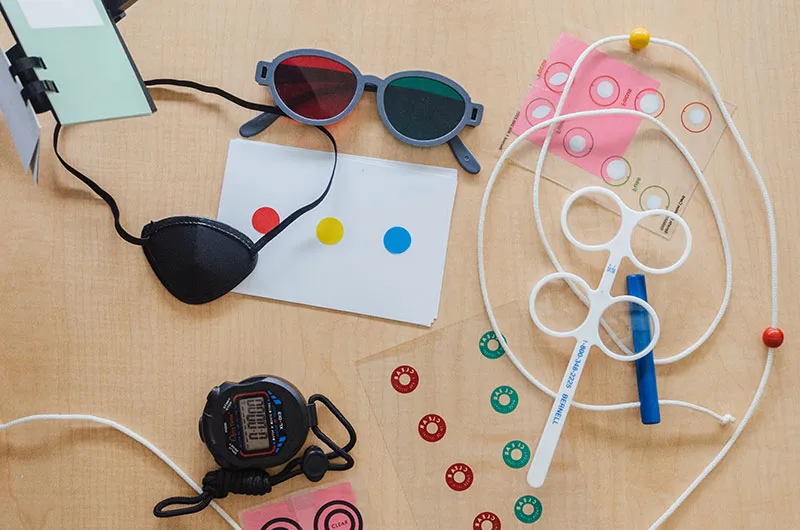
Vision therapy may be the most argued-about treatment in eye care. Search for it and you will find optometry practices describing transformed readers, and ophthalmology organizations calling it unproven. Both sides are quoting real sources. Neither, on its own, is telling you the whole story.
This page is our attempt at the whole story. We are a vision therapy practice, so we have an obvious stake in the answer, and we are going to tell you where the research does not support us as clearly as where it does.
Key takeaways
- The strongest evidence in the field supports office-based vergence and accommodative therapy for symptomatic convergence insufficiency in children, tested against placebo in randomized trials.
- The same research group’s later, larger trial found no reading benefit and no symptom advantage over placebo, which is an important limit on what anyone should claim.
- Evidence for focusing disorders and for adults is real but thinner: smaller studies, fewer controls. Post-concussion convergence insufficiency now has a 104-participant randomized trial behind it, though it compared starting therapy immediately with starting it six weeks later, not with a sham.
- Vision therapy is not a treatment for dyslexia, ADHD or amblyopia. Claims that it is go past the data.
- The most useful thing you can do is ask a provider what they are treating, how they will measure it, and when they would stop.
Three different voices, and why they disagree
Almost every argument about vision therapy collapses into confusion because three separate voices get mixed together.
The research literature answers narrow questions: did this specific treatment, for this specific diagnosis, beat a placebo in a randomized trial? That is a much smaller question than “does vision therapy work.”
Professional bodies issue positions, and they genuinely disagree. The American Academy of Pediatrics, American Academy of Ophthalmology, AAPOS and AACO hold jointly that vision problems can interfere with learning but do not cause dyslexia, and that evidence does not support eye exercises or behavioral vision therapy as treatments for learning disabilities (AAP/AAO/AAPOS/AACO, 2009); that statement was reaffirmed in 2014 with the language that such treatments “are not endorsed and should not be recommended” for educational performance (AAO et al., 2014). The American Optometric Association and American Academy of Optometry hold that vision problems can and often do interfere with learning, and that people at risk should be evaluated as part of multidisciplinary care (AAOpt/AOA, 1997).
A practice’s clinical perspective is the third voice, and it is the one you are reading here. It is worth something, but it is not evidence, and we will label it as ours when we get to it.
Where the evidence is strongest: convergence insufficiency in children
Convergence insufficiency is difficulty holding the eyes turned inward comfortably at reading distance. It is common: about 13% of fifth- and sixth-graders in a US school-based study met a high-suspect or definite definition (Rouse et al., 1999).
The Convergence Insufficiency Treatment Trial randomized 221 children aged 9 to 17 to office-based vergence/accommodative therapy with home reinforcement, home computer therapy, home pencil push-ups, or an office-based placebo. After 12 weeks, 73% of the office-based therapy group were successful or improved, versus 35% of the placebo group, 43% for pencil push-ups and 33% for home computer therapy (CITT Study Group, 2008). Among children who became asymptomatic, 84.4% of the office-therapy group were still asymptomatic a year later (CITT Study Group, 2009).
A Cochrane network meta-analysis pooling 12 trials and 1289 participants reached the same conclusion: office-based therapy with home reinforcement was more effective than placebo in children, with a risk ratio of 3.04 (Scheiman et al., 2020).
Two honest footnotes. First, 35% of the placebo group also improved, so the real gap over placebo is roughly 38 percentage points, not 73. Second, pencil push-ups alone, which are still handed out as a home fix, did not beat placebo.
What the follow-up trial found
CITT-ART is the most important study for keeping expectations straight. In the 311 children it randomized, clinical signs improved more with therapy than placebo: near point of convergence improved 10.4 cm versus 6.2 cm, and positive fusional vergence 23.2 versus 8.8 prism diopters. But symptom scores improved by similar amounts in both groups (CITT-ART, 2019). And in the companion reading analysis of 310 of those children, therapy produced a 3.7-point gain in reading comprehension versus 3.8 points for placebo (CITT-ART, 2019).
We link to that trial deliberately, and we walk through it in more depth in what the CITT and CITT-ART trials actually found. Any practice that cites the 2008 result and never mentions 2019 is showing you half the file.
Where the evidence is moderate or limited
Focusing (accommodative) problems. Within CITT, 164 of 221 children (74%) also had accommodative dysfunction, and office-based therapy raised accommodative amplitude by 9.9 D versus 2.2 D with placebo (Scheiman et al., 2011). For isolated accommodative insufficiency, though, a review found reported prevalence ranging from under 1% to 61.6% depending on criteria, and no high-quality evidence for a standard treatment; plus lenses and vision therapy have each shown benefit separately but have never been compared head to head (Hussaindeen and Murali, 2020).
After a concussion. Vision problems are genuinely common in children referred with concussion: 69% of 100 adolescents in one concussion program had a vision diagnosis (Master et al., 2016), and in a separate sample of 113 adolescents assessed 4 to 12 weeks after injury, 70% had an oculomotor diagnosis, with routine physician screening missing many (Scheiman et al., 2021). The AAP and AAO clinical report agrees these problems matter, while noting most children recover on their own by four weeks and recommending a vision-specific examination for those who do not (Master et al., 2022).
Treatment evidence is thinner than diagnosis evidence, but it is no longer absent. Most children get better without therapy: in one series, 46% of children with abnormal convergence after concussion recovered with standard care and only 13% went on to office-based vision therapy (Storey et al., 2017). The high success rates quoted in practice marketing come from uncontrolled private-practice records (Gallaway et al., 2017). A small randomized trial of 50 people found home Brock string work improved the convergence measurement more than usual care, though it did not test whether recovery was shortened (Trbovich et al., 2025).
The concussion-specific randomized trial of office-based therapy is CONCUSS. It randomized 104 people aged 11 to 25 who still had symptoms and convergence insufficiency 4 to 24 weeks after injury, either to immediate office-based vergence and accommodative therapy or to the same therapy delayed by six weeks. At six weeks, 46 of 52 (88%) in the immediate group were successful or improved on the primary outcome, a composite of near point of convergence and positive fusional vergence, versus 4 of 52 (8%) in the delayed group, and symptoms improved in 79% versus 13% (Alvarez et al., 2026). A secondary analysis of the same trial found focusing amplitude improved by roughly 4.7 to 5.1 diopters with immediate therapy versus about 1.0 with waiting (Scheiman et al., 2026). We treat that as real evidence, and we keep three limits in view: the comparison group waited rather than receiving a sham therapy, so expectation effects are not ruled out; the endpoint was eye-teaming and focusing measurements, not concussion recovery or return to play; and once both groups had completed all 16 sessions, their outcomes were equivalent, which is why the authors describe immediate therapy as shortening the symptomatic period rather than changing the destination. No trial has yet used overall concussion recovery or return to play as its primary endpoint, and none has used a sham comparison in concussed patients. We go through this literature in more detail in vision problems after a concussion.
Adults. In a trial of 46 adults aged 19 to 30, only the office-based therapy group significantly improved convergence measurements, but 42% reached symptom-elimination criteria versus 31% of placebo, and more than half remained symptomatic (Scheiman et al., 2005). Cochrane concluded the adult evidence is less clear than the pediatric evidence (Scheiman et al., 2020).
Where the evidence is negative, or simply missing
Reading and dyslexia. CITT-ART is negative for reading. A population cohort of 5822 children found no association between severe reading impairment and strabismus, refractive error, amblyopia, convergence or accommodation, and four of every five poor readers had entirely normal ophthalmic function (Creavin et al., 2015). A smaller clinical study did find more visual deficits in children with dyslexia: 79% had a deficit in at least one domain of visual function versus 33% of typical readers. Broken out, that was accommodation 55% versus 9% and ocular motor tracking 62% versus 15%, while the difference in vergence deficits (34% versus 15%) was not statistically significant. The authors themselves wrote that the cause and clinical relevance of these deficits are uncertain (Raghuram et al., 2018). And where vision therapy has been given to children with learning disorders, the binocular vision measures improved, but reading was never measured as an outcome in that study, so it tells us nothing either way about reading (Hussaindeen et al., 2018). The pediatric technical report is right that the treatment for dyslexia is evidence-based reading instruction (Handler and Fierson, 2011).
Attention and ADHD. Convergence insufficiency and ADHD co-occur about three times more often than expected (Granet et al., 2005), and in a national survey of 75,171 children, ADHD was reported in 15.6% of those with vision problems versus 8.3% without (DeCarlo et al., 2016). These are associations. There is no trial showing vision therapy treats ADHD, and we do not claim one.
Amblyopia. The AAO Preferred Practice Pattern is blunt: antisuppression, vergence, accommodation, eye-hand coordination activities and perceptual learning are often prescribed as adjuncts, but “there is no convincing evidence for treatment success with these activities for amblyopia” (AAO PPP Panel, 2023). The AAO’s separate review of binocular treatment found no level I evidence that it can substitute for patching or glasses (Pineles et al., 2020); large trials found a binocular iPad game inferior to patching (Holmes et al., 2016) and no better than a placebo game (Gao et al., 2018). A newer dichoptic digital therapeutic did beat glasses alone, 1.8 lines versus 0.8 (Xiao et al., 2022), but it was not compared with patching. Glasses, patching and atropine remain the treatment.
Sports vision. The rationale is plausible and the evidence is uneven (Appelbaum and Erickson, 2018). The most-quoted study raised one college team’s batting average from 0.251 to 0.285 with no randomization and no control for coaching or roster changes (Clark et al., 2012). Interesting, not proof.
Myopia, blue light and light therapy. Time outdoors protects against myopia onset but does not slow progression in eyes that are already myopic (Xiong et al., 2017). Blue-light-filtering lenses may not reduce eye strain at all (Singh et al., 2023). And syntonic phototherapy, which some optometric practices offer, was reviewed across eight studies with GRADE certainty rated very low for every outcome and no consistent evidence of effect (Cervera-Sanchez et al., 2023).
What the critics say, and where they are right
The most thorough independent critique came from a UK academic optometrist who examined ten categories of behavioral vision therapy and concluded that the large majority are not evidence-based, singling out convergence insufficiency, yoked prisms in neurological patients, and rehabilitation after brain injury as the areas with real support (Barrett, 2009).
That is a fair description of the field, and it lines up with everything above. The critics are right that a lot of what gets marketed under the vision therapy umbrella has never been tested against a placebo; that success rates quoted from uncontrolled case series are not comparable to trial results; and that claims about reading, grades and attention have been tested and did not hold up. Where we part company is the further step some critics take, that because the learning claims failed, the underlying binocular and accommodative problems are not worth diagnosing or treating. The CI trials say otherwise.
How to judge any provider’s claims
- Ask what is being treated. A named diagnosis with measurable signs, not “visual processing” in general.
- Ask how it will be measured. Near point of convergence, fusional ranges, accommodative amplitude and facility, and a validated symptom survey are numbers you can see move.
- Ask about the stopping rule. A program that has no point at which it would say “this is not working” is not a clinical plan.
- Watch the outcome being promised. Comfort at near, fewer headaches and less avoidance are defensible. Reading level, grades and attention are not.
- Be careful with percentages. A “90% success rate” from a practice’s own completed cases is not the same kind of number as a trial result.
Our clinical perspective
Here is where we tell you plainly what is ours rather than the literature’s. We think the honest position for a vision therapy practice is narrow and specific: we look for binocular and accommodative problems that make near work uncomfortable, we treat the ones the evidence supports treating with office-based vision therapy, and we say so when a child’s difficulty is a reading, language or attention problem that needs a different professional. Vision therapy is one tool in a multidisciplinary picture, not the explanation for everything.
That also means we tell families when they are not a good fit, which we cover in who is a good fit for vision therapy and in our plain-English guide to what vision therapy is. If you are weighing the commitment, the cost and time factors matter as much as the evidence does.
Where this leaves you
If your child or you have symptoms at near, double vision, headaches after reading, losing place, avoiding homework, then the right next step is not to decide about vision therapy. It is to find out whether a measurable binocular or focusing problem is there at all. That is what a comprehensive developmental vision evaluation is for, and the answer may well be that nothing in the visual system explains the difficulty.
We would rather tell you that than sell you a program. If you would like an evaluation at our Boynton Beach or Boca Raton office, Schedule an evaluation.
Common Questions About This Topic
Is vision therapy scientifically proven?
Parts of it are. Office-based vergence and accommodative therapy for symptomatic convergence insufficiency in children has been tested in randomized, placebo-controlled trials and in a Cochrane network meta-analysis, and it outperformed placebo. Other uses of vision therapy have much thinner evidence, and some popular claims have been tested and failed. Any honest answer has to be condition by condition, not a yes or a no.
Does vision therapy improve reading or grades?
The largest and best-designed trial on this question said no. CITT-ART randomized 310 children with convergence insufficiency and found reading comprehension improved 3.7 points with therapy and 3.8 points with placebo therapy. We treat visual discomfort during reading. We do not treat reading itself, and we do not promise better grades.
Why do ophthalmologists and optometrists disagree about vision therapy?
They are largely answering different questions. The pediatric and ophthalmology bodies are responding to the claim that vision therapy treats dyslexia and learning disabilities, and they say the evidence does not support it. Optometric organizations argue that vision problems can interfere with learning and are worth finding and treating in their own right. Both positions can be true at the same time.
Does vision therapy help after a concussion?
Convergence and focusing problems are genuinely common after concussion, and national guidance recommends a vision-specific examination when symptoms persist past about four weeks. Most children recover on their own. For those who do not, the CONCUSS randomized trial found that 88% of people aged 11 to 25 given immediate office-based vergence and accommodative therapy were successful or improved on eye-teaming measures at six weeks, versus 8% of those whose therapy was delayed, and symptoms improved in 79% versus 13%. The limits matter: the comparison group waited rather than receiving a sham, and once both groups had completed all 16 sessions their outcomes were equivalent. No trial has yet used overall concussion recovery or return to play as its primary endpoint.
How can I tell if a vision therapy program is overselling?
Ask three questions: what specific measurable problem are you treating, how will you measure whether it changed, and at what point would you stop and tell me this is not working? A program that can answer all three with numbers and a stopping rule is being straight with you.
Where This Information Comes From
- Rouse MW, Borsting E, Hyman L, et al.; CIRS Group (1999). Frequency of convergence insufficiency among fifth and sixth graders. Optometry and Vision Science. : About 13% of 453 fifth- and sixth-graders met a high-suspect or definite convergence insufficiency definition.
- Convergence Insufficiency Treatment Trial Study Group (2008). Randomized clinical trial of treatments for symptomatic convergence insufficiency in children. Archives of Ophthalmology. : In 221 children, 73% succeeded or improved with office-based therapy versus 35% with office placebo at 12 weeks.
- Convergence Insufficiency Treatment Trial Study Group (2009). Long-term effectiveness of treatments for symptomatic convergence insufficiency in children. Optometry and Vision Science. : Of children who became asymptomatic with office-based therapy, 84.4% were still asymptomatic one year later.
- Scheiman M, Kulp MT, Cotter SA, Lawrenson JG, Wang L, Li T (2020). Interventions for convergence insufficiency: a network meta-analysis. Cochrane Database of Systematic Reviews. : Across 12 trials and 1289 participants, office-based therapy beat placebo in children (RR 3.04); adult evidence is less clear.
- CITT-ART Investigator Group (2019). Treatment of symptomatic convergence insufficiency in children enrolled in CITT-ART: a randomized clinical trial. Optometry and Vision Science. : In 311 children, clinical signs improved more with therapy than placebo, but symptom scores improved similarly in both groups.
- CITT-ART Investigator Group (2019). Effect of vergence/accommodative therapy on reading in children with convergence insufficiency: a randomized clinical trial. Optometry and Vision Science. : In 310 children, reading comprehension improved 3.7 points with therapy versus 3.8 with placebo: no reading benefit.
- Scheiman M, Cotter S, Kulp MT, et al.; CITT Study Group (2011). Treatment of accommodative dysfunction in children: results from a randomized clinical trial. Optometry and Vision Science. : 74% of CITT children also had accommodative dysfunction; amplitude rose 9.9 D with office therapy versus 2.2 D with placebo.
- Hussaindeen JR, Murali A (2020). Accommodative insufficiency: prevalence, impact and treatment options. Clinical Optometry. : No high-quality evidence for a standard treatment protocol; plus lenses and therapy have never been compared head-to-head.
- Scheiman M, Mitchell GL, Cotter S, et al. (2005). A randomized clinical trial of vision therapy/orthoptics versus pencil pushups for convergence insufficiency in young adults. Optometry and Vision Science. : In 46 adults, 42% of the therapy group met symptom-elimination criteria versus 31% of placebo; most stayed symptomatic.
- Master CL, Scheiman M, Gallaway M, et al. (2016). Vision diagnoses are common after concussion in adolescents. Clinical Pediatrics. : 69% of 100 adolescents in a concussion program had a vision diagnosis; 49% had convergence insufficiency.
- Scheiman M, Grady MF, Jenewein E, et al. (2021). Frequency of oculomotor disorders in adolescents 11 to 17 years of age with concussion, 4 to 12 weeks post injury. Vision Research. : 79 of 113 adolescents (70%) had an oculomotor diagnosis; physician screening had limited sensitivity for finding them.
- Master CL, Bacal D, Grady MF, et al.; AAP, AAO, AAPOS, AACO (2022). Vision and concussion: symptoms, signs, evaluation, and treatment. Pediatrics. : Most children recover by 4 weeks; those who do not warrant a vision-specific history and examination.
- Storey EP, Master SR, Lockyer JE, et al. (2017). Near point of convergence after concussion in children. Optometry and Vision Science. : 46% of children with abnormal convergence recovered with standard care; 13% needed office-based vision therapy.
- Gallaway M, Scheiman M, Mitchell GL (2017). Vision therapy for post-concussion vision disorders. Optometry and Vision Science. : Uncontrolled two-practice series: 85% of convergence insufficiency patients who completed therapy were rated successful.
- Trbovich AM, Zynda AJ, Togashi T, et al. (2025). Randomized controlled trial of Brock string vision therapy for receded near point of convergence following concussion. Journal of Neurotrauma. : Home Brock string exercises improved near point of convergence more than usual care in 50 participants.
- Alvarez TL, Scheiman M, Hajebrahimi F, Noble M, Gohel S, Baro R, Bachman JA, Master CL, Goodman A; CONCUSS Investigator Group (2026). CONCUSS randomised clinical trial of vergence/accommodative therapy for concussion-related symptomatic convergence insufficiency. British Journal of Sports Medicine; 60(5):340-354. : In 104 participants aged 11-25 with concussion-related convergence insufficiency 4-24 weeks post-injury, 46/52 (88%) were successful or improved at six weeks on the composite near point of convergence and positive fusional vergence outcome with immediate office-based therapy, versus 4/52 (8%) with delayed therapy; symptoms improved in 79% versus 13%. The comparator was delayed therapy rather than a sham, the endpoint was clinical signs rather than overall concussion recovery, and outcomes were equivalent once both groups had completed 16 sessions.
- Scheiman M, Alvarez TL, Hajebrahimi F, Noble M, Gohel S, Baro R, Bachman JA, Master CL, Goodman A; CONCUSS Investigator Group (2026). Effectiveness of office-based vergence/accommodative therapy with movement for accommodative dysfunction in concussion-related convergence insufficiency: a secondary analysis of the CONCUSS randomised clinical trial. British Journal of Sports Medicine; published online 8 July 2026. : Secondary analysis of CONCUSS: 79% of the 106 participants had an accommodative disorder, and accommodative amplitude improved by about 4.7 D (right eye) and 5.1 D (left eye) with immediate therapy versus about 1.0 D with six weeks of watchful waiting. Secondary outcome of the same trial, same non-sham comparator.
- American Academy of Pediatrics, American Academy of Ophthalmology, AAPOS, AACO (2009). Joint statement: learning disabilities, dyslexia, and vision. Pediatrics. : Holds that vision problems do not cause dyslexia and that evidence does not support vision therapy for learning disabilities.
- Handler SM, Fierson WM; AAP Section on Ophthalmology et al. (2011). Learning disabilities, dyslexia, and vision. Pediatrics. : Technical report: dyslexia is phonologic; effective treatment is evidence-based reading instruction.
- American Academy of Ophthalmology, AAP, AAPOS, AACO (2014). Joint statement: learning disabilities, dyslexia, and vision - reaffirmed 2014. : States that eye exercises and behavioral vision therapy are not endorsed for improving long-term educational performance.
- American Academy of Optometry; American Optometric Association (1997). Vision, learning and dyslexia: a joint organizational policy statement. Journal of the American Optometric Association. : Optometric position that vision problems can interfere with learning and warrant evaluation within multidisciplinary care.
- Creavin AL, Lingam R, Steer C, Williams C (2015). Ophthalmic abnormalities and reading impairment. Pediatrics. : In 5822 children, four of five with severe reading impairment had normal ophthalmic function; no link to convergence or accommodation.
- Raghuram A, Gowrisankaran S, Swanson E, et al. (2018). Frequency of visual deficits in children with developmental dyslexia. JAMA Ophthalmology. : 79% of children with dyslexia had a deficit in 1 or more domain of visual function versus 33% of typical readers; cause and clinical relevance uncertain.
- Hussaindeen JR, Shah P, Ramani KK, Ramanujan L (2018). Efficacy of vision therapy in children with learning disability and associated binocular vision anomalies. Journal of Optometry. : Vision therapy improved binocular vision measures in children with learning disorders; reading was not the outcome measured.
- Granet DB, Gomi CF, Ventura R, Miller-Scholte A (2005). The relationship between convergence insufficiency and ADHD. Strabismus. : Convergence insufficiency and ADHD co-occurred about three times more often than expected; association, not causation.
- DeCarlo DK, Swanson M, McGwin G, Visscher K, Owsley C (2016). ADHD and vision problems in the National Survey of Children's Health. Optometry and Vision Science. : ADHD reported in 15.6% of children with vision problems versus 8.3% without (adjusted OR 1.8).
- Cruz OA, Repka MX, Hercinovic A, et al.; AAO Preferred Practice Pattern Pediatric Ophthalmology/Strabismus Panel (2023). Amblyopia Preferred Practice Pattern. Ophthalmology. : States there is no convincing evidence of treatment success for antisuppression, vergence, accommodation or perceptual-learning activities in amblyopia.
- Pineles SL, Aakalu VK, Hutchinson AK, et al. (2020). Binocular treatment of amblyopia: a report by the American Academy of Ophthalmology. Ophthalmology. : No level I evidence that binocular treatment can substitute for patching or optical treatment.
- Holmes JM, Manh VM, Lazar EL, et al.; PEDIG (2016). Effect of a binocular iPad game vs part-time patching in children aged 5 to 12 years with amblyopia. JAMA Ophthalmology. : Patching improved acuity more than the binocular game (1.35 vs 1.05 lines), with poor game adherence.
- Gao TY, Guo CX, Babu RJ, et al.; BRAVO Study Team (2018). Effectiveness of a binocular video game vs placebo video game in older children, teenagers and adults with amblyopia. JAMA Ophthalmology. : No difference between the active binocular game and a placebo game over 6 weeks.
- Xiao S, Angjeli E, Wu HC, et al.; Luminopia Pivotal Trial Group (2022). Randomized controlled trial of a dichoptic digital therapeutic for amblyopia. Ophthalmology. : 1.8 lines with the digital therapeutic plus glasses versus 0.8 lines with glasses alone; comparator was not patching.
- Appelbaum LG, Erickson G (2018). Sports vision training: a review of the state-of-the-art in digital training techniques. International Review of Sport and Exercise Psychology. : Reviews the rationale for sports vision training and notes supporting research is uneven.
- Clark JF, Ellis JK, Bench J, Khoury J, Graman P (2012). High-performance vision training improves batting statistics for University of Cincinnati baseball players. PLoS ONE. : Team batting average rose from 0.251 to 0.285 after vision training, in a single-team non-randomized comparison.
- Xiong S, Sankaridurg P, Naduvilath T, et al. (2017). Time spent in outdoor activities in relation to myopia prevention and control: a meta-analysis and systematic review. Acta Ophthalmologica. : Outdoor time protects against myopia onset (RR about 0.54) but does not slow progression in already-myopic eyes.
- Singh S, Keller PR, Busija L, et al. (2023). Blue-light filtering spectacle lenses for visual performance, sleep, and macular health in adults. Cochrane Database of Systematic Reviews. : Across 17 trials, blue-light-filtering lenses may not reduce eye strain compared with standard lenses.
- Cervera-Sanchez Z, Cacho-Martinez P, Garcia-Munoz A (2023). Efficacy of optometric phototherapy: a systematic review. Journal of Optometry. : GRADE certainty was very low for every outcome; no consistent evidence that syntonic phototherapy changes visual function.
- Barrett BT (2009). A critical evaluation of the evidence supporting the practice of behavioural vision therapy. Ophthalmic and Physiological Optics. : Independent review: most behavioural approaches are not evidence-based, with convergence insufficiency, yoked prisms in neurological patients and post-brain-injury rehabilitation as exceptions.
Care We Provide
More From the Blog
Wondering If This Sounds Like Your Family?
A developmental vision evaluation measures the skills a routine eye exam does not. Our team sees children and adults in Coconut Creek, Boynton Beach, Boca Raton and West Palm Beach.