How Much Does a Developmental Vision Evaluation Cost?
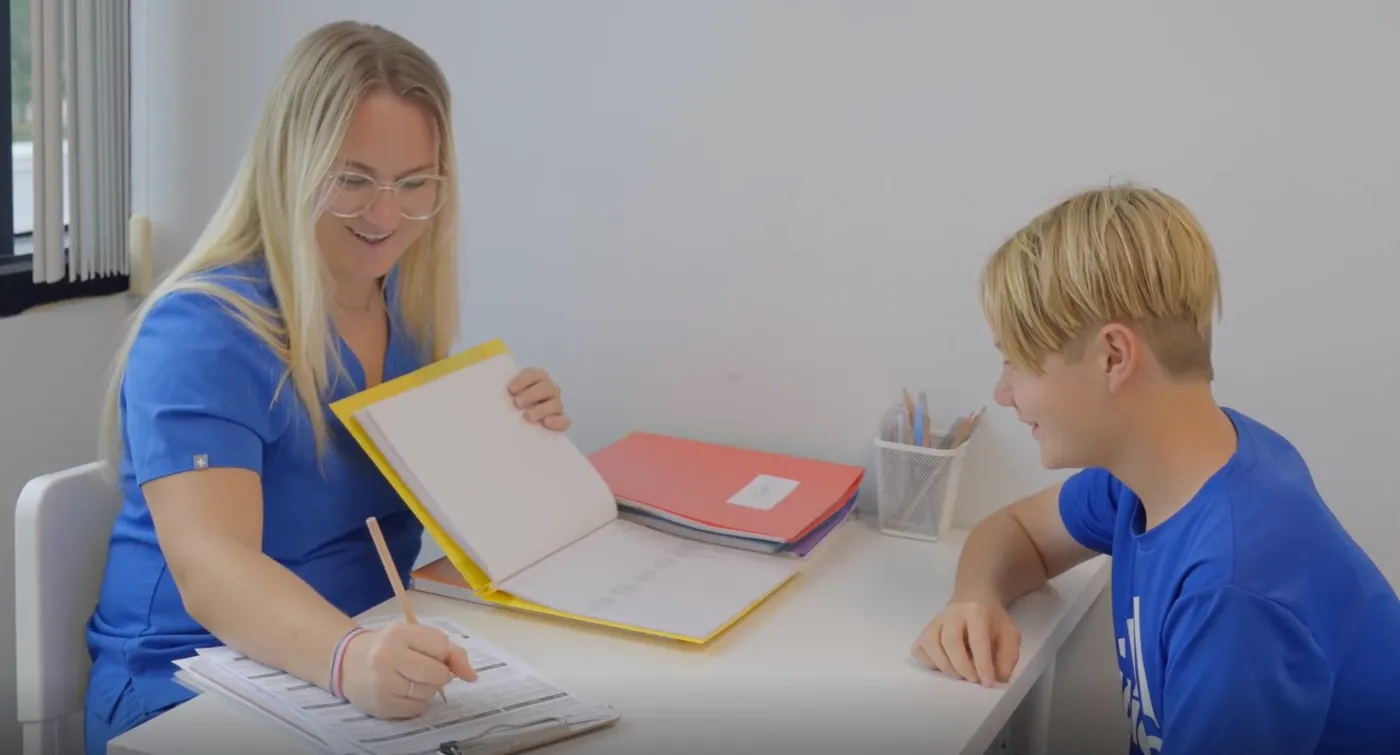
At Vision & Learning Center, a developmental vision evaluation costs $550, and it is an appointment of about 100 minutes. We publish that number on our cost and price page because families deserve to know before they pick up the phone.
The question that matters more is the one parents ask next. What do you actually get for $550?
That question comes up most often from one kind of family. Their child already passed a school screening and already had a routine eye exam. Everything looked fine on paper. At home there are still homework battles, headaches, and reading that never gets easier.
Key takeaways
- A developmental vision evaluation at VLC is $550 for a visit of about 100 minutes. A comprehensive eye exam is $150. The gap reflects a difference in scope, not a difference in care.
- The fee covers the extended evaluation, a consultation with Dr. Murray, a full written developmental vision report, and follow-up guidance from a vision therapy coordinator when therapy is recommended.
- Vision screenings are built to catch reduced eyesight and amblyopia risk factors (USPSTF, 2017). Eye-chart screening alone missed 75.5% of children later found to have eye teaming and eye movement problems (AOA, 2017).
- A comprehensive eye exam answers a narrower question - eye health and prescription. A developmental evaluation adds extended functional, visual-motor and processing testing on top of that.
- We are straight with families about the evidence. Office-based therapy has strong trial support for symptomatic convergence insufficiency (CITT, 2008). It did not beat placebo for reading scores in the largest trial that tested it (CITT-ART, 2019).
The short answer: what the $550 buys
The $550 developmental vision evaluation is an extended specialty visit, not a longer version of an eyesight check. It looks at how the visual system performs during reading, learning, attention tasks, processing and daily near work.
Across those 100 minutes, the evaluation covers:
- Eye health and prescription - the medical part of any eye exam
- Functional visual skills - how well the two eyes team, focus and track together
- Handwriting and motor skills - how the eyes guide the hand
- Primitive reflex integration - early infant movement patterns that should fade as a child develops
- Laterality and directionality - a child’s sense of left and right on their own body, and then on the page
- Dyslexia screening - to flag children who should be evaluated further
- RightEye and ReadAlyzer tracking measures - instruments that record how the eyes move across a line of text
- Visual perceptual testing - how the brain makes sense of what the eyes send it
- Auditory-visual processing - how well what a child hears and what a child sees work together
In practical terms, families are paying for an extended appointment and a consultation with Dr. Murray. When vision therapy is recommended, they also get follow-up guidance from a vision therapy coordinator, so parents understand the logistics and the treatment path before committing to anything.
What is included in this price
- An extended developmental vision evaluation, about 100 minutes
- A doctor consultation with Dr. Murray
- Additional guidance from a vision therapy coordinator, if vision therapy is recommended
- A full developmental vision report
- Documentation that can support classroom accommodation requests
- Documentation that may support a 504 plan or IEP-related school discussions, when clinically appropriate
- Documentation that may support requests for standardized testing accommodations, such as the SAT, ACT and LSAT
Parents are not simply paying for testing. They are paying for interpretation. They are also paying for documentation they can hand to a teacher, a tutor, a psychologist or a testing coordinator.
Why this is different from a screening or a routine eye exam
A comprehensive eye exam at VLC costs $150. A developmental vision evaluation costs $550. Those are two different visits answering two different questions, and it helps to see where each one stops.
What a vision screening is designed to catch
Screenings exist to flag a small set of high-stakes problems quickly. The US Preventive Services Task Force recommends vision screening at least once between ages 3 and 5. What it is looking for is amblyopia, often called lazy eye, or the risk factors for it. The same statement found the evidence insufficient to recommend screening under age 3 (USPSTF, 2017).
The American Academy of Pediatrics describes screening that starts in the newborn nursery. Instrument-based screening follows between 12 months and 3 years, and eye-chart testing from about age 4. Children who fail are referred on (Donahue and Nixon, 2016).
None of those screening protocols set out to measure eye teaming, sustained focusing, tracking efficiency or visual processing. A screening is not failing at its job when it misses those. It was never looking for them.
The practical limits are documented too. The American Optometric Association’s pediatric guideline states it plainly. Screenings may identify some children at risk, but a comprehensive eye examination is what is needed for a definitive diagnosis and appropriate treatment (AOA, 2017).
One systematic review looked at school screening run by teachers. These were mostly eye-chart programs, and largely outside the US. Pooled sensitivity was 0.70, so roughly three children in ten with a problem were missed. The reviewers still judged teacher screening satisfactory overall next to screening by eye care professionals (Umesh et al., 2026).
The AOA guideline reports two more numbers worth sitting with. Eye-chart testing alone missed 75.5% of children later found on complete examination to have binocular and oculomotor problems, meaning problems with eye teaming and eye movement. And only 38.7% of children who failed a school screening actually received follow-up care (AOA, 2017). Nationally, only 64.9% of children aged 3 to 6 had ever had vision testing by a health provider at all (Kemper et al., 2011).
What a comprehensive eye exam covers
A comprehensive eye examination is a genuine medical evaluation and a real step up from a screening. The American Optometric Association’s pediatric guideline sets out what one can include (AOA, 2017):
- History and symptoms - what the child, the family and the school report
- Eyesight and prescription - visual acuity, refraction and color vision
- Eye health - an assessment of the eyes themselves and of general health
- How the eyes team, focus and track - the guideline calls this the binocular vision, ocular motility and accommodation section. It covers:
- eye alignment and fixation, meaning how steadily each eye holds a target
- saccades and pursuits, the quick jumps between targets and the smooth follow of a moving one
- near point of convergence, or how close an object can come before the eyes stop turning in together
- stereopsis, which is depth perception from using both eyes as a pair
- fusional vergence ranges, or how much the eyes can turn in and out before an image splits into two
- accommodative amplitude, facility and response - how much focusing power the eyes have, how quickly focus shifts between near and far, and how accurately it lands
Our $150 comprehensive eye exam is the routine version of that visit. It covers eye health and prescription, without the developmental testing described below. For most patients it is exactly the right appointment. What it is not built to answer is the harder question. Can this child’s visual system hold up through forty minutes of reading?
What a developmental vision evaluation adds
The extra time goes into measuring how the visual system performs under load, meaning while it is working rather than at rest. That testing includes:
- Vergence ranges and recovery - how far the eyes can hold one clear image as a target moves in and out, and how quickly they recover when they lose it
- Accommodative amplitude and facility - how much focusing power the eyes have, and how fast focus shifts between near and far
- Saccadic and pursuit efficiency - how accurately the eyes jump from word to word, and how smoothly they follow a moving target
- Visual-motor integration - how well the eyes guide the hand for writing, copying and drawing
- Visual perceptual skills and processing - how the brain interprets, organizes and remembers what it sees
- Reflex and laterality screening - leftover infant reflexes, plus that sense of left and right on the body and on the page
There is a reason those measures matter. In a school-based US study, about 13% of fifth- and sixth-graders met a high-suspect or definite definition of convergence insufficiency, a common eye-teaming problem at near. Nearly four in five of the children who showed all three signs also had accommodative insufficiency, a focusing problem stacked on top of the teaming problem (Rouse et al., 1999).
A child can read 20/20 on the chart and still carry a problem like that. For a side-by-side comparison, see our post on the difference between a comprehensive eye exam and a developmental eye exam.
What the evidence does and does not support
We would rather you spend $550 with clear expectations than with inflated ones.
The strongest evidence in our field concerns symptomatic convergence insufficiency in children. The Convergence Insufficiency Treatment Trial enrolled 221 children. After 12 weeks, 73% of those doing office-based vergence and accommodative therapy were successful or improved, against 35% in the office placebo group (CITT, 2008).
The follow-up trial is the part that often gets left out of marketing. CITT-ART randomized 310 children. Reading comprehension improved 3.7 points with therapy versus 3.8 points with placebo (CITT-ART, 2019). Treating convergence insufficiency did not raise reading scores. Anyone promising you that outcome is going past the data.
Professional bodies also disagree here, and you should know that going in. The American Academy of Pediatrics, the American Academy of Ophthalmology, AAPOS and AACO published a joint statement. It holds that dyslexia is language-based, and that evidence does not support eye exercises or behavioral vision therapy as treatments for learning disabilities (AAP et al., 2009).
The American Academy of Optometry and the American Optometric Association take a different position. They hold that vision problems can and often do interfere with learning, and that optometric care is one part of a multidisciplinary approach, meaning one piece of a larger team (AAO/AOA, 1997).
Our clinical position at Vision & Learning Center sits with the second view, stated carefully. Vision problems do not cause dyslexia, and we do not treat dyslexia. What we do treat are measurable eye teaming, focusing and eye movement problems that make near work uncomfortable. Easing those gives reading instruction and tutoring a fair chance to work. The evaluation is how we find out whether your child has one of those problems in the first place. It can just as easily conclude that they do not.
What parents are really paying for
Families are paying for depth.
They are paying for a visit long enough to evaluate the visual system meaningfully. They are also paying for a doctor’s interpretation of what that testing shows. The question is not only whether a child can read the chart. It is whether the visual system holds up under real-life demands: reading, writing, comprehension, copying and long stretches of near work.
They are also paying for next-step clarity. The value of the visit is not only in identifying whether there is a problem. It is in explaining what that problem is, how it may be affecting daily life, and what should happen next.
Why the written report matters
One of the most valuable parts of the visit is the full developmental vision report.
Families often leave appointments with a verbal summary and nothing usable. A written report gives you something concrete. It sets out what was measured and what the numbers mean. It connects those findings to what you see at home and at school. And it lists the recommendations.
That document is what a teacher, a reading specialist, a psychologist or a testing coordinator can actually work from.
Can this help with 504 plans and IEPs?
It can contribute to the conversation, though it does not decide it.
Schools work from two different federal frameworks here. A 504 plan is what most families mean when they talk about classroom accommodations. An IEP comes from IDEA, the federal special-education law. Its regulations list visual impairment among the disability categories. They also require that the child, by reason of the disability, needs special education and related services (US Department of Education, 34 CFR 300.8).
Schools determine eligibility. A developmental vision evaluation does not create an IEP. What it does provide is documented, measured findings about reading stamina, copying, tracking and visual attention. Those are directly relevant when a team is deciding what a student needs.
At VLC, families can use the evaluation findings and report to support requests for classroom accommodations. If additional school collaboration is needed, attendance at a 504 or IEP meeting is billed separately at $150 per 30 minutes.
What about SAT, ACT, LSAT and other testing accommodations?
The same logic applies, and the same limits.
Testing organizations make their own approval decisions. The College Board reviews each request. It notes that even students with an IEP or 504 plan still have to submit a request (College Board). Other testing agencies run their own documentation and approval processes.
So the role of this evaluation is not to guarantee accommodations. It is to provide high-quality clinical documentation of functional vision findings that may support a request when those findings are relevant.
Why families book this evaluation anyway
Most families do not book a 100-minute appointment because they want more testing.
They book it because they keep being told everything looks fine while daily life clearly is not fine. They want to know why their child reads slowly, avoids near work, gets headaches, loses their place, struggles to copy from the board, or falls apart after twenty minutes of homework. They want to know whether it is measurable, and whether there is a plan.
That is what this visit is designed to answer. Sometimes the answer is that vision is not the problem, and something else deserves the attention.
How the evaluation fits with the cost of therapy
The evaluation is a standalone visit. It is not a deposit on a therapy program. Plenty of families finish it with a report, a set of recommendations and no therapy at all.
If therapy is recommended, the report and the consultation give you the information to decide. Our companion post on what vision therapy costs and what changes the price covers that next decision. And what vision therapy actually is explains how a program works week to week.
Ready for real answers?
Is this ordinary school stress, or something visual? A developmental vision evaluation is built to give you a measured answer either way. You can start with our symptom checklist, or read what to expect on our examinations page. When you are ready, Schedule an evaluation at whichever of our offices is closest to you.
Common Questions About This Topic
How much is a developmental vision evaluation at Vision & Learning Center?
It is $550 for a developmental vision evaluation of about 100 minutes. That covers the testing, the consultation with Dr. Murray, and a full written report.
Why does it cost more than a regular eye exam?
Because it covers much more ground. A comprehensive eye exam is $150 and is built around eye health and prescription. The developmental evaluation adds functional testing of eye teaming, focusing, tracking, visual-motor integration, and visual perception and processing. It takes about 100 minutes.
Does this include a written report?
Yes. The evaluation includes a comprehensive developmental vision report. That report is one of the reasons this visit is so useful to parents, schools, tutors and other providers.
Can this help with a 504 plan or an IEP?
It can provide medical documentation and recommendations that may support those conversations. The school district still decides eligibility and services. Under federal IDEA regulations, a child qualifies only if an evaluated disability means the child needs special education and related services. The written report and accommodation-support documentation are included in the visit. If Dr. Murray needs to attend a 504 or IEP meeting, that is billed separately.
Can this help with SAT, ACT or LSAT accommodations?
It can provide documentation that may support a request. Each testing agency decides whether accommodations are approved. The College Board, for example, notes that even students with an IEP or 504 plan still have to submit a request.
Where This Information Comes From
- US Preventive Services Task Force; Grossman DC, Curry SJ, Owens DK, et al. (2017). Vision Screening in Children Aged 6 Months to 5 Years: US Preventive Services Task Force Recommendation Statement. JAMA; 318(9):836-844. : Recommends vision screening at least once at ages 3-5 to detect amblyopia or its risk factors; evidence insufficient under age 3.
- Donahue SP, Nixon CN; AAP Section on Ophthalmology, AAO, AAPOS, AACO (2016). Visual System Assessment in Infants, Children, and Young Adults by Pediatricians. Pediatrics; 137(1):28-30. : Describes pediatrician office screening from the nursery onward and referral of children who fail.
- American Optometric Association (2017). Evidence-Based Clinical Practice Guideline: Comprehensive Pediatric Eye and Vision Examination. : Lists the components of a comprehensive pediatric eye and vision examination, including the binocular vision, ocular motility and accommodation section; recommends exams at 6-12 months, once at 3-5 and annually from first grade; reports that acuity testing alone missed 75.5% of children with binocular and oculomotor problems and that only 38.7% of screening failures received follow-up care.
- Kemper AR, Wallace DK, Patel N, Crews JE (2011). Preschool vision testing by health providers in the United States: findings from the 2006-2007 Medical Expenditure Panel Survey. Journal of AAPOS; 15(5):480-483. : Only 64.9% of US children aged 3-6 had ever had vision testing by a health provider.
- Umesh U, Srinivasan K, Sherigar SS, Prabhu V (2026). Effectiveness of school vision screening by teachers - a systematic review and meta-analysis. BMC Public Health; 26(1):1794. : Teacher-conducted school screening, mostly acuity-based and largely outside the US, had pooled sensitivity of 0.70 - roughly three in ten children with a problem missed - though the reviewers judged teacher screening satisfactory overall next to screening by eye care professionals.
- Rouse MW, Borsting E, Hyman L, et al.; CIRS Group (1999). Frequency of convergence insufficiency among fifth and sixth graders. Optometry and Vision Science; 76(9):643-649. : About 13% of fifth- and sixth-graders met a high-suspect or definite convergence insufficiency definition; 78.9% of three-sign cases also had accommodative insufficiency.
- Convergence Insufficiency Treatment Trial Study Group (2008). Randomized clinical trial of treatments for symptomatic convergence insufficiency in children. Archives of Ophthalmology; 126(10):1336-1349. : In 221 children, 73% succeeded or improved with office-based vergence/accommodative therapy versus 35% with office placebo.
- CITT-ART Investigator Group (2019). Effect of Vergence/Accommodative Therapy on Reading in Children with Convergence Insufficiency: A Randomized Clinical Trial. Optometry and Vision Science; 96(11):836-849. : Reading comprehension improved 3.7 points with therapy versus 3.8 with placebo; therapy was no better than placebo for reading.
- AAP Section on Ophthalmology and Council on Children with Disabilities; AAO; AAPOS; AACO (2009). Joint statement - Learning disabilities, dyslexia, and vision. Pediatrics; 124(2):837-844. : Holds that dyslexia is language-based and that evidence does not support eye exercises or behavioral vision therapy as treatments for learning disabilities.
- American Academy of Optometry; American Optometric Association (1997). Vision, learning and dyslexia: a joint organizational policy statement. Journal of the American Optometric Association; 68(5):284-286. : Holds that vision problems can and often do interfere with learning and that optometric care is one part of a multidisciplinary approach.
- US Department of Education. IDEA regulations Sec. 300.8, Child with a disability. : Lists visual impairment among the IDEA disability categories and requires that the child, by reason of the disability, needs special education and related services.
- College Board. Who Is Eligible for College Board Accommodations? : Accommodation requests are reviewed by the College Board; even students with an IEP or 504 plan must still submit a request.
Care We Provide
More From the Blog
Wondering If This Sounds Like Your Family?
A developmental vision evaluation measures the skills a routine eye exam does not. Our team sees children and adults in Coconut Creek, Boynton Beach, Boca Raton and West Palm Beach.