Binocular Vision and Reading: What Is (and Isn't) Proven
Parents ask us a version of this question every week: my child’s eyes do not work well together, and my child cannot read - are those the same problem?
It is a fair question, and it deserves a straight answer rather than a sales pitch. The honest answer has three parts. Some of what is claimed about binocular vision and reading is well supported. Some of it is genuinely uncertain. And one specific claim - that treating an eye-teaming problem will raise reading scores - has been tested in a large randomized trial and did not hold up.
Here is what the evidence actually shows, including the parts that do not favor our profession.
Key takeaways
- Reading is a language task carried out by a visual system. Both halves matter, and they are not interchangeable.
- Children referred to clinics for reading difficulty do show more focusing, tracking and convergence problems than typical readers. Those are associations in selected samples.
- In a 5,822-child population study, four of every five children with severe reading impairment had completely normal eye function.
- Uncorrected moderate farsightedness in preschoolers is linked to lower early-literacy scores. That is the clearest vision-and-literacy signal we have.
- Office-based vergence and accommodative therapy is well proven for the symptoms of convergence insufficiency. It is not proven to improve reading comprehension - the CITT-ART trial tested exactly that and found no advantage over placebo.
- Pediatrics and ophthalmology say vision problems do not cause dyslexia. Optometry says vision problems can interfere with learning. Both statements can be true at once.
How the eyes actually move when we read
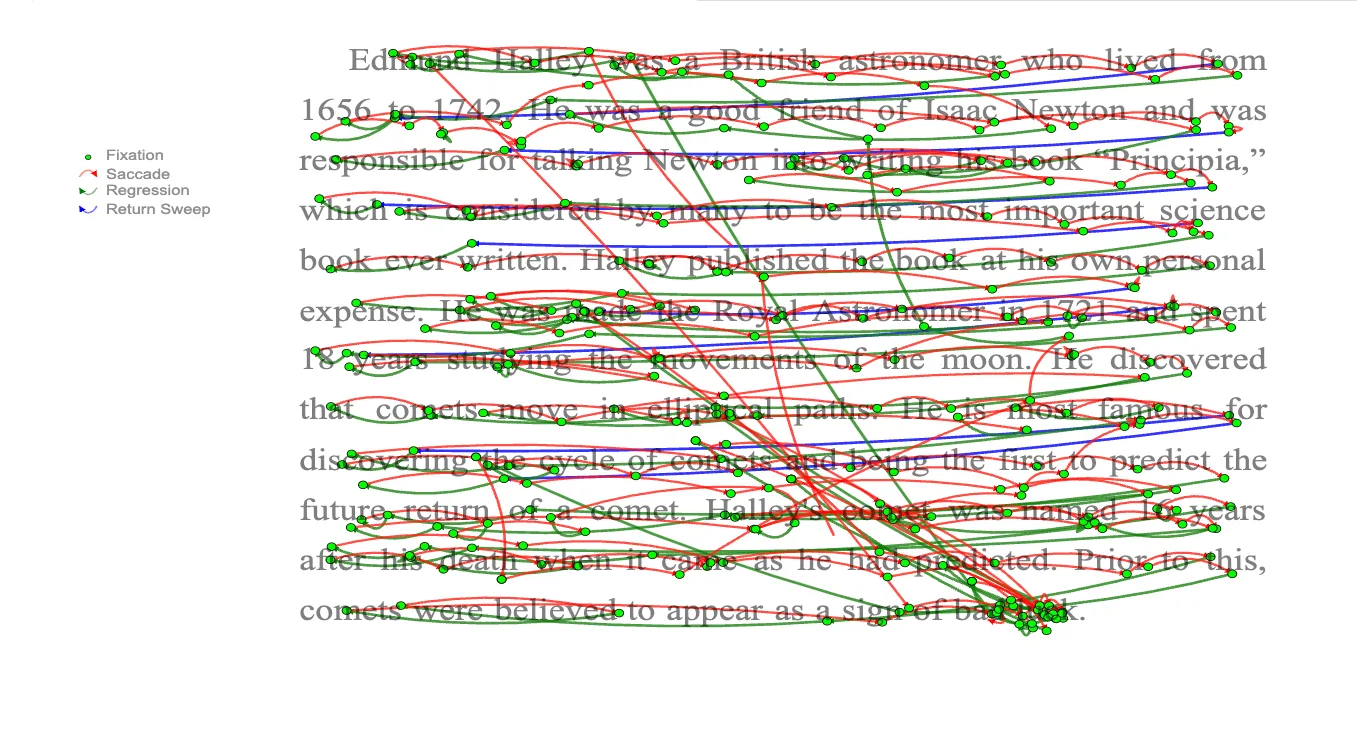
Reading does not feel like a series of jumps, but that is what it is. The eyes fix briefly on a word, the brain extracts information, and a rapid movement carries the eyes to the next landing spot. Sometimes the eyes travel backwards to re-read something. Decades of eye-tracking research have mapped these fixations, saccades, regressions and the size of the window of text a reader can take in (Rayner, 1998).
The critical finding from that literature is that eye movements track the cognitive work of reading moment by moment. When a word is hard, the eyes stay longer. When a sentence goes wrong, the eyes go back. Skilled adults read at roughly 250 words per minute, speed and comprehension trade off against one another, and - as the authors of a major review put it - language skill sits at the heart of reading speed (Rayner et al., 2016).
That has an important implication for interpretation. Because eye movements respond to the difficulty of the text, jumpy, regression-heavy eye movements in a struggling reader can be a readout of how hard the decoding is, not automatic proof of an eye-movement disorder. Recorded eye movements tell us how a child is coping. They do not, by themselves, tell us why.
What clinic studies find: more focusing and tracking problems in struggling readers
When researchers examine children who have already been identified as poor readers, they consistently find more binocular and accommodative problems than in typical readers.
- In a comparison of 29 children with developmental dyslexia and 33 typical readers, accommodation deficits were present in 55% versus 9%, tracking deficits in 62% versus 15%, and any visual deficit in 79% versus 33%. The authors were explicit that the cause and clinical relevance of these deficits are uncertain (Raghuram et al., 2018).
- Among 825 Austrian schoolchildren referred for reading and writing difficulty, compared with 328 age-matched controls, the referred group had lower accommodative amplitude, reduced accommodative and vergence facility, a receded near point of convergence and slower reading speed - with no difference in refractive error (Dusek et al., 2010).
- In 50 children with a reading-related individual education plan versus 50 controls, the IEP group showed significantly more farsightedness on cycloplegic refraction, and vergence facility correlated with reading speed and symptom scores (Quaid & Simpson, 2013).
These are real findings and we take them seriously in the exam room. But every one of them is cross-sectional and drawn from children who were already referred somewhere. They establish that struggling readers are more likely to have these vision findings. They do not establish that the vision findings caused the struggle.
What population studies find: most severely impaired readers have normal eyes
This is the study that keeps our claims honest. Researchers examined 5,822 children aged 7 to 9 in a UK birth cohort, so nobody had to be referred to be included. Of those children, 172 (about 3%) had severe reading impairment.
The result: no association between severe reading impairment and strabismus, refractive error, amblyopia, convergence or accommodation. Poorer stereoacuity and near sensory fusion problems were somewhat more common - roughly 1 in 6 versus 1 in 10 - but four of every five children with severe reading impairment had entirely normal ophthalmic function. The authors concluded there was no evidence that vision-based treatments would help this group (Creavin et al., 2015).
Both pictures are true. In an optometry clinic, a large share of the struggling readers we see have a binocular or focusing problem, because the children with visual symptoms are the ones who end up in our chairs. Across the whole population of struggling readers, most do not. Anyone who quotes only the first picture is selling something.
Farsightedness and early literacy: the clearest signal
If one refractive finding deserves parents’ attention before first grade, it is uncorrected farsightedness. The Vision in Preschoolers - Hyperopia in Preschoolers study tested 492 four- and five-year-olds. Children with uncorrected moderate hyperopia (+3 to +6 D) scored 4.3 points lower on a standardized early-literacy test than children without significant refractive error. The gap was wider with hyperopia of 4 D or more, and wider still when near visual acuity was 20/40 or worse or near stereoacuity was reduced (Kulp et al., 2016).
Two cautions. This was cross-sectional, so it shows an association, not that glasses raise literacy scores. And moderate farsightedness is exactly the kind of finding a distance-acuity screening can miss, because a young farsighted child can often force clear distance vision by focusing hard. That is one reason we favor a full examination over a screening for children entering school - see what school vision screenings miss.
CITT-ART: the trial that tested the treatment question
Everything above is observational. The treatment question - if we fix the eye-teaming problem, does reading improve? - requires a randomized trial, and we have a good one.
The original Convergence Insufficiency Treatment Trial randomized 221 children aged 9 to 17 with symptomatic convergence insufficiency. After 12 weeks, 73% of those receiving office-based vergence and accommodative therapy were successful or improved, versus 35% of those receiving office-based placebo therapy (CITT, 2008). A Cochrane network meta-analysis of 12 trials and 1,289 participants confirmed the advantage over placebo in children (Scheiman et al., 2020). Those outcomes were symptoms and clinical signs.
CITT-ART then asked the reading question directly. It randomized 310 children aged 9 to 14 with symptomatic convergence insufficiency to 16 weeks of vergence and accommodative therapy or placebo therapy and measured reading comprehension on a standardized test. Reading comprehension improved 3.7 points with therapy and 3.8 points with placebo. The therapy was no better than placebo for reading (CITT-ART, 2019).
The companion paper is worth knowing too. The clinical signs did respond: near point of convergence improved 10.4 cm with therapy versus 6.2 cm with placebo, and positive fusional vergence 23.2 versus 8.8 prism diopters. But symptom scores improved by similar amounts in both groups in this trial (CITT-ART, 2019).
A separate study of 94 children with specific learning disorders found binocular vision anomalies in 62.8% of them and showed that vision therapy improved their binocular measurements - but reading and academic scores were not the outcome measured (Hussaindeen et al., 2018). That is the pattern across this literature: therapy moves the vision numbers; it has not been shown to move the reading numbers.
Where the professional bodies stand
Pediatrics and ophthalmology
A joint statement from the American Academy of Pediatrics, the American Academy of Ophthalmology, AAPOS and the American Association of Certified Orthoptists holds that dyslexia is a language-based disorder, that vision problems can interfere with learning but do not cause dyslexia, and that scientific evidence does not support eye exercises, behavioral vision therapy or tinted lenses for treating learning disabilities (AAP/AAO/AAPOS/AACO, 2009; reaffirmed 2014). The accompanying technical report adds that dyslexia stems from deficits in phonological processing and that the effective treatment is evidence-based reading instruction (Handler & Fierson, 2011).
Optometry
The joint optometric policy statement holds that vision problems can and often do interfere with learning, that people at risk of learning-related vision problems should be evaluated by an optometrist providing care in this area, and that the goal of optometric intervention is to improve visual function and relieve associated signs and symptoms as one part of a multidisciplinary approach (AAO/AOA, 1997).
Read carefully, these two positions overlap more than the debate suggests. Neither claims vision therapy treats dyslexia. The disagreement is about how much a binocular or accommodative problem matters to a child’s school day, and how aggressively to look for one. For a longer discussion, see understanding the AAPOS position on vision therapy.
Our position at Vision & Learning Center
This is our clinical perspective, and we label it as such rather than dressing it up as trial evidence.
We treat the visual discomfort. Reading is taught by reading instruction.
If a child has a convergence, focusing or eye-movement problem that makes 20 minutes of near work uncomfortable, that is a real problem worth treating on its own terms - and the CITT evidence supports treating symptomatic convergence insufficiency. Children with convergence insufficiency and no ADHD diagnosis still score higher on a parent-reported academic behavior problem survey than children with normal binocular vision (Rouse et al., 2009), which fits what parents tell us about homework avoidance. Making near work comfortable is a legitimate goal.
What we will not tell you is that therapy will raise a reading level. If your child cannot decode words, the intervention with evidence behind it is structured reading instruction, and we will say so and help you find it. Vision therapy and tutoring solve different problems - we wrote about which problem each one solves.
What an evaluation is actually for
A developmental vision evaluation answers a narrow, useful question: is there a measurable vision problem making reading physically harder than it needs to be?
We measure eye health and refractive error, eye teaming and convergence, focusing accuracy and stamina, eye-movement efficiency, depth perception, and visual processing. The American Optometric Association’s pediatric guideline recommends a comprehensive examination at 6 to 12 months, once between ages 3 and 5, before first grade and annually after that, and reports that acuity testing alone missed 75.5% of children later found on full examination to have binocular and oculomotor problems (AOA, 2017).
Either answer is worth having. A “yes” gives you something specific to treat. A “no” means your child’s time and your money should go toward reading instruction, and you can stop wondering.
Read more
- Vision and Learning: how visual skills affect school - the overview post for this series
- Can a child have 20/20 vision and still struggle with reading?
- Are letter reversals always a sign of dyslexia?
- How we use the ReadAlyzer to assess reading eye movements
- Learning-related vision problems and convergence insufficiency
If reading is a fight in your house and you would like to know whether vision is part of it - or rule it out and move on - a comprehensive developmental vision evaluation will give you a clear answer. Schedule an evaluation at our Boynton Beach or Boca Raton office, or read more about our comprehensive and developmental eye exams.
Common Questions About This Topic
Do binocular vision problems cause dyslexia?
No. Dyslexia is a language-based disorder rooted in phonological processing, and the pediatric and ophthalmology bodies are clear that vision problems are not its cause. A child can have dyslexia and a treatable eye-teaming or focusing problem at the same time. Treating the second one does not treat the first.
Will vision therapy raise my child's reading scores?
The best trial we have says no, not directly. CITT-ART randomized 310 children with symptomatic convergence insufficiency and found reading comprehension improved 3.7 points with vergence and accommodative therapy versus 3.8 points with placebo therapy. Therapy is aimed at the vision problem and the discomfort it causes, not at reading achievement.
Then why do so many struggling readers fail a binocular vision exam?
Clinic samples of children referred for reading difficulty do show more focusing, tracking and convergence problems than typical readers. But those are associations in selected groups. In a 5,822-child population cohort, four of every five children with severe reading impairment had entirely normal ophthalmic function.
Is there any vision problem clearly linked to early reading?
Uncorrected moderate farsightedness is the clearest one. In the VIP-HIP study, uncorrected hyperopic 4- and 5-year-olds scored 4.3 points lower on an early-literacy test than children with no significant refractive error, with wider gaps when near vision or near depth perception was also reduced.
Should my struggling reader still have a vision evaluation?
Yes, as one step among several. An evaluation is worth doing because it either finds a treatable problem that is making reading physically uncomfortable, or it rules vision out so that time and money go to reading instruction instead. Both answers are useful.
Where This Information Comes From
- Rayner K (1998). Eye movements in reading and information processing: 20 years of research. Psychological Bulletin, 124(3), 372-422. : Landmark review of fixations, saccades, the perceptual span and regressions, concluding that reading eye movements reflect moment-to-moment cognitive processing.
- Rayner K, Schotter ER, Masson MEJ, Potter MC, Treiman R (2016). So Much to Read, So Little Time: How Do We Read, and Can Speed Reading Help? Psychological Science in the Public Interest, 17(1), 4-34. : Reviews the reading process; normal reading runs around 250 words per minute, speed and comprehension trade off against each other, and language skill is at the heart of reading speed.
- Raghuram A, Gowrisankaran S, Swanson E, Zurakowski D, Hunter DG, Waber DP (2018). Frequency of Visual Deficits in Children With Developmental Dyslexia. JAMA Ophthalmology, 136(10), 1089-1095. : Accommodation deficits in 55% vs 9% and tracking deficits in 62% vs 15% of children with dyslexia vs typical readers; the authors call the cause and clinical relevance uncertain.
- Dusek W, Pierscionek BK, McClelland JF (2010). A survey of visual function in an Austrian population of school-age children with reading and writing difficulties. BMC Ophthalmology, 10, 16. : 825 children referred for reading and writing difficulty had lower accommodative amplitude, reduced accommodative and vergence facility and a receded near point of convergence versus 328 controls; single-practice referral sample.
- Quaid P, Simpson T (2013). Association between reading speed, cycloplegic refractive error, and oculomotor function in reading disabled children versus controls. Graefe's Archive for Clinical and Experimental Ophthalmology, 251(1), 169-187. : Children with a reading-related IEP showed more hyperopia on cycloplegic refraction than controls, and vergence facility correlated with reading speed and symptom scores; association only.
- Creavin AL, Lingam R, Steer C, Williams C (2015). Ophthalmic abnormalities and reading impairment. Pediatrics, 135(6), 1057-1065. : In 5,822 children aged 7-9, severe reading impairment showed no association with strabismus, refractive error, amblyopia, convergence or accommodation; four of five severely impaired readers had normal ophthalmic function.
- VIP-HIP Study Group; Kulp MT, Ciner E, Maguire M, et al. (2016). Uncorrected Hyperopia and Preschool Early Literacy: Results of the Vision in Preschoolers-Hyperopia in Preschoolers (VIP-HIP) Study. Ophthalmology, 123(4), 681-689. : Uncorrected moderately hyperopic 4- and 5-year-olds scored 4.3 points lower on an early-literacy test, with larger gaps at 4 D or more, reduced near acuity or reduced near stereoacuity; cross-sectional association.
- Convergence Insufficiency Treatment Trial Study Group (2008). Randomized clinical trial of treatments for symptomatic convergence insufficiency in children. Archives of Ophthalmology, 126(10), 1336-1349. : In 221 children aged 9-17, office-based vergence/accommodative therapy produced a successful or improved outcome in 73% versus 35% for office placebo after 12 weeks; the outcome measured was symptoms, not reading.
- CITT-ART Investigator Group (2019). Effect of Vergence/Accommodative Therapy on Reading in Children with Convergence Insufficiency: A Randomized Clinical Trial. Optometry and Vision Science, 96(11), 836-849. : In 310 children aged 9-14 with symptomatic convergence insufficiency, reading comprehension improved 3.7 points with 16 weeks of therapy versus 3.8 points with placebo therapy; negative for reading.
- CITT-ART Investigator Group (2019). Treatment of Symptomatic Convergence Insufficiency in Children Enrolled in the Convergence Insufficiency Treatment Trial-Attention & Reading Trial. Optometry and Vision Science, 96(11), 825-835. : Near point of convergence improved 10.4 cm with therapy versus 6.2 cm with placebo and fusional vergence 23.2 versus 8.8 prism diopters, but symptom scores improved similarly in both groups.
- Scheiman M, Kulp MT, Cotter SA, Lawrenson JG, Wang L, Li T (2020). Interventions for convergence insufficiency: a network meta-analysis. Cochrane Database of Systematic Reviews, 12, CD006768. : Across 12 trials and 1,289 participants, office-based vergence/accommodative therapy beat placebo for a successful outcome in children (RR 3.04); outcomes were symptoms and clinical signs, not academic performance.
- Hussaindeen JR, Shah P, Ramani KK, Ramanujan L (2018). Efficacy of vision therapy in children with learning disability and associated binocular vision anomalies. Journal of Optometry, 11(1), 40-48. : Binocular vision anomalies were present in 62.8% of 94 children with specific learning disorders, and 10 sessions of vision therapy improved binocular measures; reading and academic scores were not the outcome.
- American Academy of Pediatrics Section on Ophthalmology and Council on Children with Disabilities; AAO; AAPOS; AACO (2009). Joint statement - Learning disabilities, dyslexia, and vision. Pediatrics, 124(2), 837-844. : Holds that dyslexia is language-based, that vision problems can interfere with learning but do not cause dyslexia, and that eye exercises, behavioral vision therapy and tinted lenses are not supported for treating learning disabilities.
- Handler SM, Fierson WM; AAP Section on Ophthalmology, Council on Children with Disabilities, AAO, AAPOS, AACO (2011). Learning disabilities, dyslexia, and vision. Pediatrics, 127(3), e818-e856. : Technical report stating that dyslexia stems from phonological processing deficits, that children with dyslexia have the same visual function and ocular health as other children, and that evidence-based reading instruction is the effective treatment.
- American Academy of Ophthalmology, American Academy of Pediatrics, AAPOS, AACO (2014). Joint Statement: Learning Disabilities, Dyslexia, and Vision - Reaffirmed 2014. : Reaffirms that vision problems are not the cause of primary dyslexia or learning disabilities and that vision therapy and tinted lenses should not be recommended to improve long-term educational performance.
- American Academy of Optometry; American Optometric Association (1997). Vision, learning and dyslexia. Journal of the American Optometric Association, 68(5), 284-286. : Optometric policy statement holding that vision problems can and often do interfere with learning, and that the goal of optometric intervention is to improve visual function within a multidisciplinary approach.
- American Optometric Association (2017). Evidence-Based Clinical Practice Guideline: Comprehensive Pediatric Eye and Vision Examination. St. Louis: AOA. : Recommends comprehensive exams at 6-12 months, once between ages 3 and 5, before first grade and annually after; reports that acuity testing alone missed 75.5% of children later found to have binocular and oculomotor problems.
- Rouse M, Borsting E, Mitchell GL, et al.; CITT Study Group (2009). Academic behaviors in children with convergence insufficiency with and without parent-reported ADHD. Optometry and Vision Science, 86(10), 1169-1177. : Children with symptomatic convergence insufficiency but no ADHD still scored higher on a parent-reported academic behavior problem survey than children with normal binocular vision (11.7 vs 8.7).
Care We Provide
More From the Blog
Wondering If This Sounds Like Your Family?
A developmental vision evaluation measures the skills a routine eye exam does not. Our team sees children and adults in Coconut Creek, Boynton Beach, Boca Raton and West Palm Beach.