Vision Therapy vs Tutoring: Which Problem Does Each Solve?

When a child is struggling in school, most parents arrive at the same practical question: does my child need tutoring, or is something else going on?
It is a fair question, and the honest answer is that these are not competing options. Tutoring and vision therapy treat different problems. Tutoring builds academic skill. Vision therapy treats how the visual system works. The expensive mistake is not choosing the “wrong” one. It is spending a year on one when the child needed the other, or needed both.
Key takeaways
- Tutoring is the treatment for a reading, writing or math skill problem, and the evidence for it is strong. A meta-analysis of dozens of randomized experiments found an overall effect of 0.288 standard deviations on learning (Nickow et al., 2024).
- Vision therapy is the treatment for a diagnosed vision problem. For symptomatic convergence insufficiency in children, office-based therapy clearly beat placebo (CITT, 2008; Scheiman et al., 2020).
- Vision therapy does not raise reading scores. The largest trial designed to test that question found no benefit over placebo (CITT-ART, 2019).
- Pediatric and ophthalmology bodies state that vision problems do not cause dyslexia and that vision therapy should not be recommended as a treatment for learning disabilities (AAP/AAO/AAPOS/AACO, 2009). Optometric bodies hold that vision problems can and often do interfere with learning (American Academy of Optometry/AOA, 1997). We think both statements can be true at once.
- Some children need both supports; in our experience, pausing reading instruction in order to run vision therapy costs ground academically.
Why parents compare these two
Parents compare vision therapy and tutoring because from the outside the symptoms look alike. A child who avoids reading, drags out homework, reads below their potential or melts down over a chapter book looks like a child who needs academic help. Often they are.
But those same behaviors show up when reading is physically uncomfortable. If the eyes are not aiming together well, focusing easily or moving accurately along a line of print, a child may avoid reading not because they cannot learn, but because the task costs far more effort than it should. That is why some families do a year of tutoring, watch the child’s skills improve on paper, and still see the same avoidance and fatigue at the kitchen table.
What tutoring is designed to improve
Tutoring is designed to improve academic performance and learning skills — reading and phonics, comprehension, spelling, writing, math, study skills, organization, test preparation and classroom content.
It works. In the largest systematic review of the question, tutoring programs across preK-12 produced consistently positive impacts on learning, with the biggest gains when tutors were teachers or paraprofessionals, when children were in earlier grades, and when sessions ran at least three times a week during the school day (Nickow et al., 2024).
This matters for a specific reason. When a child’s difficulty is with reading itself, structured reading instruction is the treatment. The AAP technical report is explicit that dyslexia stems from deficits in phonologic processing and that effective treatment is evidence-based reading instruction covering decoding, fluency, vocabulary and comprehension (Handler & Fierson, 2011). We say the same thing to families in our offices. No amount of vision therapy replaces good reading instruction.
In short, tutoring helps with what the child is expected to learn.
What vision therapy is designed to improve
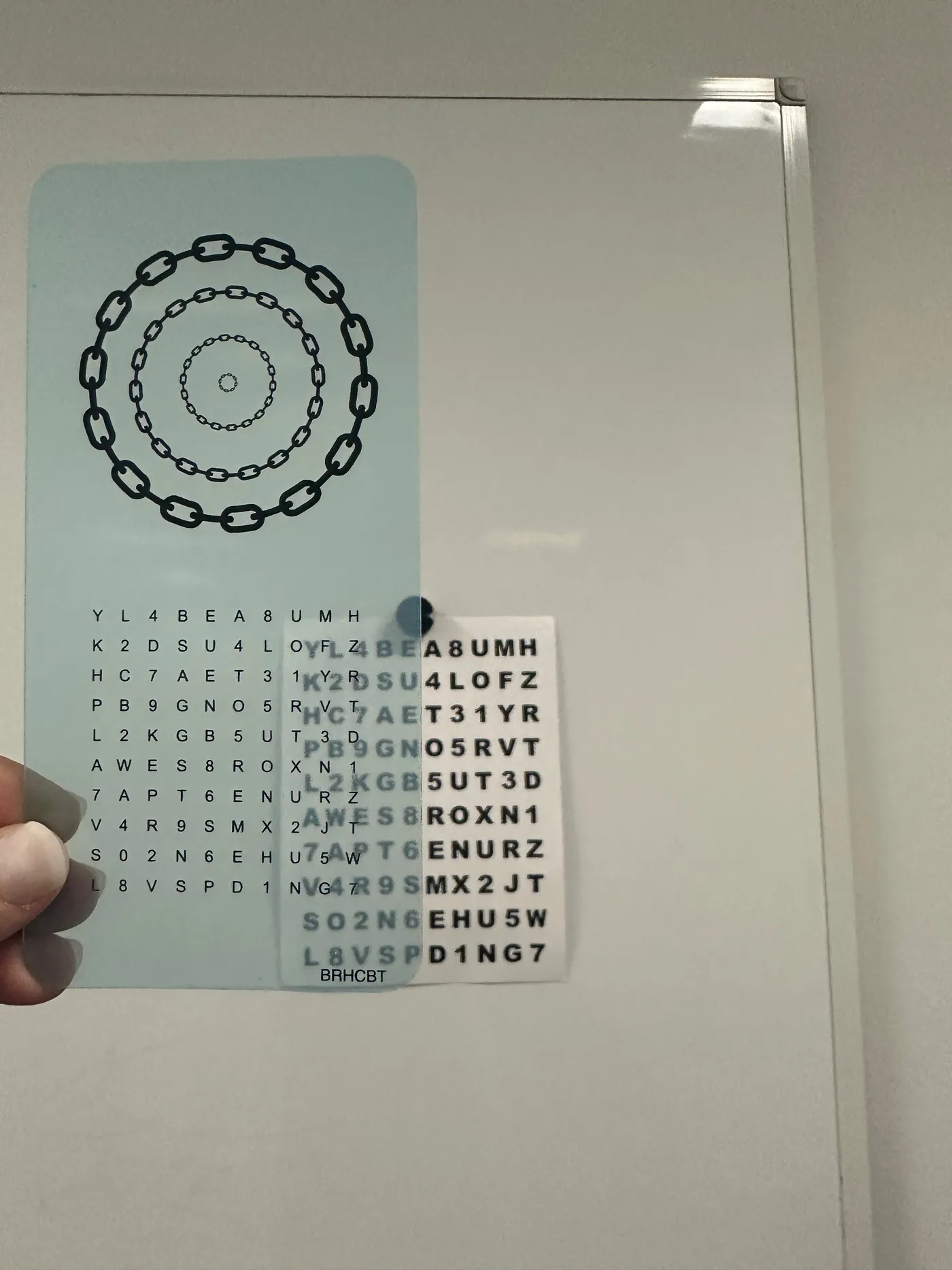
Vision therapy is designed to improve how the visual system functions: eye teaming, focusing, tracking, visual comfort and stamina during sustained near work. There is more detail on our vision therapy and learning-related vision pages.
The best evidence sits with convergence insufficiency, a common eye teaming problem in which the eyes struggle to turn in and stay aimed at near. In a school-based study, about 13% of fifth- and sixth-graders met high-suspect or definite criteria for it, and nearly four in five of those with three-sign CI also had an accommodative (focusing) problem (Rouse et al., 1999).
In the 221-child Convergence Insufficiency Treatment Trial, 73% of children given office-based vergence and accommodative therapy with home reinforcement were successful or improved after 12 weeks, versus 35% given office placebo therapy (CITT, 2008). A Cochrane network meta-analysis of 12 trials and 1,289 participants reached the same conclusion for children (Scheiman et al., 2020), and the same therapy improved accommodative amplitude by 9.9 D compared with 2.2 D on placebo (Scheiman et al., 2011).
Vision therapy does not teach phonics, reading rules, vocabulary, math facts or classroom content. It is not academic instruction and is not meant to replace it. Its job is to make the visual demands of near work cost less.
What the research actually says about the overlap
This is the part most comparison articles skip, so we will be direct about it.
Treating a vision problem does not raise reading scores. CITT-ART enrolled 310 children aged 9 to 14 with symptomatic convergence insufficiency and randomized them to 16 weeks of office-based vergence and accommodative therapy or to placebo therapy. Reading comprehension improved 3.7 points with therapy and 3.8 points with placebo — no difference (CITT-ART, 2019). In the companion paper, clinical signs improved much more with real therapy (near point of convergence 10.4 cm versus 6.2 cm), while symptom scores improved similarly in both groups (CITT-ART, 2019). A separate randomized study of 46 children with learning disorders and binocular vision anomalies found that therapy improved binocular vision measures, but it did not measure reading or academic outcomes at all, so it cannot answer the reading question either way (Hussaindeen et al., 2018).
Most poor readers do not have a vision problem. In a population cohort of 5,822 children aged 7 to 9, four out of five children with severe reading impairment had normal ophthalmic function, and no association was found with convergence, accommodation, refractive error, amblyopia or strabismus — though stereoacuity worse than 60 arcseconds was somewhat more common in the severely impaired readers (about 1 in 6 versus 1 in 10) (Creavin et al., 2015).
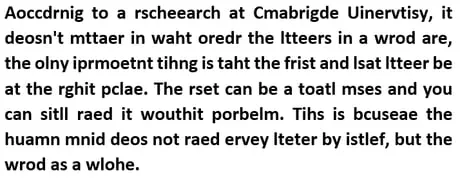
That fits what reading actually is. Turning print into meaning is a language task the brain performs with whatever visual information it is given, which is why the recommended treatment for a decoding problem is explicit phonics, fluency, vocabulary and comprehension instruction rather than eye exercises (Handler & Fierson, 2011). The familiar scrambled-word demonstration below is a rough illustration of the same idea rather than evidence for it: the letters inside each word are jumbled, and most adults still get the meaning, because what the reader brings to the page matters as much as what the eyes deliver.
But visual efficiency problems are more common in children who are already struggling. In a clinic-based comparison of 29 children with developmental dyslexia and 33 typical readers, 79% of the dyslexia group had some visual deficit versus 33% of the typical readers, including accommodation deficits in 55% versus 9% and tracking deficits in 62% versus 15% — though that is a small sample, and the authors state the cause and clinical relevance are uncertain (Raghuram et al., 2018). In 825 Austrian children referred for reading and writing difficulty, accommodative amplitude, accommodative and vergence facility and near point of convergence were all poorer than in controls (Dusek et al., 2010). And children with convergence insufficiency but no ADHD still scored worse on a parent-rated academic behavior survey than children with normal binocular vision (Rouse et al., 2009).
Put together, the fair reading is this: a vision problem is not the explanation for most reading difficulty, and treating it is not a reading intervention — but it is common enough in struggling readers, and uncomfortable enough, that it is worth ruling in or out rather than assuming. That is also why the two professional positions differ. Pediatrics and ophthalmology emphasize that vision therapy should not be offered as a treatment for learning disabilities (AAP/AAO/AAPOS/AACO, 2009); optometry emphasizes that vision problems can interfere with learning and should be diagnosed and managed as part of a multidisciplinary plan (American Academy of Optometry/AOA, 1997). Our clinical position at Vision & Learning Center is the narrow one: we treat vision problems, and we expect reading gains to come from reading instruction.
Signs the problem may be mostly academic
- Difficulty understanding concepts even when the work is visually comfortable
- Weak phonics, decoding or language skills without complaints of visual discomfort
- Trouble with comprehension more than with endurance
- Gaps from missed instruction or a disrupted school year
- Struggles that are not tied to reading stamina, eye strain or near work
- Clear improvement when material is retaught directly and repeatedly
These children usually need someone to teach the material differently, more slowly or with more repetition. Start there.
Signs the problem may involve vision
- Headaches or eye strain with reading
- Blur or double vision, especially later in a homework session
- Losing place, skipping lines or rereading the same line
- Using a finger to hold place well past the age you would expect
- Avoiding reading despite good understanding when read to
- Performance that starts strong and falls apart as the task gets longer
- Trouble copying from the board or shifting focus between near and far
- A child who is bright and verbal but comes undone with reading or writing
None of these diagnose anything. They are a reason to have vision measured properly. Passing a school screening or reading 20/20 on a wall chart does not settle the question: the AOA pediatric guideline reports that acuity testing alone missed 75.5% of children later found to have binocular and oculomotor problems on a complete examination (AOA, 2017). Our symptom checklist and our page on reading difficulty walk through the same signs in more detail.
When a child needs both
Often this is not an either-or decision at all.
- A child may have weak decoding skills and an eye teaming or tracking problem
- A child may need to catch up academically while near work becomes more comfortable
- A child may have struggled long enough that both a learning gap and visual inefficiency are now in the picture
Families often feel relief here, because it explains why one kind of help never quite finished the job. If both problems are present, both need attention — and if you have to sequence them, do not drop the reading instruction. That is the piece the evidence most clearly ties to reading gains.
Why tutoring alone may not settle visual strain
Tutoring is excellent at helping a child understand content, practice skills and rebuild confidence. What it cannot do is change how the eyes team, focus or track. If a child has poor convergence, a focusing problem or low visual stamina, more reading practice by itself may not make near work comfortable, and it can raise frustration by asking for more of the exact task that already feels hard.
That is not an argument against tutoring. It is an argument for knowing which problem you are treating.
Where to start
Tutoring helps a child learn better. Vision therapy helps a child use vision better. If the struggle is mainly about skill and content, tutoring is the right next step. If reading is uncomfortable, effortful or avoided despite good comprehension, vision deserves a proper look. If both are true, plan for both.
For more, see our overview of vision and learning, our article on reading struggles that may be vision related, and our comparisons page on how a developmental vision evaluation differs from a routine eye exam.
If you are not sure whether your child’s difficulty is academic, visual or both, the useful next step is to measure rather than guess. A comprehensive developmental vision evaluation tells you whether vision is part of the picture, so the support you invest in matches the problem your child actually has. Schedule an evaluation at our Boynton Beach or Boca Raton office.
Common Questions About This Topic
Is vision therapy the same as tutoring?
No. Tutoring teaches academic content and skills such as phonics, decoding, comprehension and math. Vision therapy treats a diagnosed vision problem such as convergence insufficiency, accommodative dysfunction or an eye movement disorder. They address different problems, and neither one substitutes for the other.
Can tutoring help a child who has a vision problem?
Yes, for the academic part. Tutoring can build the reading and math skills a child is missing. It does not change how well the eyes aim, focus or track, so if near work is physically uncomfortable, that discomfort will still be there during the tutoring session.
Does vision therapy improve reading scores?
The largest randomized trial to test that question found it did not. In CITT-ART, reading comprehension improved 3.7 points with office-based vergence and accommodative therapy and 3.8 points with placebo therapy in 310 children with symptomatic convergence insufficiency. Vision therapy treats the vision problem. Reading instruction treats the reading problem.
Can a child need both tutoring and vision therapy?
Yes, and in our experience many children do. A child can have a genuine gap in reading skill and a treatable focusing or eye teaming problem at the same time. If both are present, both need to be addressed.
Should I start with tutoring or a vision evaluation?
If the biggest concerns are comprehension, decoding or missed instruction, start with reading support. If your child complains of headaches, blur or double vision, loses place, rereads lines or avoids near work despite understanding it, a comprehensive developmental vision evaluation should come first or run alongside the tutoring.
Where This Information Comes From
- Nickow A, Oreopoulos P, Quan V (2024). The Promise of Tutoring for PreK-12 Learning: A Systematic Review and Meta-Analysis of the Experimental Evidence. American Educational Research Journal; 61(1):74-107. : Across dozens of randomized experiments, tutoring produced an overall pooled effect of 0.288 SD on learning, with the largest effects from teacher or paraprofessional tutors, earlier grades, and sessions at least three times a week during the school day.
- Handler SM, Fierson WM; AAP Section on Ophthalmology, Council on Children with Disabilities, AAO, AAPOS, AACO (2011). Learning disabilities, dyslexia, and vision. Pediatrics; 127(3):e818-e856. : Technical report stating that dyslexia stems from deficits in phonologic processing and that the effective treatment is evidence-based reading instruction covering decoding, fluency, vocabulary and comprehension.
- American Academy of Pediatrics, American Academy of Ophthalmology, AAPOS, AACO (2009). Joint statement - Learning disabilities, dyslexia, and vision. Pediatrics; 124(2):837-844. : Holds that vision problems can interfere with learning but do not cause dyslexia, and that evidence does not support eye exercises, behavioral vision therapy or tinted lenses as treatments for learning disabilities.
- American Academy of Optometry; American Optometric Association (1997). Vision, learning and dyslexia. Journal of the American Optometric Association; 68(5):284-286. : Optometric policy statement that vision problems can and often do interfere with learning, and that the goal of optometric intervention is to improve visual function as one part of multidisciplinary care.
- CITT-ART Investigator Group (2019). Effect of Vergence/Accommodative Therapy on Reading in Children with Convergence Insufficiency: A Randomized Clinical Trial. Optometry and Vision Science; 96(11):836-849. : In 310 children aged 9-14, reading comprehension improved 3.7 points with office-based therapy versus 3.8 points with placebo; therapy was no better than placebo for reading performance.
- CITT-ART Investigator Group (2019). Treatment of Symptomatic Convergence Insufficiency in Children Enrolled in the CITT-Attention & Reading Trial: A Randomized Clinical Trial. Optometry and Vision Science; 96(11):825-835. : Near point of convergence improved 10.4 cm with therapy versus 6.2 cm with placebo and fusional vergence 23.2 versus 8.8 prism diopters, but symptom scores improved similarly in both groups.
- Convergence Insufficiency Treatment Trial Study Group (2008). Randomized clinical trial of treatments for symptomatic convergence insufficiency in children. Archives of Ophthalmology; 126(10):1336-1349. : In 221 children aged 9-17, 73% were successful or improved after 12 weeks of office-based vergence and accommodative therapy versus 35% with office placebo.
- Scheiman M, Kulp MT, Cotter SA, Lawrenson JG, Wang L, Li T (2020). Interventions for convergence insufficiency: a network meta-analysis. Cochrane Database of Systematic Reviews; 12:CD006768. : Across 12 trials and 1,289 participants, office-based therapy with home reinforcement beat placebo in children (RR 3.04); outcomes were symptoms and clinical signs, not academic performance, and adult evidence is less clear.
- Scheiman M, Cotter S, Kulp MT, et al.; CITT Study Group (2011). Treatment of accommodative dysfunction in children: results from a randomized clinical trial. Optometry and Vision Science; 88(11):1343-1352. : 74% of CITT children with symptomatic convergence insufficiency also had accommodative dysfunction; accommodative amplitude improved 9.9 D with office-based therapy versus 2.2 D with placebo.
- Rouse MW, Borsting E, Hyman L, et al.; CIRS Group (1999). Frequency of convergence insufficiency among fifth and sixth graders. Optometry and Vision Science; 76(9):643-649. : About 13% of 453 fifth- and sixth-graders met high-suspect or definite convergence insufficiency criteria, and 78.9% of those with three-sign CI also had accommodative insufficiency.
- Rouse M, Borsting E, Mitchell GL, et al.; CITT Study Group (2009). Academic behaviors in children with convergence insufficiency with and without parent-reported ADHD. Optometry and Vision Science; 86(10):1169-1177. : Academic Behavior Survey scores were worse in children with convergence insufficiency and no ADHD than in children with normal binocular vision (11.7 vs 8.7).
- Creavin AL, Lingam R, Steer C, Williams C (2015). Ophthalmic abnormalities and reading impairment. Pediatrics; 135(6):1057-1065. : In 5,822 children aged 7-9, four of five with severe reading impairment had normal ophthalmic function, with no association found for convergence, accommodation, refractive error, amblyopia or strabismus; stereoacuity worse than 60 arcseconds was somewhat more common (1 in 6 vs 1 in 10).
- Raghuram A, Gowrisankaran S, Swanson E, Zurakowski D, Hunter DG, Waber DP (2018). Frequency of Visual Deficits in Children With Developmental Dyslexia. JAMA Ophthalmology; 136(10):1089-1095. : In a small clinic sample of 29 children with dyslexia versus 33 typical readers, accommodation deficits in 55% versus 9% and tracking deficits in 62% versus 15%; the authors call the cause and clinical relevance uncertain.
- Dusek W, Pierscionek BK, McClelland JF (2010). A survey of visual function in an Austrian population of school-age children with reading and writing difficulties. BMC Ophthalmology; 10:16. : 825 children referred for reading and writing difficulty had lower accommodative amplitude, reduced accommodative and vergence facility and a receded near point of convergence compared with 328 controls.
- Hussaindeen JR, Shah P, Ramani KK, Ramanujan L (2018). Efficacy of vision therapy in children with learning disability and associated binocular vision anomalies. Journal of Optometry; 11(1):40-48. : Binocular vision anomalies were present in 62.8% of 94 children with specific learning disorders, and vision therapy improved binocular vision measures; no reading or academic outcome was measured.
- American Optometric Association (2017). Evidence-Based Clinical Practice Guideline: Comprehensive Pediatric Eye and Vision Examination. : Reports that Snellen acuity testing alone missed 75.5% of children later found to have binocular and oculomotor problems on a complete examination, and that only 38.7% of children who failed a school screening received follow-up care.
Care We Provide
More From the Blog
Wondering If This Sounds Like Your Family?
A developmental vision evaluation measures the skills a routine eye exam does not. Our team sees children and adults in Coconut Creek, Boynton Beach, Boca Raton and West Palm Beach.