Vision Therapy at Home: What Works, What Needs an Office
Search for “vision therapy at home” and you will find pencil push-up instructions, eye exercise videos and apps that promise to train your eyes in ten minutes a day. For a family weighing the cost and the weekly drive to an office, the appeal is obvious.
So it is worth asking the question directly: can you do vision therapy at home? This one has actually been tested, and the answer is more specific than either “yes” or “no.”
Key takeaways
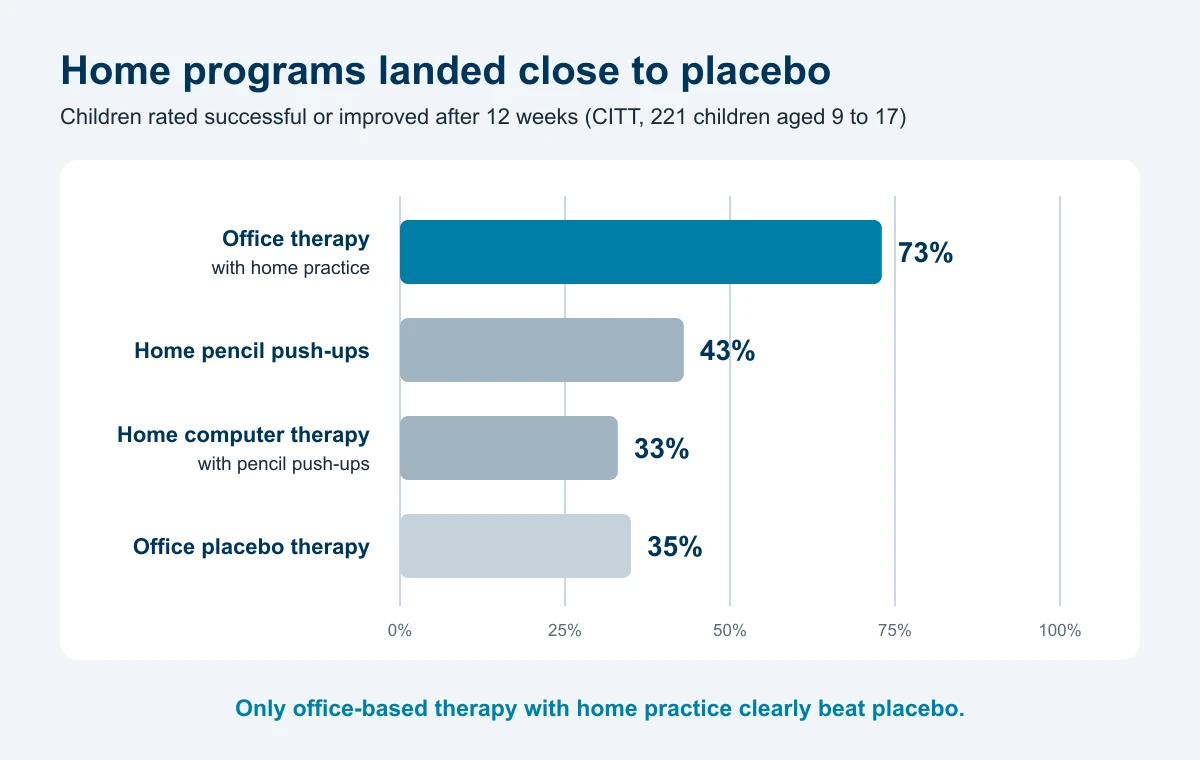
- In the largest trial in children with convergence insufficiency, office-based therapy with home reinforcement led to a successful or improved outcome in 73% of children. Home pencil push-ups (43%) and a home computer program (33%) landed close to placebo therapy (35%) (CITT Study Group, 2008).
- A Cochrane review of 12 trials concluded that, in children, office-based therapy with home reinforcement is more effective than home pencil push-ups or home computer therapy. It called the adult evidence less clear (Scheiman et al., 2020).
- That evidence is about convergence insufficiency. For other diagnoses, the home-versus-office question has been studied far less.
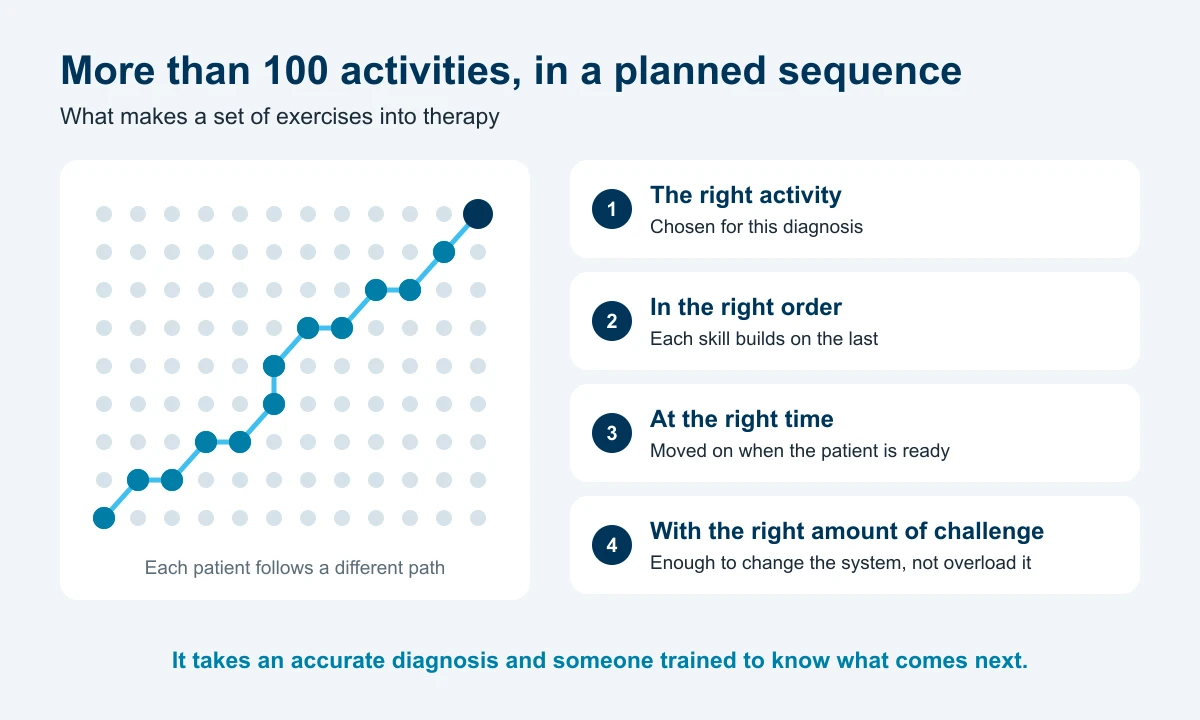
- A vision therapy program is a sequence. Ours draws on more than 100 activities, done in the right order, at the right time, with the right amount of challenge. That takes an accurate diagnosis and someone trained to know what to do next.
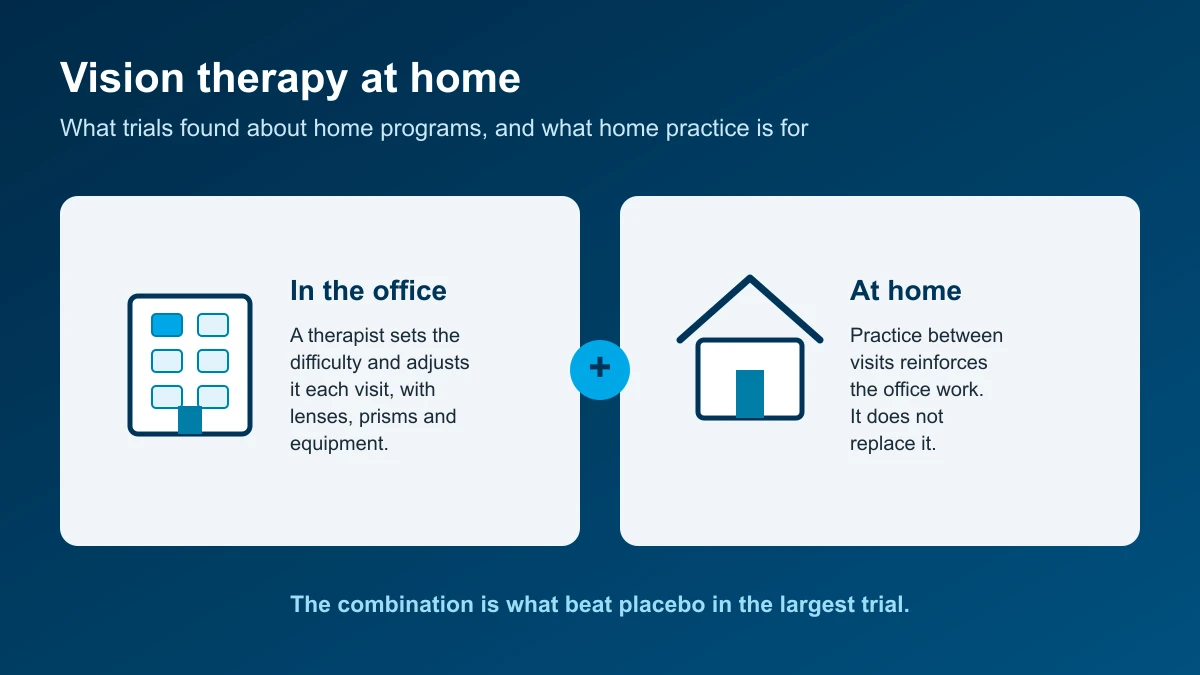
- Home practice still matters. It was built into the office-based program that won the trial. Its job is to reinforce supervised work, not to replace it.
- Eye exercises do not treat dyslexia (AAP/AAO/AAPOS/AACO, 2009) or attention problems (CITT-ART, 2021), and they do not replace glasses.
What the best trial found about home-based treatment
The Convergence Insufficiency Treatment Trial randomly assigned 221 children aged 9 to 17 with symptomatic convergence insufficiency to one of four 12-week programs:
- Office-based vergence and accommodative therapy with home reinforcement
- Home-based pencil push-ups
- Home-based computer vergence and accommodative therapy plus pencil push-ups
- Office-based placebo therapy, with activities designed not to train convergence or focusing
After 12 weeks, the office-based group had a significantly lower symptom score than each of the other three groups (15.1, versus 24.7 for pencil push-ups, 21.3 for home computer therapy and 21.9 for placebo). The share of children with a successful or improved outcome was 73% with office-based therapy, 43% with pencil push-ups, 33% with home computer therapy and 35% with placebo (CITT Study Group, 2008).
Two things stand out. The two home-only programs ended up about where placebo therapy did. And the winning program was not office visits alone. It included assigned home practice. We go through the full trial, including its limits, in what the CITT and CITT-ART trials actually found.
What the Cochrane review concluded
A Cochrane network meta-analysis pooled 12 randomized trials with 1,289 participants. In children, office-based therapy with home reinforcement was about three times as likely to succeed as placebo therapy (risk ratio 3.04), 2.86 times as likely as home pencil push-ups and 1.96 times as likely as home computer therapy. The authors rated that evidence high-certainty (Scheiman et al., 2020).
For adults, the same review found the picture less clear. Office-based therapy improved one clinical measure of convergence more than placebo, but there was no evidence of a difference in symptoms. In an earlier trial of 46 young adults, the symptom target was reached by 42% with office-based therapy, 31% with placebo therapy and 20% with pencil push-ups, and more than half of the office-based group still had symptoms (Scheiman et al., 2005).
How far this evidence reaches
These trials studied convergence insufficiency. That is where the comparison between home and office treatment is strongest, and mostly in children. For focusing problems, eye movement problems, amblyopia, strabismus and vision problems after brain injury, the question of home versus office has not been tested with the same rigor. We would not stretch the CITT numbers to cover them. For a wider view, see does vision therapy work?
Why supervised therapy may do better
The trials measured which program worked better. They did not test why. What follows is our clinical reasoning, not a trial result.
The short version is this. Vision therapy is not one exercise, or ten. In our programs we use more than 100 activities, and the therapy is in how they are put together: the right activity, in the right order, at the right time, with the right amount of stress on the visual system. Too little and nothing changes. Too much, or the wrong step too early, and the patient learns a workaround instead of the skill. The only way to do that well is to start from an accurate diagnosis and to have someone trained to understand what to do next. A video or an app has neither.
- Dosing. An activity that is too easy changes nothing. One that is too hard gets done wrong or abandoned. A therapist sets the level each week.
- Feedback. Many activities depend on the patient noticing what their eyes are doing. A child cannot always tell a correct response from a workaround, such as quietly ignoring one eye. A therapist watching can.
- Progression. Programs move through stages. Knowing when to move on, and when to go back, takes measurement.
- Equipment. Office therapy uses lenses, prisms and instruments that are not available, or not appropriate, without a prescription. See prism glasses vs vision therapy for how those tools differ.
- Follow-through. A standing appointment is easier to keep than a daily routine nobody is checking. We cover the adherence data in why consistency matters in vision therapy.
What home practice is for
None of this means home practice is pointless. The opposite is true. The program that won the trial paired office visits with assigned home practice, so home work was part of the treatment that was tested.
Our own programs follow the same idea. Patients come in for one 45-minute session or two 30-minute sessions a week, and we recommend home practice 3 to 5 days a week. Programs for binocular vision and visual processing problems usually run about 18 to 24 weeks. Programs for amblyopia, strabismus and brain injury often take longer.
The home activities are chosen by the therapist to reinforce what was just worked on in the office, and they change as the patient progresses. Think of it like a music lesson. Practice between lessons is where much of the repetition happens, but the teacher decides what to practice and corrects what has drifted.
Online eye exercise videos and apps
A home exercise can be the right tool when a clinician has made a diagnosis and prescribed it. In one small trial, 50 people with a measured convergence deficit after concussion were given either a prescribed home Brock string program or usual care. Convergence improved by 8.9 cm with the string and 3.8 cm with usual care (Trbovich et al., 2025). That was a specific exercise, for a measured problem, assigned by a clinician. It is not the same as picking a routine from a video.
Exercises chosen without a diagnosis run into three problems.
The right activity depends on the diagnosis. Eyes that drift outward at near and eyes that turn inward too much need different, sometimes opposite, work. A focusing problem is not treated like a tracking problem. That is why we do not publish step-by-step exercise instructions here. A set of steps is not useful without knowing which problem it is for.
The cost is usually time. Most generic exercises are not dangerous. The risk is that a family spends months on a routine aimed at the wrong target, while the real problem goes unmeasured and a child keeps struggling.
Some claims go further than the evidence. Generic eye exercises do not treat:
- Dyslexia. Pediatric and ophthalmology organizations state that vision problems do not cause dyslexia and that scientific evidence does not support eye exercises as a treatment for it (AAP/AAO/AAPOS/AACO, 2009). Dyslexia is treated with reading instruction.
- ADHD. In a randomized trial of 310 children with convergence insufficiency, office-based therapy was no better than placebo therapy at improving attention (CITT-ART, 2021). If full supervised therapy did not change attention, a video will not. A vision problem can still sit alongside ADHD, which we cover in vision problems vs ADHD.
- The need for glasses. Eye teaming and focusing therapy is not a substitute for a glasses prescription, and none of the trials above tested it as one.
What a family can do at home without a prescription
These are comfort and habit measures. They are not therapy, and they will not correct an eye teaming or focusing problem.
- Take regular breaks from near work. The 20-20-20 rule (every 20 minutes, look 20 feet away for 20 seconds) is an easy reminder. Be realistic about it: in a study of 30 young adults, scheduled 20-second breaks did not reduce symptoms compared with no breaks (Johnson and Rosenfield, 2023). Treat breaks as sensible, not as a treatment.
- Set up the reading spot. Good, even light, a comfortable viewing distance rather than a book or tablet held close to the face, and glare kept off the screen. This is ergonomic common sense, not a studied treatment.
- Get outside. In a meta-analysis, more outdoor time lowered the risk of becoming nearsighted. It did not slow nearsightedness that had already started (Xiong et al., 2017). It is not a treatment for eye teaming problems.
- Break up marathon sessions. Split long stretches of homework, reading or gaming into shorter blocks. More on this in how much screen time is too much.
- Write down what you see. Headaches, double vision, losing place, covering one eye, avoiding reading. Our symptom checklist gives you a structured list to bring to an appointment.
If the symptoms keep showing up despite good habits, that is the signal to have vision measured, not to add more home routines.
Red flags that need an eye doctor the same day
Do not start exercises for any of these. Call an eye doctor the same day, or go to an emergency department:
- Sudden double vision
- An eye that has newly started to turn in, out, up or down
- Eye pain
- Sudden loss of vision, in part or all of the visual field
- Any of the above after a head injury, or together with a severe headache, weakness, numbness or trouble speaking
When distance or cost is the obstacle
These are real barriers, and the answer is not to pretend a video is equivalent. Start with a diagnosis, then ask the provider direct questions:
- What is the diagnosis, and what does the evidence say about treating it?
- Which parts of the program must happen in the office, and what is assigned for home?
- Is there more than one visit schedule, and how does each affect the length of the program?
- How will progress be measured, and when will we re-evaluate?
- If we can only manage part of the program, what would you prioritize?
- What will this cost in total, and what help is available to pay for it?
For reference, our Developmental Vision Evaluation is $550 and takes about 100 minutes, and therapy sessions run $110 to $200. We are out-of-network and provide the paperwork you need to seek reimbursement. We accept HSA, FSA, CareCredit and payment plans, as well as Florida FES-UA scholarships. Details are on our cost and payment options pages.
Where to start
Home practice is part of good vision therapy. On the current evidence, it is not a replacement for a diagnosis and a supervised program, at least for convergence insufficiency in children, where the question has been tested best.
If you are seeing symptoms, the useful first step is to find out what is actually going on. Read more about our vision therapy program, or schedule a developmental vision evaluation with Dr. Christina Murray, OD, FOVDR. We have four offices, in Coconut Creek, Boynton Beach, Boca Raton and West Palm Beach, and evaluations are offered at Boynton Beach and Boca Raton. Call (561) 462-1245 with questions.
Common Questions About This Topic
Can you do vision therapy at home?
Home practice is part of vision therapy, but the research does not support it as a replacement for supervised care. In the largest trial in children with convergence insufficiency, office-based therapy with home reinforcement led to a successful or improved outcome in 73% of children, compared with 43% for home pencil push-ups and 33% for a home computer program. The evidence is strongest for convergence insufficiency and thinner for other conditions.
Do pencil push-ups work?
As a stand-alone treatment, not well. In children, home pencil push-ups produced results close to placebo therapy in the Convergence Insufficiency Treatment Trial. In a smaller trial of 46 young adults, 20% of the pencil push-up group reached the symptom target, compared with 42% with office-based therapy and 31% with placebo therapy.
Are eye exercise videos and apps worth trying?
They are not harmful in most cases, but an exercise chosen without a diagnosis may be aimed at a problem you do not have. Different eye teaming and focusing problems call for different, sometimes opposite, activities. The larger cost is usually time: months spent on a generic routine while the actual problem goes unmeasured.
Can eye exercises fix dyslexia, ADHD or the need for glasses?
No. Pediatric and ophthalmology organizations state that eye exercises are not supported as a treatment for dyslexia or learning disabilities, and a randomized trial found vergence and accommodative therapy no better than placebo for attention. Eye teaming and focusing exercises also do not replace a glasses prescription.
How much home practice does a vision therapy program involve?
In our programs, patients come in for one 45-minute or two 30-minute office sessions a week, and we recommend home practice 3 to 5 days a week. The home activities are assigned by the therapist to reinforce what was worked on in the office, and they change as the patient progresses.
Where This Information Comes From
- Convergence Insufficiency Treatment Trial Study Group (2008). Randomized clinical trial of treatments for symptomatic convergence insufficiency in children. Archives of Ophthalmology; 126(10):1336-1349. : 221 children aged 9-17 in four 12-week arms: a successful or improved outcome in 73% with office-based therapy plus home reinforcement, 43% with home pencil push-ups, 33% with home computer therapy plus push-ups and 35% with office placebo therapy.
- Scheiman M, Kulp MT, Cotter SA, Lawrenson JG, Wang L, Li T (2020). Interventions for convergence insufficiency: a network meta-analysis. Cochrane Database of Systematic Reviews; 12:CD006768. : 12 trials and 1,289 participants: in children, office-based therapy with home reinforcement was more effective than home pencil push-ups (RR 2.86) and home computer therapy (RR 1.96), high-certainty evidence; the adult evidence is less clear.
- Scheiman M, Mitchell GL, Cotter S, et al. (2005). A randomized clinical trial of vision therapy/orthoptics versus pencil pushups for the treatment of convergence insufficiency in young adults. Optometry and Vision Science; 82(7):583-595. : 46 adults aged 19-30: only office-based therapy changed the clinical signs; the symptom target was reached by 42% with office-based therapy, 31% with placebo therapy and 20% with pencil push-ups, and more than half of the treated group remained symptomatic.
- Trbovich AM, Zynda AJ, Togashi T, et al. (2025). Randomized controlled trial of Brock string vision therapy for receded near point of convergence following concussion. Journal of Neurotrauma; 42(19-20):1708-1718. : In 50 participants after concussion, a prescribed home Brock string program improved near point of convergence by 8.9 cm versus 3.8 cm with usual care; a small trial of a clinician-prescribed exercise in diagnosed patients.
- American Academy of Pediatrics, American Academy of Ophthalmology, AAPOS, AACO (2009). Joint statement - Learning disabilities, dyslexia, and vision. Pediatrics; 124(2):837-844. : States that vision problems do not cause dyslexia or learning disabilities and that scientific evidence does not support eye exercises or behavioral vision therapy as treatments for them.
- CITT-ART Investigator Group (2021). Effect of Vergence/Accommodative Therapy on Attention in Children with Convergence Insufficiency: A Randomized Clinical Trial. Optometry and Vision Science; 98(3):222-233. : In 310 children aged 9-14, office-based vergence and accommodative therapy was no better than placebo therapy at improving parent- or teacher-rated attention.
- Johnson S, Rosenfield M (2023). 20-20-20 Rule: Are These Numbers Justified? Optometry and Vision Science; 100(1):52-56. : In 30 young adults doing a 40-minute tablet task, scheduled 20-second breaks had no significant effect on symptoms, reading speed or accuracy; the authors do not support them as a therapeutic intervention for digital eye strain.
- Xiong S, Sankaridurg P, Naduvilath T, et al. (2017). Time spent in outdoor activities in relation to myopia prevention and control: a meta-analysis and systematic review. Acta Ophthalmologica; 95(6):551-566. : Across 25 articles, more outdoor time lowered the risk of becoming nearsighted (risk ratio 0.536 in clinical trials) but did not slow progression in eyes that were already myopic.
Care We Provide
More From the Blog
Wondering If This Sounds Like Your Family?
A developmental vision evaluation measures the skills a routine eye exam does not. Our team sees children and adults in Coconut Creek, Boynton Beach, Boca Raton and West Palm Beach.