Why Consistency Matters in Vision Therapy

Nearly every family we start in therapy eventually asks some version of the same question: does the home practice actually matter, or is the weekly office visit the part that counts? It is a fair question, and for once the research gives a fairly clear answer.
Key takeaways
- The vision therapy programs tested in clinical trials were never office visits alone. Home practice of at least 15 minutes a day, five days a week was built into every treatment arm, including the placebo arm (CITT, 2008).
- Families are much better at keeping appointments than at keeping the home routine. In CITT-ART, 96.8% of scheduled therapy visits were completed, but children in the therapy group were rated as doing their home procedures most of the time or always in only 64.2% of their treatment weeks on average (CITT-ART, 2019).
- The home computer program slipped the most. Therapist-rated compliance ran 91.4% in the office-based therapy group, 87% in the office placebo group and 84.9% with pencil push-ups, but 67.3% with home computer therapy (CITT, 2008).
- In amblyopia trials of a take-home iPad game, only 22.2% of children (Holmes et al., 2016) and 13% of teenagers (Manh et al., 2018) completed more than 75% of what was prescribed.
- Across 27 studies of home digital amblyopia treatments, higher adherence correlated with greater acuity improvement (Asensio-Jurado et al., 2026) — an association, not proof that extra minutes cause extra gain.
The program that worked in the research included homework
When people say “vision therapy is evidence-based for convergence insufficiency,” the thing that was studied is a package: a weekly 60-minute in-office session with a therapist, plus short daily practice at home. In the Convergence Insufficiency Treatment Trial, every group — including the placebo group — was given at least 15 minutes of home therapy to do five days a week; the home computer group was prescribed 15 minutes of software plus 5 minutes of pencil push-ups. After 12 weeks, 73% of the office-based therapy group were rated successful or improved, compared with 35% of the office placebo group, 43% of the pencil push-up group and 33% of the home computer group (CITT, 2008).
The Cochrane network meta-analysis that pooled 12 trials and 1289 participants describes the winning treatment in exactly those terms: office-based vergence and accommodative therapy with home reinforcement, which outperformed placebo in children and outperformed home-only push-ups or computer programs (Scheiman et al., 2020). Home practice on its own is not useless — a 2025 randomized trial found home Brock string exercises improved near point of convergence more than usual care after concussion (Trbovich et al., 2025) — but the combination is what has the strongest support.
Where programs actually fall apart
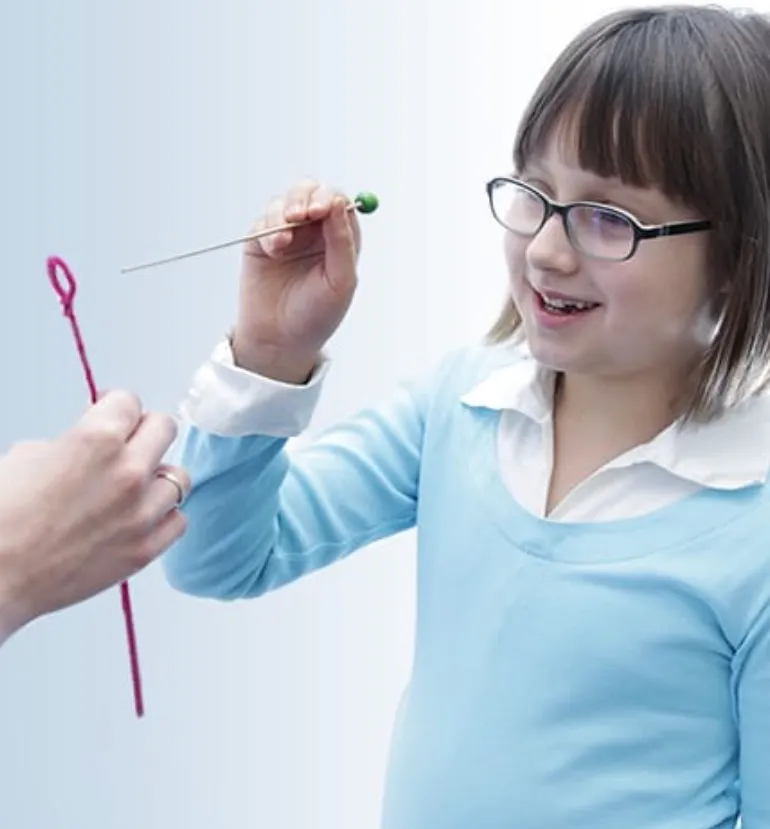
The adherence numbers are the interesting part, because they are so lopsided. In CITT-ART, 4762 of 4921 scheduled therapy visits were completed — 96.8%, essentially perfect attendance. Home therapy in the same trial held up less well: across the 16 weeks of treatment, children in the therapy group were rated as doing the prescribed home procedures most of the time or always in an average of 64.2% of their weeks (CITT-ART, 2019). Families show up. The 15 minutes on a Tuesday night is what gets lost.
The same pattern shows up in amblyopia research, where home treatment can be measured electronically. When children were given a binocular iPad game to play an hour a day, only 22.2% completed more than 75% of it, and the game did not match part-time patching (Holmes et al., 2016). In teenagers the figure was 13% (Manh et al., 2018). A 2026 systematic review of 27 home digital amblyopia studies found pooled adherence of 74.2%, with adherence dropping as treatment ran longer and as patients got older, and higher adherence correlating with greater visual acuity improvement (Asensio-Jurado et al., 2026).
Two honest caveats. Adherence in these studies is usually estimated by the therapist from home logs, software records and what the family reports, so it is not a stopwatch measurement. And no trial has randomly assigned people to do more or less home practice, so we can say adherence travels with better outcomes — not that it causes them. In CITT-ART the placebo group was actually rated as more adherent at home, at an average of 76.3% of weeks versus 64.2% (CITT-ART, 2019), which is a good reminder that effort alone does not explain results.
What consistency can and cannot buy
Being straight about this matters more to us than sounding impressive.
Supported: in children with symptomatic convergence insufficiency, the office-plus-home program relieves symptoms and improves eye-teaming measures better than placebo (CITT, 2008; Scheiman et al., 2020), and it improves focusing amplitude (Scheiman et al., 2011).
Not supported: in the larger CITT-ART trial, therapy improved the clinical signs more than placebo but symptom scores improved about the same in both groups (CITT-ART, 2019), and reading comprehension improved 3.7 points with therapy versus 3.8 with placebo (CITT-ART, 2019). Doing your homework faithfully will not raise reading scores by itself.
Our clinical perspective: in the programs we run, patients who keep the home routine tend to move through their goals in fewer weeks, and patients who stop practicing for long stretches usually need the program extended — which costs more time and money. That is our observation from our own practice, not a controlled finding, and we say so plainly. See how long vision therapy takes for how we think about program length.
Do the gains hold?
For children who responded, yes, mostly. One year after finishing, 84.4% of children who had become asymptomatic with office-based therapy were still asymptomatic (CITT, 2009), and across the children treated in that trial, reduced focusing amplitude had recurred in only 12.5% (Scheiman et al., 2011) — a figure reported for the whole treated cohort rather than for the office-based group alone. That follow-up only tracked responders, so it tells us gains are reasonably durable in the people who got them — not that everyone who finishes is protected forever.
Four habits that keep a program on track
These are the four things we coach every family on at the start of a program.
1. Consistency beats intensity
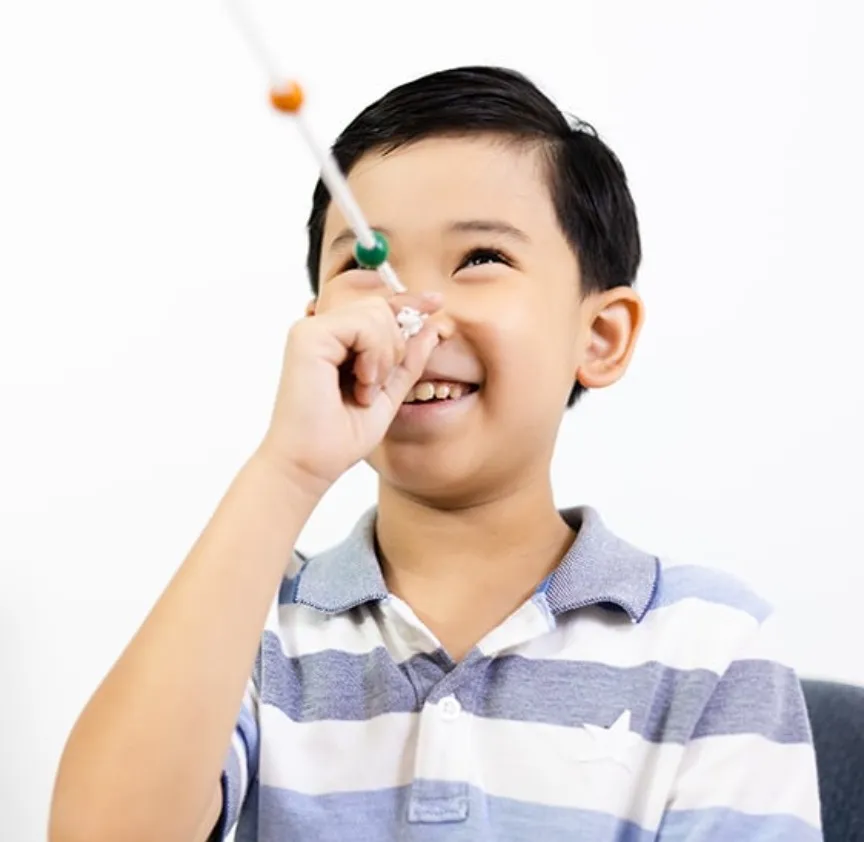
Short and regular wins. Fifteen focused minutes a day, five days a week, is the pattern the research used (CITT, 2008). Our own programs prescribe home practice 3-4 days a week for 15-20 minutes for patients attending one 45-minute session a week; when that cadence is not realistic at home, we recommend 2-3 in-office sessions a week instead. Either way, a single 90-minute catch-up session on Sunday is not the same thing. Attach practice to something that already happens — right after dinner, before screen time — and it stops depending on anyone remembering.
2. Effort and engagement
Ten minutes of real attention is worth more than twenty minutes of going through the motions with a screen on in the background. If your child is exhausted, move the session earlier rather than pushing through.
3. Ask questions
Ask your therapist what an activity is for, what “doing it right” looks like, and what to do when it goes wrong. Families who ask questions catch technique errors early, and we can adjust an activity we know is being skipped. You can also read what to expect from a vision therapy program before you start.
4. Understand the why
Knowing that a Brock string is training the eyes to aim together at a specific distance — not just “doing an eye exercise” — makes the 15 to 20 minutes feel worth it. Our therapy goals and procedures page walks through what each part of a program is targeting.
Practical tips for a real week
- Keep all materials in one box so nobody spends five minutes hunting for the red-green glasses.
- Use the home log we send with you and bring it to each visit, even the weeks it looks bad. It changes what we do next.
- Split it: two seven-minute blocks are fine.
- Stop and tell us if an activity causes headache, double vision or eye pain. That is information, not failure.
- Expect plateaus. Progress in vision therapy is rarely a straight line, and a flat week is not a reason to quit.
- For adults and teens, put it on the calendar like any other appointment.
Ready to find out whether therapy is the right fit?
Consistency only pays off if the program is aimed at the right problem in the first place. A comprehensive developmental vision evaluation measures how the eyes team, focus and track, and tells us whether therapy is appropriate, what it would target and roughly how long it would take. Schedule an evaluation at our Boynton Beach or Boca Raton office, or start with what vision therapy is if you are still gathering information.
Common Questions About This Topic
How much home practice does vision therapy usually require?
In the clinical trials that established vision therapy for convergence insufficiency, home practice was at least 15 minutes a day, five days a week, alongside a weekly 60-minute in-office session. Our own programs are set up differently: we prescribe home practice 3-4 days a week for 15-20 minutes alongside one 45-minute in-office session a week, and when consistent home practice is not possible we recommend 2-3 in-office sessions a week instead. The exact activities and minutes are set for each patient, and home practice is kept short by design so it fits into a school night.
What happens if we miss a week?
One missed week is not a crisis. Tell your therapist so the next session can be adjusted rather than pushing ahead as if the practice happened. In our clinical experience, repeated missed weeks tend to slow progress and stretch the program out, which also raises the total cost. That is our observation from running programs, not a finding from a controlled trial.
Does doing more homework guarantee faster results?
No. A 2026 systematic review of home digital amblyopia treatments found that higher adherence correlated with greater visual acuity improvement, but a correlation is not proof that extra minutes cause extra gain, and no trial has randomly assigned different amounts of home practice. Doing the prescribed amount well is more useful than doing extra.
My child resists the exercises. What should we do?
Tell us early. Resistance often means an activity is too hard, too long, or genuinely uncomfortable, and any of those can be changed. Headaches, double vision or eye pain during an activity are reasons to stop and let your therapist know at the next visit.
Do the gains hold after therapy ends?
In the one-year follow-up of the convergence insufficiency trial, 84.4% of children who had become symptom-free with office-based therapy were still symptom-free a year later, and reduced focusing amplitude had returned in only 12.5% of treated children. That follow-up only tracked children who had responded to treatment, so it shows durability in responders rather than proving that anyone who finishes stays fixed.
Where This Information Comes From
- Convergence Insufficiency Treatment Trial Study Group (2008). Randomized clinical trial of treatments for symptomatic convergence insufficiency in children. Archives of Ophthalmology; 126(10):1336-1349 (PMID 18852411, PMC full text). : In 221 children aged 9-17, 73% of the office-based vergence/accommodative therapy group were successful or improved at 12 weeks versus 35% office placebo, 43% pencil push-ups and 33% home computer therapy; every arm was prescribed at least 15 minutes of home therapy 5 days a week, and therapist-rated compliance was 91.4%, 87%, 84.9% and 67.3% in those four groups.
- CITT-ART Investigator Group (2019). Treatment of symptomatic convergence insufficiency in children enrolled in the Convergence Insufficiency Treatment Trial - Attention and Reading Trial. Optometry and Vision Science; 96(11):825-835 (PMID 31651593, PMC full text). : Signs improved more with therapy than placebo but CISS symptom scores improved similarly (mean difference 1.5 points, P=.21); 4762 of 4921 scheduled office visits (96.8%) were completed, while participants were rated adherent with home therapy in a mean 64.2% of their 16 treatment weeks versus 76.3% in the placebo group.
- CITT-ART Investigator Group (2019). Effect of Vergence/Accommodative Therapy on Reading in Children with Convergence Insufficiency. Optometry and Vision Science. : Reading comprehension improved 3.7 points with therapy versus 3.8 points with placebo in 310 children; no reading benefit over placebo.
- Scheiman M, Kulp MT, Cotter SA, Lawrenson JG, Wang L, Li T (2020). Interventions for convergence insufficiency: a network meta-analysis. Cochrane Database of Systematic Reviews. : Across 12 trials and 1289 participants, office-based vergence/accommodative therapy with home reinforcement beat placebo in children (RR 3.04) and beat home-only push-ups or computer therapy; adult evidence is less clear.
- Convergence Insufficiency Treatment Trial Study Group (2009). Long-term effectiveness of treatments for symptomatic convergence insufficiency in children. Optometry and Vision Science. : Of children who became asymptomatic with office-based therapy, 84.4% were still asymptomatic one year later.
- Scheiman M, Cotter S, Kulp MT, et al.; CITT Study Group (2011). Treatment of accommodative dysfunction in children: results from a randomized clinical trial. Optometry and Vision Science. : Accommodative amplitude rose 9.9 D with office-based therapy versus 2.2 D with placebo; one year after therapy, reduced amplitude had recurred in only 12.5% of the trial's treated children (reported for the cohort, not by treatment group).
- Holmes JM, Manh VM, Lazar EL, et al.; PEDIG (2016). Effect of a Binocular iPad Game vs Part-time Patching in Children Aged 5 to 12 Years With Amblyopia. JAMA Ophthalmology. : Only 22.2% of the game group completed more than 75% of prescribed play, and patching produced more improvement (1.35 vs 1.05 lines).
- Manh VM, Holmes JM, Lazar EL, et al.; PEDIG (2018). A Randomized Trial of a Binocular iPad Game Versus Part-Time Patching in Children Aged 13 to 16 Years With Amblyopia. American Journal of Ophthalmology. : Only 13% of teenagers completed more than 75% of prescribed game treatment; acuity gain was 3.5 letters versus 6.5 with patching.
- Asensio-Jurado L, Argilés M, Vinuela-Navarro V, Quevedo-Junyent L (2026). Analysis of patient adherence to emerging treatment tools for improving visual functions in amblyopia: a systematic review and meta-analysis. Journal of Optometry. : Across 27 studies and 1727 participants, pooled adherence was 74.2%; adherence fell with longer treatment and older age, and higher adherence correlated with greater visual acuity improvement (p<0.001).
- Trbovich AM, Zynda AJ, Togashi T, et al. (2025). Randomized Controlled Trial of Brock String Vision Therapy for Receded Near Point of Convergence Following Concussion. Journal of Neurotrauma. : Home Brock string exercises improved near point of convergence by 8.9 cm versus 3.8 cm with usual care in 50 people aged 11-30 after concussion.
Care We Provide
More From the Blog
Wondering If This Sounds Like Your Family?
A developmental vision evaluation measures the skills a routine eye exam does not. Our team sees children and adults in Coconut Creek, Boynton Beach, Boca Raton and West Palm Beach.