Vision Therapy for Adults: Does It Work After Childhood?
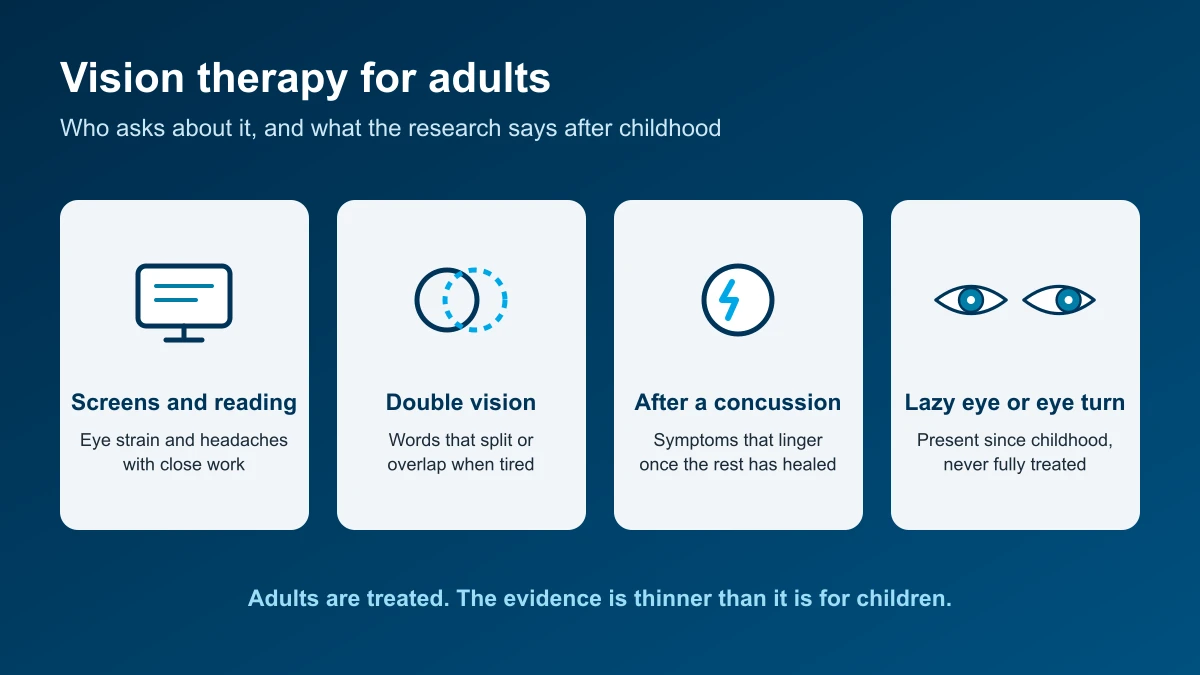
Most of what you read about vision therapy is written for parents. That leaves adults with a fair question: if the problem was never treated in childhood, or only showed up at 40, is there any point in treating it now?
Age does not rule you out. The research in adults is smaller and less certain than the research in children, though, and it varies by diagnosis. This article goes through it condition by condition, then covers what an adult program looks like, how long it takes and what to rule out first.
Key takeaways
- Adults can be treated, but the proof is thinner than it is for children. A Cochrane review found only six adult trials of convergence insufficiency treatments and called the adult evidence less clear (Scheiman et al., 2020).
- In young adults with convergence insufficiency, office-based therapy improved the eye teaming measurements where pencil push-ups did not. More than half were still symptomatic at 12 weeks (Scheiman et al., 2005).
- Adult lazy eye is no longer considered untreatable, but adult studies are small and gains are usually partial.
- After a concussion, the best trial stops at age 25. After a stroke, rehabilitation mostly teaches compensation and does not restore lost visual field.
- Sudden double vision is a medical emergency. It needs a medical work-up before anyone talks about therapy.
Which adults ask about vision therapy
The adults who come to us tend to fall into a few groups:
- People with eye strain, headaches or blur after screen work or reading
- People who see double some of the time, often when tired
- People who have trouble with night driving, parking or judging depth
- People with visual symptoms that began after a concussion, a stroke or another brain injury
- People with a lifelong eye turn or lazy eye
- People who have always hated reading and never knew why
- Athletes and people in visually demanding work who want sharper visual skills, which is a different kind of visit covered further down
Our BVD in adults page describes how that feels day to day, and how BVD affects adults at work and behind the wheel goes deeper on screens and driving. This article is about treatment.
Convergence insufficiency in adults
Convergence insufficiency is trouble turning the eyes inward and holding them there at reading distance. Most of the research on it was done in children.
The main adult trial randomized 46 adults aged 19 to 30 to 12 weeks of office-based therapy, office-based placebo therapy or pencil push-ups at home. Only the office-based therapy group showed meaningful change in the measurements. Their near point of convergence moved from 12.8 cm to 5.3 cm, and their convergence reserve rose from 11.3 to 29.7 prism diopters (Scheiman et al., 2005).
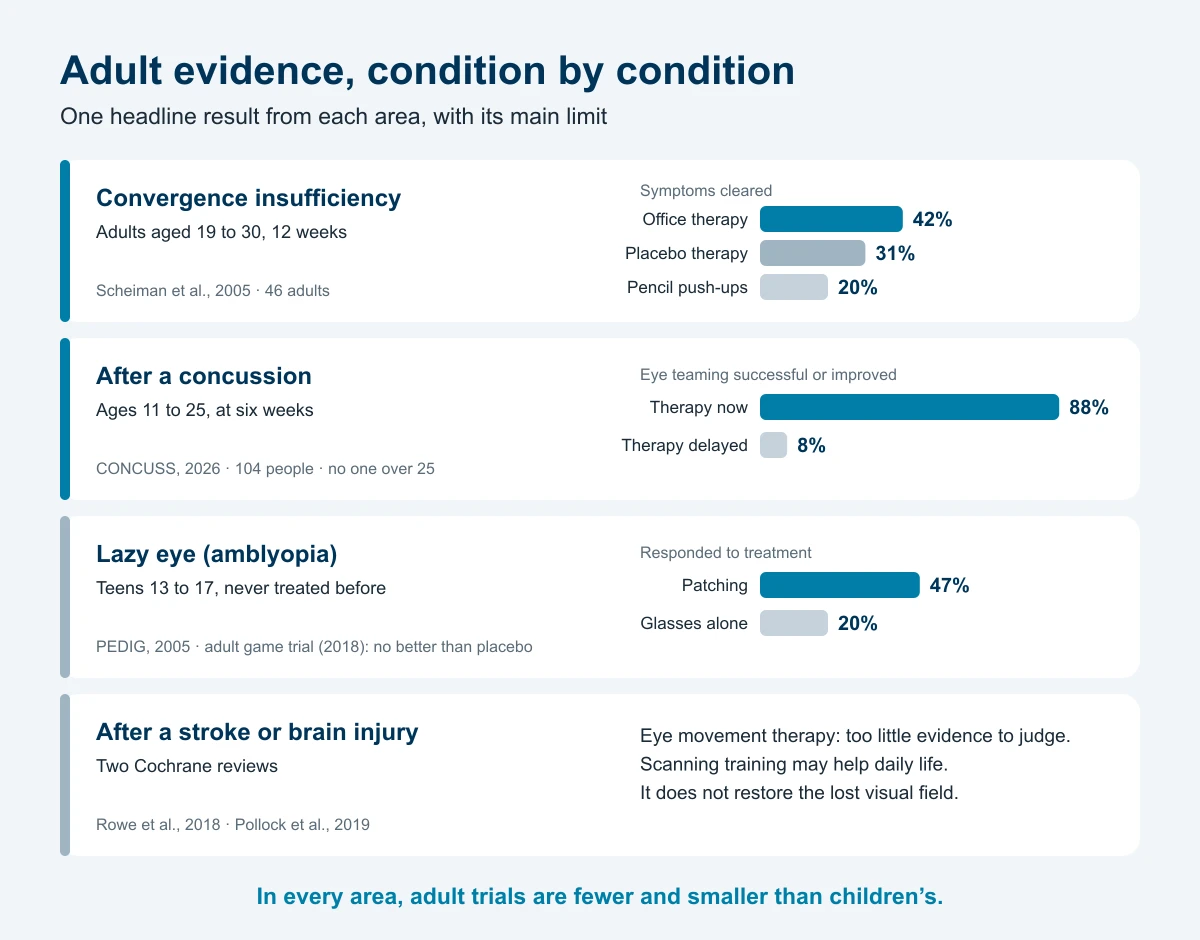
Symptoms were a different story. All three groups reported feeling better. Symptoms cleared in 42% of the office therapy group, 31% of the placebo group and 20% of the pencil push-up group. That means 58% of the adults who did real therapy still had some symptoms at 12 weeks, although fewer than before.
The Cochrane network meta-analysis reached a similar position. It found six adult trials with 321 participants in total, and rated only one of them at low risk of bias. Office-based therapy improved convergence reserve more than placebo. There was no evidence of a difference in near point of convergence or in symptom scores. The authors concluded that office-based therapy with home practice is more effective than home-based options for children, and that in adults the evidence is less clear (Scheiman et al., 2020).
So the fair statement for an adult is this: therapy can change the measurements, pencil push-ups alone are a weak substitute, and symptom relief is likely to be partial for some people. The adult trials are also small and mostly enrolled people under 30.
Lazy eye in adults
For decades, the teaching was that amblyopia could only be treated during a “critical period” in early childhood, and that after about age 7 the window had closed. That view has softened, and it helps to be exact about how far.
A randomized trial of 507 patients aged 7 to 17 tested patching with near activities against glasses alone. Among 13- to 17-year-olds who had never been treated before, 47% responded to patching compared with 20% with glasses alone. Among all teens in that age group, including those treated earlier in life, the rates were 25% and 23%, which is no real difference. Most patients, including those who responded, were left with some reduced vision in the weaker eye (PEDIG, 2005). That trial stopped at age 17.
In adults the evidence is thinner. In a small laboratory study, five adults who had little or no depth perception regained a substantial amount after thousands of practice trials. The depth perception they recovered was coarser than normal, and the study had no control group (Ding & Levi, 2011). It shows the adult visual system can still change. It does not show how often that happens in ordinary care.
When a binocular treatment was tested in a larger controlled trial, the result was sobering. In 115 participants aged 7 and older, with an average age of 21.5, a home binocular video game played for 6 weeks improved the weaker eye by 0.06 logMAR. A placebo game improved it by 0.07. That is less than one line on the eye chart in both groups, with no difference between them (Gao et al., 2018).
An adult with amblyopia should expect an honest conversation. The first step is accurate glasses. Gains in sharpness are usually modest, and goals such as more comfortable two-eyed vision may be more realistic than 20/20 in the weaker eye. Our lazy eye page covers the basics, and adults with an eye turn should also read about adult strabismus and double vision treatment options, which include prism and surgery.
After a concussion
Eye teaming and focusing problems are common in people whose symptoms linger after a concussion. The CONCUSS trial randomized 104 people with concussion-related convergence insufficiency to start office-based therapy right away or after a six-week delay. At six weeks, 88% of the immediate group were successful or improved on the eye teaming measurements, compared with 8% of the group still waiting (Alvarez et al., 2026).
Two limits matter for adults. The participants were aged 11 to 25, so the trial says nothing direct about a 45-year-old. And the comparison group waited instead of receiving a placebo therapy, so some of the difference in symptoms may reflect expectation. For older adults we are extending a result from younger people. More detail is on our concussions page and in vision problems after concussion.
After a stroke or brain injury
Stroke and other brain injuries can cause double vision, eye movement problems and loss of part of the visual field. Here the evidence is the weakest, and expectations need to be the most careful.
A Cochrane review of treatments for eye movement disorders after acquired brain injury found five randomized trials with 116 participants. The one trial of eye movement rehabilitation had 12 people. The authors concluded there was insufficient evidence to guide treatment decisions (Rowe et al., 2018).
For visual field loss after stroke, a second Cochrane review covered 20 studies with 732 randomized participants. It found low-quality evidence that scanning training, which teaches a person to move the eyes into the blind area, may improve quality of life. It found no evidence that scanning training changes the visual field itself, and too little evidence to judge therapies meant to restore the lost field (Pollock et al., 2019).
In plain terms, rehabilitation after a stroke can help a person compensate, for example by scanning into the blind side more effectively. It should not be sold as a way to bring back lost field, and it belongs alongside care from the person’s neurologist and rehabilitation team.
Sports and occupational vision training
Some adults come to us with nothing to fix. They are race car drivers, tennis players, billiards players, competitive shooters and people whose work puts heavy demands on their vision, and they want to train the visual skills their sport or job depends on.
This is performance training. It is a different thing from vision therapy, which treats a diagnosed condition, and the two should not be confused. Every athlete still starts with an evaluation, because an undiagnosed eye teaming or focusing problem is worth finding before any training begins.
The research here is less developed than it is for convergence insufficiency. Training reliably improves the tasks that are trained. Whether that carries over to results in competition is where the evidence thins out, and nobody should promise you a change in your numbers. Our sports vision page sets out what the studies show, and how sports vision training can help athletes goes through it in more detail.
How an adult program differs from a child’s
The activities come from the same toolbox. Several things are different.
- Motivation is usually better. Adults choose to come, understand why they are doing an activity and tend to keep up with home practice. This is our clinical observation, and it is a real advantage.
- Habits are older. An adult may have spent 30 years closing one eye to read, tilting the head or avoiding books. Those workarounds take time to unlearn.
- The demands are specific. Goals are tied to the job and the commute: eight hours at a monitor, driving at night, reading reports without a headache.
- Other things are going on. After about 40, near focus weakens with age, and many adults need a reading prescription as part of the plan.
Our programs draw on more than 100 activities. What makes them therapy is doing them in the right order, at the right time, with the right amount of stress on the visual system. That depends on an accurate diagnosis and on someone trained to know what to do next. This is our clinical reasoning, not a trial result. Our vision therapy page describes the program.
Dr. Murray knows the adult side of this personally: she discovered deficits in her own visual system as an adult.
How long it takes and what it costs
In our offices, programs for binocular vision and visual processing usually run about 18 to 24 weeks. Programs for amblyopia, strabismus and brain injury often take longer. Patients come for one 45-minute session or two 30-minute sessions a week, and we ask for home practice 3 to 5 days a week. For more on timelines, see how long vision therapy takes.
Therapy sessions cost $110 to $200 each. We are out-of-network with insurance and provide the paperwork to request reimbursement from your plan. We accept HSA and FSA funds and CareCredit, and we offer payment plans. Current fees are on our cost and pricing page.
What to rule out first
Vision therapy is the wrong first step for several adult problems.
- Sudden double vision is a medical emergency. Double vision that starts suddenly, especially with a drooping eyelid, a severe headache, weakness, numbness or trouble speaking, needs emergency care the same day.
- A new eye turn in an adult needs a medical work-up. An eye that begins to drift in adulthood has to be investigated before any therapy is considered.
- Cataract. Glare and poor night driving are common early signs.
- Dry eye. It causes burning, tired eyes and blur that comes and goes with blinking, and it is common with screen work.
- An outdated prescription. A small uncorrected error, or the need for a first reading prescription, can produce every symptom on the list above.
If one of these explains the symptoms, that is the thing to treat.
Prism glasses as an alternative or a companion
Prism lenses shift the image so the eyes do not have to work as hard to keep it single. They help only while you wear them, and for some adults that is exactly what is wanted.
In a crossover trial of 29 adults aged 45 to 68 with symptomatic convergence insufficiency, each person wore progressive glasses with base-in prism for three weeks and matching placebo glasses for three weeks. The average symptom score was 30.21 at the start, 13.38 with the prism glasses and 23.62 with the placebo glasses (Teitelbaum et al., 2009). It is a small, short study, and it measured symptoms only.
Prism can be the whole plan for an adult who does not have time for a program, or whose problem is unlikely to respond to therapy. It can also be used with therapy and reduced later. Our prisms page explains the lenses, and prism glasses vs vision therapy compares the two.
Where to start
Start by finding out whether there is a measurable problem. The symptom checklist is a quick first look, and our binocular vision dysfunction page explains what gets measured.
For adults, the visit is a Binocular Vision Assessment, which takes about an hour. Examinations are done at our Boynton Beach and Boca Raton offices. Vision & Learning Center was founded in 2017 by Dr. Christina Murray, OD, FOVDR, sees both children and adults, and also has offices in Coconut Creek and West Palm Beach.
For the wider research picture, read does vision therapy work.
To book, schedule an evaluation or call (561) 462-1245.
Common Questions About This Topic
Does vision therapy work for adults?
It can, for the right diagnosis. In a randomized trial of adults aged 19 to 30 with convergence insufficiency, office-based therapy was the only treatment that improved the eye teaming measurements, although more than half of that group still had some symptoms at 12 weeks. The adult research is smaller and less certain than the research in children, so results should be checked with repeat measurements.
Is it too late for vision therapy as an adult?
Age by itself does not rule it out. Adults are treated for eye teaming and focusing problems, and studies show the adult visual system can still change. What matters more is the diagnosis: some adult problems respond to therapy, some are better managed with lenses or prism, and some need a medical work-up first.
Can lazy eye be treated in adults?
Sometimes, and with limits. A trial in 7- to 17-year-olds showed that treatment can still improve vision in teens who were never treated before. In adults the studies are small, and the largest randomized trial of a binocular video game that included adults found it no better than a placebo game. Any adult plan should start with accurate glasses and realistic goals.
How long does vision therapy take for adults?
In our offices, programs for binocular vision and visual processing usually run about 18 to 24 weeks. Programs for amblyopia, strabismus and brain injury often take longer. Patients come for one 45-minute session or two 30-minute sessions a week and practice at home 3 to 5 days a week.
Are prism glasses better than vision therapy for adults?
They do different jobs. Prism shifts the image so the eyes do less work while the glasses are on, and therapy aims to improve the eye teaming skill itself. In one small crossover trial in adults aged 45 to 68 with convergence insufficiency, reading glasses with base-in prism lowered symptom scores more than placebo glasses. Some adults use prism alone, some do therapy, and some use both.
Where This Information Comes From
- Scheiman M, Kulp MT, Cotter SA, Lawrenson JG, Wang L, Li T (2020). Interventions for convergence insufficiency: a network meta-analysis. Cochrane Database of Systematic Reviews; 12:CD006768. : Six adult trials with 321 participants, only one at low risk of bias: office-based therapy improved fusional vergence more than placebo (mean difference 16.73 prism diopters) with no evidence of a difference in near point of convergence or symptom score. The authors conclude the adult evidence is less clear than the evidence in children.
- Scheiman M, Mitchell GL, Cotter S, Kulp MT, Cooper J, Rouse M, Borsting E, London R, Wensveen J (2005). A randomized clinical trial of vision therapy/orthoptics versus pencil pushups for the treatment of convergence insufficiency in young adults. Optometry and Vision Science; 82(7):583-595. : In 46 adults aged 19-30, only office-based therapy produced significant changes in near point of convergence (12.8 cm to 5.3 cm) and fusional vergence (11.3 to 29.7 prism diopters). Symptoms were eliminated in 42% with office therapy, 31% with placebo therapy and 20% with pencil push-ups, so 58% of the therapy group were still symptomatic at 12 weeks.
- Scheiman MM, Hertle RW, Beck RW, et al.; Pediatric Eye Disease Investigator Group (2005). Randomized trial of treatment of amblyopia in children aged 7 to 17 years. Archives of Ophthalmology; 123(4):437-447. : Among 13- to 17-year-olds never treated before, 47% responded to patching with near activities versus 20% with glasses alone; among all 13- to 17-year-olds the rates were 25% and 23%. Most patients were left with a residual visual acuity deficit. The trial did not enroll adults.
- Gao TY, Guo CX, Babu RJ, et al.; BRAVO Study Team (2018). Effectiveness of a Binocular Video Game vs Placebo Video Game for Improving Visual Functions in Older Children, Teenagers, and Adults With Amblyopia: A Randomized Clinical Trial. JAMA Ophthalmology; 136(2):172-181. : In 115 participants aged 7 and older (mean age 21.5), amblyopic eye acuity improved 0.06 logMAR with a home binocular video game and 0.07 logMAR with a placebo game after 6 weeks, with no difference between groups.
- Ding J, Levi DM (2011). Recovery of stereopsis through perceptual learning in human adults with abnormal binocular vision. Proceedings of the National Academy of Sciences USA; 108(37):E733-E741. : Five adults who were stereoblind or stereoanomalous showed substantial recovery of stereopsis after thousands of training trials; the recovered depth perception had reduced resolution and precision. A laboratory study with no control group.
- Alvarez TL, Scheiman M, Hajebrahimi F, Noble M, Gohel S, Baro R, Bachman JA, Master CL, Goodman A; CONCUSS Investigator Group (2026). CONCUSS randomised clinical trial of vergence/accommodative therapy for concussion-related symptomatic convergence insufficiency. British Journal of Sports Medicine; 60(5):340-354. : In 104 participants aged 11-25 with concussion-related convergence insufficiency, 88% were successful or improved on eye teaming measures after six weeks of immediate office-based therapy versus 8% with delayed therapy. The comparison group waited instead of receiving a sham, and no participant was older than 25.
- Rowe FJ, Hanna K, Evans JR, et al. (2018). Interventions for eye movement disorders due to acquired brain injury. Cochrane Database of Systematic Reviews; 3:CD011290. : Five randomized trials with 116 participants; the authors found insufficient evidence to inform treatment decisions for eye movement disorders after acquired brain injury. The one oculomotor rehabilitation trial had 12 participants and was rated very low certainty.
- Pollock A, Hazelton C, Rowe FJ, et al. (2019). Interventions for visual field defects in people with stroke. Cochrane Database of Systematic Reviews; 5(5):CD008388. : Twenty studies with 732 randomized participants: low-quality evidence that compensatory scanning training may improve quality of life, no evidence that it changes the visual field itself, and insufficient evidence on restitution therapy or prisms.
- Teitelbaum B, Pang Y, Krall J (2009). Effectiveness of base in prism for presbyopes with convergence insufficiency. Optometry and Vision Science; 86(2):153-156. : In a crossover trial of 29 adults aged 45-68 with symptomatic convergence insufficiency, mean symptom score fell from 30.21 at baseline to 13.38 with base-in prism progressive glasses versus 23.62 with placebo glasses, each worn for 3 weeks.
Care We Provide
More From the Blog
Wondering If This Sounds Like Your Family?
A developmental vision evaluation measures the skills a routine eye exam does not. Our team sees children and adults in Coconut Creek, Boynton Beach, Boca Raton and West Palm Beach.