Vision Therapy vs Occupational Therapy: The Difference

Parents compare vision therapy and occupational therapy all the time, and it makes sense. Both come up in conversations about handwriting, reading, coordination, attention and posture. Both may be recommended for the same child. Both can help.
But they are not the same thing. The difference is not about which profession is better. It is about what problem each one is solving.
Key takeaways
- Occupational therapy targets participation and function: fine motor skills, handwriting practice, posture, sensory processing, regulation and access to the school day.
- Optometric vision therapy targets a diagnosed visual disorder: eye teaming, focusing, tracking, suppression and how the two eyes work together at near.
- Handwriting is the clearest overlap. Visual-motor and visual-perceptual scores are genuinely related to legibility, and to math and reading achievement. In the handwriting research, though, they explain only a minority of the variation in legibility, so neither profession owns the whole problem.
- Occupational therapy that works on handwriting has to include real handwriting practice, and enough of it. Sensory-only approaches did not improve handwriting in the trials.
- Vision therapy has strong evidence for symptomatic convergence insufficiency in children and no evidence that it improves reading comprehension. We say both.
- Many children do best with co-management, each provider working from their own evaluation and talking to the other.
What each profession is actually scoped to do
Occupational therapy
Occupational therapy is centered on function and participation. The American Occupational Therapy Association describes school-based practice as addressing the physical, cognitive, psychosocial and sensory components of performance. Practitioners focus on academics, play and leisure, social participation, self-care skills, and transition or work skills. They also bring expertise in analyzing and modifying activities and environments so that barriers to participation come down (AOTA, 2017).
In practice that usually means fine motor skills, handwriting, posture and body control, self-care, sensory processing and regulation, classroom participation, and accommodations. Occupational therapists are trained to spot the sensory, vestibular, proprioceptive, motor-planning and regulation issues that can sit alongside a child’s visual difficulties. In our experience co-managing these children, those pieces often need attention at the same time as the visual system. That is our clinical impression, not a developmental sequence the research has settled.
Optometric vision therapy
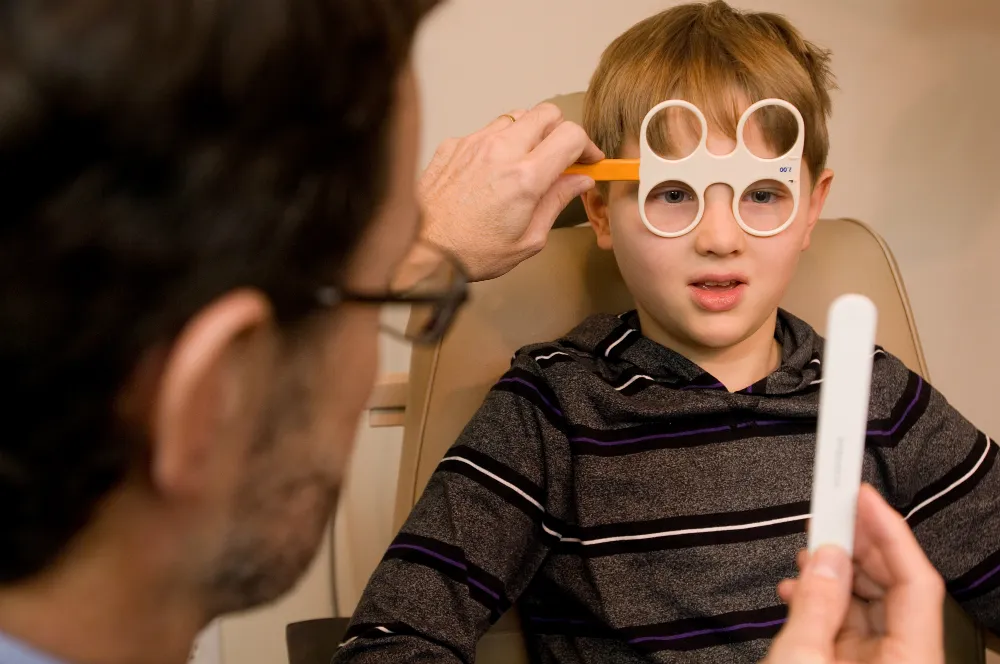
Vision therapy addresses the visual system itself: eye teaming, eye tracking, focusing, binocular coordination, visual comfort and stamina, suppression, amblyopia and strabismus-related visual function. The target is how the eyes and brain work together during reading and other near tasks.
The American Optometric Association defines optometric vision therapy as a sequence of neurosensory and neuromuscular activities. A doctor of optometry prescribes and monitors each program individually. Lenses, prisms, filters, occluders and specialized instruments are an integral part of it (AOA).
That matters because treating vision usually involves diagnostic testing and medical tools — lenses and prisms — that sit inside optometric care rather than general functional support. If you want the plain-English version of what a program involves, start with our guide to what vision therapy is.
Handwriting: where the two overlap most
Handwriting is the best example of why families get confused, because both professions have a legitimate claim on it.
Handwriting problems are among the most common reasons children are referred to occupational therapy in the first place (Hoy et al., 2011). That same systematic review looked at 11 controlled handwriting trials. Interventions without handwriting practice were ineffective, and so were programs with fewer than 20 practice sessions. Effective occupational therapy for handwriting has to include enough real handwriting practice. The skill improves when the skill is practiced, not from sensory work alone.
Visual skills are measurably part of the picture too. Researchers tested 155 children in grades 2 through 4. Visual-motor integration, visual perception and motor coordination scores all differed between the highest- and lowest-achieving quartiles in reading and math. Visual perception and motor coordination stayed significantly related to achievement even after partially controlling for verbal school ability and age (Sortor & Kulp, 2003). Depth perception matters for hand skills too. Pegboard and bead-threading performance tracked with stereoacuity in 143 people aged 10 to 30 (O’Connor et al., 2010).
Now the honest limit. Researchers compared fine-motor, visual-motor and visual-perceptual scores with real handwriting samples from 99 students in grades 3 through 6 who had learning or behavior problems. The correlations were modest: 0.07 to 0.38 for legibility and 0.04 to 0.42 for speed. Together those measures explained no more than 20% of the variation in legibility and 26% of the variation in speed (Klein et al., 2011).
Read that number the right way. It does not mean visual skills are irrelevant. It means messy handwriting has more than one cause, and no single provider should promise to fix it alone. If handwriting or math layout is your main worry, our page on handwriting and math difficulties walks through the visual contributors we test for. Our page on motor and coordination concerns covers the wider picture.
What the vision evidence does and does not support
This is where claims get loose, so we will be specific.
For symptomatic convergence insufficiency in children, the evidence for office-based vergence and accommodative therapy is good. In the 221-child Convergence Insufficiency Treatment Trial, 73% of children were successful or improved after 12 weeks of office-based therapy with home reinforcement. The comparison groups did worse: 35% with office placebo, 43% with pencil push-ups and 33% with home computer therapy (CITT, 2008). A Cochrane network meta-analysis of 12 trials and 1,289 participants confirmed that advantage over placebo in children (risk ratio 3.04, 95% CI 2.32 to 3.98). The same review noted that the adult evidence is less clear (Scheiman et al., 2020).
For reading, the picture is different, and we will not pretend otherwise. In CITT-ART, 310 children with symptomatic convergence insufficiency were randomized to 16 weeks of therapy or placebo therapy. Reading comprehension improved 3.7 points with therapy and 3.8 points with placebo (CITT-ART, 2019). A separate study followed 94 students with specific learning disorders, seen at a learning-disability center in Chennai, India. They were teenagers, mean age 15, and 62.8% had binocular vision anomalies. Of the 46 with a non-strabismic anomaly, 24 were randomized to therapy, and their binocular vision measures improved. Those measures were the outcome, not reading scores (Hussaindeen et al., 2018). That is a referral population at a specialist center, not a general-population rate, and an older group than most of the children we see.
The professional bodies disagree about what to make of that. In 2009 the American Academy of Pediatrics, the American Academy of Ophthalmology, AAPOS and the American Association of Certified Orthoptists issued a joint statement. It says most experts believe dyslexia is a language-based disorder, and that vision problems can interfere with learning but do not cause primary dyslexia or learning disabilities. It also states that scientific evidence does not support eye exercises or behavioral vision therapy for these conditions (AAP et al., 2009). The optometric position comes from two different organizations: the American Academy of Optometry and the American Optometric Association. Their joint statement holds that vision problems can and often do interfere with learning. It describes optometric care as one part of multidisciplinary care, aimed at improving visual function and relieving the signs and symptoms that go with it (American Academy of Optometry & AOA, 1997).
Our clinical perspective sits with the second framing, stated narrowly: we do not treat dyslexia, and vision therapy is not reading instruction. What we treat is an uncomfortable, unreliable visual system that makes near work harder than it should be. That is worth finding and fixing on its own terms, alongside — never instead of — the reading and writing help a child needs. That distinction is the same one we draw in vision therapy vs tutoring.
Primitive reflexes: a shared vocabulary, a thin evidence base
Retained primitive reflexes come up in both occupational therapy and developmental optometry offices, so they deserve a straight answer.
One double-blind randomized trial enrolled 60 children aged 8 to 11 with reading difficulties. A movement program that replicated primary reflex movements significantly reduced persistent asymmetrical tonic neck reflex. The placebo-movement and no-movement groups did not change (McPhillips et al., 2000). A later study of 409 children found more persistent reflex in the weakest readers. Even so, the same author concluded that reflex persistence “cannot be used as a causal model for reading difficulties, including dyslexia” (McPhillips & Sheehy, 2004).
Recent systematic reviews land in the same place. One found studies linking persisting reflexes with poorer balance, dexterity and academics, along with five generally positive intervention studies. It still calls those interventions promising rather than established (Provaznik et al., 2026). Another review covered 27 studies of preschoolers. It found motor impairment associated with language, executive-function and academic difficulties, but only three of those studies included reflex data at all (McWhirter et al., 2024).
So we treat reflex screening as a clinical observation that helps explain a child’s posture and motor patterns — not a diagnosis, and not a promise. It is also a natural place for occupational therapy and vision care to compare notes. Our overview of primitive reflexes goes further.
Signs a developmental vision evaluation is worth adding
Add a developmental vision evaluation to the plan when a child shows things like:
- losing place while reading, or skipping lines
- headaches or eye strain with near work
- blurred or double vision
- difficulty copying from the board
- strong verbal ability but weak performance on visually demanding tasks
- reading avoidance and poor visual stamina
- closing one eye, rubbing eyes or tilting the head during near work
Parents sometimes hope one provider can cover all of it. But the question “what kind of vision problem is actually going on” needs a professional licensed to diagnose visual disorders and build the vision treatment plan.
Scope of practice reflects that. In the AOTA’s own compilation of state law, Michigan addresses this directly. Vision therapy and low vision rehabilitation count as occupational therapy services only under a referral, prescription, supervision or co-management by a physician or optometrist. Michigan also states that the practice of occupational therapy does not include the practice of optometry. Kentucky regulation says an occupational therapist shall not develop a visually related rehabilitation plan. It adds that low-vision and visual-therapy services “shall not include independent diagnostic vision evaluations” (AOTA State Affairs Group, 2021). Those are two states’ rules, not a national standard. Scope of practice is written state by state, so the wording where you live may be different, or may not mention vision at all. The practical question for a family stays the same everywhere: who on the team is licensed to diagnose a visual disorder and write the vision treatment plan?
When co-management makes sense
This is usually the best-case scenario, and it is how we prefer to work.
- Occupational therapy handles sensory integration, vestibular and proprioceptive foundations, motor planning, regulation and functional participation. It also covers the handwriting practice the research says has to happen for handwriting to improve.
- Developmental optometry diagnoses and manages the visual disorder, including lenses, prisms and optometric vision therapy when indicated.
Co-management fits both professions’ guidance better than stretching one provider into another’s specialty. You can see how we structure the vision side on our learning-related vision page.
Questions worth asking each provider
When you talk to an occupational therapist:
- What functional skills are you targeting, and how will we measure them?
- How much actual handwriting practice is in the plan, and over how many sessions?
- Are you seeing sensory, vestibular, proprioceptive or motor-planning issues?
- Do you think a developmental vision evaluation is also needed?
When you talk to a developmental optometrist:
- Is there a diagnosed tracking, focusing or binocular vision problem, and what were the numbers?
- Is my child suppressing or struggling to use both eyes together?
- Would lenses, prisms or vision therapy be part of treatment?
- Would occupational therapy still help on the sensory-motor or functional side?
How the training differs
Occupational therapists are highly trained in their own field, and we refer to them regularly. Developmental optometry is a different training track. Doctors of optometry complete pre-professional undergraduate education plus four years at a college of optometry, leading to the OD degree. They are licensed to prescribe spectacle lenses, contact lenses, medications, low vision rehabilitation and vision therapy (AOA). Dr. Murray is additionally board certified as a Fellow of the College of Optometrists in Vision Development.
Both services are valuable and not interchangeable; the best outcomes usually come when both providers are working from their own evaluation and talking to each other.
If handwriting, copying, reading stamina or coordination is the concern, and no one has ruled out the visual side, a comprehensive developmental vision evaluation is the place to start. Schedule an evaluation at our Boynton Beach or Boca Raton office.
Common Questions About This Topic
Is vision therapy the same as occupational therapy?
No. They can overlap in what a child does better afterward, but they are distinct services with different training and different scopes of practice. Occupational therapy focuses on participation and function. Optometric vision therapy is a sequence of activities prescribed and monitored by a doctor of optometry to treat a diagnosed visual disorder.
Can an occupational therapist diagnose my child's vision problem?
An occupational therapist evaluates function and participation; diagnosing a binocular, accommodative or oculomotor disorder is an optometric or ophthalmological examination. State law varies on what vision-related services an OT may provide and under whose referral.
Can an occupational therapist help a child who also has a vision problem?
Absolutely, and many do. Occupational therapy can be very valuable for sensory processing, regulation, posture, motor planning, handwriting practice and classroom participation while a developmental optometrist diagnoses and manages the visual side.
Why would a child need both?
Because a child can have a true visual disorder and sensory-motor or functional challenges at the same time. Handwriting is the clearest example. The research shows visual-motor and visual-perceptual scores explain only a minority of the variation in legibility, so neither profession has the whole answer alone.
Will vision therapy fix my child's handwriting or reading?
We would not promise that. Vision therapy has good evidence for treating symptomatic convergence insufficiency in children. But the largest trial of vision therapy and reading found no benefit over placebo therapy for reading comprehension. We treat the visual problem we find and measure; handwriting practice and reading instruction belong to occupational therapy and to teaching.
Where This Information Comes From
- American Occupational Therapy Association (2017). What Is the Role of the School-Based Occupational Therapy Practitioner? Questions & Answers for School Administrators. Bethesda, MD: AOTA. : AOTA states that in schools, occupational therapy practitioners focus on academics, play and leisure, social participation, self-care skills and transition/work skills, and that OT addresses the physical, cognitive, psychosocial and sensory components of performance.
- American Occupational Therapy Association, State Affairs Group (2021). Occupational Therapy Profession - Scope of Practice Definitions. Bethesda, MD: AOTA. : Michigan law lists vision therapy and low vision rehabilitation as OT services only when provided under referral, prescription, supervision or co-management by a physician or optometrist, and states OT does not include the practice of optometry; Kentucky regulation says an OT shall not develop a visually related rehabilitation plan and that these services shall not include independent diagnostic vision evaluations.
- American Optometric Association. Vision Therapy (practice specialty page). : Defines optometric vision therapy as a sequence of neurosensory and neuromuscular activities individually prescribed and monitored by the doctor of optometry, with lenses, prisms, filters, occluders and instruments as an integral part.
- American Optometric Association. What's a doctor of optometry? : Doctors of optometry complete pre-professional undergraduate education plus four years at a college of optometry, and prescribe spectacle lenses, contact lenses, medications, low vision rehabilitation and vision therapy.
- Hoy MM, Egan MY, Feder KP (2011). A systematic review of interventions to improve handwriting. Canadian Journal of Occupational Therapy; 78(1):13-25. : Across 11 controlled trials, interventions that did not include handwriting practice and those with fewer than 20 practice sessions were ineffective; effective OT for handwriting must include adequate handwriting practice.
- Klein S, Guiltner V, Sollereder P, Cui Y (2011). Relationships between fine-motor, visual-motor, and visual perception scores and handwriting legibility and speed. Physical & Occupational Therapy in Pediatrics; 31(1):103-114. : In 99 students in grades 3-6 with learning and/or behavior problems, sensorimotor scores correlated 0.07-0.38 with legibility and 0.04-0.42 with speed, explaining no more than 20% of the variance in legibility and 26% in speed.
- Sortor JM, Kulp MT (2003). Are the results of the Beery-Buktenica Developmental Test of Visual-Motor Integration and its subtests related to achievement test scores? Optometry and Vision Science; 80(11):758-763. : In 155 children in grades 2-4, visual-motor integration, visual perception and motor coordination scores differed between the top and bottom achievement quartiles; after partially controlling for verbal school ability and age the VMI composite stayed significant for math (p=0.001) and was only a trend for reading (p=0.050), while the Visual Perception and Motor Coordination subtests stayed significant for both.
- O'Connor AR, Birch EE, Anderson S, Draper H; FSOS Research Group (2010). The functional significance of stereopsis. Investigative Ophthalmology & Visual Science; 51(4):2019-2023. : In 143 participants aged 10-30, pegboard and bead-threading performance was related to stereoacuity, with normal stereoacuity performing best on all tasks.
- Scheiman M, Kulp MT, Cotter SA, Lawrenson JG, Wang L, Li T (2020). Interventions for convergence insufficiency: a network meta-analysis. Cochrane Database of Systematic Reviews; 12:CD006768. : Across 12 trials and 1,289 participants, office-based vergence/accommodative therapy with home reinforcement beat placebo in children (RR 3.04, 95% CI 2.32-3.98); the adult evidence is less clear.
- Convergence Insufficiency Treatment Trial Study Group (2008). Randomized clinical trial of treatments for symptomatic convergence insufficiency in children. Archives of Ophthalmology; 126(10):1336-1349. : In 221 children aged 9-17, 73% were successful or improved after 12 weeks of office-based therapy versus 35% with office placebo, 43% with pencil push-ups and 33% with home computer therapy.
- CITT-ART Investigator Group (2019). Effect of Vergence/Accommodative Therapy on Reading in Children with Convergence Insufficiency: A Randomized Clinical Trial. Optometry and Vision Science; 96(11):836-849. : In 310 children, reading comprehension improved 3.7 points with 16 weeks of office-based therapy versus 3.8 points with placebo therapy - no reading benefit over placebo.
- Hussaindeen JR, Shah P, Ramani KK, Ramanujan L (2018). Efficacy of vision therapy in children with learning disability and associated binocular vision anomalies. Journal of Optometry; 11(1):40-48. : Among 94 students (mean age 15) attending a learning-disability center in Chennai, India, 62.8% had binocular vision anomalies; of the 46 with a non-strabismic anomaly, 24 were randomized to therapy, which improved binocular vision measures - the study's outcomes, not reading or academic scores.
- McPhillips M, Hepper PG, Mulhern G (2000). Effects of replicating primary-reflex movements on specific reading difficulties in children: a randomised, double-blind, controlled trial. Lancet; 355(9203):537-541. : In 60 children aged 8-11 with reading difficulties, a reflex-replication movement program significantly reduced persistent asymmetrical tonic neck reflex while placebo-movement and no-movement groups did not change.
- McPhillips M, Sheehy N (2004). Prevalence of persistent primary reflexes and motor problems in children with reading difficulties. Dyslexia; 10(4):316-338. : Among 409 children aged 9-10, the lowest-reading 10% had more persistent ATNR, but the authors conclude reflex persistence cannot be used as a causal model for reading difficulties including dyslexia.
- Provaznik A, Musalek M, Bob P, et al. (2026). Persisting primitive reflexes and motor and cognitive development in children: A systematic review. Acta Psychologica; 266:106915. : Six studies linked persisting reflexes with poorer locomotion, balance and manual dexterity and six with poorer academics; of five intervention studies, most showed improved developmental outcomes, but the review calls the interventions promising rather than proven and the evidence limited and heterogeneous.
- McWhirter K, Steel A, Adams J (2024). The association between learning disorders, motor function, and primitive reflexes in pre-school children: A systematic review. Journal of Child Health Care; 28(2):402-428. : Across 27 studies, preschool motor impairment was associated with speech/language, executive-function and academic difficulties, but only three studies included reflex data (ATNR linked to fine motor skills and school readiness).
- American Academy of Pediatrics Section on Ophthalmology, Council on Children with Disabilities; American Academy of Ophthalmology; AAPOS; AACO (2009). Joint statement - Learning disabilities, dyslexia, and vision. Pediatrics; 124(2):837-844. : States that most experts believe dyslexia is a language-based disorder, that vision problems can interfere with learning but are not the cause of primary dyslexia or learning disabilities, and that scientific evidence does not support eye exercises or behavioral vision therapy for these conditions.
- American Academy of Optometry; American Optometric Association (1997). Vision, learning and dyslexia: a joint organizational policy statement. Journal of the American Optometric Association; 68(5):284-286. : The optometric position: vision problems can and often do interfere with learning, the goal of optometric intervention is to improve visual function and relieve associated signs and symptoms, and optometric care is one part of a multidisciplinary approach.
Care We Provide
More From the Blog
Wondering If This Sounds Like Your Family?
A developmental vision evaluation measures the skills a routine eye exam does not. Our team sees children and adults in Coconut Creek, Boynton Beach, Boca Raton and West Palm Beach.