Amblyopia Treatment Options: What PEDIG Trials Show
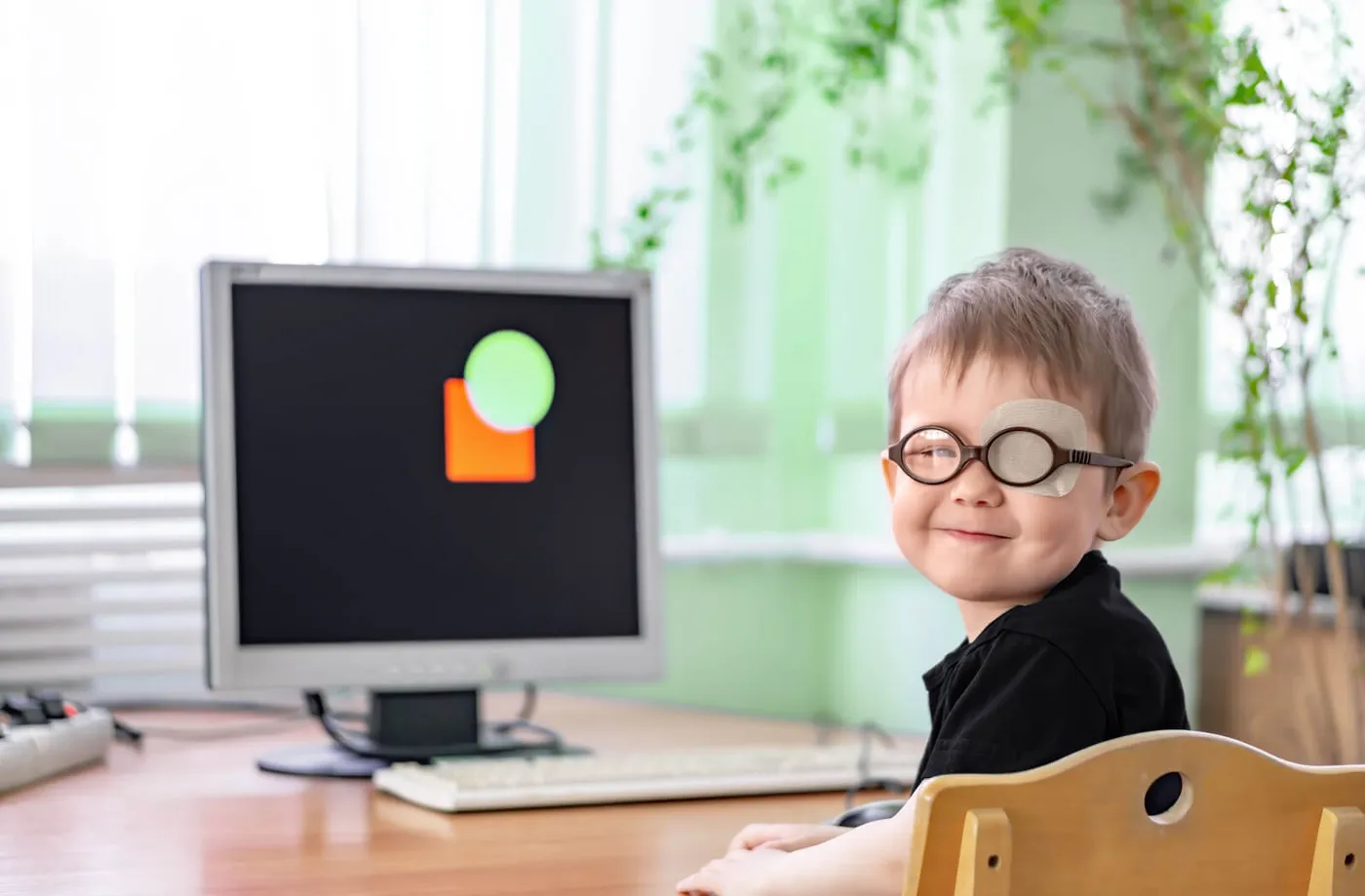
Amblyopia - most families know it as lazy eye - is one of the few childhood vision conditions with a genuinely large body of randomized-trial evidence behind it. Much of that evidence comes from the Pediatric Eye Disease Investigator Group, or PEDIG, a network of clinical sites that has been running amblyopia trials since the late 1990s.
That evidence answers the questions parents actually ask: Do we have to patch all day? Are drops as good as a patch? Is my nine-year-old too late? Do the game apps and headsets work? Here is what the trials show, what they do not show, and where in-office therapy honestly fits.
Key takeaways
- Amblyopia affects roughly 1.4% of people worldwide and about 2.4% in North America (Fu et al., 2020).
- Glasses alone do a lot: 77% of children with untreated anisometropic amblyopia gained 2 or more lines on optical correction alone, and 27% resolved completely (Cotter et al., 2006).
- For moderate amblyopia, 2 hours of daily patching worked as well as 6 (Repka et al., 2003). For severe amblyopia, 6 hours worked as well as full time (Holmes et al., 2003).
- Atropine drops performed close to patching (2.84 versus 3.16 lines) and are a legitimate alternative (PEDIG, 2002).
- Earlier is better, but older is not hopeless: 53% of 7 to 12-year-olds responded to patching with near activities plus daily atropine, versus 25% on glasses alone (Scheiman et al., 2005).
- Binocular games and headsets are promising but not yet a replacement for standard treatment (AAO, Pineles et al., 2020).
What amblyopia is, and how common it is
Amblyopia is reduced vision in an eye that is structurally healthy. In early childhood the visual brain learns to process input from each eye. If one eye delivers a blurrier or misaligned image - because of a large difference in prescription between the eyes, a big uncorrected prescription in both, an eye turn, or an obstruction such as a cataract or droopy lid - the brain favors the clearer eye and the other never develops normal acuity.
Pooling 60 studies and more than 1.8 million people, one meta-analysis put global amblyopia prevalence at 1.44%, higher in North America (2.41%) and Europe (2.90%) (Fu et al., 2020). In US preschoolers aged 30 to 72 months, the Multi-ethnic Pediatric Eye Disease Study found amblyopia in 1.5% to 2.6% of children and reported that 78% of cases were attributable to refractive error (MEPEDS, 2008). That last number matters more than it looks: most amblyopia starts with a prescription nobody knew about.
Acuity is not the only thing affected. Depth perception is usually the bigger everyday casualty - impaired stereopsis is the most common deficit in amblyopia under normal two-eyed viewing, and it can affect motor coordination, sport and mobility (Levi et al., 2015). We go into what that looks like day to day on our lazy eye page.
Step one is almost always glasses
The most under-appreciated finding in the whole PEDIG program is how much amblyopia improves on glasses alone. In a study of 84 children aged 3 to under 7 with untreated anisometropic amblyopia, optical correction by itself improved acuity by 2 or more lines in 77% of children and resolved the amblyopia entirely in 27%. Improvement kept accumulating for up to 30 weeks (Cotter et al., 2006).
The American Academy of Ophthalmology’s Amblyopia Preferred Practice Pattern states it plainly: “Treatment of refractive error alone is the initial step in care of children 0 through 17 years of age with amblyopia” (AAO PPP, 2023). So if your child has just been prescribed glasses for amblyopia, give them a real trial period before assuming a patch is coming. Several months of consistent wear may be the whole treatment.
Patching: how many hours actually helps
Patching covers the stronger eye so the amblyopic eye is forced to work. For decades the instinct was more hours, all day, no exceptions. PEDIG tested that instinct.
Moderate amblyopia: two hours is usually enough
In 189 children under 7 with moderate amblyopia (20/40 to 20/80), 2 hours and 6 hours of daily patching produced exactly the same mean improvement - 2.40 lines at 4 months - with a 62% success rate in each group (Repka et al., 2003). Each group also did an hour of near activities while patched.
Severe amblyopia: six hours, not the whole day
In 175 children under 7 with severe amblyopia (20/100 to 20/400), 6 hours of prescribed daily patching improved acuity 4.8 lines, versus 4.7 lines with full-time patching (Holmes et al., 2003).
The AAO PPP reflects both results: 2 hours “produces an improvement in VA that is similar in magnitude to the improvement produced by 6 hours” for moderate amblyopia, while “for amblyopia worse than 20/80, 6 or more hours of patching is often prescribed” (AAO PPP, 2023).
This is one of the kindest findings in pediatric eye care. A dose a family can actually complete beats a heroic dose they abandon. We wrote more about how patching is used alongside active therapy in The Role of Eye Patches in Vision Therapy.
Atropine drops: a real alternative
Atropine penalization uses a daily drop to blur the stronger eye’s near vision, shifting work to the amblyopic eye without a patch on the face. In 419 children under 7 with moderate amblyopia, acuity improved 3.16 lines with patching and 2.84 lines with atropine at 6 months, with success rates of 79% and 74% (PEDIG, 2002). Parents in that trial found atropine somewhat easier to accept.
Followed to age 15, 147 of those participants had a mean amblyopic-eye acuity of about 20/25, with 59.9% seeing 20/25 or better - and outcomes did not differ by which treatment they were originally assigned. The same follow-up is honest about the ceiling: 48.3% still had a difference of 2 lines or more between their eyes (Repka et al., 2014). Treatment usually improves amblyopia substantially. It does not always erase it.
Does age close the door?
Earlier is better, and the trials say so clearly. A meta-analysis of individual data from four PEDIG trials found children aged 7 to under 13 were significantly less responsive than children aged 3 to 7, with no meaningful difference between 3 to 5 and 5 to 7 year-olds for moderate amblyopia (Holmes et al., 2011).
But “less responsive” is not “unresponsive.” In a trial of 507 patients aged 7 to 17, 53% of the 7 to 12-year-olds responded to the treatment arm - 2 to 6 hours a day of patching combined with near visual activities, plus daily atropine at that age - compared with 25% on optical correction alone. Among 13 to 17-year-olds the overall difference was small - but in teenagers who had never been treated before, 47% responded versus 20% (Scheiman et al., 2005). The AAO PPP agrees that “patching should be considered for older children and teenagers, particularly if they have not previously been treated” (AAO PPP, 2023).
If you have been told your child aged out of treatment, that is worth a second opinion. Adults carrying a long-standing eye turn or double vision have a separate set of options, which we cover in Adult Strabismus and Double Vision.
Binocular and dichoptic games: promising, not proven
Dichoptic treatment shows each eye a different part of an image or game, so the two eyes must cooperate to see the whole picture. It is the most interesting new direction in amblyopia care - and the evidence is genuinely mixed, so we will not simplify it.
- PEDIG iPad game, ages 5 to 12. In 385 children, the binocular game improved acuity 1.05 lines versus 1.35 lines with 2 hours of daily patching. Of the 176 children in the game group whose usage logs were available, only 22.2% completed more than 75% of the prescribed play (Holmes et al., 2016).
- PEDIG iPad game, teens. In 100 teenagers, the game gained 3.5 letters versus 6.5 with patching, and only 13% completed more than 75% of treatment (Manh et al., 2018).
- BRAVO, ages 7 and up. Against a placebo game, the active binocular game showed no benefit (0.06 versus 0.07 logMAR) (Gao et al., 2018).
- Dichoptic digital therapeutic, ages 4 to 7. A pivotal trial of 105 children found 1.8 lines of improvement with the therapeutic plus glasses versus 0.8 lines with glasses alone at 12 weeks (Xiao et al., 2022). The comparator was glasses, not patching - so it does not show superiority to a patch.
- Pooled evidence. A 2026 systematic review of 12 randomized trials and 1,034 children found no significant difference between dichoptic therapy and patching for visual acuity (mean difference -0.01, 95% CI -0.05 to 0.03), stereoacuity, compliance or adverse events (Halabi & Aldhahwani, 2026).
Reviewing 20 studies in a literature search that closed in April 2019 - so before the two most recent entries above - the American Academy of Ophthalmology concluded there was no level I evidence supporting binocular treatment as a substitute for patching or optical treatment (Pineles et al., 2020), and the 2023 Preferred Practice Pattern still says “the evidence remains limited to recommend binocular therapy for treatment” (AAO PPP, 2023).
Adherence was poor in both PEDIG game trials, and the investigators were explicit that they could not tell whether the weak response reflected too little use or too little effect. Engagement is probably not the whole story, though: in the placebo-controlled BRAVO trial, 64% of the active group and 83% of the placebo group completed more than a quarter of the prescribed play, and the active game still did no better than placebo.
If you are curious how these tools are being used in clinics, we cover that in Virtual Reality and Vision Therapy.
Where in-office vision therapy fits - and the AAO caveat
We should be straightforward here, because it is our own field. The AAO Preferred Practice Pattern reviews vision exercises for amblyopia and states there is “no convincing evidence for treatment success with these activities for amblyopia” (AAO PPP, 2023). Anyone who tells you office-based therapy is the proven way to raise amblyopic acuity is going beyond the evidence.
Our clinical perspective at Vision & Learning Center: we do not offer vision therapy as a substitute for glasses, patching or atropine. We use it for the problems that sit alongside amblyopia and are not addressed by acuity treatment - eye teaming and depth perception once the two eyes can meaningfully work together, eye-movement control for reading, focusing stamina, and the visual-motor skills that lag when a child has spent years functioning on one eye. We also use active near tasks during patching, because that is how PEDIG’s patching arms were actually run. When amblyopia comes with a constant eye turn, we co-manage with pediatric ophthalmology rather than work around it. You can read what that looks like from a therapist’s chair in Amblyopia in the Eyes of the Therapist, and more about our approach on our amblyopia and strabismus page.
The part treatment plans often miss: how it feels
A patch is worn on a child’s face, at school, in front of everyone. A 2025 systematic review of 25 studies published between 1999 and 2021 found that both children and their guardians can experience distress from amblyopia treatment, and that occlusive patching - and patching during the school years in particular - raises the likelihood of distress most. The authors suggested earlier diagnosis and considering atropine as a first-line option to protect wellbeing while still treating effectively (Haine et al., 2025).
This is not a reason to skip treatment. It is a reason to choose the dose and the method with the child in the room, to patch after school rather than during it where the clinical picture allows, and to take teasing seriously when a parent reports it. We wrote about that side of care in The Social Implications of Eye Turns and Patching.
Catching it early is still the biggest lever
Amblyopia rarely announces itself - a child with one good eye reports nothing wrong - so detection is the real bottleneck. The US Preventive Services Task Force recommends vision screening at least once between ages 3 and 5 to detect amblyopia or its risk factors (USPSTF, 2017). The American Optometric Association’s pediatric guideline goes further, recommending a comprehensive eye examination at 6 to 12 months, at least once between 3 and 5 years, and before first grade and annually after that (AOA, 2017). A screening is a filter; an examination measures refraction, alignment, eye teaming and depth perception directly.
If your child has an eye that turns, squints or closes in bright light, has failed a screening, or has a family history of amblyopia or strabismus - and especially if you have been told to simply wait and see - we would rather measure it. Schedule an evaluation at our Boynton Beach or Boca Raton office, or read more about what a comprehensive developmental vision evaluation includes.
Common Questions About This Topic
How many hours a day does my child really need to patch?
For moderate amblyopia (roughly 20/40 to 20/80), a PEDIG randomized trial of 189 children under 7 found that 2 hours of daily patching produced the same 2.40 lines of improvement as 6 hours, with 62% success in each group. For severe amblyopia (20/100 to 20/400), a companion trial of 175 children found 6 hours of daily patching worked as well as full-time patching (4.8 versus 4.7 lines). More hours are not automatically better, and the AAO Preferred Practice Pattern reflects the same dosing.
Are atropine drops as good as a patch?
For moderate amblyopia in children under 7, essentially yes. In a 419-child PEDIG trial, acuity improved 3.16 lines with patching and 2.84 lines with daily atropine in the stronger eye at 6 months, with success rates of 79% and 74%. At age 15, outcomes did not differ by which treatment the child originally received. The AAO Preferred Practice Pattern states that atropine appears to be as effective as occlusion.
Is my child too old to treat amblyopia?
Younger is better, but older is not hopeless. A PEDIG analysis of four trials found children aged 7 to under 13 responded significantly less well than children aged 3 to 7. Even so, in a trial of 507 patients aged 7 to 17, 53% of the 7 to 12-year-olds responded to the treatment arm - 2 to 6 hours a day of patching with near activities, plus daily atropine at that age - versus 25% on glasses alone, and among 13 to 17-year-olds who had never been treated before, 47% responded versus 20%. It is worth an evaluation at any age.
Do the vision games and headsets work as well as patching?
The evidence is genuinely mixed. Two large PEDIG trials found a binocular iPad game underperformed part-time patching, with poor adherence. A placebo-controlled trial found no benefit over a placebo game. A pivotal trial of a dichoptic digital therapeutic did show 1.8 lines of gain versus 0.8 lines with glasses alone, but that trial had no patching arm. A 2026 meta-analysis of 12 trials and 1,034 children found no significant difference between dichoptic therapy and patching. The AAO's position is that binocular treatment is not yet a replacement for standard treatment.
Will glasses alone fix it, or will we definitely need to patch?
Glasses alone do a great deal of the work. In a PEDIG study of 84 children aged 3 to under 7 with untreated anisometropic amblyopia, acuity improved by 2 lines or more in 77% of children on optical correction alone and the amblyopia resolved in 27%. Improvement kept accruing for up to 30 weeks. That is why the AAO Preferred Practice Pattern calls treatment of refractive error the initial step in care.
Where This Information Comes From
- Fu Z, Hong H, Su Z, Lou B, Pan CW, Liu H (2020). Global prevalence of amblyopia and disease burden projections through 2040: a systematic review and meta-analysis. British Journal of Ophthalmology. : Pooling 60 studies and 1,859,327 people, global amblyopia prevalence was 1.44%, with 2.41% in North America and 2.90% in Europe.
- Multi-ethnic Pediatric Eye Disease Study Group (2008). Prevalence of amblyopia and strabismus in African American and Hispanic children ages 6 to 72 months. Ophthalmology. : Among 3,007 African American and 3,007 Hispanic/Latino children aged 6-72 months, strabismus was found in 2.4-2.5%; amblyopia, assessed only in the 30-72-month subset, in 1.5-2.6%, with 78% of cases attributable to refractive error.
- Cotter SA; Pediatric Eye Disease Investigator Group (2006). Treatment of anisometropic amblyopia in children with refractive correction. Ophthalmology; 113(6):895-903. : In 84 children aged 3 to under 7 with untreated anisometropic amblyopia, glasses alone improved acuity by 2 or more lines in 77% and resolved the amblyopia in 27%, with improvement continuing up to 30 weeks.
- Repka MX, Beck RW, Holmes JM, et al.; Pediatric Eye Disease Investigator Group (2003). A randomized trial of patching regimens for treatment of moderate amblyopia in children. Archives of Ophthalmology. : In 189 children under 7 with moderate amblyopia, 2 hours and 6 hours of daily patching produced the same 2.40 lines of improvement at 4 months (62% success in each group).
- Holmes JM, Kraker RT, Beck RW, et al.; Pediatric Eye Disease Investigator Group (2003). A randomized trial of prescribed patching regimens for treatment of severe amblyopia in children. Ophthalmology. : In 175 children under 7 with severe amblyopia, 6 hours of daily patching improved acuity 4.8 lines versus 4.7 lines with full-time patching.
- Pediatric Eye Disease Investigator Group (2002). A randomized trial of atropine vs. patching for treatment of moderate amblyopia in children. Archives of Ophthalmology. : In 419 children under 7, acuity improved 3.16 lines with patching and 2.84 lines with atropine at 6 months (79% versus 74% success); both were judged appropriate first-line treatments.
- Repka MX, Kraker RT, Holmes JM, et al.; Pediatric Eye Disease Investigator Group (2014). Atropine vs patching for treatment of moderate amblyopia: follow-up at 15 years of age. JAMA Ophthalmology. : At age 15, mean amblyopic-eye acuity was about 20/25; 59.9% saw 20/25 or better, but 48.3% still had a 2-line or greater difference between the eyes, with no difference by original treatment.
- Holmes JM, Lazar EL, Melia BM, et al.; Pediatric Eye Disease Investigator Group (2011). Effect of age on response to amblyopia treatment in children. Archives of Ophthalmology. : Individual-data meta-analysis of 4 PEDIG trials: children aged 7 to under 13 were significantly less responsive than children aged 3 to 7, though some older children still responded markedly.
- Scheiman MM, Hertle RW, Beck RW, et al.; Pediatric Eye Disease Investigator Group (2005). Randomized trial of treatment of amblyopia in children aged 7 to 17 years. Archives of Ophthalmology. : In 507 patients aged 7-17, the treatment arm was 2-6 hours daily patching with near activities for all, plus atropine for ages 7-12; 53% of 7-12-year-olds responded versus 25% on optical correction alone, and among never-treated 13-17-year-olds, 47% versus 20%. Most were left with a residual acuity deficit.
- Holmes JM, Manh VM, Lazar EL, et al.; Pediatric Eye Disease Investigator Group (2016). Effect of a Binocular iPad Game vs Part-time Patching in Children Aged 5 to 12 Years With Amblyopia. JAMA Ophthalmology. : In 385 children, the binocular iPad game improved acuity 1.05 lines versus 1.35 lines with 2 hours of daily patching; of the 176 game-group participants with usage log data, only 22.2% completed more than 75% of prescribed play.
- Manh VM, Holmes JM, Lazar EL, et al.; Pediatric Eye Disease Investigator Group (2018). A Randomized Trial of a Binocular iPad Game Versus Part-Time Patching in Children Aged 13 to 16 Years With Amblyopia. American Journal of Ophthalmology. : In 100 teenagers, the game improved acuity 3.5 letters versus 6.5 letters with patching; only 13% of the game group completed more than 75% of prescribed treatment.
- Gao TY, Guo CX, Babu RJ, et al.; BRAVO Study Team (2018). Effectiveness of a Binocular Video Game vs Placebo Video Game for Improving Visual Functions in Older Children, Teenagers, and Adults With Amblyopia. JAMA Ophthalmology. : In 115 participants aged 7 and older, the active binocular game improved acuity 0.06 logMAR versus 0.07 logMAR for the placebo game - no benefit over placebo, although 64% of the active group and 83% of the placebo group completed more than a quarter of the prescribed play.
- Xiao S, Angjeli E, Wu HC, et al.; Luminopia Pivotal Trial Group (2022). Randomized Controlled Trial of a Dichoptic Digital Therapeutic for Amblyopia. Ophthalmology. : In 105 children aged 4-7, a dichoptic digital therapeutic plus glasses improved acuity 1.8 lines versus 0.8 lines with glasses alone at 12 weeks; the comparator was glasses, not patching.
- Halabi MH, Aldhahwani B (2026). The efficacy and safety of dichoptic therapy in comparison to patching in children with amblyopia: A systematic review and meta-analysis. Acta Ophthalmologica; 104(2):e139-e151. : Pooling 12 randomized trials and 1,034 children, dichoptic therapy and patching showed no significant difference in visual acuity (MD -0.01, 95% CI -0.05 to 0.03), stereoacuity, compliance or adverse events.
- Pineles SL, Aakalu VK, Hutchinson AK, et al. (2020). Binocular Treatment of Amblyopia: A Report by the American Academy of Ophthalmology. Ophthalmology. : Reviewing 20 studies from a literature search conducted January 2018 and updated April 2019, the AAO found no level I evidence supporting binocular treatment as a substitute for patching or optical treatment and did not recommend it as a replacement for standard therapy.
- Cruz OA, Repka MX, Hercinovic A, et al.; AAO Preferred Practice Pattern Pediatric Ophthalmology/Strabismus Panel (2023). Amblyopia Preferred Practice Pattern. Ophthalmology; 130(3):P136-P178. : States that treatment of refractive error alone is the initial step in care for ages 0-17; that 2 hours of patching gives improvement similar to 6 hours for moderate amblyopia; that atropine appears as effective as occlusion; that patching should be considered for older children and teens; and that there is no convincing evidence of treatment success for vision exercises in amblyopia, with evidence still limited for binocular therapy.
- Haine L, Taylor I, Vaughan M (2025). The Psychological Impact of Amblyopia Treatment: A Systematic Literature Review. British & Irish Orthoptic Journal; 21(1):1-14. : Across 25 studies from 1999-2021, both children and guardians can experience distress from amblyopia treatment; occlusive patching and patching during school age most increase the likelihood of distress. The authors' suggestion of earlier identification and of offering atropine as a first-line option appears in the full text (PMC11740718), not the abstract.
- Levi DM, Knill DC, Bavelier D (2015). Stereopsis and amblyopia: A mini-review. Vision Research. : Impaired stereoscopic depth perception is the most common deficit in amblyopia under ordinary binocular viewing and can affect motor coordination, sport and mobility.
- US Preventive Services Task Force; Grossman DC, Curry SJ, Owens DK, et al. (2017). Vision Screening in Children Aged 6 Months to 5 Years: USPSTF Recommendation Statement. JAMA. : Recommends vision screening at least once at ages 3 to 5 to detect amblyopia or its risk factors; evidence is insufficient for screening under age 3.
- American Optometric Association (2017). Evidence-Based Clinical Practice Guideline: Comprehensive Pediatric Eye and Vision Examination. : Recommends a comprehensive eye examination at 6-12 months, at least once between 3 and 5 years, and before first grade and annually thereafter for low-risk children.
Care We Provide
More From the Blog
Wondering If This Sounds Like Your Family?
A developmental vision evaluation measures the skills a routine eye exam does not. Our team sees children and adults in Coconut Creek, Boynton Beach, Boca Raton and West Palm Beach.