Visual Skills for Soccer: Scanning, Saves and Headers
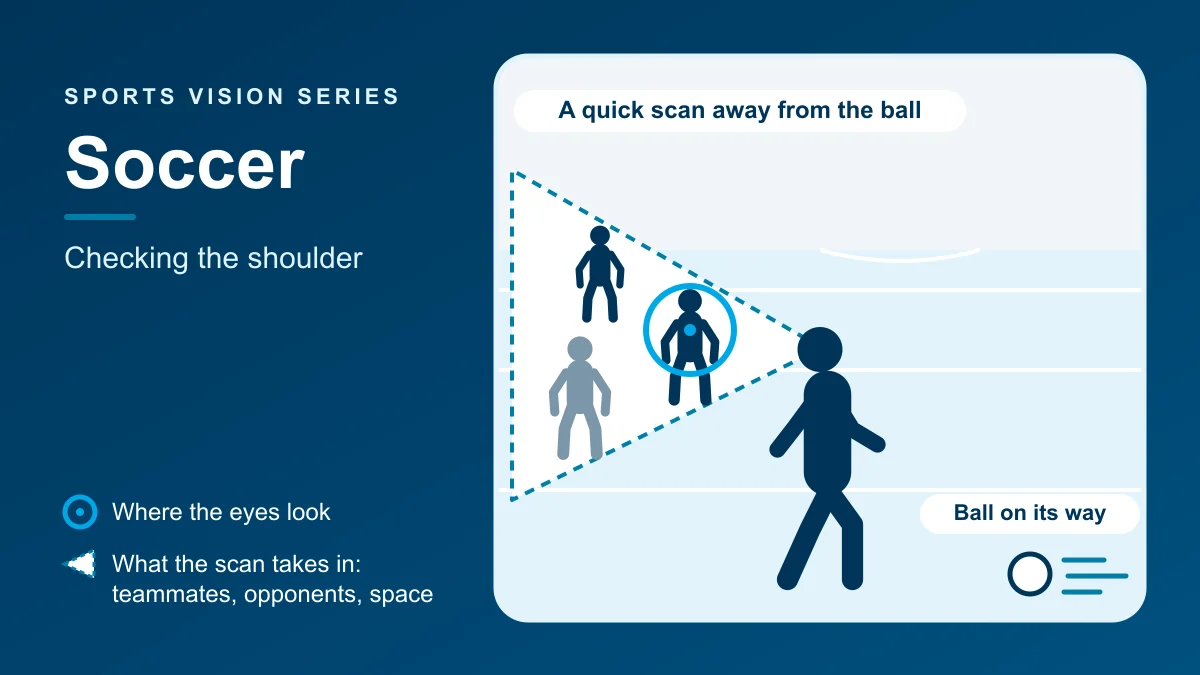
Watch a good midfielder in the seconds before a pass arrives. Their head swivels, once, twice, away from the ball and back. That glance is one of the most studied visual skills for soccer, and it is only one of several. A goalkeeper facing a penalty is reading a body, not a ball. A defender judging a long clearance is estimating depth and timing. And every header sends a jolt through the head that the visual system can register.
This post is built around the questions soccer parents and players actually ask: what scanning is and whether it matters, how goalkeepers read shots, what heading does to the eyes, which vision problems show up on the field, and what vision therapy and training can and can’t do.
Key takeaways
- In a season-long study of Premier League players, more scanning before receiving the ball went with a higher chance of completing the next pass, a small but positive effect (Jordet et al., 2020).
- Expert goalkeepers read the kicker’s legs and the ball, wait longer and make fewer corrections than novices (Savelsbergh et al., 2002).
- Ten headers in a session produced short-term changes in eye-movement and eye-teaming measures in two small studies (Kawata et al., 2016; Nowak et al., 2020).
- Vision therapy for a diagnosed eye-teaming problem such as convergence insufficiency has high-certainty evidence in children: office-based therapy with home reinforcement clearly outperformed placebo across 12 trials (Scheiman et al., 2020).
- Quiet eye training improved performance with a moderate-to-large effect across nine training studies (Lebeau et al., 2016), and made penalty kicks more accurate in practice in a small soccer study (Wood & Wilson, 2011).
What visual skills does soccer demand?
Soccer asks for a wide spread of visual skills because the ball, 21 other players and the space between them are all moving at once.
- Peripheral awareness and scanning: knowing where teammates, opponents and space are without looking straight at them.
- Eye tracking: following a ball in the air or along the ground, and switching quickly between targets.
- Depth perception and timing: judging when a long ball, cross or clearance will arrive.
- Anticipation: reading an opponent’s body to predict a pass or shot before it happens.
- Eye-foot coordination: turning what the eyes see into an accurate touch.
- Comfortable eye teaming and focusing: the foundation under all of it, including away from the field in the classroom.
Why do coaches keep telling players to “check your shoulder”?
Because it seems to help, modestly. Scanning is an active head movement away from the ball to gather information before receiving it. Researchers filmed 27 Premier League players over 21 matches and 9,574 possessions. Central midfielders and central defenders scanned most, and forwards least. Players scanned less under tight pressure. After accounting for individual players and pass difficulty, the more a player scanned, the higher the chance of completing the pass. The authors call the effect small but positive (Jordet et al., 2020).
Two details are worth knowing:
- A scan is a quick sweep, not a long look. When four elite midfielders wore eye trackers in full 11 v 11 play, only 2.3% of their scans contained a fixation, and the point where the scan stopped carried the most information (Aksum et al., 2021). The information is gathered fast, mostly outside central vision.
- Scanning is not the whole story. Comparing award-winning Champions League players with elite teammates in the same matches and positions, researchers found no difference in scanning frequency (Caso et al., 2025). At the very top, everyone scans; something else separates the best.
For young players, scanning is a coachable habit. It also depends on peripheral vision and eye movements working well, which is where an eye exam comes in.
How do goalkeepers read a shot?
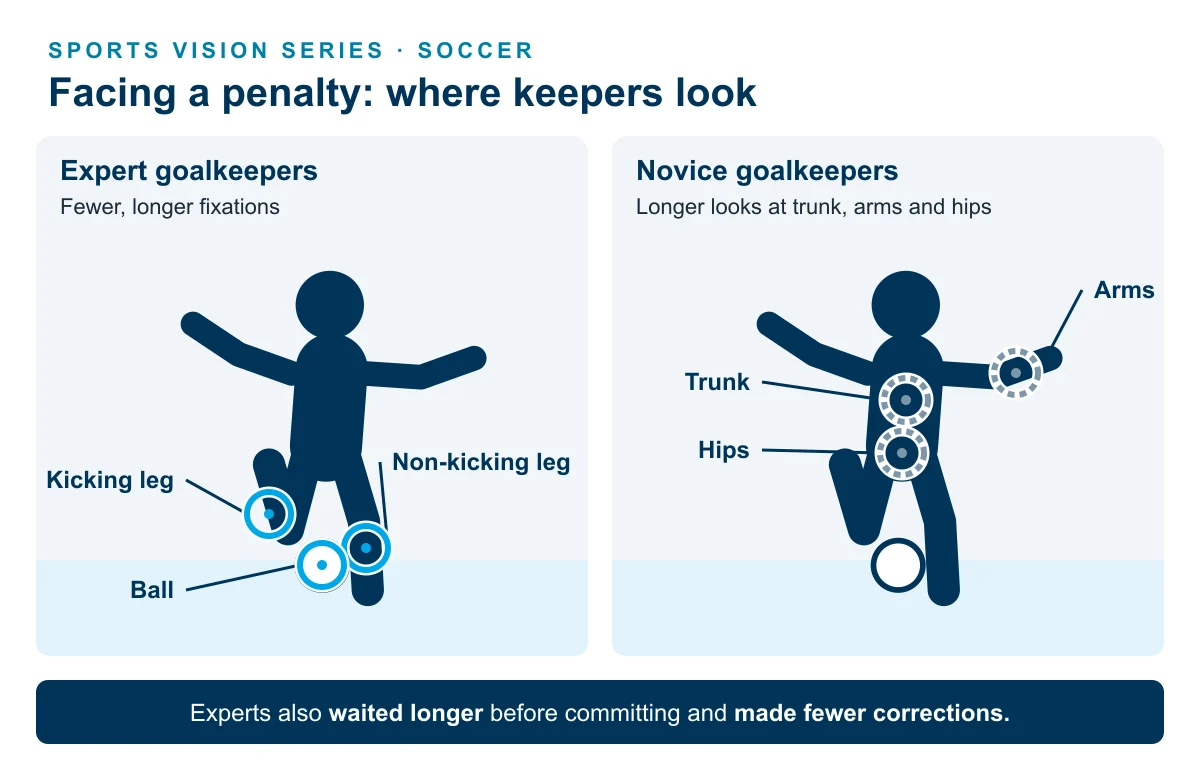
By watching the kicker’s lower body, and by waiting. In a classic study, expert and novice goalkeepers responded to filmed penalty kicks with a joystick while their eye movements were recorded. The experts predicted the direction of the kick more accurately, waited longer before committing and made fewer corrections. They used fewer fixations of longer duration and looked at the kicking leg, the non-kicking leg and the ball, while novices spent longer on the trunk, arms and hips (Savelsbergh et al., 2002). Among expert keepers, the most successful appeared to spend longer looking at the non-kicking leg (Savelsbergh et al., 2005).
Can anticipation be trained? A 2025 pair of scoping reviews found 13 training studies in goalkeeping suggesting that it might be, but noted that most research is in adult men, in lab-based penalty situations that do not closely match real play (Huesmann et al., 2025).
Skills in play for keepers: anticipation, visual search, depth perception for crosses and high balls, and fast reaction to deflections. A keeper with reduced depth perception from amblyopia may find high balls especially hard to judge; reduced stereopsis is the most common deficit in amblyopia and has been linked to difficulty with sports in children (Levi et al., 2015).
Does “quiet eye” help penalty takers?
The quiet eye is the final steady fixation on a target just before a movement begins. Across sports, experts tend to have longer quiet eye periods than novices, and a meta-analysis of nine training studies found quiet eye training improved performance with a moderate-to-large effect (d = 0.84) (Lebeau et al., 2016).
Soccer’s own evidence is more mixed. Ten university players who completed seven weeks of quiet eye training for penalties were more accurate than ten players who practiced the same number of kicks, and had 50% fewer shots saved in retention testing. But in a penalty shootout designed to create pressure, their accuracy advantage disappeared (Wood & Wilson, 2011). Handling pressure is its own skill, which is why we never promise better match results from training.
What does heading do to the eyes?
Heading is a soccer-specific concern, and the eyes are one of the places researchers look for its effects.
- In 20 young adult players, ten headers of balls projected at 11.2 m/s pushed the near point of convergence (how close the eyes can team on a target before it doubles) further out, both immediately and 24 hours later. The control group did not change (Kawata et al., 2016).
- In a randomized trial of 78 adult players, ten headers of balls at 25 mph were compared with ten kicks. Both groups got faster on a rapid number-reading test that relies on eye movements, but the heading group improved less, trailing by about 2 to 3 seconds at every time point up to 24 hours (Nowak et al., 2020).
These studies measured short-term changes in adults, not lasting harm, and not in children. They support a sensible conclusion: the visual system responds to head impacts, so eye-teaming and eye-movement symptoms after heavy heading sessions or a clash of heads deserve attention.
Concussion
Concussion is a separate and bigger question. About 42% of athletes checked on average about six days after a sport-related concussion had convergence insufficiency, and those athletes scored worse on reaction time (Pearce et al., 2015). The joint AAP, AAO, AAPOS and AACO report recommends a vision-specific examination for children whose visual symptoms have not settled by about four weeks (Master et al., 2022). Our post on vision problems after concussion explains what that exam covers, and our concussion and brain injury page describes how we help.
Which vision problems show up on a soccer field?
Common, treatable problems often look like “just a bad touch” or “not seeing the pass.”
- Blur at distance from nearsightedness or astigmatism: missing a teammate’s run across the field, misjudging long balls. See refractive error.
- Eye-teaming problems such as convergence insufficiency: usually worse at near, so they often show up as headaches or losing your place when reading, and fatigue.
- Focusing problems (accommodative disorders): slow to refocus from near to far, blur after homework.
- Eye movement problems (ocular motor dysfunction): losing the ball in flight, slow to switch between ball and runner.
- Reduced depth perception from amblyopia or an eye turn: mistimed headers and volleys, trouble with high balls. See amblyopia and strabismus care.
How vision therapy and training help soccer players
For a diagnosed problem, vision therapy is treatment, and this is where it has its strongest results: a supervised program of activities for eye teaming, focusing and eye movements, with home practice. For symptomatic convergence insufficiency in children, a Cochrane network meta-analysis of 12 trials found high-certainty evidence that office-based therapy with home reinforcement clearly outperforms placebo, with a risk ratio of 3.04 in its favor (Scheiman et al., 2020). For a player whose homework headaches come from convergence insufficiency, that is often the change that matters most; after a head knock, an exam shows whether the same problems are present.
For a healthy visual system, sports vision training builds skills on top. Across 33 randomized trials, several of them in soccer, training improved lab measures such as reaction time, with the biggest gains when the test resembled the drill (reaction time effect 2.66) and smaller gains when it did not (0.50) (Guo et al., 2025). Studies linking training to competitive statistics are still few (Laby & Appelbaum, 2021), so we never promise better stats.
For the full evidence picture, see our series hub on how sports vision training can help athletes, and for what treatment has meant for real patients, our success stories. For other sports in the series, see volleyball and football.
Questions to ask at your player’s eye exam
- Does my player see clearly at distance in each eye, and do they need correction for games?
- How well do the eyes team and focus up close, and does that explain homework headaches?
- Are eye movements accurate and quick, for both tracking and switching targets?
- What is my player’s depth perception, and is it within the normal range?
- If there has been a head injury, what should we watch for, and when should we come back?
Signs a soccer player’s vision may be holding them back
- Misjudges long balls, crosses or clearances more than teammates do
- Rarely seems to know what is around them before receiving the ball
- Mistimes headers or volleys
- Squints at distance, or complains the ball “disappears” under lights
- Headaches, eye strain or losing their place when reading
- Covers or closes one eye, or tilts the head, to look at something
- New blur, double vision or light sensitivity after a head knock
Our symptom checklist is a quick way to sort out whether an evaluation makes sense.
Our clinical perspective
Soccer rewards players who see the field, and seeing the field depends on both habit and hardware. Coaches build the habit. Our job is the hardware: clear sight, comfortable eye teaming and focusing, accurate eye movements and good depth perception. When one of those is off, a player can be working harder than teammates to take in the same picture, and nobody on the sideline can see it.
In our practice we regularly see players whose game feels easier once that hardware is working. Families often tell us their player stops getting headaches over homework and plays with more confidence once their eyes team and focus comfortably.
We start with a comprehensive vision evaluation, with the player’s position in mind. If we find a problem, we treat it. If the visual system is healthy, we say so, and if the family wants performance training, we explain what it can build: sharper reaction and anticipation on trained tasks, with carry-over to matches still being studied, and no promise of better stats. After a head injury, we would rather see a player early than after a season of struggling. Find us on our locations page or schedule an evaluation.
Common Questions About This Topic
What is scanning in soccer?
Scanning is a quick turn of the head, away from the ball, to check where teammates, opponents and space are before receiving a pass. In a season-long study of 27 English Premier League players, those who scanned more often had a higher probability of completing their next pass, though the effect was small. Central midfielders and central defenders scanned the most, forwards the least.
How do goalkeepers read a penalty kick?
Expert goalkeepers watch the kicker's legs and the ball rather than the upper body. In a film-based study, experts predicted penalty direction more accurately, waited longer before moving and made fewer corrections than novices. Among experts, the more successful keepers appeared to spend longer looking at the non-kicking leg.
Does heading a soccer ball affect the eyes?
In the short term, it can. In a randomized trial of adult players, ten headers slowed performance on a rapid eye-movement reading test compared with ten kicks, with differences lasting at least 24 hours. A smaller study found ten headers temporarily worsened near point of convergence, an eye-teaming measure. Neither study shows lasting harm, but both show the visual system responds to head impacts.
Can vision training make my child a better soccer player?
It can improve the skills being trained. Across nine studies, quiet eye training improved performance with a moderate-to-large effect, mostly in aiming tasks, and in a small soccer study it made penalty kicks more accurate in practice, though not under shootout pressure. No one can promise better match stats. Treating a diagnosed vision problem, such as convergence insufficiency, has the strongest evidence of all.
When should a soccer player see an eye doctor after a concussion?
The joint AAP, AAO, AAPOS and AACO report says most children recover from visual symptoms within about four weeks and recommends a vision-specific examination if they have not. We suggest coming sooner for double vision, a sudden eye turn or loss of side vision. Headaches with reading, blur or losing your place on a page are also worth reporting.
Where This Information Comes From
- Jordet G, Aksum KM, Pedersen DN, Walvekar A, Trivedi A, McCall A, Ivarsson A, Priestley D (2020). Scanning, Contextual Factors, and Association With Performance in English Premier League Footballers: An Investigation Across a Season. Frontiers in Psychology; 11:553813. : 27 Premier League players filmed across 21 matches and 9,574 possessions: central midfielders and central defenders scanned most, forwards least; scanning fell under tight pressure; more scanning was associated with a higher probability of completing a pass, a small but positive effect.
- Aksum KM, Brotangen L, Bjørndal CT, Magnaguagno L, Jordet G (2021). Scanning activity of elite football players in 11 vs. 11 match play: An eye-tracking analysis on the duration and visual information of scanning. PLoS One; 16(8):e0244118. : Exploratory case study of four elite midfielders wearing mobile eye trackers in 11 v 11 play: fixations occurred in only 2.3% of scans, and the end point of a scan carried the most information.
- Caso S, McGuckian TB, van der Kamp J (2025). No evidence that visual exploratory activity distinguishes the super elite from elite football players. Science and Medicine in Football; 9(2):172-180. : Champions League footage comparing 18 award-winning players with 18 elite teammates in the same matches and positions: no significant difference in scanning frequency or performance between the groups.
- Savelsbergh GJ, Williams AM, Van der Kamp J, Ward P (2002). Visual search, anticipation and expertise in soccer goalkeepers. Journal of Sports Sciences; 20(3):279-287. : Expert and novice goalkeepers responded to filmed penalties with a joystick: experts predicted direction more accurately, waited longer, made fewer corrections and used fewer, longer fixations focused on the kicking leg, non-kicking leg and ball; novices looked longer at the trunk, arms and hips.
- Savelsbergh GJ, Van der Kamp J, Williams AM, Ward P (2005). Anticipation and visual search behaviour in expert soccer goalkeepers. Ergonomics; 48(11-14):1686-1697. : Among expert goalkeepers, the more successful ones predicted height and direction better, waited longer before responding and appeared to spend longer fixating the non-kicking leg. Film-based task.
- Huesmann K, Schorer J, Büsch D, Loffing F (2025). Expertise and training of anticipation in goalkeeping: Two scoping reviews. Journal of Sports Sciences; 43(18):2075-2099. : 20 studies on expertise and 13 on training in goalkeeping: more expert keepers anticipate better and use cues more effectively; training approaches might improve anticipation, but research is mostly lab-based, in adult men, with low perception-action coupling.
- Wood G, Wilson MR (2011). Quiet-eye training for soccer penalty kicks. Cognitive Processing; 12(3):257-266. : Ten university players given seven weeks of quiet eye training versus ten who practiced the same number of kicks: the trained group was more accurate and had 50% fewer shots saved in retention testing, but lost its accuracy advantage in a pressured shootout. Very small study.
- Lebeau JC, Liu S, Sáenz-Moncaleano C, Sanduvete-Chaves S, Chacón-Moscoso S, Becker BJ, Tenenbaum G (2016). Quiet Eye and Performance in Sport: A Meta-Analysis. Journal of Sport & Exercise Psychology; 38(5):441-457. : 27 non-intervention studies showed a large expert-novice difference in quiet eye (d = 1.04); 9 intervention studies showed large effects of quiet eye training on the quiet eye period (d = 1.53) and on performance (d = 0.84), mostly in aiming tasks.
- Kawata K, Tierney R, Phillips J, Jeka JJ (2016). Effect of Repetitive Sub-concussive Head Impacts on Ocular Near Point of Convergence. International Journal of Sports Medicine; 37(5):405-410. : 20 young adult soccer players: ten headers of balls projected at 11.2 m/s receded near point of convergence immediately and at 24 hours, while the no-heading control group did not change. Small study, short follow-up.
- Nowak MK, Bevilacqua ZW, Ejima K, Huibregtse ME, Chen Z, Mickleborough TD, Newman SD, Kawata K (2020). Neuro-Ophthalmologic Response to Repetitive Subconcussive Head Impacts: A Randomized Clinical Trial. JAMA Ophthalmology; 138(4):350-357. : 78 adult soccer players randomized to ten headers (balls at 25 mph) or ten kicks; 67 analyzed. Both groups got faster on the King-Devick test with repetition, but the kicking group improved more, by about 2.0 to 2.8 seconds at 0, 2 and 24 hours. Short-term outcomes only.
- Master CL, Bacal D, Grady MF, et al.; AAP Section on Ophthalmology, American Academy of Ophthalmology, AAPOS, AACO (2022). Vision and Concussion: Symptoms, Signs, Evaluation, and Treatment. Pediatrics; 150(2):e2021056047. : Joint clinical report: most children recover from visual symptoms of concussion by four weeks; those who do not warrant a vision-specific examination including convergence, accommodation, pursuits and saccades.
- Pearce KL, Sufrinko A, Lau BC, Henry L, Collins MW, Kontos AP (2015). Near Point of Convergence After a Sport-Related Concussion: Measurement Reliability and Relationship to Neurocognitive Impairment and Symptoms. American Journal of Sports Medicine; 43(12):3055-3061. : About 42% of 78 athletes seen a mean 5.8 days after a sport-related concussion had convergence insufficiency, and they scored worse on reaction time and visual motor speed.
- Guo Y, Yuan T, Yang M, Qiu J (2025). Does the 'learning effect' caused by digital devices exaggerate sports visual training outcomes? A systematic review and meta-analysis. Frontiers in Physiology; 16:1664572. : 33 randomized trials, 1,048 participants, several in soccer: training improved lab measures, but effects were far larger when the test resembled the training task (reaction time SMD 2.66 vs 0.50).
- Laby DM, Appelbaum LG (2021). Review: Vision and On-field Performance: A Critical Review of Visual Assessment and Training Studies with Athletes. Optometry and Vision Science; 98(7):723-731. : Relatively few studies link visual assessment or training to competitive statistics; the authors call for larger, randomized, placebo-controlled and pre-registered studies.
- Scheiman M, Kulp MT, Cotter SA, Lawrenson JG, Wang L, Li T (2020). Interventions for convergence insufficiency: a network meta-analysis. Cochrane Database of Systematic Reviews; 12:CD006768. : 12 trials, 1,289 participants: high-certainty evidence that office-based vergence/accommodative therapy with home reinforcement beats placebo in children (RR 3.04, 95% CI 2.32-3.98); adult evidence is less clear.
- Levi DM, Knill DC, Bavelier D (2015). Stereopsis and amblyopia: A mini-review. Vision Research; 114:17-30. : Reduced stereopsis is the most common deficit in amblyopia, with a likely impact on visuomotor tasks and on children's sport.
Care We Provide
More From the Blog
Wondering If This Sounds Like Your Family?
A developmental vision evaluation measures the skills a routine eye exam does not. Our team sees children and adults in Coconut Creek, Boynton Beach, Boca Raton and West Palm Beach.