Visual Skills for Football: What Players' Eyes Do
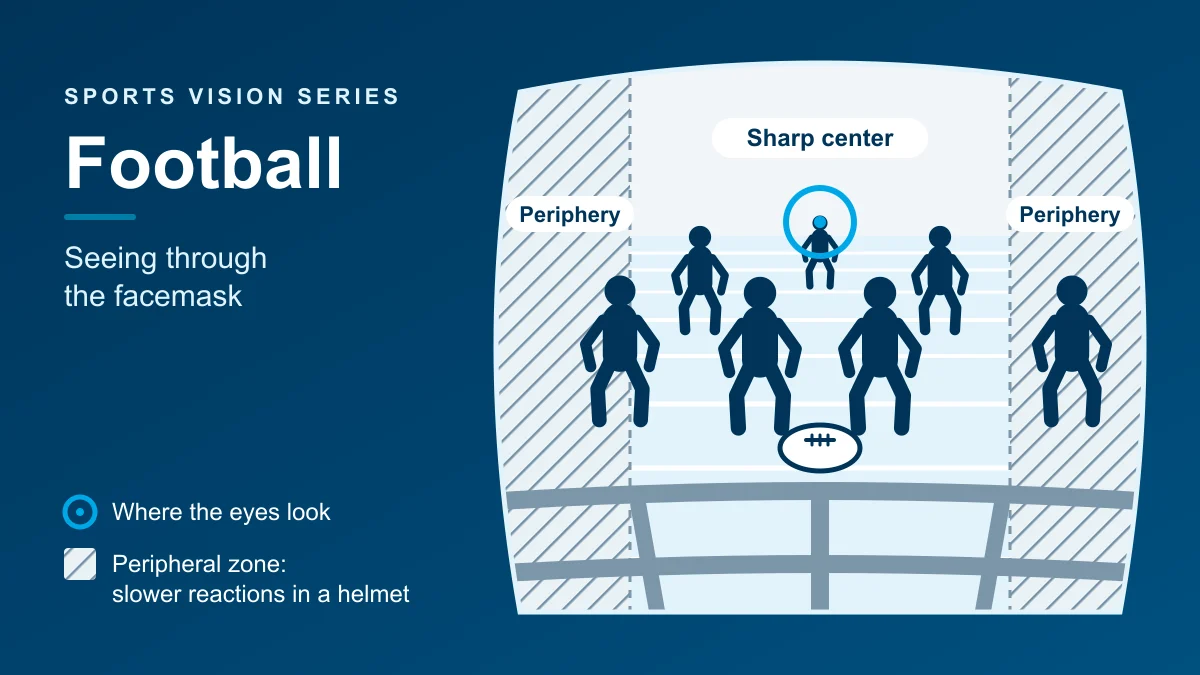
A football play asks the eyes to do several jobs at once. The quarterback reads a defense and leads a receiver who is still moving. The receiver picks a spinning ball out of the sky while a defender closes in. A lineman reacts to movement at arm’s length, much of it at the edge of vision, through a facemask. The visual skills for football are real, measurable, and different for each position.
This guide walks through those demands position by position, looks at what the helmet does to peripheral vision, covers the eye problems that quietly get in a player’s way, and explains what vision therapy and sports vision training can, and can’t yet, do for football players.
Key takeaways
- Football’s visual demands differ by position: quarterbacks depend on fast visual decisions, receivers and defensive backs on tracking and depth judgment, linemen on peripheral awareness and reaction at close range.
- Experts in many sports pick up cues faster and more accurately than novices and use fewer, longer fixations (Mann et al., 2007).
- Helmets measurably slow reactions to peripheral targets in lab tests of Division I players, and every facemask and visor tested did so, including clear visors (Miller et al., 2019; Ballmann & Rogers, 2024).
- About 42% of athletes checked on average about six days after a sport-related concussion had convergence insufficiency, and they scored worse on reaction time (Pearce et al., 2015).
- For symptomatic convergence insufficiency, vision therapy has strong trial support: 73% of children aged 9-17 succeeded or improved with office-based therapy versus 35% with placebo (CITT, 2008). Sports vision training sharpens reaction time and decision speed in trials, with game-day gains still being studied.
Visual skills for football, position by position
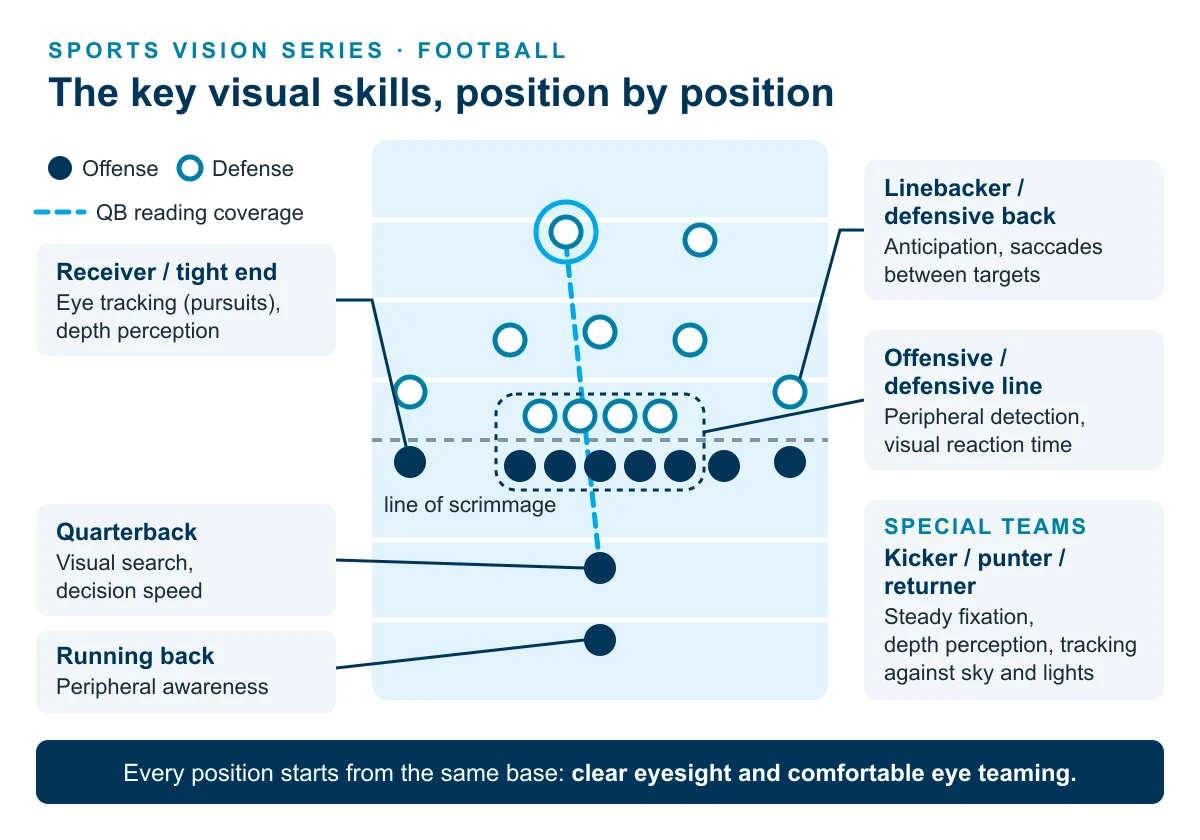
Every player needs clear eyesight and comfortable eye teaming. Above that foundation, each position leans on a different mix of skills.
| Position | Key visual moments | Skills most involved |
|---|---|---|
| Quarterback | Reading coverage after the snap, finding the open receiver, leading a moving target | Visual search, decision speed, peripheral awareness, judging speed and distance |
| Receiver / tight end | Tracking the ball over the shoulder, adjusting to a ball in flight, catching through contact | Eye tracking (pursuits), depth perception, eye-hand coordination, dynamic visual acuity |
| Running back | Finding a hole that opens and closes in a fraction of a second | Peripheral awareness, visual reaction time, anticipation |
| Offensive / defensive line | Reacting to the snap and to hands and feet at arm’s length | Peripheral detection, visual reaction time, eye-body coordination |
| Linebacker / defensive back | Reading the quarterback’s eyes and shoulders, breaking on the ball, tracking a receiver and the ball at once | Anticipation, saccades between targets, depth perception, peripheral awareness |
| Kicker / punter / returner | Fixing on the ball and the target; judging a punt’s hang and drift | Steady fixation, depth perception, tracking against sky and lights |
The quarterback: seeing ahead of the play
A quarterback’s job is partly a prediction problem. In one small experiment, quarterbacks threw to a moving receiver while their view was blocked after release, and they were still successful on almost 80% of those throws, about as often as with full vision. Their own predictions of whether a throw would work explained little of their actual success (Shaffer & Maynor, 2011). The authors suggest quarterbacks aim at a consistent angle between ball and receiver. In plain terms: much of the visual work happens before the ball leaves the hand.
At the professional level, a study of 42 NFL quarterbacks found that Combine scores for reaction time, visual spatial processing and decision-making predicted later performance measures beyond where each player was drafted (Boone et al., 2025). In other words, at the highest level of the game, these visual and decision skills matter.
Receivers and defensive backs: tracking and depth
Catching a ball in traffic depends on keeping the eyes on a moving target (smooth pursuit), judging when it will arrive (depth perception and timing) and getting the hands there (eye-hand coordination). Stereopsis, the fine depth perception that comes from both eyes working together, is part of that. Reduced stereopsis is the most common deficit in amblyopia, and a review of the research links it to difficulty with visuomotor tasks and sport in children (Levi et al., 2015). Our guide to how depth perception develops explains the skill in more detail.
Defensive backs add a layer: they read the quarterback, then switch their eyes between receiver and ball. Those fast jumps of the eyes are saccades. Across sports, experts tend to use fewer fixations of longer duration and pick up the relevant cue sooner than novices (Mann et al., 2007).
Linemen: the edge of vision, at close range
Linemen work in a crowd at arm’s length. Much of what matters, a stunt, a pulling guard, a hand swiping, arrives in peripheral vision. That is also where the helmet gets in the way.
What the helmet does to a player’s vision
A helmet is essential protection, and nothing here argues against wearing one. But it helps players and coaches to know that it has a visual cost.
- In a crossover study of 25 Division I players on a 64-light reaction board, wearing a helmet slowed reaction time to peripheral lights and reduced the number of targets hit, compared with no helmet. Adding an eye shield made a small difference that was not statistically significant (Miller et al., 2019).
- A follow-up in 16 Division I players used a step-and-reach agility drill. Light, medium and heavy facemask configurations all slowed performance compared with no helmet, as did clear, smoke-tinted and mirrored visors. There was no meaningful difference between facemask types, or between visor tints (Ballmann & Rogers, 2024).
These were lab tasks in small groups, so they do not tell us how many plays a facemask costs. They do suggest a practical point: an athlete who is already working with a narrower or slower visual field, or an uncorrected prescription, has less margin to give away once the helmet goes on.
Does eye black help?
Somewhat, in sunlight. In a small randomized study, 46 people were tested on a contrast chart in direct sun. Eye black grease under the eyes improved contrast sensitivity compared with no product and compared with antiglare stickers, which did not help (DeBroff & Pahk, 2003). That is a chart result, not a game result. It is a reasonable, cheap habit for day games, but it will not fix blur from an uncorrected prescription.
What gets in the way: vision problems that show up on the field
Most of the vision problems that hold football players back are not rare, and most are treatable. Here is how common ones tend to show up.
Uncorrected blur. A player who is nearsighted or has astigmatism may do fine up close and struggle with a deep ball, the play clock or a sideline signal. In our experience, players often do not notice blur that has crept in gradually. See our overview of refractive error.
Eye-teaming problems. Convergence insufficiency makes it hard to hold both eyes together on a close target. In a player it can show up less on the field than in the film room and the classroom: headaches with reading, words that move, fatigue by the end of a study session.
Focusing problems. An accommodative disorder slows the shift of focus between near and far, such as a playbook wristband to the defense, or notes to the board.
Tracking problems. Weak pursuits or inaccurate saccades can look like a receiver who “loses the ball” late or a defensive back who is a step behind on reads. Our page on ocular motor dysfunction covers the signs.
Reduced depth perception. Amblyopia (lazy eye) or a history of an eye turn often means reduced stereopsis (Levi et al., 2015). Many players compensate well with other depth cues, but judging a ball’s arrival may take more effort. See amblyopia and strabismus care.
Concussion and the eyes
Concussion is the football injury families worry about most, and it often affects the visual system.
- In 78 athletes seen about six days after a sport-related concussion, roughly 42% had convergence insufficiency. Those athletes scored worse on reaction time, visual motor speed and verbal memory, and reported more symptoms (Pearce et al., 2015).
- A timed rapid number-naming test, the King-Devick, is used on the sideline. In a 2026 Division I study where football accounted for 38% of the concussions, any slowing from baseline had 81% sensitivity but only 56% specificity (Harmon et al., 2026). That makes it a screening prompt, not a diagnosis.
- The joint clinical report from the American Academy of Pediatrics, American Academy of Ophthalmology, AAPOS and AACO notes that most children recover from visual symptoms within about four weeks, and recommends a vision-specific examination for those who do not (Master et al., 2022).
Can vision training prevent concussions? A university sports-medicine program published a methods paper describing team vision training and reported fewer concussions among players who took part than among those who did not (Clark et al., 2015). It is an interesting early report rather than a randomized trial, so we do not offer vision training as concussion prevention. Where vision care has a clear role is afterward: finding the convergence and focusing problems a concussion can leave behind, and treating them.
For the full picture, read vision problems after concussion: what the research shows, and see our concussion and brain injury page.
Protective eyewear matters in any sport with a risk of eye injury, and the AAP and AAO say it should be mandatory for athletes who are functionally one-eyed (AAP, 2004). A player with one good eye should talk with their eye doctor about which shield or visor is appropriate.
How vision therapy helps football players
Two different things get called “vision training,” and it matters which one a player needs.
Treating a diagnosed problem. This is where vision therapy has its strongest results. When an evaluation finds convergence insufficiency, a focusing disorder or a tracking problem, vision therapy treats it: a structured, supervised program of exercises for eye teaming, focusing and eye movements, with home practice between visits. In the landmark randomized trial for symptomatic convergence insufficiency in children, 73% of those who had office-based therapy were successful or improved, versus 35% with placebo therapy (CITT, 2008). For a player whose eyes tire in the film room, treating a diagnosed eye-teaming problem can make close work comfortable again; after a hit, a vision exam can show whether the same problems are part of the picture.
Performance training for a healthy visual system. Sports vision training works on reaction time, peripheral awareness and decision speed in players whose eyes are already healthy. A 2025 meta-analysis of 33 randomized trials found that visual training improved attention, reaction time, decision-making and eye-hand coordination (Guo et al., 2025). Gains were largest on tests that resembled the training drill (reaction time effect 2.66 versus 0.50), and studies linking training to competitive statistics are still few (Laby & Appelbaum, 2021), so no one can promise better game stats.
Our series hub, how sports vision training can help athletes, goes through that evidence in detail, and our success stories show what treatment has meant for real patients, including Henry, whose family saw his coordination and tracking in sports improve during his program.
Signs a football player’s vision may be holding them back
- Drops catchable balls, especially deep balls or balls thrown into traffic
- Seems late to react to movement at the side, or gets “surprised” by blocks
- Squints at the scoreboard, play clock or sideline signals
- Headaches, eye strain or blurred print after reading or watching film
- Covers or closes one eye, or tilts the head, to look at something
- Complains of double vision, or words that move on the page
- Any visual symptom that started, or got worse, after a hit to the head
If several of these fit, our symptom checklist is a good next step.
Our clinical perspective
We see football players at two moments: when something does not feel right and nobody has found out why, and after a concussion. In both cases the first job is the same, a comprehensive vision evaluation that looks past the letter chart to eye teaming, focusing, tracking and depth perception, with the player’s position in mind.
When we find a clinical problem, we treat it, and this is the part of our work we find most rewarding. In our practice we regularly see athletes whose eyes team and focus comfortably again after therapy: reading and film study stop causing headaches, and players often tell us they feel more confident and settled on the field. After a concussion, families often tell us that treating the lingering eye-teaming and focusing problems is what finally let their player get back to school and sport comfortably. When the visual system is already healthy, we will say so, and if the player wants performance training we explain what it can do: sharpen reaction and decision speed on trained tasks, with how much carries onto the field still being studied. We never promise better stats.
Our advice for families: before the season, make sure your player sees clearly and comfortably. If there has been a head injury and visual symptoms linger, do not wait. Find us on our locations page or schedule an evaluation.
Common Questions About This Topic
What visual skills matter most in football?
It depends on the position. Quarterbacks rely on fast visual decisions and judging a moving receiver; receivers and defensive backs rely on tracking a ball in flight and depth perception; linemen rely on peripheral awareness and reaction to movement at close range. Every position depends on clear eyesight and comfortable eye teaming underneath those skills, which is why an evaluation starts there.
Does a football helmet affect vision?
Yes, measurably. In a study of 25 Division I players, wearing a helmet slowed reaction time to lights in the peripheral field and reduced how many targets players hit compared with no helmet. A second study of 16 players found every facemask and visor tested, including clear visors, slowed a reactive agility drill. Adding a visor made no significant further difference beyond the helmet itself.
Does eye black actually work?
There is some evidence it helps in sunlight. In a small randomized study of 46 people tested in direct sun, eye black grease improved contrast sensitivity compared with no product and compared with antiglare stickers, which did not help. The study used a letter chart outdoors, not game play, so it shows a small visual effect rather than better performance.
Can vision training reduce concussions in football?
That has not been shown. One university sports-medicine program reported fewer concussions among players who took part in team vision training, but the report was a methods paper, not a randomized trial, and players were not randomly assigned. No controlled trial has established that vision training prevents concussion. What is well supported is checking the eyes after a concussion, because convergence problems are common.
Should a football player get a vision exam before the season?
It is a sensible time for one. A distance letter chart, the usual screening test, does not measure eye teaming, focusing, tracking or depth perception. A comprehensive exam before the season also gives a documented baseline, which is useful to have if the athlete later has a head injury and symptoms that affect the eyes.
Where This Information Comes From
- Shaffer DM, Maynor AB (2011). To see or not to see: effects of visual feedback on performance and intuitions of quarterbacks in American football. Perception; 40(3):377-378. : Quarterbacks threw to a moving receiver with and without vision of the flight; they were successful on almost 80% of occluded trials, statistically as often as with normal viewing, and their predictions of their own success explained little of their actual success. Short report.
- Boone RT, Zambrotta NS, Manocchio AM, Bowman JK (2025). Head in the game: the impact of cognitive abilities on performance of National Football League quarterbacks. Frontiers in Psychology; 16:1540498. : In 42 NFL quarterbacks tested at the Combine, reaction time, visual spatial processing and decision-making scores added predictive value beyond draft position for career performance metrics. Correlational; it does not test training.
- Mann DT, Williams AM, Ward P, Janelle CM (2007). Perceptual-cognitive expertise in sport: a meta-analysis. Journal of Sport & Exercise Psychology; 29(4):457-478. : Across 42 studies and 388 effect sizes, experts picked up perceptual cues more accurately and faster than non-experts and used fewer, longer fixations. Describes differences between skill levels, not the effect of training.
- Miller RA, Rogers RR, Williams TD, Marshall MR, Moody JR, Hensarling RW, Ballmann CG (2019). Effects of Protective American Football Headgear on Peripheral Vision Reaction Time and Visual Target Detection in Division I NCAA Football Players. Sports (Basel); 7(9):213. : Crossover study of 25 Division I players on a 64-light board: a helmet, with or without an eye shield, slowed peripheral reaction time and reduced target detection versus no helmet; the eye shield added a small, non-significant effect. Lab task, small sample.
- Ballmann CG, Rogers RR (2024). American Football Headgear Impairs Visuomotor Drill Performance in Division I NCAA Football Athletes. Journal of Functional Morphology and Kinesiology; 9(3):169. : In 16 Division I players, light, medium and heavy facemask reinforcement and clear, smoke-tinted and mirrored visors all worsened a step-and-reach reactive agility drill compared with no helmet; there were no differences between facemask types or between visor types.
- DeBroff BM, Pahk PJ (2003). The ability of periorbitally applied antiglare products to improve contrast sensitivity in conditions of sunlight exposure. Archives of Ophthalmology; 121(7):997-1001. : 46 subjects tested outdoors in sunlight and randomized to eye black grease, antiglare stickers or petroleum jelly: eye black improved binocular contrast sensitivity versus control and versus stickers. Letter-chart outcome, not game performance.
- Pearce KL, Sufrinko A, Lau BC, Henry L, Collins MW, Kontos AP (2015). Near Point of Convergence After a Sport-Related Concussion: Measurement Reliability and Relationship to Neurocognitive Impairment and Symptoms. American Journal of Sports Medicine; 43(12):3055-3061. : Of 78 athletes (mean age 14.3) seen a mean 5.8 days after a sport-related concussion, about 42% had a receded near point of convergence; they scored worse on verbal memory, visual motor speed and reaction time and reported more symptoms. Cross-sectional, no uninjured controls.
- Harmon KG, Whelan BM, Aukerman DF, Poddar SK, DeLeo A, Elkington HA, Garruppo G, Holliday M, Hwang CE (2026). Validity of the King Devick Test for Acute Diagnosis of Concussion in NCAA Division I Athletes. Sports Health; 18(2):391-400. : 97 concussed Division I athletes and 97 matched controls; football accounted for 38% of the concussions. Any slowing of the rapid number-naming test versus baseline had 81% sensitivity and 56% specificity: useful as a screen, not a diagnosis.
- Master CL, Bacal D, Grady MF, et al.; AAP Section on Ophthalmology, American Academy of Ophthalmology, AAPOS, AACO (2022). Vision and Concussion: Symptoms, Signs, Evaluation, and Treatment. Pediatrics; 150(2):e2021056047. : Joint clinical report: most children recover from visual symptoms of concussion by four weeks; those who do not warrant a vision-specific examination including pursuits, saccades, near point of convergence and accommodation.
- Clark JF, Colosimo A, Ellis JK, Mangine R, Bixenmann B, Hasselfeld K, Graman P, Elgendy H, Myer G, Divine J (2015). Vision training methods for sports concussion mitigation and management. Journal of Visualized Experiments; (99):e52648. : Methods paper from a university sports-medicine program describing team vision training (tachistoscope, Brock string, strobe glasses, light boards); the abstract reports fewer concussions among players who trained than among those who did not. Not a randomized trial, and the abstract gives no counts.
- Guo Y, Yuan T, Yang M, Qiu J (2025). Does the 'learning effect' caused by digital devices exaggerate sports visual training outcomes? A systematic review and meta-analysis. Frontiers in Physiology; 16:1664572. : 33 randomized trials, 1,048 participants: visual training improved attention, reaction time, decision-making and eye-hand coordination, but effects were much larger when the test resembled the training task (reaction time SMD 2.66 vs 0.50; visual attention 1.65 vs 0.07).
- Laby DM, Appelbaum LG (2021). Review: Vision and On-field Performance: A Critical Review of Visual Assessment and Training Studies with Athletes. Optometry and Vision Science; 98(7):723-731. : Critical review of studies linking visual assessment or training to competitive statistics: relatively few exist, and the field needs larger, better-powered, randomized placebo-controlled and pre-registered studies.
- Convergence Insufficiency Treatment Trial Study Group (2008). Randomized clinical trial of treatments for symptomatic convergence insufficiency in children. Archives of Ophthalmology; 126(10):1336-1349. : In 221 children aged 9-17, office-based vergence/accommodative therapy produced a successful or improved outcome in 73% versus 35% with office placebo therapy after 12 weeks.
- Levi DM, Knill DC, Bavelier D (2015). Stereopsis and amblyopia: A mini-review. Vision Research; 114:17-30. : Reduced stereoscopic depth perception is the most common deficit in amblyopia under ordinary binocular viewing, with a likely impact on visuomotor tasks and on playing sports in children.
- American Academy of Pediatrics Committee on Sports Medicine and Fitness (2004). Protective eyewear for young athletes. Pediatrics; 113(3 Pt 1):619-622. : AAP and AAO strongly recommend protective eyewear in sports with a risk of eye injury, and say it should be mandatory for functionally one-eyed athletes and after eye surgery or trauma when recommended.
Care We Provide
More From the Blog
Wondering If This Sounds Like Your Family?
A developmental vision evaluation measures the skills a routine eye exam does not. Our team sees children and adults in Coconut Creek, Boynton Beach, Boca Raton and West Palm Beach.