Visual Skills for Volleyball: Reading the Rally
Volleyball gives the eyes very little time and very little certainty. A float serve drifts late. A setter disguises where the ball is going until the last touch. A hitter’s arm swing hides the angle of the attack. The visual skills for volleyball are less about seeing the ball clearly and more about knowing, a fraction of a second early, where it is going to be.
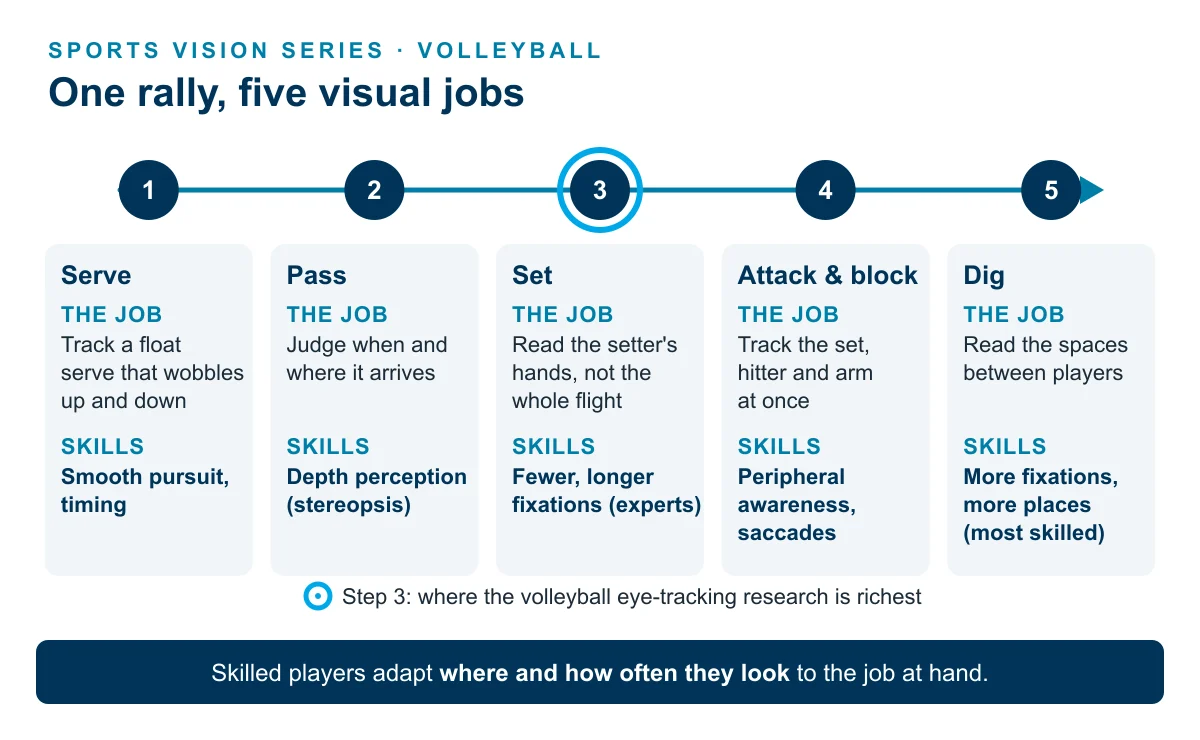
This post follows a single rally, from serve to dig, and names the visual job at each moment, what the research says about how skilled players do it, and which vision problems tend to show up at each stage. It closes with what vision therapy and training can do for players, and a short list of warning signs for parents and coaches.
Key takeaways
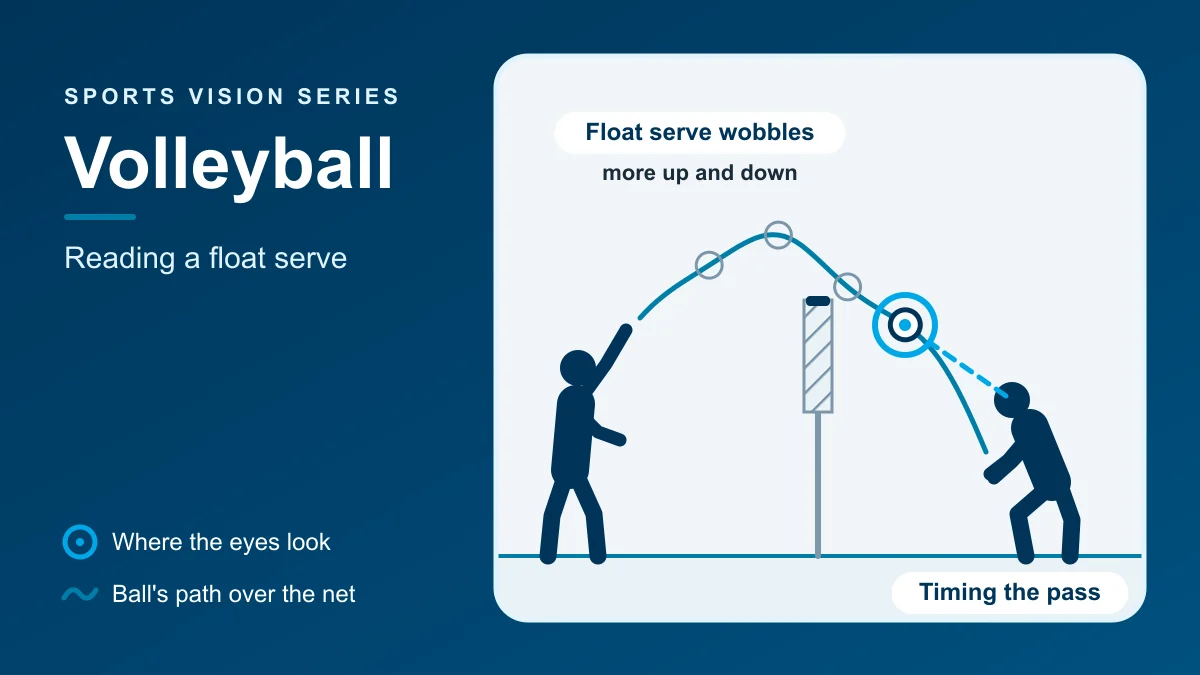
- A float serve’s path moves more up and down than side to side, which makes timing the pass the hard part (Reiser et al., 2020).
- Expert volleyball players tend to make fewer, longer fixations and watch the setter’s hands rather than the whole flight of the ball (Piras et al., 2010).
- In a film-based test, elite players read the final pass correctly 97.5% of the time, versus 83.5% for novices, with no significant difference in raw reaction time (Vansteenkiste et al., 2014). Reading the play matters more than reflexes.
- Vision therapy gets strong results for diagnosed eye-teaming problems: 73% of children with convergence insufficiency succeeded or improved with office-based therapy versus 35% with placebo (CITT, 2008). Training also sharpens trained skills, such as timing on a lab anticipation test, with gains kept two months later (Amprasi et al., 2026).
- Women’s volleyball accounted for 14 of 97 concussions in a recent college study (Harmon et al., 2026). Lingering visual symptoms after a head injury deserve an exam.
The rally, moment by moment
1. The serve: tracking a ball that will not hold still
A float serve is hit with little spin, so its path can wobble. Researchers who reconstructed the 3D flight of float serves by top indoor and beach players found the float effect was greater in the vertical plane than in the horizontal plane (Reiser et al., 2020). For the passer, that means the ball’s height at arrival, and so the timing of the platform, is harder to predict than its direction.
Skills in play: smooth pursuit (keeping the eyes on the ball), depth perception and timing, and a stable platform guided by the eyes. A passer who struggles with eye tracking may “lose” the ball in its last few feet, or shank passes that look routine from the stands.
2. The pass: judging depth and timing
Meeting a ball on the forearms is an interception problem: the eyes and brain have to estimate when the ball will arrive and where. Depth perception from both eyes, called stereopsis, is one input. In people aged 10 to 30, those with normal stereoacuity performed best on hand-eye tasks such as pegboards and bead threading (O’Connor et al., 2010). Reduced stereopsis is the most common deficit in amblyopia, and a review links it to difficulty with sports in children (Levi et al., 2015). We explain the skill further in our guide to how depth perception develops.
3. The set: reading the setter’s hands
This is where volleyball-specific eye research is richest. When 15 professional players and 15 non-athletes watched a filmed setter, the experts made fewer fixations of longer duration and looked at the incoming pass and then at the setter’s hands, while non-athletes followed the whole course of the ball (Piras et al., 2010). In a later study, experts predicted whether the toss would go forward or backward faster and more accurately than novices (Piras et al., 2014).
The lesson for young players is not “watch the ball harder.” It is that skilled players look at the source of the information, the setter’s body and hands, before the ball has told them anything.
4. The attack and the block: seeing more than one thing at once
A blocker has to track the set, the hitter’s approach and the hitter’s arm, often in different parts of the visual field at once. In a study comparing elite, intermediate and novice female players reacting to filmed attacks, response accuracy was 97.5%, 91.5% and 83.5% respectively, but reaction times did not differ significantly. All three groups used similar “visual pivot” points, and the authors suggest experts extract more from the area just outside central vision (Vansteenkiste et al., 2014).
Skills in play: peripheral awareness, saccades (quick, accurate jumps of the eyes between targets), and the anticipation that comes from years of seeing the same patterns.
5. The dig: reading space, not just the ball
Defending in the back row may call for a different visual strategy from reading a set. When 27 players wore eye trackers as backcourt defenders in live, game-like drills, the most skilled players made more fixations to more locations, and spent time looking at the spaces between players, while less skilled players locked onto the ball and individual players (Afonso et al., 2012). A 2025 study added that the expert pattern of fewer, longer fixations appeared only later in the rally, and not while players prepared before the serve (Kanatschnig et al., 2025).
So “good eyes” in volleyball is not one fixed style. Skilled players adapt where and how often they look to the job at hand. That fits the wider research across sports: experts are better at picking up the right cues, and the details vary by sport and by task (Mann et al., 2007).
When vision gets in the way: how common problems show up on the court
| Vision problem | How it can look in a volleyball player |
|---|---|
| Uncorrected nearsightedness or astigmatism | Late on serves from deep in the court; trouble reading the opponent’s rotation or the scoreboard |
| Convergence insufficiency (eye teaming) | Mostly a near-vision problem: headaches or eye strain with homework and film study, fatigue late in the day; sometimes double vision when tired |
| Accommodative (focusing) disorder | Slow to shift focus from near to far; blur after reading, which can carry into evening practice |
| Eye movement problems | Loses the ball in flight; slow to shift the eyes from setter to hitter; misjudges a ball that changes direction |
| Amblyopia or reduced stereopsis | Mistimes passes and blocks; relies heavily on other depth cues and may tire of it; see amblyopia and strabismus care |
None of these is diagnosed by a pass on a school or sports-physical eye chart. Reading letters at 20 feet says little about eye teaming, focusing or tracking.
Sun, sand and glare
Beach volleyball adds bright sky and reflected glare. Sun glare lowers contrast sensitivity, the ability to pick an object out from its background, and in a small randomized study conducted in direct sunlight, eye black grease under the eyes improved contrast sensitivity compared with no product and with antiglare stickers (DeBroff & Pahk, 2003). That was a chart test, not a game, but it confirms glare has a measurable visual cost.
Concussion in volleyball
Volleyball is not usually thought of as a concussion sport, but head contact with the ball, the floor and teammates happens. In a Division I study covering 2020 to 2022, women’s volleyball accounted for 14 of 97 concussions, second only to football (Harmon et al., 2026). Visual symptoms are common after concussion, and the joint AAP, AAO, AAPOS and AACO report recommends a vision-specific examination for children whose symptoms have not resolved by about four weeks (Master et al., 2022). Our post on vision problems after concussion covers what to watch for.
How vision therapy and vision training help volleyball players
If there is a diagnosed problem, treat it. This is where vision therapy has its strongest results. Vision therapy is a supervised program of activities for eye teaming, focusing and eye movements, with home practice. In the landmark randomized trial for symptomatic convergence insufficiency in children, 73% of those who had office-based therapy were successful or improved, versus 35% with placebo therapy (CITT, 2008). For a player whose eyes tire during film study, treating a diagnosed eye-teaming problem can make close work comfortable again.
If the visual system is healthy, training builds skills on top. Sports vision training targets skills such as reaction time, peripheral awareness and anticipation, and trials show gains on lab tests of those skills, largest when the test resembles the drill:
- In a small randomized trial, girls aged 8 to 10 who practiced timing tasks for eight weeks cut their timing error on a lab anticipation timer and kept the gain two months later (Amprasi et al., 2026).
- Across 33 randomized trials in many sports, visual training improved lab measures of attention and reaction time, with the largest gains when the test resembled the training drill (visual attention effect 1.65 versus 0.07) (Guo et al., 2025).
Match performance has not yet been measured in controlled studies, so we never promise better stats; the gains shown so far are on lab measures, mostly ones that resemble the training.
Our series hub, how sports vision training can help athletes, lays out the wider evidence, and our success stories show what treatment has meant for real patients. If you have a football player at home too, our post on visual skills for football covers that sport’s very different demands.
Signs a volleyball player’s vision may be holding them back
- Passes that are consistently mistimed, especially on float serves
- Frequently misjudges balls near the lines or the antenna
- Seems to react late to the set or the hitter compared with teammates
- Squints, rubs the eyes, or complains that the ball “disappears”
- Headaches or eye strain after homework, screens or film study
- Closes or covers one eye, or tilts the head, to look at something
- Any new visual symptom after a knock to the head
Our symptom checklist can help you decide whether an evaluation makes sense.
Our clinical perspective
In volleyball, the difference between a good read and a late one is often made before the ball is hit, and much of that is experience. We cannot give a player experience. What we can do is check the visual system underneath it and treat what we find: clear sight at every distance, eye teaming and focusing, eye movements and depth perception. When one of those is off, the player is working harder than they should to do the same job.
In our practice we regularly see players who were working that hard without knowing it. Once their eyes team, focus and track comfortably, families often tell us homework and film study stop ending in headaches, and their player plays with more confidence.
A comprehensive vision evaluation is where that starts. If we find something, we treat it. If everything is healthy, we say so, and if the athlete wants performance training we explain what it can build: sharper reaction and anticipation on trained tasks, with carry-over to matches still being studied, and no promise of better stats. To get started, see our locations or schedule an evaluation.
Common Questions About This Topic
What visual skills does volleyball require?
Volleyball relies on tracking a ball whose path can change late, judging depth and timing to meet it, reading the setter and hitters to anticipate the play, and peripheral awareness of teammates and the net. Underneath all of that sit clear eyesight, comfortable eye teaming and quick focusing, which a comprehensive eye exam checks before any training is considered.
Why is a float serve so hard to pass?
A float serve has little spin, so its path can wobble as it crosses the court. A 2020 analysis of float serves by top indoor and beach players measured that movement from 3D video and found the float effect was larger in the vertical direction than side to side. That makes timing, not just direction, the hard part for the passer.
How do expert volleyball players read the game?
Eye-tracking studies show expert players tend to make fewer fixations of longer duration and look at more informative places, such as the setter's hands rather than the whole flight of the ball. In a film-based test, elite players predicted the direction of the final pass correctly 97.5% of the time, compared with 83.5% for novices.
Can vision training make my child a better volleyball player?
Training sharpens the skills it targets. A small randomized trial in 8- to 10-year-old players found that eight weeks of practice sharpened timing on a lab anticipation test, and the gain was retained two months later. That study did not measure match performance, so no one can promise better results on the scoreboard. If a vision problem such as convergence insufficiency is found, treating it has the strongest evidence of all.
Do volleyball players get concussions?
Yes. In a 2026 study of concussions among college athletes, women's volleyball accounted for 14 of 97 concussions, second only to football. Visual symptoms such as trouble focusing, eye strain or double vision are common after concussion, and a vision-specific exam is recommended if they have not settled by about four weeks.
Where This Information Comes From
- Reiser M, Zentgraf K, Kindermann S, Künzell S (2020). An Approach to Quantify the Float Effect of Float Serves in Indoor and Beach Volleyball. Frontiers in Sports and Active Living; 2:559277. : 3D video analysis of 24 float serves by 12 top athletes in each of beach and indoor volleyball: the float effect was greater vertically than horizontally, and a certain release speed was necessary but not sufficient for the ball to float.
- Piras A, Lobietti R, Squatrito S (2010). A study of saccadic eye movement dynamics in volleyball: comparison between athletes and non-athletes. Journal of Sports Medicine and Physical Fitness; 50(1):99-108. : 15 professional players and 15 non-athletes watched filmed setting sequences: experts made fewer, longer fixations and looked at the pass and the setter's hands, while non-athletes followed the whole flight of the ball. Film-based lab task.
- Piras A, Lobietti R, Squatrito S (2014). Response time, visual search strategy, and anticipatory skills in volleyball players. Journal of Ophthalmology; 2014:189268. : Expert players predicted the direction of a setter's toss on video faster and more accurately than novices, using fewer fixations of longer duration.
- Vansteenkiste P, Vaeyens R, Zeuwts L, Philippaerts R, Lenoir M (2014). Cue usage in volleyball: a time course comparison of elite, intermediate and novice female players. Biology of Sport; 31(4):295-302. : Adult female players reacting to filmed attacks: response accuracy was 97.5% (elite), 91.5% (intermediate) and 83.5% (novice); reaction times did not differ significantly, and the authors suggest experts extract more information from just outside central vision.
- Afonso J, Garganta J, McRobert A, Williams AM, Mesquita I (2012). The perceptual cognitive processes underpinning skilled performance in volleyball: evidence from eye-movements and verbal reports of thinking involving an in situ representative task. Journal of Sports Science and Medicine; 11(2):339-345. : 27 female players wore eye trackers as backcourt defenders in live simulated play: the most skilled made more fixations to more locations and looked at spaces between players, while less skilled players watched the ball and specific players.
- Kanatschnig T, Korda Ž, Schrapf N, Leitner L, Anzengruber C, Lappi O, Körner C, Tilp M, Kober SE (2025). Expertise-driven temporal gaze dynamics during anticipation in volleyball. PLoS One; 20(10):e0334702. : Professional players (n = 14) showed lower fixation rates and longer fixations than less expert players, but only later in the rally; before the serve, experts and amateurs did not differ.
- Mann DT, Williams AM, Ward P, Janelle CM (2007). Perceptual-cognitive expertise in sport: a meta-analysis. Journal of Sport & Exercise Psychology; 29(4):457-478. : 42 studies, 388 effect sizes: experts pick up perceptual cues more accurately and faster than non-experts and use fewer fixations of longer duration. Sport type and research method moderated the effects.
- Amprasi E, Koufou N, Trigonis I, Tsartsapakis I, Zafeiroudi A, Kouli O (2026). The Impact of an 8-Week Deliberate Practice Intervention on Coincidence Anticipation Timing and Long-Term Retention in Youth Female Volleyball Players. Children (Basel); 13(6):822. : 32 girls aged 8-10 randomized to eight weeks of timing practice or standard training: the trained group reduced timing error on a lab anticipation timer, retained at two months. Small single study; match performance was not measured.
- O'Connor AR, Birch EE, Anderson S, Draper H; FSOS Research Group (2010). The functional significance of stereopsis. Investigative Ophthalmology & Visual Science; 51(4):2019-2023. : In 143 people aged 10-30, pegboard and bead-threading performance was related to stereoacuity, and those with normal stereoacuity performed best on all tasks.
- Levi DM, Knill DC, Bavelier D (2015). Stereopsis and amblyopia: A mini-review. Vision Research; 114:17-30. : Reduced stereopsis is the most common deficit in amblyopia under binocular viewing, with a likely impact on visuomotor tasks and on children's sport.
- DeBroff BM, Pahk PJ (2003). The ability of periorbitally applied antiglare products to improve contrast sensitivity in conditions of sunlight exposure. Archives of Ophthalmology; 121(7):997-1001. : 46 subjects tested in direct sunlight: sun glare reduces contrast sensitivity, and eye black grease improved binocular contrast sensitivity versus control and versus antiglare stickers. Chart outcome, not play.
- Harmon KG, Whelan BM, Aukerman DF, Poddar SK, DeLeo A, Elkington HA, Garruppo G, Holliday M, Hwang CE (2026). Validity of the King Devick Test for Acute Diagnosis of Concussion in NCAA Division I Athletes. Sports Health; 18(2):391-400. : Of 97 concussions in Division I athletes studied from 2020 to 2022, 37 were in football and 14 in women's volleyball; 44% occurred in female athletes.
- Master CL, Bacal D, Grady MF, et al.; AAP Section on Ophthalmology, American Academy of Ophthalmology, AAPOS, AACO (2022). Vision and Concussion: Symptoms, Signs, Evaluation, and Treatment. Pediatrics; 150(2):e2021056047. : Joint clinical report: most children recover from visual symptoms of concussion by four weeks; those who do not warrant a vision-specific examination.
- Guo Y, Yuan T, Yang M, Qiu J (2025). Does the 'learning effect' caused by digital devices exaggerate sports visual training outcomes? A systematic review and meta-analysis. Frontiers in Physiology; 16:1664572. : 33 randomized trials, 1,048 participants: training improved lab measures, but effects shrank sharply when the test did not resemble the training task (visual attention SMD 1.65 vs 0.07; reaction time 2.66 vs 0.50).
- Convergence Insufficiency Treatment Trial Study Group (2008). Randomized clinical trial of treatments for symptomatic convergence insufficiency in children. Archives of Ophthalmology; 126(10):1336-1349. : In 221 children aged 9-17, office-based vergence/accommodative therapy produced a successful or improved outcome in 73% versus 35% with office placebo therapy after 12 weeks.
Care We Provide
More From the Blog
Wondering If This Sounds Like Your Family?
A developmental vision evaluation measures the skills a routine eye exam does not. Our team sees children and adults in Coconut Creek, Boynton Beach, Boca Raton and West Palm Beach.