Vision Therapy Activity: Rotating Pegboard
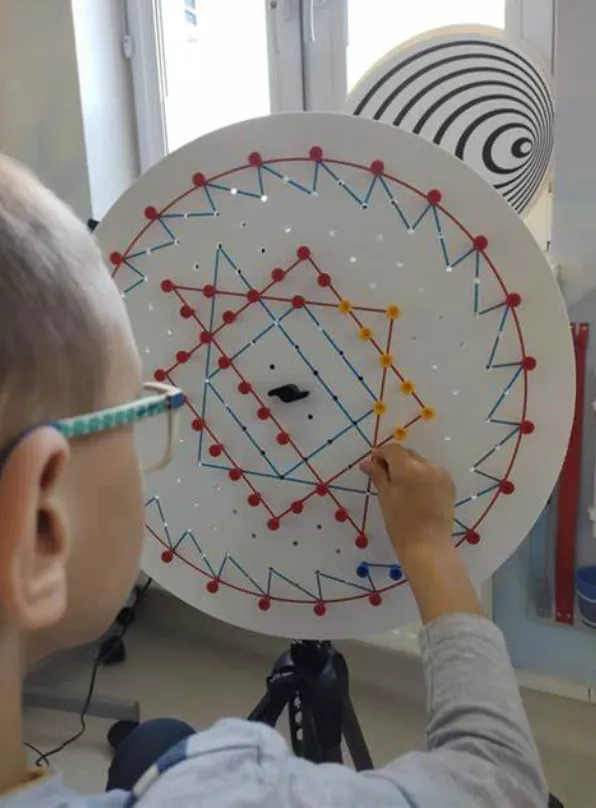
A board full of small holes, a fistful of golf tees, and a motor that makes the whole thing turn. The rotating pegboard is not glamorous, and it is one of the busiest tools in our therapy rooms.
It earns that place because it refuses to let any single skill hide. To drop a tee into a moving hole, the eyes have to find the hole, the brain has to work out where it is relative to the body, the hand has to travel there, and all of it has to happen before the hole moves on. Here is how we run it, what it loads, and an honest account of what research does and does not show.
Key takeaways
- The activity is simple: put golf tees into a rotating pegboard and take them out again, with or without an eye patch.
- It loads localization, eye-hand coordination, bilateral integration, sustained attention and speed at the same time.
- Scores on a timed peg-placing dexterity test track with depth perception in research, which is why we watch tee placement as a functional check as well as a workout (O’Connor et al., 2010).
- No trial has tested the pegboard on its own. Randomized evidence supports whole office-based therapy programs for specific diagnoses, not single activities (CITT, 2008; Scheiman et al., 2020).
How the pegboard activity works
The patient stands or sits at a rotating board and inserts golf tees into the holes, then removes them, while the board turns. That is the whole procedure. Everything interesting happens in how the therapist loads it.
We change the rotation speed, the direction of the spin, the size of the tee and the size of the target hole. A patient who is overshooting and undershooting badly starts with a big tee and a big hole and a slow turn. As the aim tightens, the target gets smaller and the board gets faster. We also ask patients to track one specific tee through a full revolution without losing it, which is a different job from placing a tee and a good way to see whether pursuit eye movements are smooth or jumpy.
Patched or unpatched
The activity can be done with one eye patched or with both eyes open, depending on the patient and the stage of the plan. Patching takes away the second viewpoint, so distance has to be judged from monocular cues alone, and it lets us work an eye that has been carrying less of the load. When each eye is more reliable on its own, we take the patch off and let the two eyes solve the task together. We write more about that decision in the role of eye patches in vision therapy.
The skills it targets
Localization. Knowing where something is in space, relative to your own body, is the foundational skill here. A moving hole makes that judgment fresh every second. This is the same skill we build with the Marsden ball and the pointer straw, approached from a different angle.
Eye-hand coordination and visual-motor integration. Vision has to guide the hand, not just report on it. That link between what the eyes see and what the hand does is what standardized tests call visual-motor integration.
Bilateral integration. Holding tees in one hand and placing with the other, or alternating hands across the midline, asks the two sides of the body to cooperate on one task. Related patterns show up in our writing on motor and coordination concerns.
Speed and sustained attention. A rotating board sets the pace, so the patient cannot slow the task down to stay accurate. Holding accuracy while the clock runs is a real demand, and it is often the first thing to slip when a patient is fatigued.
What the evidence actually shows
We want to be precise here, because activity-level claims are where vision therapy marketing usually goes wrong.
Peg-placing accuracy and depth perception are linked. Researchers tested 143 people aged 10 to 30 on the Purdue pegboard - a stationary board scored by how many pegs you can place in 30 seconds - plus bead threading and water pouring. Performance on those tasks was related to stereoacuity, and the people with normal stereoacuity did best on every test (O’Connor et al., 2010). That is a timed dexterity test, not this rotating board, so treat it as evidence about the underlying skill rather than a study of the activity. Depth perception itself keeps sharpening through childhood, from about 100 arcseconds at age 3 to 40 by age 7 (Birch et al., 2008), and reduced stereo vision is the most common deficit in amblyopia, where it can affect motor coordination, sport and mobility (Levi et al., 2015). So when tee placement falls apart in a session, we read it as information about how the eyes and hands are working together, not just as a score.
Visual-motor integration relates to handwriting and school skills. In 99 students in grades three to six who had learning and/or behavior problems, visual-motor integration was the only measure that separated skilled from unskilled handwriters, though all the sensorimotor scores together explained 20% or less of legibility (Klein et al., 2011). In 191 children, visual-motor integration scores were significantly related to teacher ratings of reading, math, writing and spelling (Kulp, 1999). These are associations, not proof that training the skill changes the report card.
Therapy programs, not single activities, are what has been tested. One non-randomized study of 70 visually impaired students found that a therapy program improved Frostig eye-hand coordination scores while visual acuity did not change (Heravian Shandiz et al., 2018). That protocol used a Marsden ball and pen-and-target work rather than a pegboard, and the students were visually impaired, so it does not transfer straight to a typical binocular vision plan. The strong randomized evidence sits at program level: office-based vergence and accommodative therapy with home reinforcement produced a successful or improved outcome in 73% of children with symptomatic convergence insufficiency versus 35% with office placebo (CITT, 2008), and a Cochrane review of 12 trials (1,289 participants) reached the same conclusion for children, where office-based therapy was about three times more likely than placebo to produce a successful outcome (RR 3.04, 95% CI 2.32 to 3.98) (Scheiman et al., 2020). The same body of work is candid about limits: in 310 children, therapy was no better than placebo for reading comprehension (CITT-ART, 2019).
Our clinical perspective at Vision & Learning Center is that the pegboard is a well-established procedure for building and observing eye-hand accuracy under time pressure. That is a description of what we do, not a promise about grades or handwriting. You can see where it sits in a full plan in our overview of our therapy goals and procedures.
When a pegboard difficulty is worth a closer look
Clumsy tee placement in one session means nothing on its own. A pattern is different: a child who consistently misjudges where things are, who bumps into doorframes, who cannot catch, who writes letters that drift off the line, or who works accurately for two minutes and then falls apart. Those are the patterns we want to see measured.
If that sounds like your child, or like you, a comprehensive developmental vision evaluation is the place to start. Learn what our examinations include or Schedule an evaluation.
Common Questions About This Topic
What is the rotating pegboard activity in vision therapy?
It is a round board drilled with small holes, mounted so it can turn, and a handful of golf tees. The patient places tees into the holes and takes them out again while the board rotates. The therapist changes the speed, the direction, the size of the tee and the size of the target hole to keep the task at the edge of what the patient can do.
Why do therapists sometimes patch one eye for pegboard work?
Patching one eye removes the second view, so the patient has to judge distance from monocular cues alone. We use it when one eye needs the practice, and we take the patch off once each eye is working more reliably so the two can go back to solving the task together. Your therapist decides when and whether patching applies to your plan.
Is there research proving the pegboard improves vision?
No randomized trial has tested this single activity, and we do not claim one. What research does show is that scores on a timed peg-placing dexterity test track with depth perception, that visual-motor integration relates to handwriting and school skills, and that full office-based therapy programs beat placebo for specific diagnoses such as symptomatic convergence insufficiency. The pegboard is one procedure inside a program, not a treatment on its own.
Will the pegboard help my child's handwriting?
We cannot promise that. Studies link visual-motor integration scores to handwriting legibility and to teacher ratings of writing, but those are associations, and no controlled trial shows that pegboard work improves handwriting. Handwriting itself is usually addressed directly, most often by an occupational therapist.
Can we do a pegboard activity at home?
Only if your therapist has assigned it and shown you the set-up, including the speed and whether a patch is involved. Home work is meant to reinforce what happens in the office. Golf tees are a choking hazard for young children, so keep them supervised and put them away afterwards.
Where This Information Comes From
- O'Connor AR, Birch EE, Anderson S, Draper H; FSOS Research Group (2010). The functional significance of stereopsis. Investigative Ophthalmology & Visual Science; 51(4):2019-2023. : In 143 people aged 10-30, performance on the Purdue pegboard (pegs placed in 30 seconds), bead threading and water pouring was related to stereoacuity; those with normal stereoacuity performed best on every test.
- Birch E, Williams C, Drover J, et al. (2008). Randot Preschool Stereoacuity Test: normative data and validity. Journal of AAPOS; 12(1):23-26. : In 4,355 normally sighted children aged 3-18, mean stereoacuity sharpened from 100 arcseconds at age 3 to 60 by age 5 and 40 by age 7.
- Levi DM, Knill DC, Bavelier D (2015). Stereopsis and amblyopia: A mini-review. Vision Research; 114:17-30. : Reduced stereoscopic depth perception is the most common deficit in amblyopia under ordinary binocular viewing and can affect motor coordination, sport and mobility.
- Klein S, Guiltner V, Sollereder P, Cui Y (2011). Relationships between fine-motor, visual-motor, and visual perception scores and handwriting legibility and speed. Physical & Occupational Therapy in Pediatrics; 31(1):103-114. : In 99 students in grades 3-6 with learning and/or behavior problems, sensorimotor scores explained 20% or less of handwriting legibility; only visual-motor integration separated skilled from unskilled writers.
- Kulp MT (1999). Relationship between visual motor integration skill and academic performance in kindergarten through third grade. Optometry and Vision Science; 76(3):159-163. : In 191 children, visual-motor integration scores were significantly related to teacher ratings of reading, math, writing and spelling in 7- to 9-year-olds.
- Heravian Shandiz J, Riazi A, Azimi Khorasani A, Yazdani N, Torab Mostaedi M, Zohourian B (2018). Impact of Vision Therapy on Eye-hand Coordination Skills in Students with Visual Impairment. Journal of Ophthalmic & Vision Research; 13(3):301-306. : A 70-student non-randomized study in visually impaired learners: Frostig eye-hand coordination scores rose from 22.74 to 24.69 with therapy versus 21.60 to 21.89 in controls, with no change in visual acuity; the protocol used a Marsden ball and pen-and-target work, not a pegboard.
- Convergence Insufficiency Treatment Trial Study Group (2008). Randomized clinical trial of treatments for symptomatic convergence insufficiency in children. Archives of Ophthalmology; 126(10):1336-1349. : In 221 children aged 9-17, office-based vergence/accommodative therapy with home reinforcement produced a successful or improved outcome in 73% versus 35% with office placebo at 12 weeks.
- Scheiman M, Kulp MT, Cotter SA, Lawrenson JG, Wang L, Li T (2020). Interventions for convergence insufficiency: a network meta-analysis. Cochrane Database of Systematic Reviews; 12:CD006768. : A review of 12 trials and 1,289 participants; in the pediatric network (four CITT trials, 737 participants) office-based therapy beat placebo, RR 3.04, 95% CI 2.32-3.98. The adult evidence is less clear.
- CITT-ART Investigator Group (2019). Effect of Vergence/Accommodative Therapy on Reading in Children with Convergence Insufficiency: A Randomized Clinical Trial. Optometry and Vision Science; 96(11):836-849. : In 310 children, reading comprehension improved 3.7 points with vision therapy versus 3.8 points with placebo therapy: no reading advantage.
Care We Provide
More From the Blog
Wondering If This Sounds Like Your Family?
A developmental vision evaluation measures the skills a routine eye exam does not. Our team sees children and adults in Coconut Creek, Boynton Beach, Boca Raton and West Palm Beach.