Vision Therapy Activity: Pointer Straw
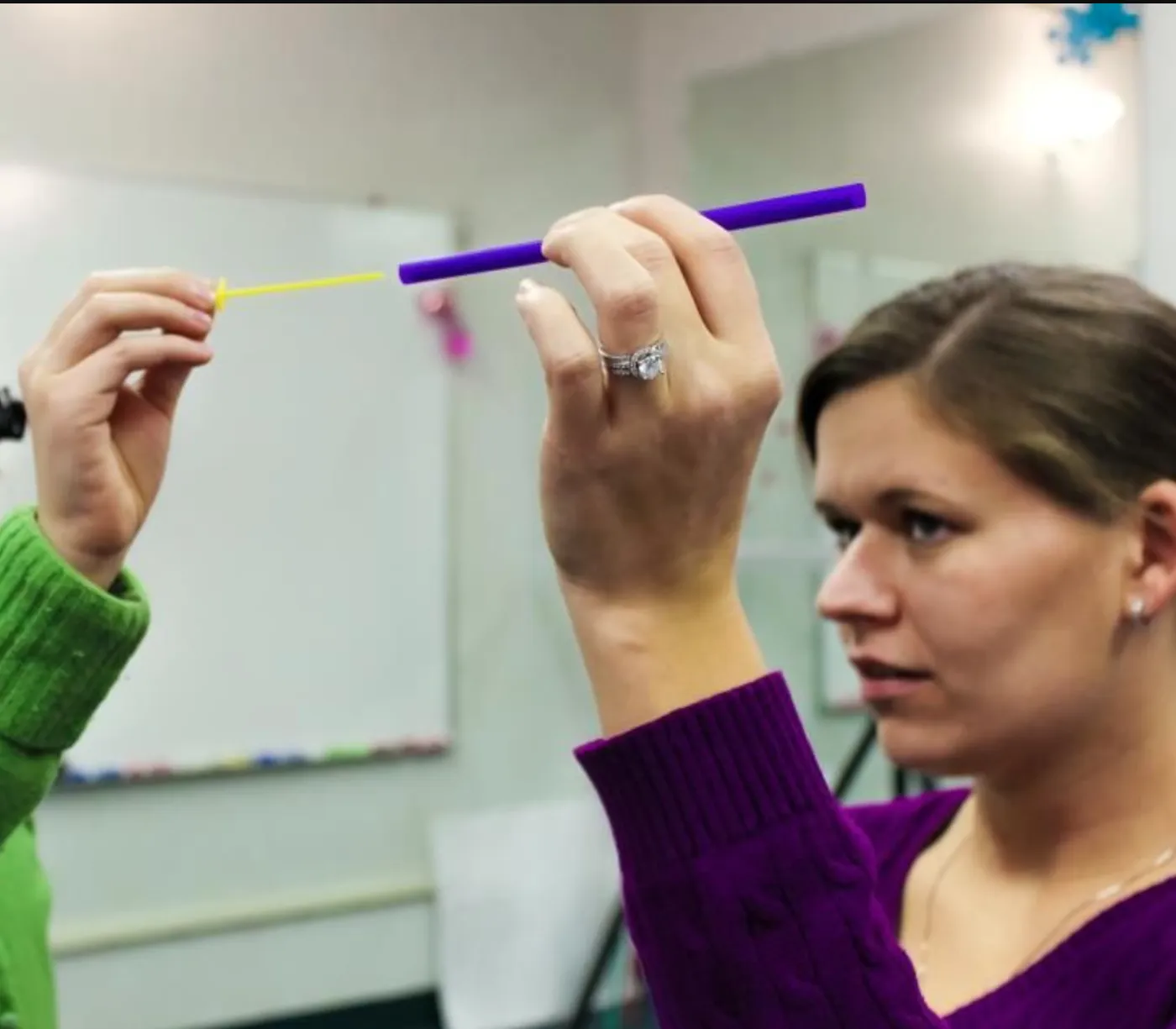
A drinking straw and a pointer. That is the whole equipment list for one of the activities we run most often in our therapy rooms.
Pointer straw looks like a game, and for younger patients it plays like one. The question it is really asking is serious: can you tell exactly where something is in space, and can you get your hand there on the first try?
Key takeaways
- The therapist holds a straw in different orientations, at different distances and heights; the patient slides a pointer tip into the open end.
- The target skill is localization — knowing precisely where an object sits in space — along with spatial awareness, depth judgment and eye-hand coordination.
- Difficulty is set by target size, not by changing the activity. Big misses mean a bigger straw and a wider pointer, then we work back down.
- It can be done patched or unpatched. Covering an eye trains that eye’s own aim; two-eyed depth perception only appears with both eyes open, and people with strabismic amblyopia rarely gain stereo from monocular training alone (Levi et al., 2015).
- Depth perception is measurably related to fine-motor performance (O’Connor et al., 2010), but no trial has tested this activity on its own. What trials support is the complete office-based program (CITT, 2008).
What the activity is
The therapist holds an ordinary straw in the air. The patient holds a pointer — a dowel, a stylus, sometimes a narrower straw — and moves it until the tip is inside the open end. That is one repetition. Then the straw moves somewhere else and the patient does it again.
Nothing about the position is fixed, and that is the entire point: a target that never moves stops teaching after a few minutes.
Orientations, distances and heights
We hold the straw three ways:
- Horizontally, so the opening faces sideways and the pointer has to come in from the side.
- Vertically, so the opening faces up or down and the approach is from above or below.
- Diagonally, at the angles in between. This is usually the hardest, because neither the horizontal nor the vertical reference lines of the room help.
Layered on top of those orientations, we change two more things constantly: distance and height. Distance runs from close to the patient’s face, out to arm’s length, and on to the far edge of reach — this is what puts the depth demand in the activity, because a straw ten inches away and one thirty inches away look remarkably similar until the eyes actually converge and focus on the target. Height runs from below the waist to chest level to above the head, which changes posture and keeps the skill from getting stuck in one comfortable working zone.
Changing positions, distances and heights forces the eyes and the hand to keep agreeing about where the straw is. When any part of that system is guessing, the pointer misses, and the miss is information.
Sizing the target to the patient
Pointer size and straw size are both adjustable, and we adjust them on purpose. If a patient is overshooting or undershooting significantly with the standard-size pointer and straw, we move to a bigger target — a wider tube, a fatter pointer — so the movement can be built successfully instead of failing repeatedly. From there we work our way down to a smaller straw as accuracy improves.
How a patient misses matters as much as whether they miss. Consistent overshoot on far targets, misses only on one side of the body, and a tip that arrives in the right place at the wrong angle are three different findings that point to three different pieces of the program.
The skills underneath
- Localization. Judging where an object is in space accurately enough to act on it.
- Spatial awareness. Building a stable sense of near, far, above, below and off to the side, relative to the body.
- Depth judgment. Distance changes are the part of this activity that cannot be solved by memory or a lucky sweep.
- Visually guided movement. The activity uses visual processing to steer the hand to the correct spot, which is what makes it a foundational visual-motor task rather than a fine-motor one.
- Motor planning and attention. With the position changing every repetition, the patient plans a new movement each time rather than repeating a groove.
Patched or unpatched
Pointer straw can be done with one eye patched or with both eyes open, and we choose based on the patient’s diagnosis and where they are in the program.
With one eye covered, that eye has to aim on its own, using the depth cues that survive without a partner: relative size, motion, perspective and head movement. For patients working on amblyopia, it also means the weaker eye is doing meaningful near work rather than simply being uncovered. Near activities during patching are standard in the amblyopia trials — the PEDIG patching studies prescribed an hour of near work alongside daily patching, and found that 2 hours and 6 hours of patching produced the same 2.40-line gain in moderate amblyopia (Repka et al., 2003); in older children, a regimen of patching with near activities plus atropine drops produced a response in 53% of 7- to 12-year-olds versus 25% with glasses alone (Scheiman et al., 2005). Those trials tested patching regimens, not which near activity was used, so we present pointer straw as a sound way to fill that hour, not as the reason patching works.
We then move to the unpatched version, and it is worth being precise about why. Two-eyed depth perception is a binocular skill: it cannot be produced, trained or measured one eye at a time. The patched stage builds each eye’s own accuracy and visual attention; the two-eyed depth work happens once both eyes are open together. That distinction matters clinically, because reduced stereo depth is the most common deficit in amblyopia and people with strabismic amblyopia rarely improve stereo through monocular training alone (Levi et al., 2015).
What the research supports, and what it does not
No randomized trial has tested pointer straw by itself. The strong evidence in our field is for complete office-based vergence and accommodative therapy programs with home reinforcement, in patients with a specific diagnosis: 73% of children were successful or improved at 12 weeks versus 35% on office placebo in the 221-child CITT (CITT, 2008), confirmed across 12 trials and 1,289 participants in a Cochrane network meta-analysis (Scheiman et al., 2020). Just as importantly, the largest trial of the reading question found no advantage for vision therapy over placebo therapy on reading comprehension (CITT-ART, 2019). We do not promise reading gains from any single activity.
The underlying skill does relate to real-world function. In 143 people aged 10 to 30, performance on pegboard and bead-threading tasks tracked stereoacuity, and those with normal stereoacuity performed best on every task (O’Connor et al., 2010). Depth perception is also still maturing through childhood, from about 100 arcseconds at age 3 to 40 arcseconds by age 7 (Birch et al., 2008), which is why we judge a child’s accuracy against their age rather than an adult standard.
Where it fits in a therapy program
Pointer straw rarely works alone. It sits beside the Marsden ball, which trains the same localization skill with a moving target, and the pegboard, which adds tracking and fine-motor control on a rotating board. When and why an eye gets covered is covered in more depth in our post on eye patching in vision therapy, and the way we sequence activities and decide a skill has become automatic is described in our overview of vision therapy goals and procedures.
Which activities belong in a program, and in what order, depends entirely on what the testing shows. If depth judgment, eye-hand coordination or a suspected lazy eye sounds like part of your child’s story, a comprehensive developmental vision evaluation is the place to start. Schedule an evaluation with our team in Coconut Creek, Boynton Beach or West Palm Beach.
Common Questions About This Topic
What is the pointer straw activity in vision therapy?
The therapist holds an ordinary straw in the air and the patient guides a pointer tip into the open end. The straw is held horizontally, vertically and diagonally, at different distances from the patient and at different heights, so no two repetitions are quite the same.
What skill is it actually training?
Localization: knowing precisely where an object sits in space and getting the hand there on the first attempt. Spatial awareness, depth judgment, eye-hand coordination and motor planning all ride along with it.
Why would the therapist use a bigger straw?
Because target size is how we set the difficulty. If a patient overshoots or undershoots badly with the standard pointer and straw, we move to a larger opening and a wider pointer so the movement pattern can be built successfully, then work back down to a smaller straw as accuracy improves.
Why is one eye sometimes patched during this activity?
Patching removes the two-eyed depth cue and makes each eye do its own aiming with the head, motion and perspective cues that remain. It is one step in a sequence. Depth perception that comes from the two eyes working together can only be trained and observed with both eyes open, so we move to the unpatched version once each eye is aiming reliably.
Is there research proving the pointer straw activity works?
Not for this activity by itself. No randomized trial has tested it alone. What randomized trials support is the complete office-based vergence and accommodative therapy program with home reinforcement, for specific diagnoses such as symptomatic convergence insufficiency. Research does show that depth perception is related to fine-motor task performance, which is part of why we work on it.
Where This Information Comes From
- O'Connor AR, Birch EE, Anderson S, Draper H; FSOS Research Group (2010). The functional significance of stereopsis. Investigative Ophthalmology & Visual Science; 51(4):2019-2023. : In 143 people aged 10-30, pegboard and bead-threading performance was related to stereoacuity; those with normal stereoacuity performed best on every task.
- Birch E, Williams C, Drover J, et al. (2008). Randot Preschool Stereoacuity Test: normative data and validity. Journal of AAPOS; 12(1):23-26. : In 4,355 normally sighted children aged 3-18, mean stereoacuity sharpened from 100 arcseconds at age 3 to 60 by age 5 and 40 by age 7.
- Levi DM, Knill DC, Bavelier D (2015). Stereopsis and amblyopia: A mini-review. Vision Research; 114:17-30. : Impaired stereoscopic depth perception is the most common deficit in amblyopia and can affect motor coordination, sport and mobility; strabismic amblyopes rarely improve stereo with monocular training.
- Repka MX, Beck RW, Holmes JM, et al.; Pediatric Eye Disease Investigator Group (2003). A randomized trial of patching regimens for treatment of moderate amblyopia in children. Archives of Ophthalmology; 121(5):603-611. : In 189 children under 7 with moderate amblyopia, 2 hours and 6 hours of daily patching (each paired with 1 hour of near activities) produced the same 2.40-line gain at 4 months.
- Scheiman MM, Hertle RW, Beck RW, et al.; Pediatric Eye Disease Investigator Group (2005). Randomized trial of treatment of amblyopia in children aged 7 to 17 years. Archives of Ophthalmology; 123(4):437-447. : In 507 patients aged 7-17, 53% of 7- to 12-year-olds responded to patching with near activities plus atropine versus 25% with optical correction alone; most were left with a residual acuity deficit.
- Convergence Insufficiency Treatment Trial Study Group (2008). Randomized clinical trial of treatments for symptomatic convergence insufficiency in children. Archives of Ophthalmology; 126(10):1336-1349. : In 221 children aged 9-17, office-based vergence/accommodative therapy with home reinforcement produced a successful or improved outcome in 73% versus 35% with office placebo at 12 weeks.
- Scheiman M, Kulp MT, Cotter SA, Lawrenson JG, Wang L, Li T (2020). Interventions for convergence insufficiency: a network meta-analysis. Cochrane Database of Systematic Reviews; 12:CD006768. : Across 12 trials and 1,289 participants, office-based therapy beat placebo in children (RR 3.04, 95% CI 2.32-3.98); adult evidence is less clear.
- CITT-ART Investigator Group (2019). Effect of Vergence/Accommodative Therapy on Reading in Children with Convergence Insufficiency: A Randomized Clinical Trial. Optometry and Vision Science; 96(11):836-849. : In 310 children, reading comprehension improved 3.7 points with vision therapy versus 3.8 with placebo therapy: no reading advantage.
Care We Provide
More From the Blog
Wondering If This Sounds Like Your Family?
A developmental vision evaluation measures the skills a routine eye exam does not. Our team sees children and adults in Coconut Creek, Boynton Beach, Boca Raton and West Palm Beach.