Vision Therapy Activity: Four Corner Fixation
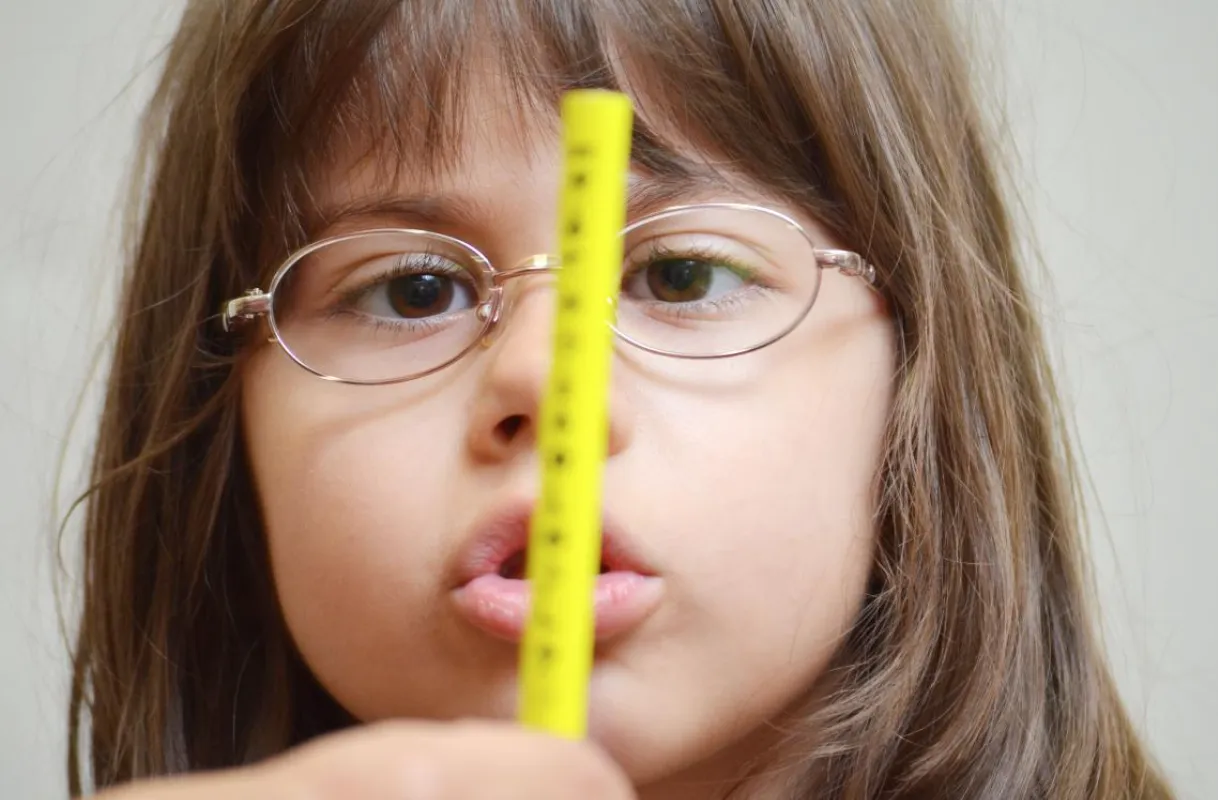
Four corner fixation looks almost too simple to be therapy: a target in the middle of the table, four numbered targets in the corners, a therapist calling out numbers. What it asks for is precise control over where the eyes stop and how cleanly they get there, the same control reading and copying from a board depend on. Here is how it runs, what it works on, and an honest account of what the research does and does not show.
Key takeaways
- A central “home base” target plus four numbered corner targets: the therapist calls a number, the eyes go there and hold, then return on the cue “home base.”
- It works two eye-movement skills, fixation stability and saccadic accuracy, and because the cue is spoken it adds a listening demand on top.
- Reading runs on fixations and saccades, and children’s eye movements differ measurably from adults’ (Rayner, 1998; Miller & O’Donnell, 2013).
- Tracking deficits are more common in children with dyslexia, 62% versus 15% (Raghuram et al., 2018), yet four of five severely impaired readers in a 5,822-child cohort had normal ophthalmic function (Creavin et al., 2015).
- No trial has tested this activity alone, and the best trial of vision therapy and reading was negative (CITT-ART, 2019). We use it to improve visual function, not to promise grades.
How the activity works
A central target sits in the middle of the work area. That is home base. In each corner is a target labeled 1, 2, 3 or 4. The patient starts by fixating home base; the therapist says a number; the patient shifts their gaze to whichever corner carries that number and holds it. The therapist then says, “home base,” and the eyes come back to the center.
Two details are what separate this from a guessing game. The head is meant to stay still, so the eyes do the work rather than the neck. And the landing matters as much as the destination: arriving in one clean movement is a different result from arriving in a jump plus a correction, so a therapist watches for that and says what they see.
What the activity works on
Fixation stability
Fixation means holding the eyes steady on one point in space. It sounds passive, but it is active work, and everything else sits on top of it. A patient who finds the right corner but cannot hold it for three seconds is telling us something quite different from one who lands off target in the first place.
Saccadic accuracy
The jump from home base to a corner is a saccade: a fast, ballistic eye movement aimed at a target. We watch three things. Does the eye arrive in one movement, or in a jump plus a correction? Is accuracy even in all four directions, since many patients are weaker on one diagonal? And does it hold up over two minutes, or fall apart once the task stops being novel?
The listening demand built into the cue
The cue is spoken, not pointed at. So the patient has to hear “three,” hold it in working memory, recall which corner carries it, and move their eyes there: a listening task and a visual task at once. That is what a classroom demands when a teacher talks while a child looks between board and paper. This is a description of what the task requires, not a claim that the activity treats a hearing or language difficulty.
Why eye movements matter for reading
Reading is not a smooth glide along the line. It is a chain of brief stops, called fixations, linked by fast jumps, and information about the text is taken in during the stops, not during the jumps (Rayner, 1998; Miller & O’Donnell, 2013). In skilled adults reading silently, most fixations last about 200 to 250 milliseconds. Children’s look different: they fixate longer, make shorter saccades, skip fewer words, make more regressive movements back to text they have already passed, and take in less per fixation, with a perceptual span of roughly 11 characters to the right of fixation compared with 14 to 15 in adults (Miller & O’Donnell, 2013).
The caveat is baked into the same research: eye movements during reading reflect how hard the words are to process, not only how well the eyes are steered (Rayner, 1998). Messy eye movements over text can signal a decoding difficulty rather than an eye-movement problem, which is why we also test eye movements away from text, as four corner fixation does.
What the research does and does not show
In a study of 29 children with developmental dyslexia and 33 typical readers, the children with dyslexia were more likely to have ocular motor tracking deficits (62% versus 15%) and accommodative deficits (55% versus 9%); it is a small sample, and the authors state plainly that the cause and clinical relevance are uncertain (Raghuram et al., 2018). In a cohort of 5,822 children, four of every five with severe reading impairment had normal ophthalmic function (Creavin et al., 2015). Both findings are true, and we quote both.
The strongest trial evidence in our field supports office-based vergence and accommodative therapy for symptomatic convergence insufficiency in children: 73% were successful or improved versus 35% with office placebo (CITT, 2008). The same group’s later trial found therapy no better than placebo for reading comprehension, 3.7 points versus 3.8 (CITT-ART, 2019). In children with learning disorders and a non-strabismic binocular vision anomaly, therapy improved binocular vision measures, but that study measured binocular vision, not reading (Hussaindeen et al., 2018).
The professional bodies disagree openly, and you deserve to know that. The joint statement from pediatrics and ophthalmology holds that vision problems can interfere with learning but do not cause dyslexia, and that eye exercises are not supported for learning disabilities (AAP/AAO/AAPOS/AACO, 2009). The optometric policy statement holds that vision problems can and often do interfere with learning, and that optometric care aims to improve visual function as part of multidisciplinary care (AAO/AOA, 1997).
Our clinical perspective: we treat vision, not reading. If a child spends effort placing their eyes that should go into understanding the sentence, that is worth measuring and addressing, alongside and never instead of evidence-based reading instruction.
One note on measurement: the widely used Developmental Eye Movement test, compared against an infrared eye tracker in 158 children, did not correlate with objectively recorded saccadic parameters, though it did correlate with reading performance and processing speed (Ayton et al., 2009). We treat a test time as one data point in the ocular motor dysfunction workup, not a diagnosis, and weigh it against what we see in activities like this one.
After a concussion
Saccadic problems turn up often after head injury: 29% of 100 adolescents in a concussion program had saccadic dysfunction, alongside accommodative disorders in 51% and convergence insufficiency in 49% (Master et al., 2016), and 70% of 113 adolescents examined 4 to 12 weeks after concussion had at least one oculomotor diagnosis (Scheiman et al., 2021). The 2022 clinical report from the American Academy of Pediatrics and its ophthalmology partners notes that most children recover on their own within four weeks, and recommends a vision-specific examination including pursuits, saccades and near point of convergence for those who do not (Master et al., 2022). No controlled trial shows that vision therapy speeds concussion recovery, so we say so plainly, here and on our concussion page.
Ways the task gets harder
Once the basic version is comfortable, therapists commonly raise the demand in familiar ways:
- Smaller targets, corners spread wider apart, or the set-up moved onto a vertical surface.
- Faster calls, or several numbers in a row with no return to home base.
- A metronome, so the eyes move on a beat rather than when they feel ready.
- Two-step cues, such as “three, then one.”
- A second task layered on top, such as naming a letter at each corner or counting backward.
- A balance demand, such as standing on an unstable surface while the eyes work.
Which of these a given patient meets, and when, is a decision for the therapist running the program, based on what they are seeing in the room.
The same logic drives our other saccade work, such as the Hart chart and the visual-search demands of Spot It. Four corner fixation is one procedure inside a program; our post on the goals and procedures of vision therapy explains how we decide which procedures a patient needs, and our vision therapy service page covers what a full program looks like.
Trying it at home
Home practice helps most when it repeats something a therapist has already shaped and watched. Without that feedback it can drift, with the head starting to turn and the landings getting sloppy, and the repetitions then reinforce the workaround instead of the skill. If four corner fixation is on your home list, keep sessions short, keep the head still, and bring questions to the next visit.
If your child loses their place when reading, skips lines or says the words move, or an adult in your family is still struggling with print and screens after a concussion, a comprehensive developmental vision evaluation is the place to start. See what that involves on our examinations page, or Schedule an evaluation.
Common Questions About This Topic
What is the four corner fixation activity?
It is a vision therapy procedure that uses a central target, called home base, plus four targets numbered 1 to 4 in the corners of the work area. The patient fixates home base, the therapist calls a number, the patient shifts their gaze to that corner and holds it, and then returns to home base on the cue 'home base.'
Why does the therapist say the number instead of pointing to the corner?
Because the spoken cue adds the listening half of the task. The patient has to hear the number, hold it in mind, remember which corner carries it, and move the eyes there without a visual prompt. That is closer to a classroom, where a teacher talks while a child looks between the board and the paper.
What skills does it work on?
Two eye-movement skills: fixation stability, which is holding the eyes steady on a point, and saccadic accuracy, which is landing on a new target in one clean jump instead of overshooting and correcting. Because the cue is spoken rather than pointed at, the task also carries a listening demand on top of the visual one.
Will this activity improve my child's reading?
We do not promise that, and the evidence does not support promising it. The largest randomized trial of office-based vision therapy in children with convergence insufficiency found no reading-comprehension advantage over placebo therapy. We use this activity to improve visual function and comfort at near, alongside, never instead of, evidence-based reading instruction.
Can we set this up at home?
Only if your therapist has assigned it and has watched you do it once. Without that feedback, practice can drift into head-turning and sloppy landings, and the repetitions then reinforce the workaround rather than the skill. Home work is meant to reinforce office sessions, not replace them.
Where This Information Comes From
- Rayner K (1998). Eye movements in reading and information processing: 20 years of research. Psychological Bulletin; 124(3):372-422. : Landmark review: reading proceeds through brief fixations linked by saccades, and eye-movement patterns reflect moment-to-moment cognitive processing, not muscle control alone.
- Miller B, O'Donnell C (2013). Opening a Window into Reading Development: Eye Movements' Role Within a Broader Literacy Research Framework. School Psychology Review; 42(2):123-139. : Skilled adult silent-reading fixations mostly last 200-250 ms; children fixate longer, make shorter saccades, skip fewer words, make more regressions, and have a smaller perceptual span (about 11 characters versus 14-15 in adults).
- Raghuram A, Gowrisankaran S, Swanson E, Zurakowski D, Hunter DG, Waber DP (2018). Frequency of Visual Deficits in Children With Developmental Dyslexia. JAMA Ophthalmology; 136(10):1089-1095. : Ocular motor tracking deficits in 62% of children with dyslexia versus 15% of typical readers, accommodative deficits 55% versus 9%, any visual deficit 79% versus 33%; the authors call the cause and clinical relevance uncertain.
- Creavin AL, Lingam R, Steer C, Williams C (2015). Ophthalmic abnormalities and reading impairment. Pediatrics; 135(6):1057-1065. : In 5,822 children aged 7-9, four of every five with severe reading impairment had normal ophthalmic function, and no association was found with convergence or accommodation.
- Ayton LN, Abel LA, Fricke TR, McBrien NA (2009). Developmental Eye Movement Test: What is it Really Measuring? Optometry and Vision Science; 86(6):722-730. : In 158 children aged 8-11, DEM test performance did not correlate with objectively recorded saccadic parameters or symptoms, though it did correlate with reading performance and visual processing speed (reading and processing-speed subsamples n=77 and n=75).
- Convergence Insufficiency Treatment Trial Study Group (2008). Randomized clinical trial of treatments for symptomatic convergence insufficiency in children. Archives of Ophthalmology; 126(10):1336-1349. : In 221 children aged 9-17, office-based vergence/accommodative therapy with home reinforcement produced a successful or improved outcome in 73% versus 35% with office placebo at 12 weeks.
- CITT-ART Investigator Group (2019). Effect of Vergence/Accommodative Therapy on Reading in Children with Convergence Insufficiency: A Randomized Clinical Trial. Optometry and Vision Science; 96(11):836-849. : In 310 children, reading comprehension improved 3.7 points with office-based therapy versus 3.8 points with placebo therapy: no reading advantage.
- Hussaindeen JR, Shah P, Ramani KK, Ramanujan L (2018). Efficacy of vision therapy in children with learning disability and associated binocular vision anomalies. Journal of Optometry; 11(1):40-48. : After 10 therapy sessions, children with learning disorders improved on binocular vision measures; reading and academic scores were not the outcomes measured.
- American Academy of Pediatrics Section on Ophthalmology and Council on Children with Disabilities; American Academy of Ophthalmology; AAPOS; AACO (2009). Joint statement - Learning disabilities, dyslexia, and vision. Pediatrics; 124(2):837-844. : Holds that dyslexia is language-based, that vision problems can interfere with learning but do not cause dyslexia, and that evidence does not support eye exercises or behavioral vision therapy for learning disabilities.
- American Academy of Optometry; American Optometric Association (1997). Vision, learning and dyslexia: a joint organizational policy statement. Journal of the American Optometric Association; 68(5):284-286. : Holds that vision problems can and often do interfere with learning, and that the goal of optometric intervention is to improve visual function as one part of multidisciplinary care.
- Master CL, Scheiman M, Gallaway M, Goodman A, Robinson RL, Master SR, Grady MF (2016). Vision Diagnoses Are Common After Concussion in Adolescents. Clinical Pediatrics; 55(3):260-267. : Among 100 adolescents in a concussion program, 69% had a vision diagnosis: accommodative 51%, convergence insufficiency 49%, saccadic dysfunction 29%.
- Scheiman M, Grady MF, Jenewein E, Shoge R, Podolak OE, Howell DH, Master CL (2021). Frequency of oculomotor disorders in adolescents 11 to 17 years of age with concussion, 4 to 12 weeks post injury. Vision Research; 183:73-80. : Of 113 adolescents examined 4-12 weeks after concussion, 70% had at least one oculomotor diagnosis, and physician screening had limited sensitivity.
- Master CL, Bacal D, Grady MF, et al.; AAP Section on Ophthalmology, AAO, AAPOS, AACO (2022). Vision and Concussion: Symptoms, Signs, Evaluation, and Treatment. Pediatrics; 150(2):e2021056047. : Clinical report: most children recover on their own by 4 weeks; those who do not warrant a vision-specific examination including pursuits, saccades, near point of convergence and accommodation.
Care We Provide
More From the Blog
Wondering If This Sounds Like Your Family?
A developmental vision evaluation measures the skills a routine eye exam does not. Our team sees children and adults in Coconut Creek, Boynton Beach, Boca Raton and West Palm Beach.