Vision Therapy Activity: Spot It
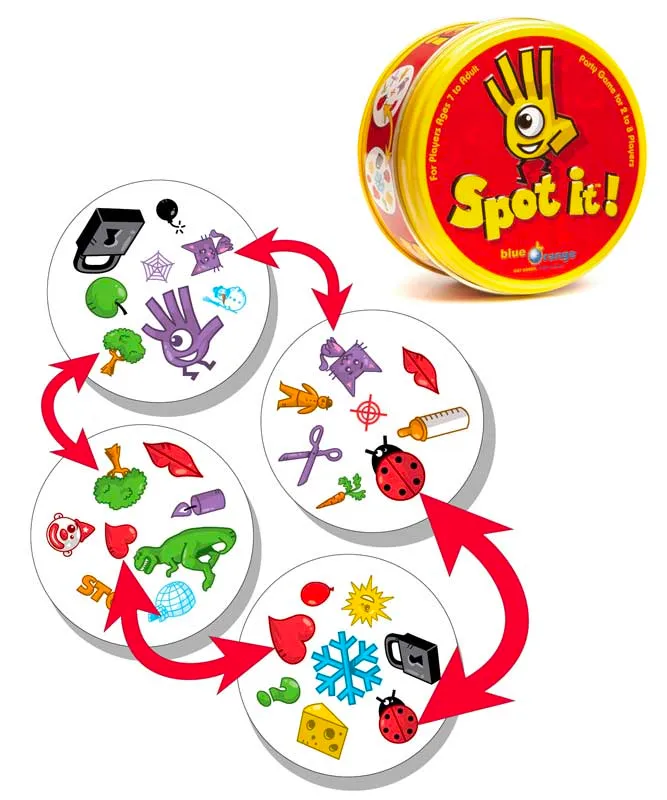
To the average shopper, Spot It looks like an ordinary matching card game: a tin of round cards covered in cartoon symbols. To a vision therapist it is one of the fastest, least intimidating ways to see how someone’s eyes behave under a little pressure. That is down to the deck’s one design rule: any two cards share exactly one symbol. The answer is always there, so the only thing that varies is how efficiently the eyes and brain go and get it.
Key takeaways
- We use Spot It in vision therapy as an observation tool and a loaded practice task, never as a treatment on its own.
- One round shows fixation, saccades, pursuits, visual discrimination, figure-ground and processing speed working together.
- We change the demand, not the game: fewer cards for a five-year-old; timing, patching, movement or balance for an older child or adult.
- Reading runs on fixations and saccades (Rayner, 1998), and eye-movement and visual-motor scores track with school performance (Hopkins et al., 2019) - an association, not proof that a card game improves schoolwork.
- Trials support the full office-based program for specific diagnoses (CITT trial, 2008) and found no reading benefit over placebo (CITT-ART, 2019).
What a therapist watches in one round
Fixation: can the eyes stay put?
To find a match you have to hold your gaze on one symbol long enough to identify it, then hold the next one long enough to compare. What we typically see in the therapy room is different: a patient looks at the first card, breaks away to glance around the room, comes back, and by then the comparison starts over. In our clinical experience that break is not laziness; we read it as a fixation system that cannot hold comfortably and keeps resetting. That is our clinical impression, not something the research settles.
Saccades: do the eyes land where they mean to?
The rapid back-and-forth between cards, symbol by symbol, is a string of saccades - the same class of eye movement reading depends on. Reading is not a smooth glide along a line but brief fixations separated by fast jumps, and those patterns reflect moment-to-moment processing (Rayner, 1998).
What we often see when saccades are inaccurate is a patient who bounces between the two cards, plainly looking at both, and still cannot call the match as fast as you would expect, going back over symbols already covered. We work that skill more formally in activities such as four-corner fixation.
Pursuits: can the eyes follow?
Now slide one card gently while the search continues. The patient has to follow a moving target with smooth pursuit while still fixating individual symbols and saccading between cards - all three basic eye movements at once.
Discrimination, figure-ground and speed
Spot It also loads the perceptual side. A symbol appears in different sizes and rotations from card to card, so the brain has to recognize it as the same thing anyway. Picking one target out of a crowded cluster is figure-ground, and beating an opponent to it adds a speed demand - skills we cover in our guide to visual perceptual skills. We time rounds to look for consistency, not to crown a winner: someone who finds the first match in two seconds and the seventh in fifteen is telling us about visual endurance.
Changing it by age, and playing at home
We use the same principles from roughly age five into adulthood, adjusting the load rather than switching games, because visual search itself changes with age. Across 298 people aged 6 to 89, search was slower early and late in life, and children were affected particularly by the mere presence of distractors (Hommel et al., 2004); in 293 participants aged 4 to 25, accuracy matured earliest and search efficiency last (Gil-Gomez de Liano et al., 2020).
- Ages 5-7: a junior deck or a trimmed set, no clock, naming the symbol out loud instead of racing.
- Ages 8-12: the full deck and timing, then added demands such as naming the symbol’s color out loud, standing on a balance board, or patching one eye when the plan calls for it.
- Teens and adults: longer sequences and dual tasks. After a concussion we go the other way - short bouts, stopping at the first symptom.
At home, play it as a family game whenever you like, but use it as assigned therapy only if your therapist has set it up for you. Office-based programs are built that way on purpose: the trial protocols paired weekly visits of about an hour with roughly 15 minutes of home practice five days a week, with procedures sequenced easiest to hardest (CITT protocol, 2008).
What is and is not known about training these skills
The skills Spot It touches do travel with school performance. Visual-motor integration and eye-movement timing were the visual measures most associated with reading and math in 222 second-graders (Hopkins et al., 2019), and visual-motor scores tracked with teachers’ ratings of reading, math, writing and spelling in 191 younger children (Taylor Kulp, 1999). Children with dyslexia showed tracking deficits far more often than typical readers, 62% versus 15%, though those authors called the cause and clinical relevance uncertain (Raghuram et al., 2018), and children referred for reading and writing difficulty had weaker focusing and vergence facility (Dusek et al., 2010).
Those are associations, and they cut both ways. Once reading ability was accounted for, a standard eye-movement test was a poor predictor of reading rate (Webber et al., 2011). In a cohort of 5,822 children, four of every five with severe reading impairment had normal ophthalmic function (Creavin et al., 2015). When children with learning disorders received vision therapy, what improved were binocular vision measures, not academic ones (Hussaindeen et al., 2018). And in 310 children with symptomatic convergence insufficiency, reading comprehension improved 3.7 points with office-based therapy versus 3.8 with placebo (CITT-ART, 2019).
What controlled trials do support is the complete office-based vergence and focusing program, with home reinforcement, for specific diagnoses: 73% successful or improved at 12 weeks versus 35% on office placebo in the 221-child CITT (CITT trial, 2008), confirmed by a Cochrane network meta-analysis of 12 trials (Scheiman et al., 2020). We know of no trial that has tested Spot It on its own, and we would not expect one.
The professional bodies disagree here too. A joint statement from pediatrics and ophthalmology groups holds that vision problems can interfere with learning but do not cause dyslexia, and that vision therapy is not supported for learning disabilities (AAP/AAO/AAPOS/AACO, 2009). The optometric position is that vision problems can and often do interfere with learning, and that optometric care is one part of multidisciplinary care (AAO/AOA, 1997). Our clinical perspective, offered as ours: when a patient is uncomfortable or inefficient at near, finding and treating that is worth doing on its own terms - never as a substitute for reading instruction or tutoring.
Where Spot It fits in a program
Spot It is never a plan by itself. It sits inside a sequence built from an evaluation, alongside the procedures in our overview of vision therapy goals and procedures and our learning-related vision care. Its jobs are to show us how the eyes are working, and to hold attention long enough for the real work to happen.
So the next time your family plays at the kitchen table, watch the eyes rather than the score. If someone repeatedly loses their place, says the symbols swim, or gets a headache after a few rounds, that is worth a proper look. A comprehensive developmental vision evaluation is where we start. Schedule an evaluation at our Boynton Beach or Boca Raton office.
Originally written by Abid Khan, Vision Therapist, at Vision & Learning Center. Updated by our clinical team.
Common Questions About This Topic
How is Spot It used in vision therapy?
Two ways. First as an observation window: in a single round we can watch how steadily someone holds a target, how accurately they jump from card to card, and how quickly they tell similar symbols apart. Then as a loaded practice task, where we add movement, timing, a patch or a naming rule to make the same search harder on purpose.
What eye movements does Spot It involve?
Fixation, which is holding the eyes steady on one symbol long enough to identify it. Saccades, the fast jumps from card to card and symbol to symbol. And pursuits, if the therapist gently moves a card so the eyes have to follow it while the search continues.
What ages is Spot It useful for?
We have used the same principles with patients from roughly age five into adulthood, changing the demand rather than the game. Younger children get fewer cards, fewer symbols and no clock. Older children, teens and adults get the full deck, timing, and added balance or movement demands.
Does playing Spot It improve reading?
There is no evidence that it does, and we do not claim it. The largest randomized trial of office-based vision therapy in children with convergence insufficiency found no reading advantage over placebo therapy. What controlled trials support is the full office-based program for specific binocular and focusing diagnoses. Spot It is one small piece of such a program, not a reading treatment.
Can we play Spot It at home as therapy?
Play it as a family game any time. Use it as therapy only if your therapist has assigned it and shown you the set-up, because the value is in the specific demand being added, not in the cards. Home practice reinforces what happens in the office; it does not replace it.
Where This Information Comes From
- Rayner K (1998). Eye movements in reading and information processing: 20 years of research. Psychological Bulletin; 124(3):372-422. : Landmark review: reading proceeds as brief fixations separated by fast saccades, and eye-movement patterns reflect moment-to-moment cognitive processing.
- Webber A, Wood J, Gole G, Brown B (2011). DEM test, visagraph eye movement recordings, and reading ability in children. Optometry and Vision Science; 88(2):295-302. : In 59 children, slower eye-movement test times went with slower reading, but once reading ability was accounted for the eye-movement test was a poor predictor of reading rate.
- Hopkins S, Black AA, White SLJ, Wood JM (2019). Visual information processing skills are associated with academic performance in Grade 2 school children. Acta Ophthalmologica; 97(8):e1141-e1148. : In 222 second-graders, visual-motor integration and horizontal eye-movement timing were the visual measures most associated with reading and math; models explained 28.6% and 24.1% of score variance.
- Taylor Kulp M (1999). Relationship between visual motor integration skill and academic performance in kindergarten through third grade. Optometry and Vision Science; 76(3):159-163. : In 191 children, visual-motor integration scores were significantly related to teachers' ratings of reading, math, writing and spelling. Correlational only.
- Raghuram A, Gowrisankaran S, Swanson E, Zurakowski D, Hunter DG, Waber DP (2018). Frequency of visual deficits in children with developmental dyslexia. JAMA Ophthalmology; 136(10):1089-1095. : 29 children with dyslexia vs 33 typical readers: ocular motor tracking deficits in 62% vs 15%, focusing deficits in 55% vs 9%; the authors state the cause and clinical relevance are uncertain.
- Dusek W, Pierscionek BK, McClelland JF (2010). A survey of visual function in an Austrian population of school-age children with reading and writing difficulties. BMC Ophthalmology; 10:16. : 825 children referred for reading and writing difficulty had lower accommodative amplitude, reduced focusing and vergence facility, a receded near point of convergence and slower reading than 328 controls. Referral sample; association only.
- Hommel B, Li KZH, Li SC (2004). Visual search across the life span. Developmental Psychology; 40(4):545-558. : In 298 people aged 6 to 89, visual search was substantially slowed early and late in life; children's performance was particularly affected by the mere presence of distractors.
- Gil-Gomez de Liano B, Quiros-Godoy M, Perez-Hernandez E, Wolfe JM (2020). Efficiency and accuracy of visual search develop at different rates from early childhood through early adulthood. Psychonomic Bulletin & Review; 27(3):504-511. : In 293 participants aged 4 to 25, accuracy matured earliest while search efficiency (the cost of each added distractor) reached adult levels last.
- Convergence Insufficiency Treatment Trial (CITT) Study Group (2008). The convergence insufficiency treatment trial: design, methods, and baseline data. Ophthalmic Epidemiology; 15(1):24-36. : Protocol paper, free full text: the office-based program used weekly in-office visits of approximately 60 minutes plus 15 minutes of home therapy 5 days a week, with procedures arranged sequentially from easiest to most difficult.
- Convergence Insufficiency Treatment Trial Study Group (2008). Randomized clinical trial of treatments for symptomatic convergence insufficiency in children. Archives of Ophthalmology; 126(10):1336-1349. : In 221 children aged 9-17, office-based vergence/accommodative therapy with home reinforcement produced a successful or improved outcome in 73% versus 35% with office placebo at 12 weeks.
- Scheiman M, Kulp MT, Cotter SA, Lawrenson JG, Wang L, Li T (2020). Interventions for convergence insufficiency: a network meta-analysis. Cochrane Database of Systematic Reviews; 12:CD006768. : Across 12 trials and 1,289 participants, office-based vergence/accommodative therapy beat placebo in children (RR 3.04, 95% CI 2.32-3.98); the adult evidence is less clear.
- CITT-ART Investigator Group (2019). Effect of vergence/accommodative therapy on reading in children with convergence insufficiency: a randomized clinical trial. Optometry and Vision Science; 96(11):836-849. : In 310 children, reading comprehension improved 3.7 points with office-based vision therapy versus 3.8 points with placebo therapy: no reading advantage.
- Hussaindeen JR, Shah P, Ramani KK, Ramanujan L (2018). Efficacy of vision therapy in children with learning disability and associated binocular vision anomalies. Journal of Optometry; 11(1):40-48. : After 10 vision therapy sessions, children with learning disorders improved on nearly all binocular vision measures; the outcomes measured were binocular function, not reading or grades.
- Creavin AL, Lingam R, Steer C, Williams C (2015). Ophthalmic abnormalities and reading impairment. Pediatrics; 135(6):1057-1065. : In 5,822 children, four of every five with severe reading impairment had normal ophthalmic function, with no association found with convergence or accommodation.
- American Academy of Pediatrics, American Academy of Ophthalmology, AAPOS, AACO (2009). Joint statement - learning disabilities, dyslexia, and vision. Pediatrics; 124(2):837-844. : Vision problems can interfere with learning but do not cause dyslexia; eye exercises and behavioral vision therapy are not supported as treatments for learning disabilities.
- American Academy of Optometry; American Optometric Association (1997). Vision, learning and dyslexia: a joint organizational policy statement. Journal of the American Optometric Association; 68(5):284-286. : Optometric position: vision problems can and often do interfere with learning, and optometric care aims to improve visual function as one part of multidisciplinary care.
Care We Provide
More From the Blog
Wondering If This Sounds Like Your Family?
A developmental vision evaluation measures the skills a routine eye exam does not. Our team sees children and adults in Coconut Creek, Boynton Beach, Boca Raton and West Palm Beach.