How to Choose Glasses for Your Child
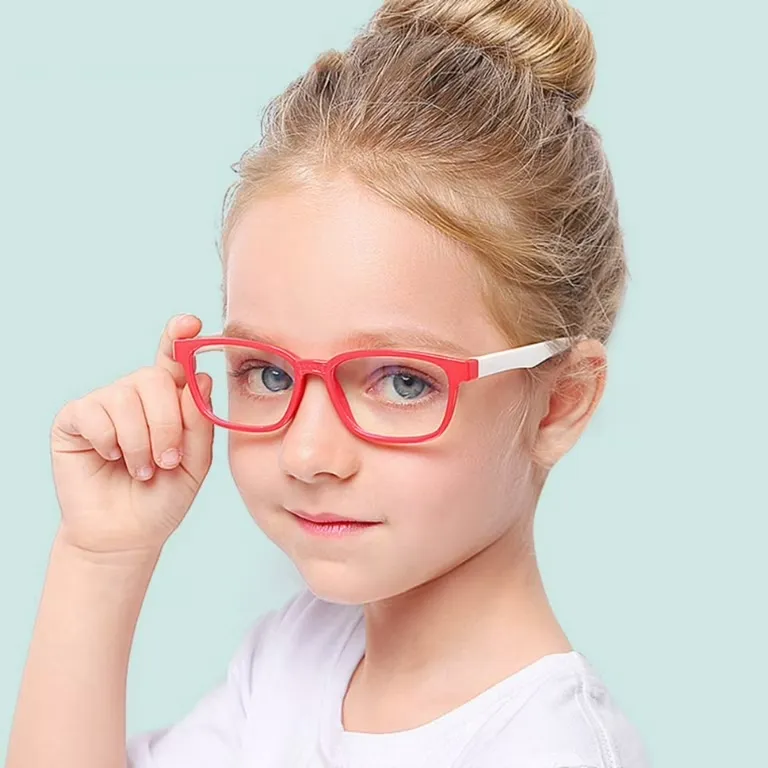
A new pair of glasses only helps if your child actually wears them. That sounds obvious, but it is the part families most often underestimate. In a systematic review of 23 studies covering 7,859 children with refractive error, pooled compliance with spectacle wear was just 40% — and across individual studies it ranged from under 10% to about 79% (Dhirar et al., 2020).
So the job is bigger than picking a cute frame. You are looking for glasses your child can see clearly through, keep on their face all day, and not mind being seen in. Here is how we help families work through that choice.
Key takeaways
- Fit matters more than style: glasses that slide down the nose get pushed up onto the head and left there.
- Ask for polycarbonate or Trivex lenses. Polycarbonate is the most shatter-resistant clear lens material available (AAO/AAP, 2013).
- Ask for full UV blocking. A child’s crystalline lens filters less ultraviolet light than an adult’s (Weale, 1988).
- Let your child pick the look, within the options you have already vetted.
- Keep a backup pair. Lost, broken and forgotten glasses are among the leading reasons children stop wearing them (Dhirar et al., 2020).
- Everyday glasses are not sports protection. That is a separate, certified pair.
Start with the prescription, not the frames
The frame is the last decision, not the first. What the lenses need to do comes out of the examination — the type and size of the refractive error, whether the two eyes match, and whether your child is being followed for something like amblyopia or an eye turn. Refractive error is not a minor detail in childhood: in a population-based study of 6,014 preschoolers, 78% of amblyopia cases were attributable to refractive error (MEPEDS, 2008).
Uncorrected focusing error can also show up in schoolwork. Four- and five-year-olds with uncorrected moderate farsightedness (+3.00 to +6.00 D) scored 4.3 points lower on a standardized early-literacy test than their peers without it (Kulp et al., 2016). That is an association, not proof that glasses raise reading scores — but it is a fair reason to take an uncorrected prescription seriously.
If you want the background on what glasses actually correct, see our explainers on why some people need glasses and on refractive error.
Seven things to look for
1. Fit comes first
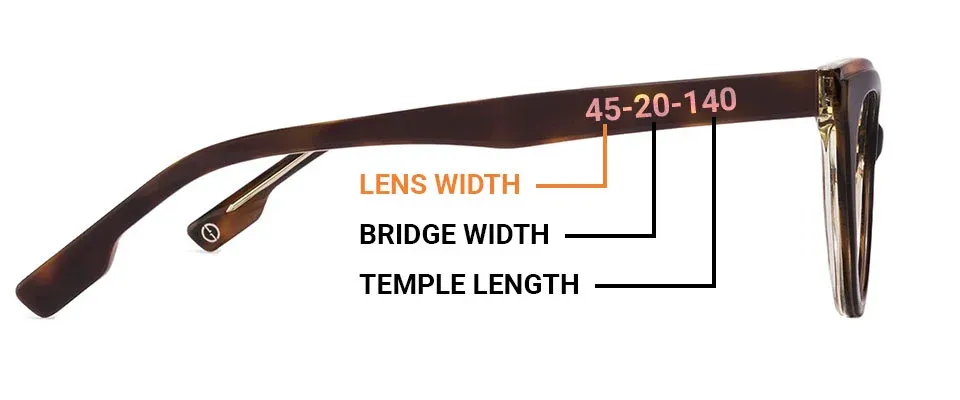
If the glasses do not fit, nothing else on this list matters. The bridge should carry the weight without pinching or leaving deep marks. The temples should follow the head and rest on the ears without squeezing. And your child’s eyes should sit roughly in the middle of the lenses, both horizontally and vertically — a frame that rides low makes your child look over the top of the correction rather than through it.
For infants and toddlers, cable temples that curve behind the ear, or a soft strap, keep the frame in place through crawling, napping and determined removal attempts.
2. Frames built for real life
Look for spring hinges that let the temples flex outward instead of snapping, a one-piece bridge rather than soldered joints, and flexible plastics or titanium alloys. Lightweight frames are more comfortable, and comfortable frames stay on.
3. Impact-resistant lenses
For children, this is not optional. The American Academy of Ophthalmology’s protective eyewear statement is direct: polycarbonate is the most shatter-resistant clear lens material and should be used for all safety eyewear (AAO/AAP, 2013). We also fit Trivex, another impact-resistant material that some patients prefer optically; both are lighter than standard plastic.
For stronger prescriptions, high-index materials thin the lens down so it is lighter at the edge — worth discussing, because a heavy lens is a frame that slides.
4. Full UV protection
Children are often outdoors for school recess and sport, and their eyes filter less ultraviolet light than an adult’s. Spectrophotometry of human crystalline lenses aged 0 to 85 years found absorbance rises systematically with age across both the visible and ultraviolet spectrum, so a young lens transmits more UV to the retina (Weale, 1988). In young adults, the ultraviolet reaching the retina varied by more than a factor of 30 between individuals (Hammond & Renzi-Hammond, 2018).
Ask for 100% UV blocking on the clear lenses, and consider photochromic lenses or a dedicated pair of prescription sunglasses for a child who plays outdoors. This is about protecting outdoor time, not limiting it — outdoor activity is associated with a lower risk of developing myopia, roughly halving onset risk in clinical trials, though it does not slow progression once myopia is present (Xiong et al., 2017).
5. Let your child choose the look
Narrow the tray to frames that fit and meet the safety criteria, then hand the choice over. Social discomfort is a recurring reason children stop wearing glasses (Dhirar et al., 2020), and a child who picked the color has something invested in wearing it.
6. Plan on a backup pair
Broken, lost and forgotten glasses accounted for roughly a quarter (23%) of the reasons children were not wearing theirs (Dhirar et al., 2020). A spare pair — an older prescription still close enough, or a second inexpensive set — means one rough afternoon does not turn into three weeks of squinting at the board.
7. Book the adjustments and the follow-up
Children grow, and in our experience frames drift out of alignment quickly with normal wear. Adjustments are quick — ask wherever the glasses were dispensed whether they are included. Keep the exam schedule too: the American Optometric Association recommends a comprehensive eye examination before first grade and annually after that for school-age children (AOA, 2017).
Why children stop wearing their glasses
When a child refuses glasses, there is almost always a reason, and it is rarely stubbornness. In the pooled data, the categories were personal factors (about 26%), breakage, loss or forgetting (about 23%), social factors (about 13%), and visual complaints or headaches (about 5%) (Dhirar et al., 2020).
That last group is the one we most want to hear about. If glasses are comfortable at distance but your child avoids them for reading, complains of headaches or blur at near, or says words move on the page, that pattern may reflect how the two eyes work together rather than the prescription itself — and it deserves a look. Our post on why a child will not wear their glasses walks through the common causes one at a time.
Sports and screens: the pairs beyond the everyday frame
Everyday glasses are not eye protection. From 1990 to 2012, an estimated 441,800 US children were treated in emergency departments for sports- and recreation-related eye injuries, about 26.9 per 100,000 children each year, with basketball (15.9%) and baseball or softball (15.2%) leading the list (Miller et al., 2018). For sports, ask for goggles with polycarbonate lenses certified to the standard for that sport — ASTM F803 for racquet sports, basketball and baseball fielders, F910 for youth baseball batters and base runners, F513 for ice hockey. A child who sees poorly in one eye should wear protection for all sports (AAO/AAP, 2013).
Screens are the other place glasses get tested. If your child is fine in class but tired and irritable after an hour of homework on a laptop, the working distance and the schedule are worth reviewing alongside the prescription — our complete screen-time guide for parents covers what the evidence supports and what it does not.
How we think about it
Our clinical perspective at Vision & Learning Center is that a glasses prescription is one finding out of many. We check the refraction carefully, then look at how the eyes team, focus and track, because a child whose glasses are correct can still be uncomfortable at near for reasons a lens alone does not address. We would rather find that at the exam than after a school year of avoided homework.
If your child is due for a first pair, a renewal, or you have new glasses that are somehow never on their face, we can measure what is going on and help you choose frames and lenses that fit the prescription and the kid. Schedule an evaluation at our Boynton Beach or Boca Raton office, or read more about what a comprehensive examination includes.
Common Questions About This Topic
What lens material is safest for children's glasses?
Polycarbonate is the standard choice for children. The American Academy of Ophthalmology's protective eyewear statement calls polycarbonate the most shatter-resistant clear lens material and says it should be used for all safety eyewear. We also fit Trivex, another impact-resistant material that some patients find optically crisper.
Do children's glasses really need UV protection?
Ask for it. Laboratory work on human crystalline lenses shows absorbance rises systematically with age, meaning a young lens filters less ultraviolet light than an adult one, and a study of young adults found the amount of UV reaching the retina varied more than thirtyfold between individuals. Full UV blocking costs little and is easy to add.
Should my child have a backup pair of glasses?
For most school-age children, yes. Lost, broken and forgotten glasses account for roughly a quarter of the reasons children stop wearing them in the published research, and a spare pair kept at home or in a backpack means one bad afternoon does not cost weeks of blurry vision.
Can my child wear regular glasses for sports?
Everyday frames are not sports protection. For basketball, baseball, racquet sports and similar activities, ask for sports goggles certified to the relevant ASTM standard with polycarbonate lenses. Children who see poorly in one eye should wear protective eyewear for all sports.
How often should children's glasses be checked?
Bring them in any time the fit slips or the lenses are scratched, and keep to a regular exam schedule. The American Optometric Association recommends a comprehensive eye examination before first grade and annually thereafter for school-age children.
Where This Information Comes From
- Dhirar N, Dudeja S, Duggal M, Gupta PC, Jaiswal N, Singh M, Ram J (2020). Compliance to spectacle use in children with refractive errors - a systematic review and meta-analysis. BMC Ophthalmology; 20:71. doi:10.1186/s12886-020-01345-9 : 23 cross-sectional studies and 7,859 children; across the 20 studies reporting it, pooled compliance with spectacle wear was 40.14% (95% CI 32.78-47.50), ranging from 9.84% to 78.57%. Reasons for non-wear: personal 25.78%, breakage/loss/forgetfulness 23.34%, social 13.18%, visual problems/headache 5.47%.
- American Academy of Ophthalmology, American Academy of Pediatrics (2013). Protective Eyewear for Young Athletes (clinical statement). San Francisco: AAO. : States that polycarbonate is the most shatter-resistant clear lens material and should be used for all safety eyewear, lists ASTM certification standards by sport, and says all functionally one-eyed athletes should wear eye protection for all sports.
- Miller KN, Collins CL, Chounthirath T, Smith GA (2018). Pediatric Sports- and Recreation-Related Eye Injuries Treated in US Emergency Departments. Pediatrics; 141(2):e20173083. doi:10.1542/peds.2017-3083 : An estimated 441,800 US children aged 17 and under were treated in emergency departments for sports- and recreation-related eye injuries from 1990-2012 (26.9 per 100,000 per year); basketball (15.9%) and baseball/softball (15.2%) led the causes.
- Weale RA (1988). Age and the transmittance of the human crystalline lens. Journal of Physiology; 395:577-587. doi:10.1113/jphysiol.1988.sp016935 : Spectrophotometry of 24 excised human lenses aged 0-85 years found a systematic increase in absorbance with age in both the visible and ultraviolet spectrum, so younger lenses transmit more UV.
- Hammond BR Jr, Renzi-Hammond L (2018). Individual variation in the transmission of UVB radiation in the young adult eye. PLoS ONE; 13(7):e0199940. doi:10.1371/journal.pone.0199940 : In 42 young adults (mean age 19), all detected 315 nm ultraviolet radiation reaching the retina and individual variation exceeded a factor of 30.
- Multi-ethnic Pediatric Eye Disease Study Group (2008). Prevalence of amblyopia and strabismus in African American and Hispanic children ages 6 to 72 months: the Multi-ethnic Pediatric Eye Disease Study. Ophthalmology; 115(7):1229-1236.e1. : In 6,014 preschool children, amblyopia affected 1.5-2.6% and 78% of amblyopia cases were attributable to refractive error.
- VIP-HIP Study Group; Kulp MT, Ciner E, Maguire M, et al. (2016). Uncorrected Hyperopia and Preschool Early Literacy: Results of the Vision in Preschoolers-Hyperopia in Preschoolers (VIP-HIP) Study. Ophthalmology; 123(4):681-689. : Uncorrected hyperopes (+3 to +6 D) aged 4-5 scored 4.3 points lower on an early-literacy test than emmetropes; an association only, not evidence that glasses raise literacy scores.
- American Optometric Association (2017). Evidence-Based Clinical Practice Guideline: Comprehensive Pediatric Eye and Vision Examination. St. Louis: AOA. : Recommends a comprehensive eye examination at 6-12 months, at least once between 3 and 5 years, and before first grade and annually thereafter; notes acuity-only screening missed 75.5% of children later found to have binocular and oculomotor problems.
- Xiong S, Sankaridurg P, Naduvilath T, et al. (2017). Time spent in outdoor activities in relation to myopia prevention and control: a meta-analysis and systematic review. Acta Ophthalmologica; 95(6):551-566. : Outdoor time was protective against myopia onset (risk ratio about 0.54 in clinical trials) but did not slow progression in eyes that were already myopic.
Care We Provide
More From the Blog
Wondering If This Sounds Like Your Family?
A developmental vision evaluation measures the skills a routine eye exam does not. Our team sees children and adults in Coconut Creek, Boynton Beach, Boca Raton and West Palm Beach.