What Is a Developmental Optometrist?
Parents usually meet the phrase “developmental optometrist” in the middle of a different search. A teacher, an occupational therapist or another parent suggests one, and the next question is a reasonable one: my child already has an eye doctor, so what is this, and do we need it?
A developmental optometrist is an optometrist who concentrates on how vision works in use. The question is not only “can this child see the letters?” but “can this child keep both eyes aimed, focused and moving accurately for as long as schoolwork requires?” This article explains the role, how it differs from the other eye care professionals you may see, and when a different doctor is the right choice.
Key takeaways
- A developmental optometrist is a Doctor of Optometry who diagnoses and treats problems with eye teaming, focusing, eye movements and visual processing, using lenses, prisms and vision therapy. You may also see the terms behavioral optometrist or vision therapy optometrist.
- Eye disease and eye surgery belong to ophthalmologists, who are physicians. A pediatric ophthalmologist adds a fellowship in children’s eye conditions (AAO, 2026; AAPOS, 2024).
- Reading 20/20 on a chart does not settle the question. Acuity testing alone missed 75.5% of children later found to have eye teaming or eye movement problems on a complete examination (AOA, 2017).
- Vision therapy is well supported for symptomatic convergence insufficiency in children (CITT, 2008; Scheiman et al., 2020). It is not a treatment for dyslexia and has not been shown to raise reading scores (CITT-ART, 2019; AAP/AAO/AAPOS/AACO, 2009).
- “Developmental optometrist” is not a separate license. The credential to look for is FOVDR, or FCOVD on older listings.
What a developmental optometrist is
Every developmental optometrist is an optometrist first. That means a Doctor of Optometry (OD) degree, earned in four years of optometry school after college (AAO, 2026), and a state license to examine eyes, diagnose vision conditions and prescribe glasses and contact lenses.
What makes the practice “developmental” is where the doctor spends their time. Vision is learned as a child grows. Aiming two eyes at one point, holding focus up close and moving the eyes smoothly across a page are skills that develop over years, and they do not always develop evenly. A developmental optometrist measures those skills in detail and treats them when they fall short.
The words developmental, behavioral and neuro-developmental are used loosely and often describe the same kind of practice. None of them is a license or a protected title. That is why the certification below matters more than the label.
How this differs from other eye care professionals
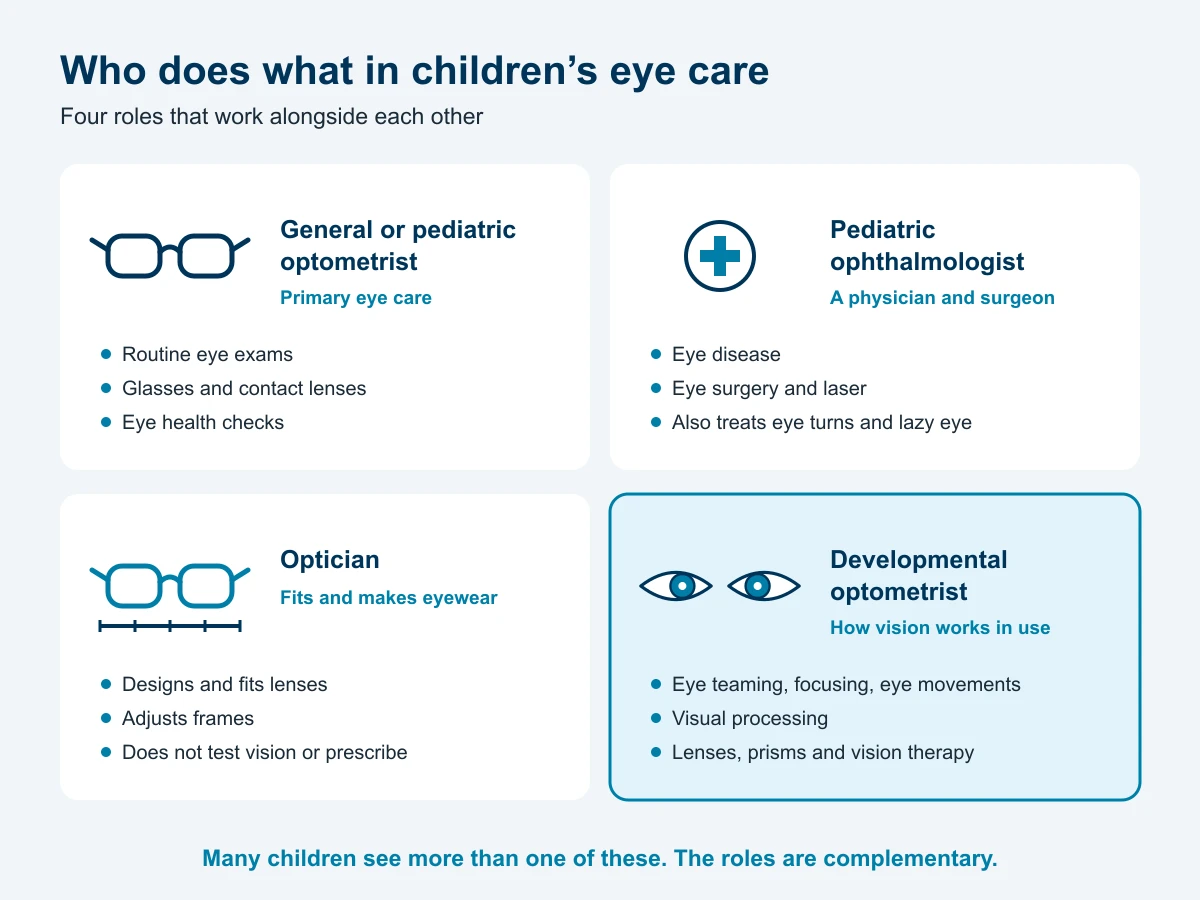
Four kinds of professional work with children’s eyes. Their roles are complementary, and many children see more than one of them.
A general or pediatric optometrist provides primary eye care: checking eye health, measuring the prescription, and prescribing glasses or contacts. “Pediatric” tells you the doctor is comfortable examining children. It does not necessarily mean the office runs the longer battery of eye teaming, focusing and eye movement tests, or offers vision therapy. This is the right doctor for routine exams, and most children should have one.
A pediatric ophthalmologist is a physician. Ophthalmologists are medical or osteopathic doctors with 12 to 14 years of education and training who diagnose and treat all eye diseases and perform eye surgery (AAO, 2026). Pediatric ophthalmologists go on to complete a fellowship in children’s eye conditions, and their treatments include surgery and laser (AAPOS, 2024). They also diagnose and treat crossed or drifting eyes and amblyopia, so there is real overlap with developmental optometry in those conditions.
An optician is a technician trained to design, verify and fit eyeglass lenses. Opticians do not test vision or write prescriptions (AAO, 2026).
A developmental optometrist sits alongside these roles. We do not perform surgery and we are not the place for managing eye disease. Our work is the functional side of vision: how well the system performs during reading, writing, sports and screen use, and what can be done without surgery to improve it.
What the FOVDR credential means
Because the title itself is unregulated, the clearest signal of additional training is board certification.
FOVDR stands for Fellow of Optometric Vision Development and Rehabilitation. It is the board certification in vision development and vision therapy awarded by the Optometric Vision Development and Rehabilitation Association (OVDRA). The organization was formerly known as the College of Optometrists in Vision Development (COVD), so doctors certified under the old name are listed as FCOVD. The two sets of letters refer to the same fellowship.
The credential tells you the optometrist pursued and was examined on post-graduate training in this specific area, beyond what the optometry degree requires. It does not tell you whether a given child needs treatment. That still depends on what the testing shows.
Dr. Christina Murray, OD, FOVDR, who founded our practice in 2017, is a graduate of The Ohio State University and Nova Southeastern University and holds this fellowship. There is more about her background on our about page.
What a developmental vision evaluation measures
A school screening checks one thing well: how clearly a child sees letters at a distance. A routine comprehensive exam adds eye health and an accurate prescription. Both are worth having, and neither is designed to measure sustained near work in depth.
That gap is larger than most parents expect. The American Optometric Association’s pediatric guideline reports that acuity testing alone missed 75.5% of children later found to have binocular and eye movement problems on a complete examination (AOA, 2017). These problems are not rare, either. In one school-based study, about 13% of fifth- and sixth-graders met high-suspect or definite criteria for convergence insufficiency, an eye teaming problem at near (Rouse et al., 1999).
A developmental vision evaluation looks at:
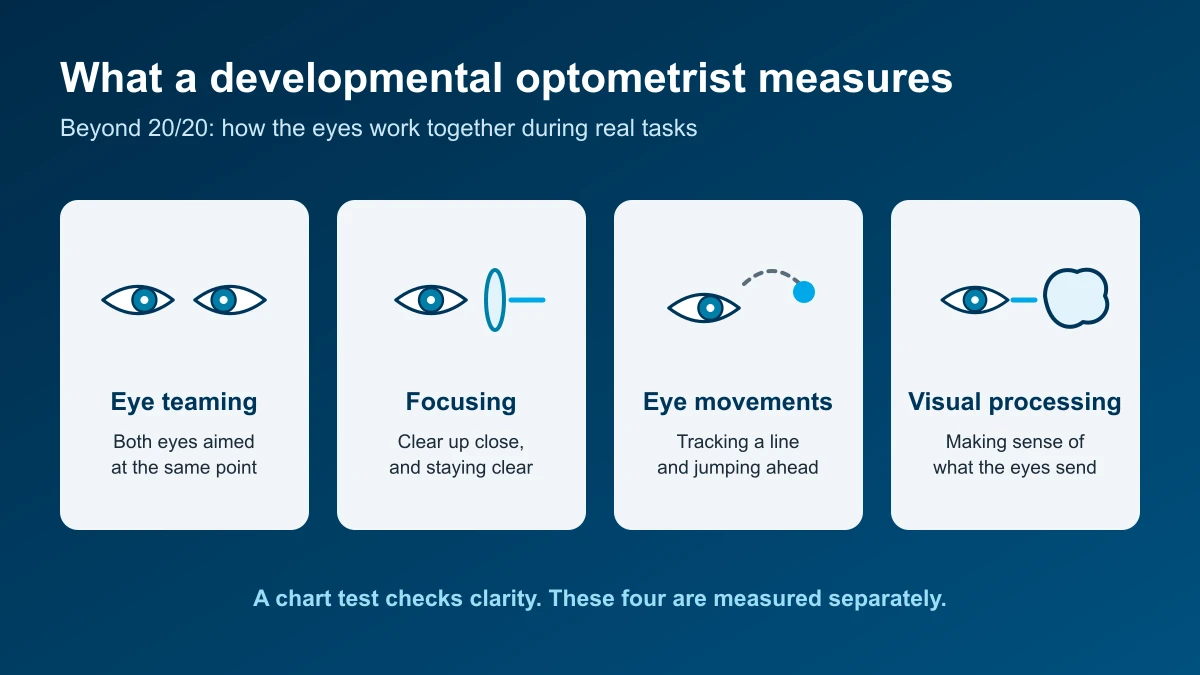
- Eye teaming (binocular vision). Whether the eyes aim at the same point, how much reserve they have for holding that aim at reading distance, and depth perception.
- Focusing (accommodation). How much focusing power is available, how quickly focus shifts between the board and the desk, and whether it holds up over time.
- Eye movements. How accurately the eyes follow a moving target and jump from word to word and line to line.
- Visual processing. How the brain uses what the eyes deliver, including visual memory, visual-motor integration and spatial skills.
We have written a separate, more detailed comparison of a comprehensive eye exam and a developmental eye exam, and another on what the data says about screenings. Our examinations page describes what happens at the visit itself.
Who should see a developmental optometrist
No list of symptoms diagnoses anything. These are reasons to have vision measured properly:
- Headaches, eye strain or tired eyes with reading or homework
- Words that blur, double or seem to move on the page
- Losing place, skipping lines or rereading the same line
- Avoiding reading even though the child understands the material when it is read aloud
- Covering or closing one eye, or holding work very close
- Schoolwork that starts well and falls apart as the task gets longer
- An eye that turns in or out, or a previous diagnosis of amblyopia or strabismus
- Vision symptoms that linger after a concussion
A child who reads 20/20 can still have several of these, which we cover in Can a child have 20/20 vision and still struggle to read?. Our symptom checklist is a quick way to see whether the pattern fits. Adults with the same complaints can be evaluated too.
When to see a different eye doctor instead
A developmental optometrist is not the right first stop for everything. Go elsewhere first in these situations.
See your regular optometrist for routine eye exams and for glasses or contact lens prescriptions. The AOA guideline recommends a comprehensive exam at 6 to 12 months, once between ages 3 and 5, and before first grade and annually after that (AOA, 2017). A child with no symptoms and no school concerns does not need a developmental evaluation on top of that.
See a pediatric ophthalmologist for eye disease, for anything that may need surgery, and when your pediatrician or optometrist refers you to one. That includes an eye turn where surgery is being considered. Surgery and therapy are not rivals, and some children have both, which we discuss in strabismus surgery and vision therapy together.
Get urgent medical care for an eye injury, sudden double vision, sudden loss of vision, or a painful red eye. Do not wait for a developmental evaluation appointment. New double vision in particular needs prompt medical assessment before anyone discusses therapy. Our article on double vision in children explains why.
What treatment can and cannot do
It is fair to ask what you get at the end of an evaluation. Sometimes the answer is reassurance that vision is not the issue. Sometimes it is glasses for near work. Sometimes it is vision therapy, and here it helps to be precise about the evidence.
The strongest research is for symptomatic convergence insufficiency in children. In the 221-child Convergence Insufficiency Treatment Trial, 73% of children given office-based therapy with home reinforcement were successful or improved after 12 weeks, compared with 35% given placebo therapy (CITT, 2008). A Cochrane review of 12 trials and 1,289 participants reached the same conclusion for children and found the evidence in adults less clear (Scheiman et al., 2020).
The limits are just as well documented. When 310 children with convergence insufficiency were randomized to therapy or placebo, reading comprehension improved 3.7 points with therapy and 3.8 points with placebo (CITT-ART, 2019). Pediatric and ophthalmology organizations state that vision problems do not cause dyslexia and that vision therapy should not be offered as a treatment for learning disabilities (AAP/AAO/AAPOS/AACO, 2009).
We agree with that boundary. A developmental optometrist treats vision problems. Reading instruction treats reading problems. A child can have both, and then both need attention. Our plain-English guide to vision therapy and our vision therapy page go into more detail.
How to find a developmental optometrist
If you are searching “developmental optometrist near me,” a few checks will narrow the list quickly.
- Look for the letters. FOVDR or FCOVD after the doctor’s name means board certification in this area. Most doctors list it on their website; if you do not see it, ask.
- Ask what the evaluation includes. It should cover eye teaming, focusing, eye movements and, where relevant, visual processing, and it should take much longer than a routine exam.
- Ask for the findings in writing. You should leave knowing what was measured, what was normal and what was not.
- Ask what happens if nothing is found. A good answer is “then we tell you that.”
- Ask about fees before you book. Coverage for this kind of care varies widely.
Seeing a developmental optometrist at our offices
Our Developmental Vision Evaluation takes about 100 minutes and costs $550. We are out-of-network with insurance plans and give families the paperwork to request reimbursement from their own plan. See cost and pricing and insurance information for details.
Initial evaluations are done at our Boynton Beach and Boca Raton offices. Our Coconut Creek and West Palm Beach offices provide vision therapy only. Addresses and hours are on the locations page.
If therapy is recommended, programs for binocular vision and visual processing problems usually run about 18 to 24 weeks. Programs for amblyopia, strabismus and brain injury often take longer.
To book or to ask whether an evaluation makes sense for your child, call (561) 462-1245 or schedule an evaluation online.
Common Questions About This Topic
What does a developmental optometrist do?
A developmental optometrist is a Doctor of Optometry who concentrates on how vision works in daily use: how the two eyes aim together, how focus is held at near, how the eyes move along a line of print, and how visual information is processed. They diagnose problems in those areas and treat them with lenses, prisms and vision therapy.
Is a developmental optometrist the same as a behavioral optometrist?
In everyday use, yes. Developmental optometrist, behavioral optometrist and vision therapy optometrist are different names for the same kind of practice. None of them is a separate license, so the more useful question is what additional training and certification the doctor has.
What is the difference between a developmental optometrist and a pediatric ophthalmologist?
A pediatric ophthalmologist is a medical doctor who completed medical school, an ophthalmology residency and a pediatric fellowship, and who treats eye disease and performs eye surgery. A developmental optometrist holds a Doctor of Optometry degree and treats functional vision problems without surgery. Many children are best served by both at different points.
What does FOVDR mean after an optometrist's name?
FOVDR stands for Fellow of Optometric Vision Development and Rehabilitation. It is the board certification in vision development and vision therapy awarded by the Optometric Vision Development and Rehabilitation Association (OVDRA). The organization was formerly called the College of Optometrists in Vision Development, so older listings show the same credential as FCOVD.
My child passed the school vision screening. Could a developmental optometrist still find something?
Yes. A screening mostly checks how clearly a child sees letters across a room. The American Optometric Association's pediatric guideline reports that acuity testing alone missed 75.5% of children later found to have eye teaming or eye movement problems on a complete examination. Passing a screening does not rule out a near-vision problem.
Where This Information Comes From
- American Academy of Ophthalmology (2026). What Is an Ophthalmologist vs Optometrist? EyeSmart patient education page. : Describes an ophthalmologist as a medical or osteopathic physician with 12 to 14 years of training who treats all eye diseases and performs eye surgery, an optometrist as holding a Doctor of Optometry degree earned in four years of optometry school, and an optician as a technician who fits eyeglass lenses and does not test vision or write prescriptions.
- American Association for Pediatric Ophthalmology and Strabismus (2024). Pediatric Ophthalmologist. AAPOS patient glossary. : States that pediatric ophthalmologists have completed medical school, an ophthalmology residency and a pediatric ophthalmology fellowship, and that their treatments include surgery and laser.
- American Optometric Association (2017). Evidence-Based Clinical Practice Guideline: Comprehensive Pediatric Eye and Vision Examination. : Recommends comprehensive exams at 6-12 months, once between 3 and 5 years, and before first grade then annually; reports that acuity testing alone missed 75.5% of children later found to have binocular and oculomotor problems on a complete examination.
- Rouse MW, Borsting E, Hyman L, et al.; CIRS Group (1999). Frequency of convergence insufficiency among fifth and sixth graders. Optometry and Vision Science; 76(9):643-649. : About 13% of 453 fifth- and sixth-graders met high-suspect or definite criteria for convergence insufficiency.
- Convergence Insufficiency Treatment Trial Study Group (2008). Randomized clinical trial of treatments for symptomatic convergence insufficiency in children. Archives of Ophthalmology; 126(10):1336-1349. : In 221 children aged 9-17, 73% were successful or improved after 12 weeks of office-based vergence and accommodative therapy versus 35% with office placebo therapy.
- Scheiman M, Kulp MT, Cotter SA, Lawrenson JG, Wang L, Li T (2020). Interventions for convergence insufficiency: a network meta-analysis. Cochrane Database of Systematic Reviews; 12:CD006768. : Across 12 trials and 1,289 participants, office-based therapy with home reinforcement beat placebo in children; the evidence in adults is less clear.
- CITT-ART Investigator Group (2019). Effect of Vergence/Accommodative Therapy on Reading in Children with Convergence Insufficiency: A Randomized Clinical Trial. Optometry and Vision Science; 96(11):836-849. : In 310 children aged 9-14, reading comprehension improved 3.7 points with office-based therapy and 3.8 points with placebo therapy, so therapy was no better than placebo for reading.
- American Academy of Pediatrics, American Academy of Ophthalmology, AAPOS, AACO (2009). Joint statement - Learning disabilities, dyslexia, and vision. Pediatrics; 124(2):837-844. : Holds that vision problems can interfere with learning but do not cause dyslexia, and that evidence does not support vision therapy as a treatment for learning disabilities.
Care We Provide
More From the Blog
Wondering If This Sounds Like Your Family?
A developmental vision evaluation measures the skills a routine eye exam does not. Our team sees children and adults in Coconut Creek, Boynton Beach, Boca Raton and West Palm Beach.