Why Do Some People Need Glasses? Focus Explained
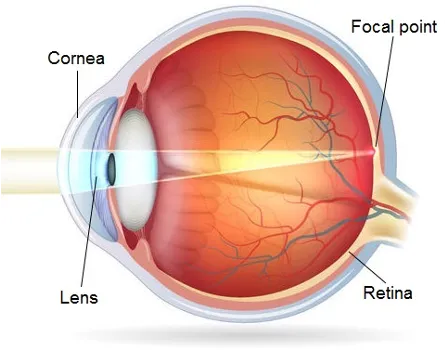
Chances are you know someone who wears glasses or contact lenses — and there is a fair chance you are that person. In the 1999-2004 National Health and Nutrition Examination Survey, which measured a nationally representative US sample with an autorefractor, clinically important refractive error affected about half of adults aged 20 and older: myopia in 33.1%, astigmatism in 36.2% and hyperopia of +3.00 D or more in 3.6% (Vitale et al., 2008).
Below: what the eye does when it focuses, what goes wrong in the four common refractive errors, and why glasses are sometimes not the end of the story.
Key takeaways
- Clinically important refractive error affects about half of US adults 20 and older (Vitale et al., 2008).
- Glasses move the focal point onto the retina: minus for myopia, plus for hyperopia and presbyopia, cylinder for astigmatism.
- Myopia is rising — 25.0% to 41.6% among Americans aged 12 to 54 between the early 1970s and 1999-2004 (Vitale et al., 2009).
- Uncorrected farsightedness in preschoolers is associated with lower early-literacy scores (Kulp et al., 2016).
- Sharp eyesight is not the same as comfortable vision; focusing and eye-teaming are measured separately from the eye chart.
How the eye focuses light
A layer of light-sensitive cells at the back of the eye — the retina — reacts to incoming light and sends the signal to the brain along the optic nerve. We follow that whole journey in how our eyes work. Light entering the eye is scattered, so three things have to happen before you see a crisp image:
- The image has to be reduced in size to fit onto the retina.
- The light has to focus exactly on the retina — not in front, not behind.
- The curve of the image has to match the curvature of the retina.
The cornea (the clear dome at the front) and the lens (behind the pupil) do that work. When either is shaped a little differently than average, or the eyeball is slightly too long or too short, the image lands off target and the world goes soft. That is a refractive error.
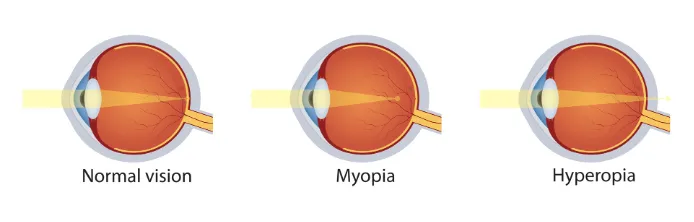 Where the focal point falls in normal vision, myopia and hyperopia
The four common reasons people need glasses
Myopia (nearsightedness)
The image focuses in front of the retina, so distance is blurry while near work is usually comfortable. A minus lens pushes the focal point back onto the retina — in effect bringing the distant image “closer” so the eye can handle it.
Hyperopia (farsightedness)
The image focuses behind the retina. Young eyes often muscle through it by focusing harder, which is why hyperopia is easy to miss on a quick screening: the cost shows up as tired eyes, headaches and avoidance of near work rather than blur. A plus lens moves the focal point forward and takes that effort off the child.
Astigmatism
An uneven curve in the cornea or lens creates two focal points instead of one, so vision is out of focus at every distance. It commonly occurs alongside myopia or hyperopia, and cylinder lenses compensate for the uneven curvature.
Presbyopia
Sometime in the forties the lens loses flexibility and can no longer change shape well enough for near focus. Menus move farther away; arms feel too short. It is a normal age change, not a disease — an estimated 1.8 billion people had presbyopia worldwide in 2015, and 826 million had near vision impairment because it was not adequately corrected (Fricke et al., 2018). Like hyperopia, it takes plus power — readers, bifocals or progressives.
Why myopia keeps showing up more often
Myopia is not only common, it is increasing. Across two US national surveys using comparable methods, prevalence among Americans aged 12 to 54 rose from 25.0% to 41.6% in about three decades (Vitale et al., 2009), and global modelling projects roughly half the world (49.8%) will be myopic by 2050 (Holden et al., 2016).
Screens are the usual suspect, and the evidence is softer than the headlines: one systematic review found essentially no association (pooled odds ratio 1.02) (Lanca & Saw, 2020), a later meta-analysis a modest one with high heterogeneity (OR 1.26) (Foreman et al., 2021). Better supported is the other side: time outdoors lowers the risk of becoming myopic (risk ratio about 0.54 in trials), though it does not slow progression once myopia has started (Xiong et al., 2017). What to do about a child whose prescription keeps climbing is covered in childhood myopia: what parents should know. More in how much screen time is too much and on our refractive error page.
For children, glasses do more than sharpen letters
Uncorrected refractive error in early childhood has consequences beyond blur. Among 492 four- and five-year-olds, those with uncorrected moderate farsightedness scored 4.3 points lower on a preschool early-literacy test, with larger gaps when near acuity or near depth perception was reduced (Kulp et al., 2016). That study is cross-sectional — an association, not proof that glasses raise reading scores — but it is a good reason not to wave off a preschooler’s prescription. Refractive error is also the leading pathway to amblyopia: in 6,014 preschoolers, 78% of amblyopia cases were attributable to it (MEPEDS, 2008), and consistently worn glasses are often the first and most important treatment.
Which raises the practical problem every parent knows. For frames, see our guide to choosing glasses for your child; if they live in a backpack instead of on a face, see when your child will not wear their glasses.
When glasses are not the whole answer
Some children and adults are told their eyesight is perfect and still report intermittent blur, double vision, eyestrain, reading fatigue, poor comprehension or words that seem to move on the page. An eye chart measures clarity at distance. It does not measure how the eyes aim together, how well focus holds through twenty minutes of reading, or how accurately they move across a line of print.
That gap is real. The AOA’s pediatric guideline cites research in which acuity testing alone missed 75.5% of children later found to have binocular and eye-movement problems on a complete examination (AOA, 2017). Convergence insufficiency alone — trouble keeping the eyes aimed at near — ran about 13% among fifth- and sixth-graders in a school-based US study (Rouse et al., 1999).
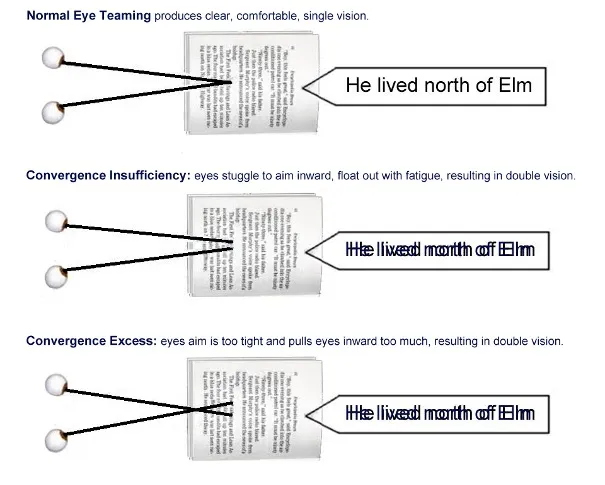 How print can double when the eyes aim in front of or behind the page
Be precise about what the research supports, though. Office-based vergence and accommodative therapy is well supported for symptomatic convergence insufficiency in children: 73% were successful or improved after 12 weeks versus 35% on office placebo (CITT, 2008). It is not a reading treatment — tested against placebo for reading comprehension in 310 children, both groups improved almost identically, 3.7 versus 3.8 points (CITT-ART, 2019).
Our clinical perspective at Vision & Learning Center sits inside those findings. We do not promise better grades. We find out whether the eyes focus, aim and track comfortably, correct what a lens can correct, and treat what therapy has been shown to help.
When to have eyes checked
For low-risk patients the American Optometric Association recommends a comprehensive eye examination at 6 to 12 months, once between ages 3 and 5, before first grade and annually through 17, then at least every two years from 18 to 64 and annually from 65 (AOA). Sooner if something has changed — new headaches, squinting, holding books close, skipping lines, or a child who quietly stopped reading for pleasure.
If that sounds familiar, a comprehensive developmental vision evaluation measures eyesight, eye health, focusing, eye teaming and tracking together, so you learn which part of the system needs help. Schedule an evaluation at one of our four South Florida offices and we will tell you plainly what we find.
Common Questions About This Topic
How many people actually need glasses?
More than most people assume. Using autorefraction on a nationally representative US sample, the 1999-2004 National Health and Nutrition Examination Survey found clinically important refractive error in about half of Americans aged 20 and older — myopia in 33.1%, astigmatism in 36.2% and hyperopia of +3.00 D or more in 3.6%.
What is the difference between nearsighted and farsighted?
In myopia (nearsightedness) light focuses in front of the retina, so distance is blurry and near is usually clear; a minus lens moves the focus back. In hyperopia (farsightedness) light focuses behind the retina, so the eye has to work harder, especially up close; a plus lens moves the focus forward and takes some of that effort away.
Why do I need reading glasses in my forties?
That is presbyopia. The lens inside the eye gradually loses the flexibility it needs to change shape for near focus, so print has to move farther away to stay clear. It is a normal age-related change, not a disease, and plus lenses in readers, bifocals or progressives compensate for it.
Is myopia getting more common?
Yes. Comparing two US national surveys with comparable methods, myopia among Americans aged 12 to 54 rose from 25.0% in 1971-1972 to 41.6% in 1999-2004. Global modelling projects myopia will affect roughly half the world's population by 2050.
My child has 20/20 vision but still struggles to read. Can that happen?
Yes. An eye chart measures clarity at distance; it does not measure how well the eyes focus, aim and move together during sustained near work. The AOA's pediatric guideline cites research in which acuity testing alone missed about three-quarters of children later found to have binocular and eye-movement problems on a full examination. That is what a developmental vision evaluation looks at.
Where This Information Comes From
- Vitale S, Ellwein L, Cotch MF, Ferris FL 3rd, Sperduto R (2008). Prevalence of refractive error in the United States, 1999-2004. Archives of Ophthalmology, 126(8), 1111-1119. : NHANES autorefraction data on 12,010 adults: age-standardized myopia 33.1%, astigmatism 36.2%, hyperopia 3.6%; clinically important refractive error affects half of US adults 20 and older.
- Vitale S, Sperduto RD, Ferris FL 3rd (2009). Increased prevalence of myopia in the United States between 1971-1972 and 1999-2004. Archives of Ophthalmology, 127(12), 1632-1639. : Using comparable methods across two national surveys, myopia prevalence among Americans aged 12-54 rose from 25.0% to 41.6%.
- Holden BA, Fricke TR, Wilson DA, et al. (2016). Global Prevalence of Myopia and High Myopia and Temporal Trends from 2000 through 2050. Ophthalmology, 123(5), 1036-1042. : Modelling from 145 studies: 22.9% of the world myopic in 2000, projected 49.8% by 2050; projections assume current trends continue.
- Xiong S, Sankaridurg P, Naduvilath T, et al. (2017). Time spent in outdoor activities in relation to myopia prevention and control: a meta-analysis and systematic review. Acta Ophthalmologica, 95(6), 551-566. : Outdoor time protected against becoming myopic (risk ratio about 0.54 in trials) but did not slow progression in eyes that were already myopic.
- Lanca C, Saw SM (2020). The association between digital screen time and myopia: A systematic review. Ophthalmic and Physiological Optics, 40(2), 216-229. : Across 15 studies of 49,789 children, a meta-analysis of five gave a pooled odds ratio of 1.02 (95% CI 0.96-1.08) — the screen-time link to myopia is mixed.
- Foreman J, Salim AT, Praveen A, et al. (2021). Association between digital smart device use and myopia: a systematic review and meta-analysis. Lancet Digital Health, 3(12), e806-e818. : Smart device use alone was associated with myopia at OR 1.26 (95% CI 1.00-1.60), 1.77 when combined with computer use, with high heterogeneity.
- Fricke TR, Tahhan N, Resnikoff S, et al. (2018). Global Prevalence of Presbyopia and Vision Impairment from Uncorrected Presbyopia. Ophthalmology, 125(10), 1492-1499. : An estimated 1.8 billion people had presbyopia in 2015, and 826 million had near vision impairment because their presbyopia was uncorrected or undercorrected.
- VIP-HIP Study Group; Kulp MT, Ciner E, Maguire M, et al. (2016). Uncorrected Hyperopia and Preschool Early Literacy. Ophthalmology, 123(4), 681-689. : In 492 four- and five-year-olds, uncorrected moderate hyperopes scored 4.3 points lower on an early-literacy test; cross-sectional, so it shows association, not that glasses raise scores.
- Multi-ethnic Pediatric Eye Disease Study Group (2008). Prevalence of amblyopia and strabismus in African American and Hispanic children ages 6 to 72 months. Ophthalmology, 115(7), 1229-1236. : In 6,014 preschoolers, amblyopia affected 1.5-2.6% and 78% of amblyopia cases were attributable to refractive error.
- American Optometric Association (2017). Evidence-Based Clinical Practice Guideline: Comprehensive Pediatric Eye and Vision Examination. St. Louis: AOA. : Recommends comprehensive exams at 6-12 months, once between 3 and 5 years, and before first grade and annually after; cites research in which Snellen acuity alone missed 75.5% of children with binocular and oculomotor problems.
- American Optometric Association. Comprehensive Eye Exams: recommended eye examination frequency. aoa.org patient page. : AOA schedule for low-risk patients: annually through age 17, at least every two years from 18 to 64, annually at 65 and older.
- Rouse MW, Borsting E, Hyman L, et al.; CIRS Group (1999). Frequency of convergence insufficiency among fifth and sixth graders. Optometry and Vision Science, 76(9), 643-649. : In 453 schoolchildren aged 9-13, 4.2% had definite and 8.8% high-suspect convergence insufficiency (about 13% combined); 78.9% of three-sign cases also had accommodative insufficiency.
- Convergence Insufficiency Treatment Trial Study Group (2008). Randomized clinical trial of treatments for symptomatic convergence insufficiency in children. Archives of Ophthalmology, 126(10), 1336-1349. : In 221 children, 73% were successful or improved after 12 weeks of office-based vergence/accommodative therapy versus 35% with office placebo; symptom questionnaire outcome.
- CITT-ART Investigator Group (2019). Effect of Vergence/Accommodative Therapy on Reading in Children with Convergence Insufficiency: A Randomized Clinical Trial. Optometry and Vision Science, 96(11), 836-849. : In 310 children, reading comprehension improved 3.7 points with therapy versus 3.8 with placebo — therapy was no better than placebo for reading.
Care We Provide
More From the Blog
Wondering If This Sounds Like Your Family?
A developmental vision evaluation measures the skills a routine eye exam does not. Our team sees children and adults in Coconut Creek, Boynton Beach, Boca Raton and West Palm Beach.