How Do Our Eyes Work? Seeing Is Not the Same as Vision

Most of us never think about how our eyes work. You look up, and you see - no effort, no conscious thought. But that ease is earned. Seeing clearly is only the first step in a long chain. That chain runs from the front of the eye to the back of the brain, and a great deal has to go right along the way.
Below we follow light through the eye, explain the difference between seeing and vision, and describe how these skills develop in childhood.
Key takeaways
- Light passes through the cornea, pupil and lens to the retina. Photoreceptors there turn it into electrical signals that travel along the optic nerve to the brain (National Eye Institute, 2022).
- Seeing is clarity - what 20/20 measures. Vision is everything the brain does with what the eyes send it.
- Visual efficiency skills (focusing, teaming, tracking) keep the world single, clear and steady. Visual processing skills give it meaning.
- These skills take years to mature. Depth perception is not present at birth (AOA). Fine depth judgment reaches about 40 arcseconds by age 7 and keeps improving into the teen years (Birch et al., 2008).
- Vision problems do not cause dyslexia, but some struggling readers do have treatable focusing or teaming problems.
From light to image: the path through the eye
Vision starts as physics. Light passes through the cornea, the clear front layer of the eye. Next comes the pupil, the opening the iris widens and narrows to control how much light gets in. The lens then fine-tunes the focus, and the image lands on the retina lining the back of the eye, where photoreceptor cells convert it into electrical signals. Those signals travel along the optic nerve, and “the brain turns the signals into the images you see” (National Eye Institute, 2022).
If the eye is a little too long or too short, or the cornea is shaped unevenly, the image lands out of focus. That is the whole reason glasses exist, and we explain it in why some people need glasses. If the tissues along that path are themselves affected, that becomes a question of ocular health.
Seeing is not the same as vision
Clear eyesight is the tip of the iceberg. Consider driving.
You need to read road signs, yes, but the signs are the easy part. At the same time you are also using:
- Peripheral awareness of what is beside you while you look ahead.
- Depth judgment to know how far away the next car is.
- Eye movements to fixate, scan and follow moving objects.
- Focus shifts from dashboard to road and back without a blur.
All of that stays coordinated with your hands, your feet and what you hear.
When you first got your permit that felt nearly impossible: anxious, exhausting, everything at once. Eventually it became automatic. That shift from effortful to automatic is what a well-developed visual system buys you.
Visual efficiency skills
These are the mechanical skills that keep the image single, clear and steady.
- Focusing (accommodation). The lens changes shape to move focus between distances - board to desk, dashboard to road. It also has to hold focus through long stretches of near work. Homework and screens lean on this system for hours at a time. That is why we wrote a separate guide to how much screen time is too much.
- Eye teaming (binocular vision). Both eyes aim at the same point, so the brain receives one image instead of two. The small difference between the two views becomes depth. We describe that ladder from simple overlap to true depth in the three grades of binocular vision. Depth is not a luxury skill. Among 143 people aged 10 to 30, those with normal stereoacuity performed best on pegboard and bead-threading tasks (O’Connor et al., 2010).
- Eye movements (tracking). Reading is not a smooth glide across the page. The eyes make quick jumps called saccades, separated by brief stops called fixations. The reading happens during those stops, and the eyes jump backward when comprehension falters. Decades of research show these movements track moment-to-moment thinking (Rayner, 1998).
Visual processing skills
Once the image arrives intact, the brain has to interpret it. That means recognizing form, separating figure from background, and remembering what was seen. It also means picturing something in the mind’s eye and organizing it in space.
That last one shows up on paper. In our clinic, children who find visual-spatial organization hard often show it in their written work. We see writing that drifts off the line, uneven spacing between words, and columns that will not line up in a math problem. That is a clinical observation rather than a diagnosis. Handwriting and math layout also lean on motor skills, language and plain practice. A sample of messy work is a reason to look further, not an answer on its own.
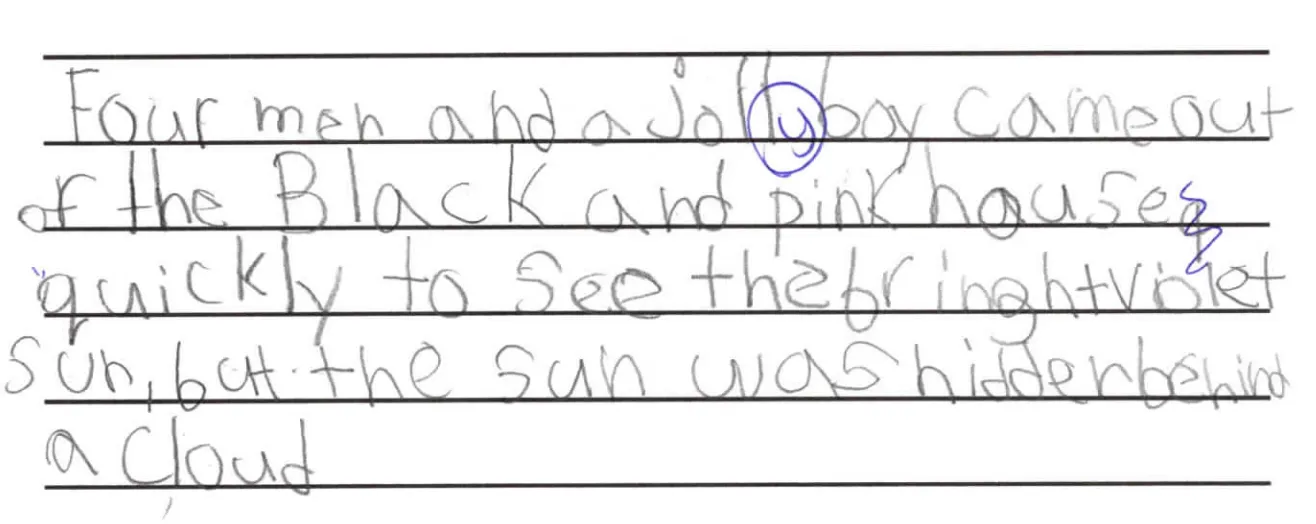
The classroom asks for all of it at once. A child copying from the board has to track, focus and team accurately on every switch between board and desk. At the same time that child has to listen while writing, decide what is worth writing down, and turn words into mental pictures. Like driving, it works only when it runs below conscious awareness. We go deeper into this in our guide to vision and learning.
How these skills develop
None of this arrives fully formed.
For roughly the first two months a baby’s eyes often do not work well together, and they may appear to cross or wander. By about three months they should be working together to focus on and follow an object (American Academy of Ophthalmology). Depth perception is not present at birth at all. The American Optometric Association notes that the eyes are not capable of working together to form a three-dimensional view until around the fifth month. Eye-hand coordination and depth perception should be well developed by age two (AOA).
Fine depth judgment keeps refining for years afterward. In 4,355 normally sighted children, average stereoacuity improved from about 100 arcseconds at age 3 to 60 by age 5 and 40 by age 7. It kept improving to about 30 arcseconds by the teen years (Birch et al., 2008). These skills matter early. Among 492 four- and five-year-olds, those with uncorrected moderate farsightedness scored lower on an early-literacy test. The gaps were largest when near acuity or near depth perception was reduced (Kulp et al., 2016).
What the research does and does not show
Vision problems do not cause dyslexia, and vision therapy is not a treatment for dyslexia. That is the position of pediatric and ophthalmology bodies (AAP/AAO/AAPOS/AACO, 2009). A cohort of 5,822 children aged 7 to 9 found no association between severe reading impairment and strabismus, refractive error, amblyopia, convergence or accommodation (Creavin et al., 2015).
To be complete about that study: the struggling readers did have slightly more trouble with depth perception. Stereoacuity worse than 60 arcseconds turned up in about 1 in 6 of them, versus 1 in 10 of their classmates, and near fusion problems were a little more common too. But four of every five had entirely normal eye findings, and the authors concluded that no vision-based treatment is supported for this group. When therapy for convergence insufficiency was tested against a placebo program for reading specifically, comprehension improved the same amount in both groups (CITT-ART, 2019).
At the same time, clinical samples find focusing and tracking deficits more often in children with dyslexia than in typical readers (Raghuram et al., 2018). The optometric position is that vision problems can and often do interfere with learning, as one part of a bigger picture (AAO/AOA, 1997).
Our clinical perspective at Vision & Learning Center sits inside those facts. We do not treat reading and we do not treat dyslexia. What we can do is find out whether a child’s eyes are focusing, teaming and tracking comfortably. That way the effort goes into the schoolwork rather than into seeing it.
When to have vision checked
The American Optometric Association recommends a comprehensive eye examination at 6 to 12 months, and at least once between ages 3 and 5. After that it recommends an exam before first grade and annually thereafter. The same guideline cites research in which acuity testing alone missed about three-quarters of children later found to have binocular and eye-movement problems (AOA, 2017). That gap is why “perfect vision” on a screening does not settle the question.
Is your child frustrated by schoolwork, avoiding reading, or not performing the way you would expect? A comprehensive developmental vision evaluation measures focusing, teaming, tracking and visual processing alongside eyesight and eye health. Schedule an evaluation at one of our four South Florida offices and we will tell you plainly what we find.
Common Questions About This Topic
How do our eyes actually work?
Light passes through the cornea, then the pupil, then the lens, which focuses it onto the retina at the back of the eye. Photoreceptor cells in the retina turn light into electrical signals that travel along the optic nerve to the brain, and the brain turns those signals into the images you see.
What is the difference between eyesight and vision?
Eyesight, or visual acuity, is how sharp the image is - what 20/20 measures. Vision is everything the brain does with that image: aiming both eyes at the same point, holding focus, moving the eyes accurately, and giving what arrives meaning. A person can have sharp eyesight and still have a vision problem.
What are visual efficiency skills?
Focusing (accommodation), eye teaming (binocular vision) and eye movements (tracking). Together they keep what you look at single, clear and steady while you read, write, drive or play. They are measured in a developmental vision evaluation, not on an eye chart.
When does depth perception develop in a baby?
The American Optometric Association notes that depth perception is not present at birth and that the eyes are not capable of working together to form a three-dimensional view until around the fifth month. Fine depth judgment keeps sharpening for years - normative data show average stereoacuity improving from about 100 arcseconds at age 3 to 40 arcseconds by age 7, and on to about 30 arcseconds by the teen years.
Can a vision problem cause dyslexia?
No. Pediatric and ophthalmology bodies hold that dyslexia is language-based and that vision problems do not cause it, and a 5,822-child cohort found four of five severely impaired readers had normal ophthalmic function. Some struggling readers do also have focusing or eye-teaming problems that make near work uncomfortable, and those are worth finding and treating on their own merits.
Where This Information Comes From
- National Eye Institute (2022). How the Eyes Work. NIH patient education page. : Describes the light path: cornea, pupil, lens, retina photoreceptors, optic nerve, and the brain turning the signals into the images you see.
- Rayner K (1998). Eye movements in reading and information processing: 20 years of research. Psychological Bulletin, 124(3), 372-422. : Landmark review: reading proceeds by saccades and fixations, and eye-movement data reflect moment-to-moment cognitive processing of text.
- O'Connor AR, Birch EE, Anderson S, Draper H; FSOS Research Group (2010). The functional significance of stereopsis. Investigative Ophthalmology & Visual Science, 51(4), 2019-2023. : In 143 people aged 10-30, pegboard and bead-threading performance related to stereoacuity; those with normal stereoacuity performed best on all tests.
- Birch E, Williams C, Drover J, et al. (2008). Randot Preschool Stereoacuity Test: normative data and validity. Journal of AAPOS, 12(1), 23-26. : In 4,355 normally sighted children aged 3-18, mean stereoacuity improved from 100 arcsec at age 3 to 60 by age 5 and 40 by age 7, improving monotonically to about 30 arcsec in the 11-18 year group.
- American Academy of Ophthalmology (2026). Vision Development: Newborn to 12 Months. aao.org EyeSmart patient education page. : For the first 2 months a baby's eyes often do not work together and may appear crossed or wandering; by 3 months the eyes should work together to focus and track.
- American Optometric Association. Infant Vision: Birth to 24 Months of Age. aoa.org patient education page. : Depth perception is not present at birth; the eyes are not capable of a three-dimensional view until around the fifth month, and eye-hand coordination and depth perception should be well developed by age 2.
- American Optometric Association (2017). Evidence-Based Clinical Practice Guideline: Comprehensive Pediatric Eye and Vision Examination. St. Louis: AOA. : Recommends comprehensive exams at 6-12 months, at least once between 3 and 5 years, and before first grade and annually thereafter; cites research that acuity screening alone missed 75.5% of children with binocular and oculomotor problems.
- VIP-HIP Study Group; Kulp MT, Ciner E, Maguire M, et al. (2016). Uncorrected Hyperopia and Preschool Early Literacy. Ophthalmology, 123(4), 681-689. : Uncorrected moderately hyperopic 4- and 5-year-olds scored 4.3 points lower on an early-literacy test, with larger deficits when near stereoacuity was 240 arcsec or worse; cross-sectional.
- Creavin AL, Lingam R, Steer C, Williams C (2015). Ophthalmic abnormalities and reading impairment. Pediatrics, 135(6), 1057-1065. : In 5,822 children aged 7-9, severe reading impairment showed no association with strabismus, refractive error, amblyopia, convergence or accommodation; reduced stereoacuity and near fusion problems were slightly more common (1 in 6 vs 1 in 10); four of five impaired readers had normal ophthalmic function and the authors concluded no vision-based treatment is supported for this group.
- Raghuram A, Gowrisankaran S, Swanson E, Zurakowski D, Hunter DG, Waber DP (2018). Frequency of Visual Deficits in Children With Developmental Dyslexia. JAMA Ophthalmology, 136(10), 1089-1095. : Accommodation deficits in 55% vs 9% and tracking deficits in 62% vs 15% of children with dyslexia vs typical readers; the authors call the clinical relevance uncertain.
- CITT-ART Investigator Group (2019). Effect of Vergence/Accommodative Therapy on Reading in Children with Convergence Insufficiency: A Randomized Clinical Trial. Optometry and Vision Science, 96(11), 836-849. : In 310 children, reading comprehension improved 3.7 points with therapy vs 3.8 with placebo; therapy was no better than placebo for reading.
- American Academy of Pediatrics Section on Ophthalmology, Council on Children with Disabilities; American Academy of Ophthalmology; AAPOS; AACO (2009). Joint statement: Learning disabilities, dyslexia, and vision. Pediatrics, 124(2), 837-844. : Dyslexia is language-based; vision problems can interfere with learning but do not cause dyslexia, and evidence does not support behavioral vision therapy for learning disabilities.
- American Academy of Optometry; American Optometric Association (1997). Vision, learning and dyslexia: a joint organizational policy statement. Journal of the American Optometric Association, 68(5), 284-286. : Optometric position: vision problems can and often do interfere with learning; optometric care aims to improve visual function as one part of multidisciplinary care.
Care We Provide
More From the Blog
Wondering If This Sounds Like Your Family?
A developmental vision evaluation measures the skills a routine eye exam does not. Our team sees children and adults in Coconut Creek, Boynton Beach, Boca Raton and West Palm Beach.