Costume Contact Lenses: The Real Risks This Halloween
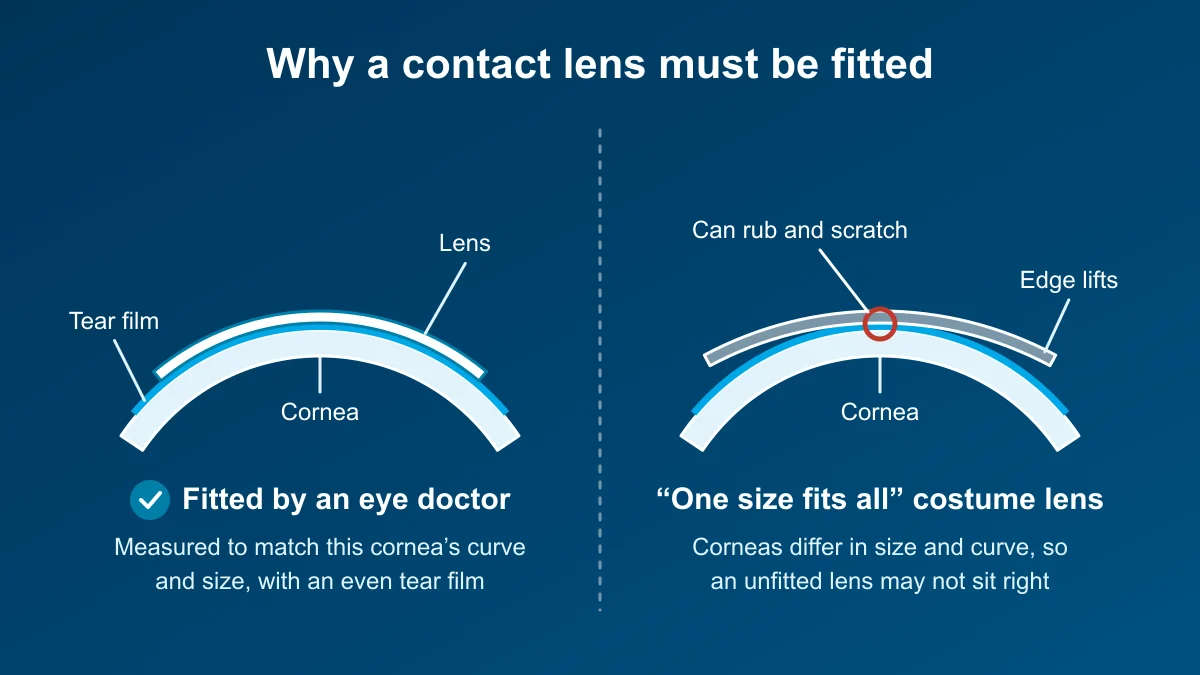
Every October, colored and “special effect” contact lenses turn up in costume shops, beauty supply stores and online ads: cat eyes, white-outs, blood-red irises. Costume contact lenses look like an accessory. Legally and medically they are not. They are medical devices that sit directly on the cornea, the clear front window of the eye. Worn without a proper fitting, they can cause an infection that leaves a permanent scar.
This guide covers what the FDA says, what the research shows about infections from decorative lenses, how to wear them safely if you really want the look, some alternatives that never touch the eye, and what to do if an eye turns red or painful after a party.
Key takeaways
- Every contact lens sold in the US is an FDA-regulated medical device. That includes plano (non-correcting) colored and costume lenses, and a prescription is required to buy them (FDA, 2022).
- Selling contact lenses without a prescription has been illegal in the US since 2005 (AAO). A store or site that sells them as cosmetics is breaking the law.
- In a French multicenter study, 60% of cosmetic lens wearers with a corneal infection ended with vision worse than 20/200, compared with 13% of other lens wearers (Sauer & Bourcier, 2011).
- An FDA evaluation of more than 300 cosmetic lenses found microbial contamination in 60% of counterfeit lenses and 27% of unapproved ones (AAO & AAOpt, 2025).
- A red, painful eye in any lens wearer needs care the same day. Take the lenses out, don’t put them back, and see an eye doctor, or go to urgent care if you can’t reach one (FDA, 2024).
Are costume contact lenses legal without a prescription?
No. Decorative contact lenses “are not cosmetics or over-the-counter merchandise,” the FDA says. “They are medical devices regulated by the U.S. Food and Drug Administration,” and places that sell them over the counter or as cosmetics “are breaking the law” (FDA, 2022). The CDC says the same: every contact lens needs a prescription and a proper fitting by a doctor (CDC, 2025).
Two federal agencies share the job. The FDA regulates the lens itself. The Federal Trade Commission enforces the Contact Lens Rule, which requires sellers to verify a prescription before they sell you lenses, cosmetic ones included. The same rule requires your eye doctor to give you a copy of your prescription at no extra charge, so you can buy from any legitimate seller you like (FTC, 2018).
This matters for a practical reason. A lens sold legally comes with an exam, a fitted size and material, and instructions on handling and cleaning. A lens from a street vendor, flea market, novelty shop or Halloween store comes with none of that. The FDA names those exact outlets as places never to buy lenses (FDA, 2024).
Why “one size fits all” lenses cause problems
Corneas are not all the same size or curve. The FDA says decorative lenses “are not ‘one size fits all’” and that an eye doctor must measure each eye to fit them properly (FDA, 2022). A poorly fitted lens can rub and scratch the cornea. According to the CDC, lenses bought without a prescription “may not fit correctly,” which leaves the eye more open to scratches and corneal ulcers (CDC, 2025).
Where the color sits may matter too. In a prospective study of 694 lens-related corneal infections across Asia, the lenses worn by cosmetic wearers were more often made with the pigment on the back surface, the side that touches the eye (Stapleton et al., 2021).
Then there is contamination. When the FDA evaluated more than 300 cosmetic lenses, 60% of counterfeit lenses and 27% of unapproved lenses had microbial contamination (AAO & AAOpt, 2025). A lens that arrives contaminated is a risk before it ever touches your finger.
What the research shows about infections from decorative lenses
The serious risk is microbial keratitis, an infection of the cornea. The organisms reported in the decorative-lens cases below include bacteria such as Pseudomonas and staphylococci, and the amoeba Acanthamoeba (Steinemann et al., 2005). The CDC lists scarring and blindness among the possible results (CDC, 2025). Here is what published studies have found, including their limits.
| Study | Who was studied | What it found |
|---|---|---|
| Steinemann et al., 2003 | 6 patients seen urgently after cosmetic plano lenses | Lenses sold one at a time, without care instructions, by cosmetics, convenience and accessory stores. One patient needed a corneal transplant. |
| Steinemann et al., 2005 | 12 first-time wearers of plano decorative lenses, plus a survey of 159 patients | None of the lenses came from an eye care professional. Four patients were admitted with blinding infections and one needed a corneal transplant. In the survey, 23% used decorative lenses, and 51% of those bought from an unlicensed provider. |
| Sauer & Bourcier, 2011 | 256 lens wearers with keratitis in 12 French university hospitals | 12.5% wore cosmetic lenses. They were younger (average 21 versus 27), rarely got their lenses from an eye care professional, and mostly had no care education. 60% ended with vision worse than 20/200, versus 13% of other wearers. |
| Young et al., 2014 | 70 published cases of lenses from unregulated sources | 73% bought over the counter and 17% borrowed or shared. 71% waited more than 48 hours after symptoms began. 61% had keratitis, and 72% of those followed to the end had permanent damage. |
| Stapleton et al., 2021 | 694 lens-related corneal infections at 11 centers in 8 Asian countries | 29.4% were in cosmetic lens wearers, 90% female and 68% under 25. Acanthamoeba was more common (9% versus 1%). |
Look at these studies honestly. Most are hospital samples and case reports, so they gather the worst outcomes. They show how bad an infection from a decorative lens can get and who tends to be affected. They can’t give you a precise risk for one person wearing one pair for one night. The Asian study, for example, found visual outcomes were similar in cosmetic and corrective lens wearers once an infection had happened (Stapleton et al., 2021).
The pattern across these studies is consistent, though. The trouble clusters where lenses skip the eye doctor: no fitting, no instructions, shared pairs, and delays before getting help. Eye doctors see it in practice too. In a survey of Boston-area optometrists, 77% of those who responded had treated complications from decorative lenses, a third of them in first-time wearers. Of 18 online costume lens sellers reviewed in the same study, 72% did not follow FTC and FDA rules (Gaiser et al., 2017). The survey was small and local, but it matches everything else in the table.
How to wear colored or costume lenses safely
If the look really matters to you, there is a legitimate route:
- Get an eye exam and a contact lens fitting. This is true even if you have perfect vision. A contact lens exam checks the health of the cornea and tear film and measures the curve the lens has to fit.
- Buy only from a seller who asks for your prescription, in person or online (FDA, 2022). If a site never asks, it is not a legitimate seller.
- Never share lenses, not even for one photo. Borrowed or shared lenses made up 17% of the complications in the review of unregulated lenses (Young et al., 2014).
- Wash and dry your hands before touching a lens. Clean lenses only with contact lens disinfecting solution, never water or saliva, and never store them in water (CDC, 2025).
- Don’t sleep in them, unless your eye doctor has specifically approved it (AAO & AAOpt, 2025). After a late party, take them out before you lie down.
- Take them out at the first sign of trouble. That means redness, pain, blur or light sensitivity. Don’t try to push through the evening.
A quick check before you buy
- Did anyone ask for your prescription? If not, walk away.
- Is the seller a costume or Halloween shop, beauty supply store, novelty store, flea market or street vendor? The FDA says not to buy there (FDA, 2024).
- Does the package promise one size fits all? The FDA says no such thing exists.
- Have you been shown how to put the lens in, take it out and clean it? If not, you are not ready to wear it.
Safer ways to get the look
Many great costumes never touch the eye at all:
- Makeup around the eyes can do more than a lens for most characters. The FDA suggests testing any costume makeup on the wearer’s arm 24 to 48 hours ahead, and checking that the color additives are FDA-approved for that use. It calls this “especially important for colored makeup around the eyes” (FDA, 2023).
- Hats and makeup instead of full masks. The FDA recommends this because masks can block vision (FDA, 2023), and that matters for children crossing streets after dark.
- Costume glasses and frames sit in front of the eye rather than on it. A child who already wears glasses can often build the costume around them. Our guide to choosing children’s glasses covers frames that stand up to active kids.
- Photo filters and editing give you the eerie eyes for social media with no risk at all.
Red or painful eye after costume contacts: what to do
Don’t wait until morning to see if it settles. The FDA’s advice is to “seek medical attention right away and remove your contact lenses if your eyes are red, have ongoing pain or discharge” (FDA, 2024). The AAO adds swelling to that list (AAO).
- Take the lenses out and don’t put them back in, even if the eye feels better.
- Keep the lenses and the case. Bring them with you. If the doctor suspects an infection, knowing what was worn helps.
- Get seen the same day. Call your eye doctor. If you can’t reach one, go to urgent care or an emergency department, especially if the pain is getting worse, your vision has dropped, or light hurts.
- Don’t treat it yourself with leftover drops, redness relievers or a patch. Contact lens wearers with a red eye need an examination, not a guess.
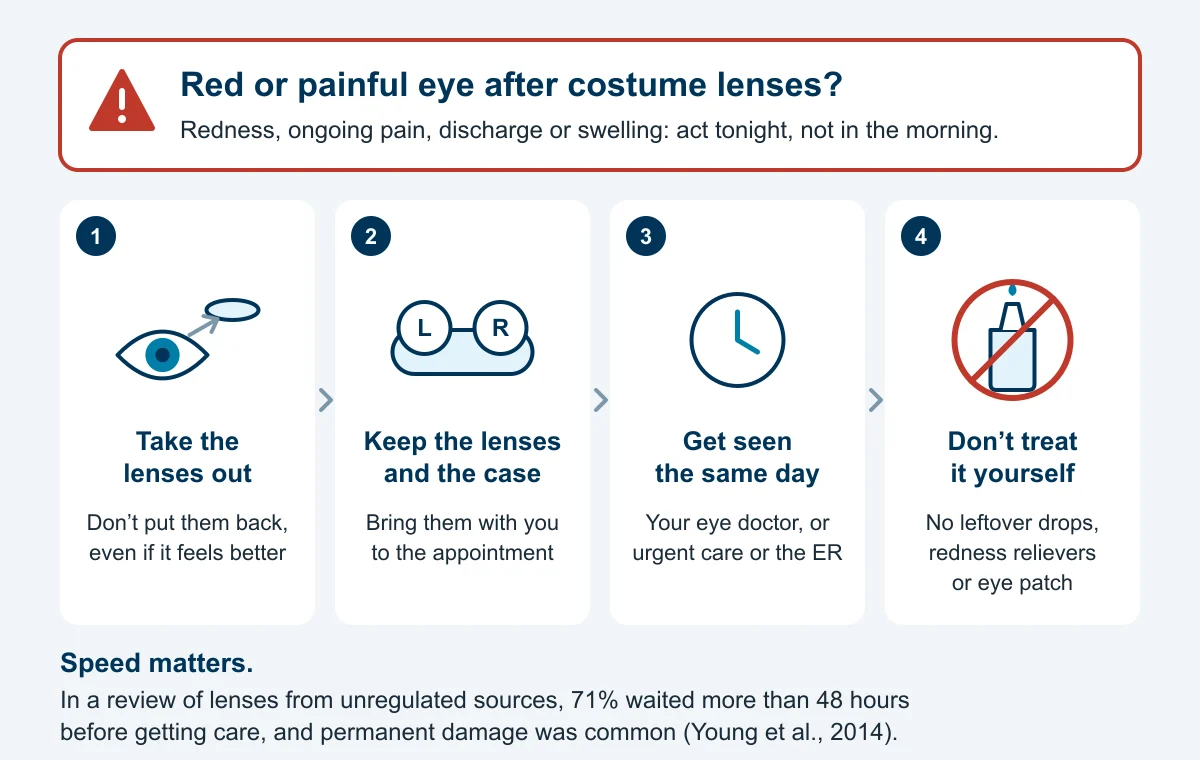
Speed matters. In the review of lenses from unregulated sources, 71% of patients waited more than 48 hours after symptoms started before getting care, and permanent damage was common (Young et al., 2014).
Who is most at risk?
The research points to young people. In the French study, cosmetic lens wearers with keratitis averaged 21 years old and had worn lenses for a shorter time than other wearers (Sauer & Bourcier, 2011). In the Asian study, 68% were under 25 (Stapleton et al., 2021). First-time wearers show up again and again because nobody taught them the rules. Teenagers who already wear lenses also report risky habits like sleeping and swimming in them, which we cover in our guide to eye problems in teenagers.
If you have a teenager, talk about this before the party, not after. Most teens have no idea these lenses need a prescription, because they’re sold beside the fake blood and plastic fangs.
Our clinical perspective
We aren’t against colored lenses. Fitted by an eye doctor, bought from a legitimate seller and handled properly, they can be worn safely. What worries us is the lens that skips all three steps: bought at a counter, put in without instructions, shared with a friend, and slept in after a long night. The published cases we reviewed for this post come mostly from that route. The outcomes run from a painful week to a corneal transplant.
Our advice for families is simple. Plan the costume around makeup, glasses or a filter. If you want lenses, start with a contact lens exam a few weeks ahead. And treat a red, painful eye in any lens wearer as same-day business.
If you have questions about lenses, eye health or a child’s vision, you can find us on our locations page or schedule an evaluation.
Common Questions About This Topic
Do you need a prescription for costume contact lenses?
Yes. In the United States every contact lens is a medical device regulated by the FDA, including colored, decorative and costume lenses that do not correct vision. A seller must have a valid prescription before selling any lens, and a store or website that sells them over the counter or as cosmetics is breaking the law. The prescription comes from an eye exam and fitting by an optometrist or ophthalmologist.
Are Halloween contact lenses safe?
They can be worn safely only when an eye doctor has examined your eyes, measured and fitted the lens, and taught you how to handle and clean it. Research on lenses bought without that step is worrying: in a French hospital study, 60% of cosmetic lens wearers with a corneal infection ended with vision worse than 20/200, compared with 13% of other lens wearers.
What should I do if my eye hurts after wearing colored contacts?
Take the lenses out and do not put them back in. The FDA advises seeking medical attention right away if your eyes are red or have ongoing pain or discharge, and a drop in vision or new light sensitivity adds to the urgency. Contact your eye doctor the same day, or go to urgent care or an emergency department if you cannot reach one. Bring the lenses and case with you.
Why are one-size-fits-all colored contacts dangerous?
The FDA states that decorative lenses are not one size fits all: an eye doctor has to measure each eye to fit them properly. A lens that is too tight or too loose can scratch the cornea, and a scratched cornea is an easier entry point for infection. Lenses from unlicensed sellers also come without the handling and cleaning instructions that lower infection risk.
Can a teenager wear colored contacts for a costume?
Only through an eye doctor, and only with the same care rules as any lens wearer. Young people are over-represented in the research on decorative lens infections: in one study of cosmetic lens infections across Asia, 68% of the affected wearers were under 25. A fitted lens from a legitimate seller, no sharing, no sleeping in lenses and removal at the first sign of redness are the minimum.
Where This Information Comes From
- U.S. Food and Drug Administration (2024). Decorative Contact Lenses for Halloween and More. : FDA page (content current as of 10/22/2024) stating that decorative lenses are medical devices, that all contact lenses must be prescribed by a doctor, listing where never to buy them (street vendors, beauty supply, flea market, novelty or Halloween stores), and advising people to remove lenses and seek medical attention right away for redness, ongoing pain or discharge.
- U.S. Food and Drug Administration (2022). Colored and Decorative Contact Lenses: A Prescription Is a Must. Consumer Update. : States decorative lenses are 'not cosmetics or over-the-counter merchandise' but FDA-regulated medical devices, are 'not one size fits all', and that sellers offering them as cosmetics or without a prescription are breaking the law. Lists corneal scratches, corneal infection, conjunctivitis, decreased vision and blindness as risks.
- U.S. Food and Drug Administration (2023). Halloween Safety Tips: Costumes, Candy, and Colored Contact Lenses. Consumer Update. : Advises testing costume makeup on the arm 24-48 hours in advance, checking that color additives are FDA-approved for their use (especially important around the eyes), and wearing makeup and hats rather than masks that can obscure vision.
- Centers for Disease Control and Prevention (2025). About Decorative Contact Lenses. Healthy Contact Lens Wear and Care. : Last reviewed May 2025. States all contact lenses are regulated medical devices requiring a prescription and fitting; advises against buying from costume shops or drug stores; care rules include never cleaning or storing lenses in water or saliva and replacing the case at least every three months.
- American Academy of Ophthalmology and American Academy of Optometry (2025). Cosmetic Contact Lenses: Potential Threat to Vision Health. Clinical statement (revised October 2025). : Joint statement: all contact lenses, including decorative and costume lenses, are medical devices requiring a prescription; reports an FDA evaluation of more than 300 cosmetic lenses in which 60% of counterfeit and 27% of unapproved lenses had microbial contamination.
- American Academy of Ophthalmology. Halloween and Cosplay Eye Safety. EyeSmart patient page. : States it has been illegal to sell contact lenses without a prescription in the United States since 2005; advises removing lenses and seeing an eye doctor for redness, swelling, excessive discharge, pain or discomfort.
- Federal Trade Commission (2018). Cosmetic contact lenses without the Rx: scary! Consumer alert. : Explains that sellers must verify a prescription for cosmetic lenses and that, under the FTC Contact Lens Rule, the eye doctor must give patients their prescription at no extra charge.
- Sauer A, Bourcier T; French Study Group for Contact Lenses Related Microbial Keratitis (2011). Microbial keratitis as a foreseeable complication of cosmetic contact lenses: a prospective study. Acta Ophthalmologica; 89(5):e439-e442. : Prospective study in 12 French university hospitals: of 256 lens wearers with microbial keratitis, 32 (12.5%) wore cosmetic lenses. Cosmetic wearers were younger (21 vs 27), rarely had lenses dispensed by eye care professionals (OR 12.3) and usually lacked care education (OR 26.5); 60% vs 13% ended with visual acuity worse than 20/200. Hospital referral sample.
- Stapleton F, Lim CHL, Kweon S, et al.; ACSIKS group (2021). Cosmetic Contact Lens-Related Corneal Infections in Asia. American Journal of Ophthalmology; 229:176-183. : Prospective 12-month study at 11 centers in 8 Asian countries: 204 of 694 lens-related corneal infections (29.4%) were in cosmetic lens wearers, who were more often female (90%) and under 25 (68%); Acanthamoeba was more common in cosmetic wearers (9% vs 1%). Visual outcomes were similar between groups in this sample.
- Steinemann TL, Fletcher M, Bonny AE, et al. (2005). Over-the-counter decorative contact lenses: cosmetic or medical devices? A case series. Eye & Contact Lens; 31(5):194-200. : Twelve first-time lens wearers seen urgently after plano decorative lenses, none dispensed by eye care professionals; four had blinding infections requiring admission and one needed a corneal transplant. In a survey of 159 patients, 23% used decorative lenses and 51% of those got them from an unlicensed provider. Case series plus survey.
- Steinemann TL, Pinninti U, Szczotka LB, et al. (2003). Ocular complications associated with the use of cosmetic contact lenses from unlicensed vendors. Eye & Contact Lens; 29(4):196-200. : Six patients seen urgently with pain and redness after cosmetic plano lenses sold individually without care instructions by cosmetics, convenience and accessory stores; one developed Pseudomonas keratitis needing a corneal transplant. Small case report.
- Young G, Young AG, Lakkis C (2014). Review of complications associated with contact lenses from unregulated sources of supply. Eye & Contact Lens; 40(1):58-64. : Systematic literature search: 23 articles, 70 cases. 73% of lenses were over the counter and 17% borrowed or shared; 71% of patients waited more than 48 hours after symptoms began before seeking care; 61% had microbial keratitis and 72% of those followed to conclusion had permanent damage. Published case reports, so severe cases are over-represented.
- Gaiser H, Ho C, Janier N, et al. (2017). Practitioner Perceptions of Patients Wearing Decorative Contact Lenses Purchased Through Unauthorized Sellers. Eye & Contact Lens; 43(2):135-139. : Survey of Boston-area optometrists (22 responded) plus review of 18 online decorative lens sellers: 77% of optometrists had seen complications, one third in first-time wearers, and 72% of the sellers did not follow FTC and FDA rules. Small, local survey.
Care We Provide
More From the Blog
Wondering If This Sounds Like Your Family?
A developmental vision evaluation measures the skills a routine eye exam does not. Our team sees children and adults in Coconut Creek, Boynton Beach, Boca Raton and West Palm Beach.