Why Your Child Won't Wear Their Glasses

If your child keeps “forgetting” their glasses, pulls them off in the car, or wears them only when reminded, you are not alone. Most reasons are practical: a lost frame, a pinching fit, a classmate’s comment. But one reason surprises parents and teachers alike. A prescription can be right for the eye chart and still feel wrong for the way your child uses their eyes all day, which is mostly up close.
Key takeaways
- Refusing glasses is common: pooled across studies, only about 40% of children prescribed glasses were wearing them at follow-up (Dhirar et al., 2020).
- Lost or broken frames, forgetting, teasing and discomfort account for most of it.
- Children who never “get used to” their glasses are much less likely to keep wearing them (Messer et al., 2012). Comfort is not a small detail.
- A prescription can pass the distance chart and still strain the eyes during reading. That is a functional vision question, and it can be measured.
How often do children stop wearing their glasses?
More often than you would guess. A systematic review of 23 studies covering 7,859 children in 14 countries pooled 20 of them and found overall spectacle compliance of 40.14%, with individual studies ranging from under 10% to nearly 79% (Dhirar et al., 2020). US children are no exception: in a school program that gave 247 children two free pairs each, two-thirds were not wearing glasses a year later, mostly because they were lost (44.9%) or broken (35.3%) (Messer et al., 2012).
Two patterns matter for parents. The stronger the prescription, the more likely a child wears it: each line of poorer uncorrected acuity raised the odds of wear by 60% in that study, and a review of 25 studies found the same relationship (Morjaria, McCormick & Gilbert, 2019). A mild prescription offers no obvious payoff, so it has to earn its place by feeling good. And adapting early predicts wearing later: children who said they never got used to their glasses were far less likely to still be wearing them (Messer et al., 2012). Weeks of complaints are information, not stubbornness.
The everyday reasons, and what helps
The compliance research points to a short list of ordinary barriers (Dhirar et al., 2020):
- Lost or broken frames. Ask for a spare pair, a hard case that lives in the backpack, and a strap for sports.
- Poor fit. Sliding frames and sore nose pads can usually be adjusted in minutes at an optical shop. Our guide to choosing the right glasses for your child covers fit and lens options.
- Teasing. In one randomized trial of 11-to-15-year-olds, teasing or bullying by peers was the reason given by 48.9% of students who had stopped wearing their glasses (Morjaria, Evans & Gilbert, 2019). Let your child choose the frame, and let the teacher know.
- Forgetting. Tie the glasses to a routine: on with shoes in the morning, into the case at bedtime.
If you have worked through that list and your child still resists, ask whether the lenses themselves are the problem.
Eyesight is not the same as functional vision
Eyesight is what the chart measures: visual acuity, written as 20/20 or 20/40. The first number is the testing distance in feet; the second is the distance at which a person with typical sight could read the same letters.
Functional vision is how your child uses their eyes in real tasks: holding print clear and single through twenty minutes of reading, shifting focus from board to desk, tracking along a line of text. It depends on focusing, eye teaming, eye movements and visual processing, so two children who both read 20/20 can have very different functional vision. Our refractive error page shows where glasses fit into that picture, and Why do some people need glasses? covers the basics.
When a “correct” prescription still feels wrong up close
Glasses are usually prescribed to correct acuity, and for many children that is all they need. But a child rarely spends the day looking twenty feet away. School, homework, tablets and books are near tasks, and a distance prescription is worn through all of them.
Farsighted (hyperopic) children show why near vision matters. In the VIP-HIP study of 492 preschoolers, children with uncorrected moderate farsightedness scored 4.3 points lower on an early-literacy test than children with no refractive error, and the gap was largest when near acuity or near depth perception was reduced (Kulp et al., 2016). That is an association, not proof that glasses raise reading scores, but near vision is where most of the school day happens.
Nearsighted (myopic) children raise a different question. An older idea held that focusing effort up close drives nearsightedness, so a near-add lens should slow it. That idea was tested: in the three-year COMET trial of 469 children, progressive addition lenses slowed myopia by 0.20 diopters versus single-vision lenses, an effect the investigators judged too small to change practice (Gwiazda et al., 2003). So we do not prescribe near lenses as a myopia cure. We do check how a newly nearsighted child focuses through a stronger prescription at reading distance, because a stronger lens changes the work the eyes do up close.
Focusing (accommodative) problems can hide behind a normal chart reading. When focusing is weak or slow to shift, near work blurs or aches even with an accurate distance prescription. Low plus reading lenses and vision therapy have each shown benefit in separate studies, though they have never been compared directly (Hussaindeen & Murali, 2020). Our accommodative disorders page describes the signs.
How we decide on a functional prescription
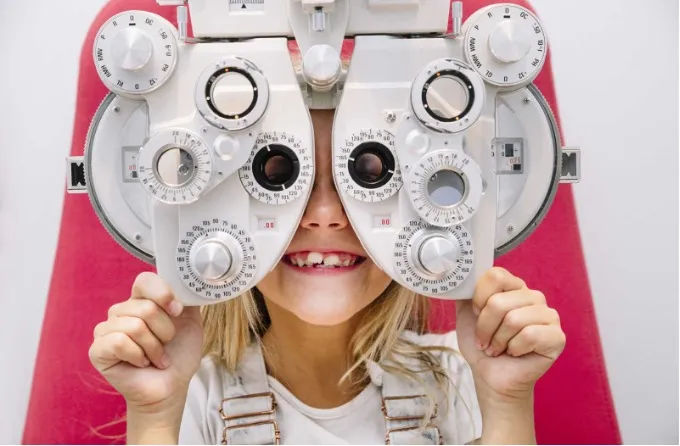
In our developmental vision evaluations we measure eye movements, eye teaming and focusing both with and without the proposed prescription, at distance and near. We then put the lenses in a trial frame and have your child read or use a tablet while we watch how the visual system responds. If focusing strain shows up, or the child starts pulling the page closer, we adjust the power or the lens design. For some children the most comfortable answer is a bifocal or anti-fatigue lens; for others it is a slightly different single-vision prescription than the chart alone would suggest. We also ask about near demands, including homework load and screen habits.
This follows the American Optometric Association’s pediatric guideline, which recommends comprehensive examinations, including binocular vision and focusing testing, at 6 to 12 months, at least once between ages 3 and 5, and before first grade and annually after that. The guideline also summarizes research in which acuity-only screening missed 75.5% of children later found on a complete examination to have binocular vision and eye-movement problems (AOA, 2017). Passing a school screening does not confirm that a prescription is doing its job at near.
When we consider vision therapy
Sometimes an evaluation finds a problem lenses alone cannot solve: the eyes do not aim together comfortably at near (convergence insufficiency), focusing is weak or slow, or tracking across a line of print is inaccurate. These can cause headaches, eye strain, intermittent double vision and trouble staying with near work, and they can make any pair of glasses feel wrong.
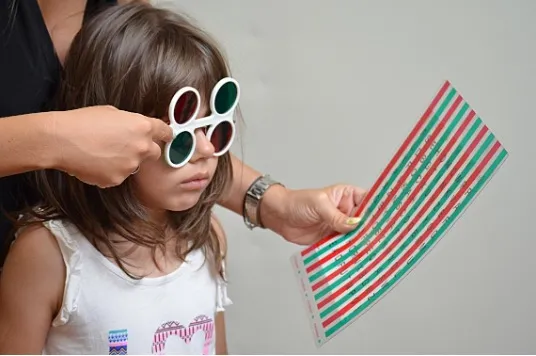
Here is what the evidence supports, and what it does not. For symptomatic convergence insufficiency in children, 12 weeks of office-based vergence and accommodative therapy with home practice produced a successful or improved outcome in 73% of children, against 35% on office-based placebo (CITT Study Group, 2008), and improved focusing amplitude far more than placebo (Scheiman et al., 2011). What it did not do was raise reading scores: in the larger follow-up CITT-ART trial, reading comprehension improved by the same amount with therapy as with placebo (CITT-ART Investigator Group, 2019). Pediatric and ophthalmology organizations go further, holding that vision therapy should not be offered as a treatment for learning disabilities (AAP/AAO/AAPOS/AACO, 2009).
Our clinical position is narrower than either headline. We recommend vision therapy to treat a diagnosed eye-teaming or focusing problem and the symptoms it causes, not as a route to better grades. Glasses come first; therapy is added only when a measurable problem remains once the best-tolerated prescription is in place.
What to do if your child won’t wear their glasses
Step 1: Ask your child. “Blurry up close,” “my eyes get tired,” “it makes me dizzy” and “kids laugh at me” each point somewhere different.
Step 2: Take the symptom checklist. Our symptom checklist scores the symptoms commonly associated with a functional vision problem and gives you something concrete to bring to the appointment.
Step 3: Get a developmental vision evaluation. A developmental vision evaluation goes past the eye chart to test focusing, eye teaming and eye movements through the actual prescription, at the distances your child actually uses. Dr. Christina Murray is board certified in vision development as a Fellow of Optometric Vision Development and Rehabilitation (FOVDR).
When a child refuses their glasses, they are telling you something. Sometimes the message is “these slide down my nose.” Sometimes it is “these make reading harder, not easier.” The way to find out which is to rule out a functional vision problem, so if you would like us to take a look, schedule an evaluation at any of our four South Florida offices.
Common Questions About This Topic
Is it normal for a child to refuse to wear glasses?
It is far more common than most parents expect. A systematic review of 23 studies covering 7,859 children in 14 countries pooled the results of 20 of them and found overall compliance with spectacle wear of about 40%. Lost or broken glasses, forgetting, teasing, parental disapproval and discomfort were the reasons children gave most often.
Could the prescription itself be the reason my child won't wear glasses?
Sometimes. A prescription can be accurate for the distance eye chart and still feel uncomfortable during reading, homework or screen time. A developmental vision evaluation checks how your child focuses and teams their eyes through the new lenses at near as well as far, so the power or the lens design can be adjusted if near work is the problem.
Will bifocal or progressive lenses stop my child's nearsightedness from getting worse?
Not by much. In the three-year COMET trial, progressive addition lenses slowed myopia by 0.20 diopters compared with single-vision lenses, and the investigators concluded the effect was too small to change clinical practice. When we add near power, it is for comfort and function up close, not as a myopia cure.
When is vision therapy considered instead of, or alongside, glasses?
When the evaluation finds an eye-teaming or focusing problem that lenses alone do not resolve. For symptomatic convergence insufficiency in children, office-based vergence and accommodative therapy outperformed placebo in the CITT trial. The same therapy did not improve reading scores in the later CITT-ART trial, so we describe it as treatment for the vision problem and its symptoms, not for schoolwork.
My child passed the school vision screening. Do they still need an exam?
A screening checks mainly for reduced distance acuity and amblyopia risk. The American Optometric Association's pediatric guideline summarizes research in which acuity-only screening missed 75.5% of children later found on a complete examination to have binocular vision or eye-movement problems. Passing a screening does not confirm that a prescription is comfortable for near work.
Where This Information Comes From
- Dhirar N, Dudeja S, Duggal M, Gupta PC, Jaiswal N, Singh M, Ram J (2020). Compliance to spectacle use in children with refractive errors: a systematic review and meta-analysis. BMC Ophthalmology; 20(1):71. : 23 studies (7,859 children, 14 countries), 20 pooled: overall spectacle compliance 40.14% (95% CI 32.78-47.50), range 9.84% to 78.57%; reasons for non-compliance included broken or lost spectacles, forgetfulness, parental disapproval, teasing, discomfort and headache.
- Messer DH, Mitchell GL, Twelker JD, Crescioni M; CLEERE Study Group (2012). Spectacle wear in children given spectacles through a school-based program. Optometry and Vision Science; 89(1):19-26. : Two-thirds of 247 US schoolchildren given two free pairs were not wearing them a year later; lost (44.9%) and broken (35.3%) were the commonest reasons; each line of poorer uncorrected acuity raised the odds of wear by 60% (adjusted OR 1.6); children who never got used to their glasses were less likely to be wearing them (adjusted OR 5.7).
- Morjaria P, Evans J, Gilbert C (2019). Predictors of spectacle wear and reasons for nonwear in students randomized to ready-made or custom-made spectacles. JAMA Ophthalmology; 137(4):408-414. : Among 362 Indian students aged 11-15 followed up, 25.4% were not wearing their spectacles; teasing or bullying by peers was the main reason given for non-wear (48.9%, 45 of 92); worse baseline vision predicted wear.
- Morjaria P, McCormick I, Gilbert C (2019). Compliance and predictors of spectacle wear in schoolchildren and reasons for non-wear: a review of the literature. Ophthalmic Epidemiology; 26(6):367-377. : Review of 25 studies published 2000-2017: greater uncorrected refractive error and poorer uncorrected acuity were associated with higher spectacle wear; age findings were inconsistent and definitions of compliance varied widely.
- VIP-HIP Study Group; Kulp MT, Ciner E, Maguire M, et al. (2016). Uncorrected hyperopia and preschool early literacy: results of the Vision in Preschoolers-Hyperopia in Preschoolers (VIP-HIP) Study. Ophthalmology; 123(4):681-689. : In 492 four- and five-year-olds, uncorrected moderate hyperopia (+3 to +6 D) was associated with early-literacy scores 4.3 points lower than emmetropes, with the largest deficits when near acuity or near stereoacuity was reduced; cross-sectional association, not a treatment result.
- Gwiazda J, Hyman L, Hussein M, et al. (2003). A randomized clinical trial of progressive addition lenses versus single vision lenses on the progression of myopia in children (COMET). Investigative Ophthalmology & Visual Science; 44(4):1492-1500. : In 469 children aged 6-11, three-year myopia progression was -1.28 D with progressive addition lenses versus -1.48 D with single-vision lenses; the authors concluded the small effect does not warrant a change in clinical practice.
- Hussaindeen JR, Murali A (2020). Accommodative insufficiency: prevalence, impact and treatment options. Clinical Optometry; 12:135-149. : Reported prevalence ranges from under 1% to 61.6% depending on the criteria used; low plus lenses and vision therapy have each shown benefit in separate studies but have never been compared head-to-head.
- American Optometric Association (2017). Evidence-Based Clinical Practice Guideline: Comprehensive Pediatric Eye and Vision Examination. : Recommends a comprehensive eye examination at 6-12 months, at least once between 3 and 5 years, and before first grade then annually; summarizes evidence that Snellen acuity screening alone missed 75.5% of children found on a complete examination to have binocular and oculomotor problems.
- Convergence Insufficiency Treatment Trial Study Group (2008). Randomized clinical trial of treatments for symptomatic convergence insufficiency in children. Archives of Ophthalmology; 126(10):1336-1349. : In 221 children aged 9-17, 12 weeks of office-based vergence/accommodative therapy with home reinforcement produced a successful or improved outcome in 73% versus 35% with office-based placebo.
- Scheiman M, Cotter S, Kulp MT, et al.; CITT Study Group (2011). Treatment of accommodative dysfunction in children: results from a randomized clinical trial. Optometry and Vision Science; 88(11):1343-1352. : 74% of CITT children with symptomatic convergence insufficiency also had accommodative dysfunction; accommodative amplitude improved 9.9 D with office-based therapy versus 2.2 D with placebo.
- CITT-ART Investigator Group (2019). Effect of vergence/accommodative therapy on reading in children with convergence insufficiency: a randomized clinical trial. Optometry and Vision Science; 96(11):836-849. : In 310 children with symptomatic convergence insufficiency, reading comprehension improved 3.7 points with therapy versus 3.8 points with placebo; therapy was no better than placebo for reading performance.
- American Academy of Pediatrics, American Academy of Ophthalmology, AAPOS, AACO (2009). Joint statement: learning disabilities, dyslexia, and vision. Pediatrics; 124(2):837-844. : Holds that vision problems can interfere with learning but do not cause dyslexia, and that evidence does not support eye exercises or behavioral vision therapy as treatments for learning disabilities.
Care We Provide
More From the Blog
Wondering If This Sounds Like Your Family?
A developmental vision evaluation measures the skills a routine eye exam does not. Our team sees children and adults in Coconut Creek, Boynton Beach, Boca Raton and West Palm Beach.