Baby Eye Color: How and When It Changes
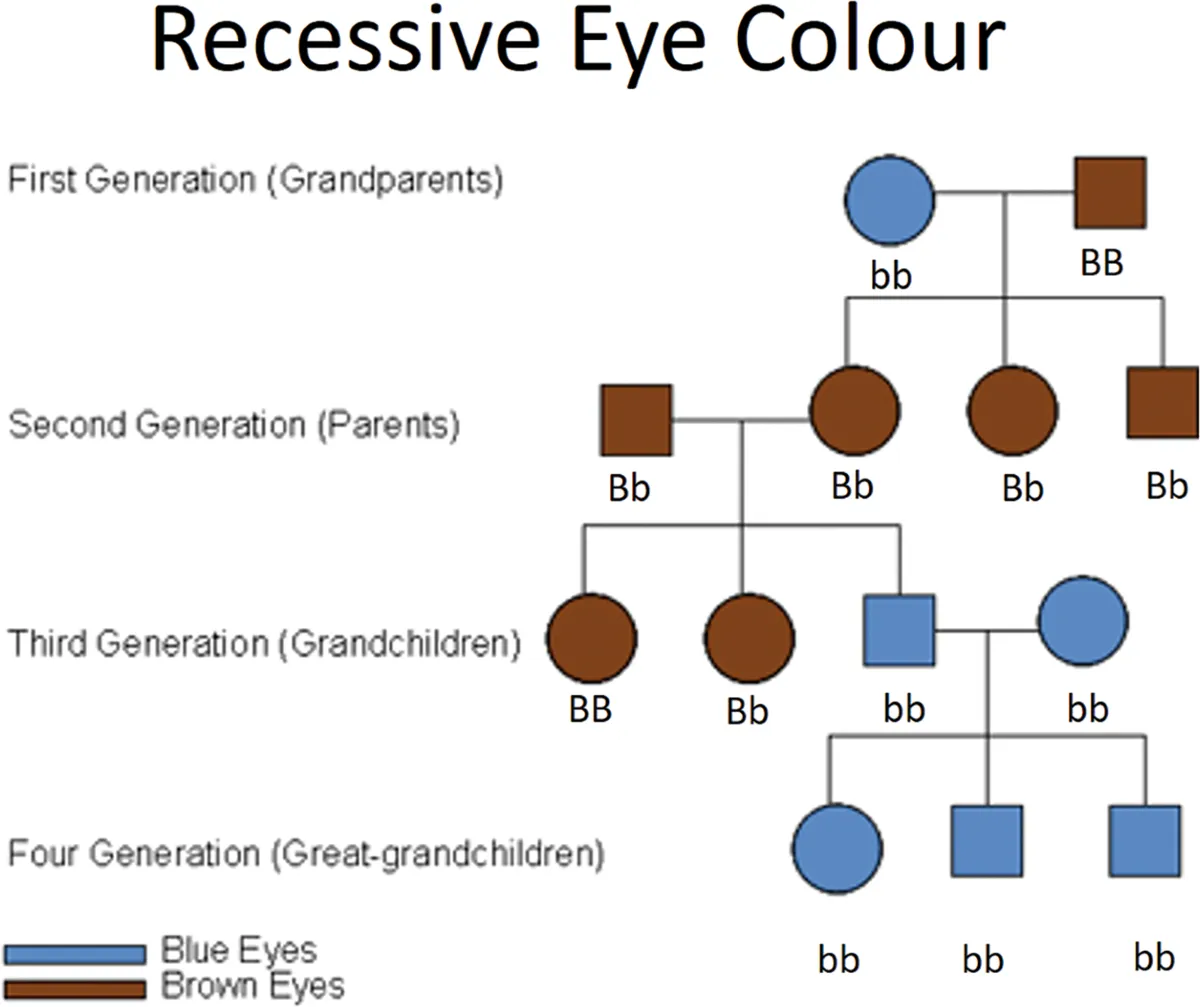
Parents ask us this in the exam room almost every week: our baby was born with slate-blue eyes, will they stay that way? Eye color is one of the few things about a newborn that is still visibly changing months after birth, and one of the very few you genuinely cannot predict.
Here is what the research actually shows about how baby eye color develops, when it settles, and the small number of changes that are worth an eye doctor’s attention rather than a photo album.
Key takeaways
- Most newborns are not born with blue eyes. Among 192 newborns with usable iris photographs in a prospective healthy full-term cohort, 63.0% had brown irises at birth and 20.8% were blue (Ludwig et al., 2016).
- Eye color comes from melanin in the iris. Pigment can keep building through the first year, which is why, in our exam rooms, we see light eyes darken far more often than we see dark eyes lighten.
- By around 9 to 12 months a baby’s eye color is probably final (American Academy of Ophthalmology); most people are stable by age 6, though 10% to 15% of the white participants in that twin study changed again later (Bito et al., 1997).
- Eye color is polygenic, so no simple parent chart can predict it (Sturm & Larsson, 2009).
- A white or dull pupil reflex, a constantly turning eye, or a new difference between the two irises are reasons to be seen promptly.
The myth we hear most: “all babies are born with blue eyes”
They are not. The Newborn Eye Screening Test (NEST) study photographed the irises of healthy full-term newborns, and among the 192 babies whose images were clear enough to read it found 63.0% brown, 20.8% blue, 5.7% green or hazel, 9.9% indeterminate and 0.5% partial heterochromia (Ludwig et al., 2016).
Brown, in other words, was the single most common newborn eye color by a wide margin. The “all babies start out blue” idea almost certainly comes from families and photographs in populations where light irises are common, and the proportions in any given nursery depend on the families it serves. It is a good story. It is not what the data show.
What actually makes an eye blue, green or brown
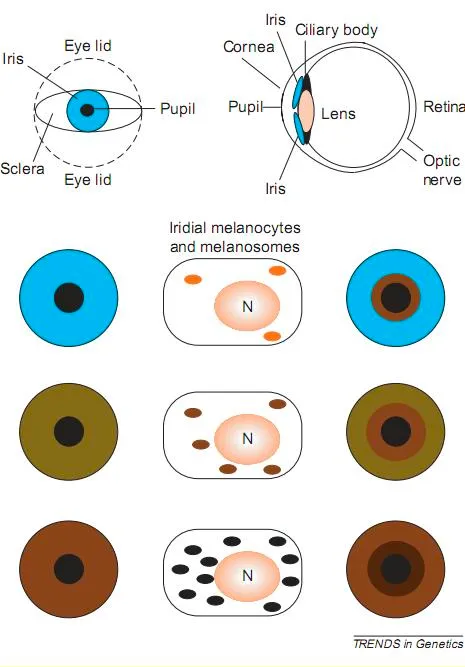
The iris is the colored ring around the pupil. Its color depends on how much melanin sits in the front layer of the iris and how light scatters through the tissue behind it. Melanin is the same pigment that colors skin and hair. More melanin absorbs more light and the iris looks brown; very little melanin lets short wavelengths scatter back out, and the iris looks blue or gray.
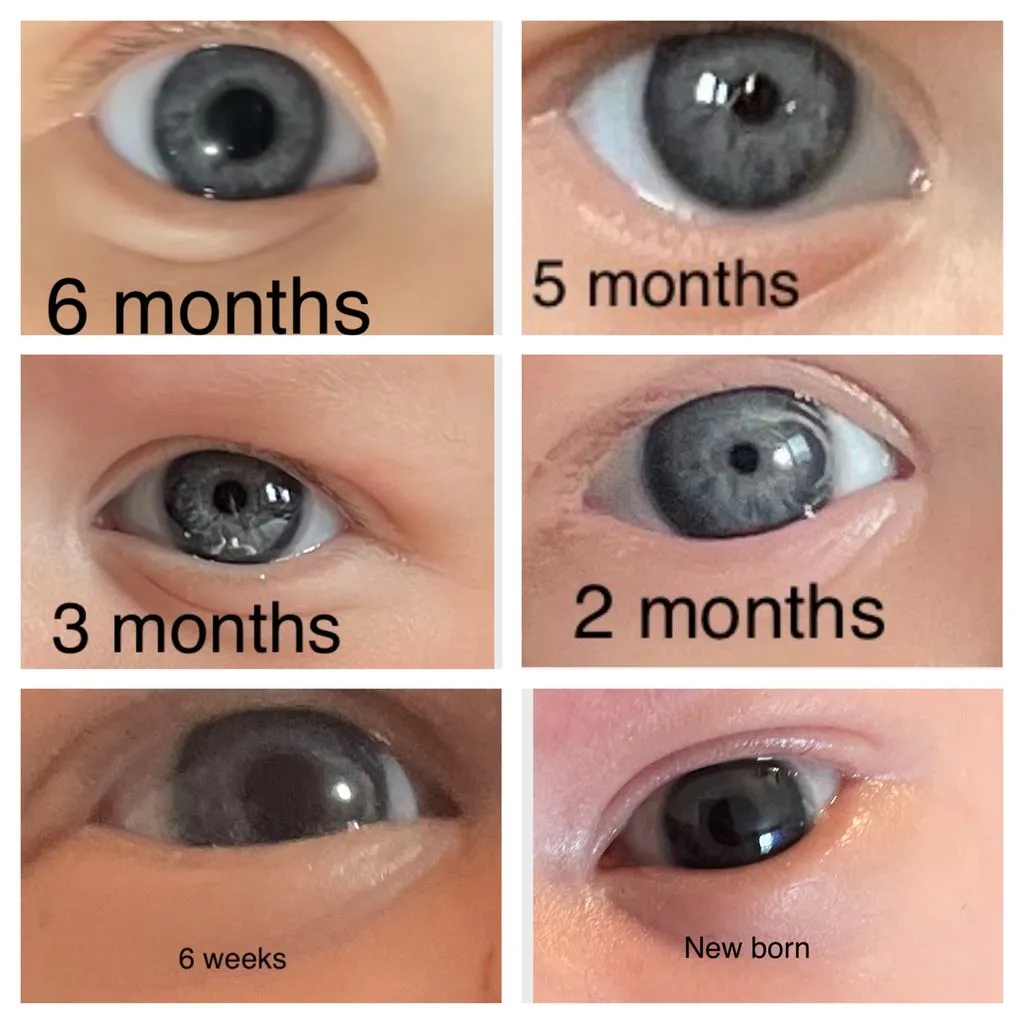
There is no blue pigment in a blue eye — only more or less melanin in front of it. That is why the change we see tends to run in one direction: as pigment builds over the first months of life, a light iris can shift toward green, hazel or brown. The reverse, a brown iris turning blue, is not something we see in practice.
When does baby eye color settle?
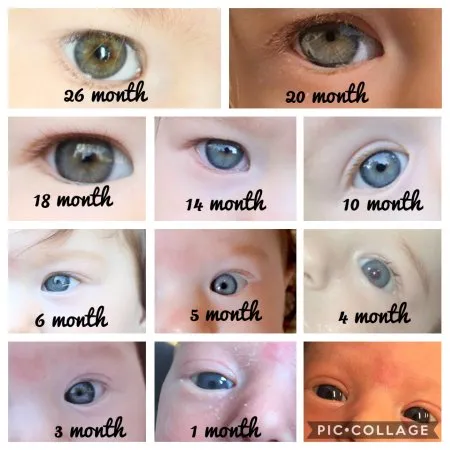
Most of the change happens in the first year. The American Academy of Ophthalmology’s infant vision timeline places the milestone at about 9 months, noting that a baby’s eyes are probably their final color by then, while adding that slight changes later are not unusual (AAO).
Longer-term data agree that “final” is a soft word. In the Louisville Twin Study, which followed 1513 twins, most individuals had reached a stable eye color by about age 6 — yet 10% to 15% of the white participants showed further eye-color change through adolescence and adulthood (Bito et al., 1997). That cohort was predominantly white, so the 10% to 15% figure describes those participants rather than children in general.
So a practical answer for parents: by the first birthday you will usually know, by kindergarten you will almost certainly know, and a subtle drift years later is still within normal.
Why you cannot predict it from the parents
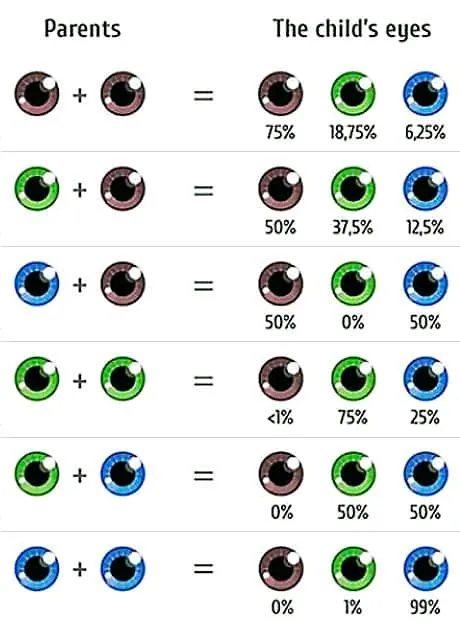
The genetics chart most of us learned in school — brown dominant, blue recessive, two genes and done — is too simple to be right. Human iris color is polygenic. About 74% of the variation traces back to a single region on chromosome 15 containing the OCA2 gene, acting largely through the nearby HERC2 variant rs12913832, with several other genes adding smaller effects (Sturm & Larsson, 2009).
That is why two brown-eyed parents can have a blue-eyed child, and why charts like the one below give probabilities, not promises.
Inheritance is still powerful, though. In the Louisville twin data, identical twins matched each other’s eye color almost perfectly (r=0.98) while fraternal twins matched far less closely (r=0.49) (Bito et al., 1997). Genes decide the destination; the first year of life simply reveals it.
Green, hazel and gray
Green and hazel irises sit in the middle of the pigment range, and they were the least common of the named iris colors at birth: 5.7% of the NEST newborns (Ludwig et al., 2016). In our exam rooms, babies who end up green or hazel often look blue or gray for the first several months and then develop a golden or brown flecking as pigment builds. Hazel eyes in particular can look different in different lighting for years, because the color depends as much on how light scatters as on how much pigment is there.
When an eye-color change deserves an eye exam
Almost all of this is ordinary development. A few things are not, and they are worth knowing:
- A white, dull or absent pupil reflex. In a photograph one pupil glows white instead of red, or your pediatrician notes an abnormal red reflex. An abnormal or white reflex is the most common sign of retinoblastoma, a rare childhood eye cancer (Parulekar, 2018). This is why the AAP and its ophthalmology partners call red reflex testing an essential part of every newborn, infant and child physical examination and define when to refer (AAP et al., 2008). Do not wait on this one.
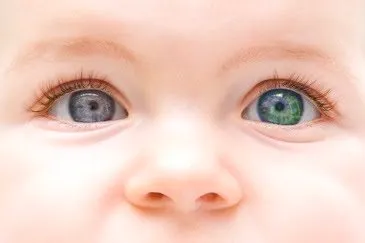
- A new or asymmetric difference in iris color. A small color difference between the eyes can be present from birth and is often harmless — 0.5% of NEST newborns had partial heterochromia (Ludwig et al., 2016). What earns an exam is a difference that appears later, or one paired with a droopy eyelid and a smaller pupil on the same side. That combination suggests Horner syndrome, which can show iris heterochromia because the sympathetic nervous system helps develop and maintain eye color (Wang et al., 2012). Horner syndrome can also be the first sign of something serious: in one tertiary-hospital series of 14 children with the condition, a tumor was the most frequent cause (6 of 14), most often neuroblastoma (4 of 14) (Pérez-Torres-Lobato et al., 2021). That is a small, referral-center sample rather than a picture of every child — and it is exactly why this combination of signs is examined rather than watched.
- An eye that constantly turns in or out. For the first two months babies’ eyes often do not work together well, but a constantly turning eye should be raised with your pediatrician, and by 3 months the eyes should be working together to focus and track (AAO).
What we do at Vision & Learning Center
Watching eye color settle is the fun part. The part we care about clinically is everything behind the iris: whether the two eyes are focusing, aligning and tracking together as they should. Those skills are developing on their own schedule during the same first year — see What Can My Baby See? for that timeline, and our parent’s guide to common eye problems in babies 0–18 months for the signs that come up most often.
The American Optometric Association recommends a first comprehensive eye examination at about 6 months of age, and its clinical guideline sets the schedule at 6 to 12 months, again between 3 and 5 years, and before first grade with annual exams after that (AOA infant vision; AOA, 2017). Those first visits are painless, mostly observational, and do not require your baby to know letters or answer questions. You can read more about the eye health we screen for on our ocular health page.
Enjoy the guessing game — and if anything about your baby’s pupils, iris color or eye alignment gives you pause, have it looked at rather than photographed for comparison. Schedule an evaluation at any of our Coconut Creek, Boynton Beach or West Palm Beach offices, or learn what to expect at our comprehensive eye examinations.
Common Questions About This Topic
Are all babies born with blue eyes?
No. Among 192 newborns with usable iris photographs in a prospective study of healthy full-term babies, 63% had brown irises at birth and only about 21% were blue. The 'all babies are born with blue eyes' idea comes from populations where light irises are common, not from newborns in general.
At what age does a baby's eye color stop changing?
Most of the change happens in the first year. The American Academy of Ophthalmology notes that by about 9 to 12 months a baby's eyes are probably their final color, with slight shifts still possible. Long-term twin data show most people are stable by age 6, though 10% to 15% of the white participants in that study changed again through adolescence and adulthood.
Can two brown-eyed parents have a blue-eyed baby?
Yes. Eye color is polygenic. One region on chromosome 15 containing OCA2, largely through the HERC2 variant rs12913832, explains about 74% of the variation, but several other genes contribute, so parent-color charts give probabilities rather than answers.
Is it normal for a baby to have two different colored eyes?
A small color difference between the irises can be present from birth and is often harmless: partial heterochromia was recorded in 0.5% of newborns in the NEST study. A difference that is new, or one that comes with a droopy eyelid and a smaller pupil on the same side, should be examined.
When should my baby have a first eye exam?
The American Optometric Association recommends a comprehensive eye examination at 6 to 12 months of age, again between 3 and 5 years, and before first grade with annual exams after that. Pediatricians also check the red reflex from the newborn nursery onward.
Where This Information Comes From
- Ludwig CA, Callaway NF, Fredrick DR, Blumenkranz MS, Moshfeghi DM (2016). What colour are newborns' eyes? Prevalence of iris colour in the Newborn Eye Screening Test (NEST) study. Acta Ophthalmologica. : Among 192 newborns with iris images of adequate quality in a prospective healthy full-term cohort: 63.0% brown, 20.8% blue, 5.7% green/hazel, 9.9% indeterminate, 0.5% partial heterochromia.
- Sturm RA, Larsson M (2009). Genetics of human iris colour and patterns. Pigment Cell & Melanoma Research. : Eye color is polygenic; about 74% of the variance traces to one chromosome 15 interval containing OCA2, largely via the HERC2 variant rs12913832.
- Bito LZ, Matheny A, Cruickshanks KJ, Nondahl DM, Carino OB (1997). Eye color changes past early childhood. The Louisville Twin Study. Archives of Ophthalmology. : In 1513 twins, most reached stable eye color by age 6, but 10-15% of the white subjects changed through adolescence and adulthood in this predominantly white US sample; identical-twin concordance r=0.98 vs 0.49 for fraternal twins.
- American Academy of Ophthalmology (Boyd K, reviewed by Lipsky SN). Vision Development: Newborn to 12 Months. aao.org EyeSmart patient education page. : At 9 months a baby's eyes are probably their final color; eyes often do not work together for the first 2 months, but a constantly turning eye should be discussed with the pediatrician.
- American Optometric Association. Infant Vision: Birth to 24 Months of Age. aoa.org patient education page. : Recommends a first thorough eye examination at about 6 months; InfantSEE assessments are offered between 6 and 12 months at no cost.
- American Optometric Association (2017). Evidence-Based Clinical Practice Guideline: Comprehensive Pediatric Eye and Vision Examination. : Recommends comprehensive eye examinations at 6-12 months, at least once between ages 3 and 5, and before first grade with annual exams thereafter.
- American Academy of Pediatrics, Section on Ophthalmology; AAPOS; AAO; AACO (2008). Red reflex examination in neonates, infants, and children. Pediatrics. : Policy statement calling red reflex testing an essential component of the neonatal, infant and child physical examination, with defined indications for referral to an ophthalmologist.
- Parulekar MV (2018). Detecting retinoblastoma. Community Eye Health Journal. : States that an abnormal or white pupil reflex is the most common sign of retinoblastoma, while squint is common in children and is rarely due to retinoblastoma.
- Wang FM, Wertenbaker C, Cho H, Marmor MA, Ahn-Lee SS, Bernard BA (2012). Unilateral straight hair and congenital Horner syndrome. Journal of Neuro-Ophthalmology. : Congenital Horner syndrome may show iris heterochromia because the sympathetic nervous system helps develop and maintain eye color.
- Perez-Torres-Lobato MR, De Las Morenas-Iglesias J, Llempen-Lopez M, et al. (2021). Paediatric Horner syndrome. A case series of 14 patients in a tertiary hospital. Archivos de la Sociedad Espanola de Oftalmologia. : In 14 children with Horner syndrome at one tertiary hospital, tumors were the most frequent cause (6/14), most often neuroblastoma (4/14).
Care We Provide
More From the Blog
Wondering If This Sounds Like Your Family?
A developmental vision evaluation measures the skills a routine eye exam does not. Our team sees children and adults in Coconut Creek, Boynton Beach, Boca Raton and West Palm Beach.