When Visual-Motor Goals Stall, Check the Visual Input
The hands can only work with what the eyes send them. This page is for you: the signs that point to a vision problem, what we check, how we work alongside your therapy, free CE courses, and handouts for your families and your clinic.
Signs a Vision Problem Is Holding Therapy Back
A child can pass a school eye chart and still have trouble aiming, focusing or judging space. That can hold back handwriting, copying and coordination, even with great therapy.
When a child on your caseload has hit a wall and you suspect the eyes are part of it, we would like to see them. Refer when you see:
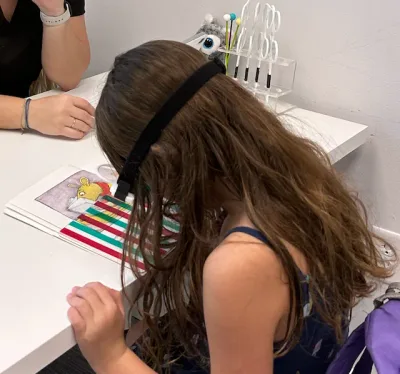
- Copying is far worse than writing from memory
- Letters drift off the line and spacing stays uneven
- Catching, stairs or judging distance lag behind
- Loses their place on worksheets or tires fast at the table
- Tilts their head, closes one eye or leans in very close
- Headaches or eye strain with near work
- Strong verbally, weak on visually demanding tasks
- Progress plateaus despite good therapy
Send the child to a doctor the same day for sudden double vision, a new eye turn, eye pain or vision loss.
What We Check
A developmental vision evaluation measures the visual skills your therapy depends on, so you know what the visual system can do right now.
-
Eye Teaming
Both eyes aiming together up close, and holding it through tabletop work.
-
Focusing
Keeping print clear for as long as the task lasts, and shifting focus between distances.
-
Eye Movements
Smooth tracking and accurate jumps from target to target, and along a line of print.
-
Visual Processing
Spatial and form perception, and visual memory.
-
Visual-Motor Integration
How well what the eyes send matches what the hands produce.
-
Acuity and Eye Health
Clear sight at distance and near, glasses where they help, and the health of the eyes.
Who Does What
Co-management is usually the best plan for the child, and it is how we prefer to work. Neither profession has to stretch into the other’s specialty.
Occupational Therapy
- Sensory integration, vestibular and proprioceptive foundations
- Motor planning, regulation and functional participation
- The handwriting practice that has to happen for handwriting to improve
- Visual-motor and visual-perceptual activities within your plan
Developmental Optometry
- Diagnosing eye teaming, focusing, eye movement and visual processing problems
- Glasses or prisms when they help
- Optometric vision therapy when it is indicated
- Reports and progress updates so your goals match what the eyes can do
How a Referral Works
Send the referral
Use our online referral form, or fax the printable form to (561) 462-1245. Families can also book themselves with one of the handouts below.
We contact the family
We reach out to the family to schedule the developmental vision evaluation, and go over the results with them the same day.
You get a written report
Within seven days of the evaluation, with the family’s consent: which visual skills are affected, and how to match your goals and materials to what the visual system can do right now.
We stay in touch
If the child starts vision therapy, you get progress updates, so our work and yours support each other.
Free CE Courses for Occupational Therapists
Dr. Murray teaches Functional Vision in Rehabilitation, two free, live, in-person courses written for occupational therapists. Dates are not set yet.
-
Part 1 · Two hours
Understanding Visual Dysfunction Across the Lifespan
How functional vision supports reading, balance, mobility and daily activities, and what it looks like when it isn’t working: in children with developmental vision concerns, after a concussion or brain injury, after a stroke, and with vestibular symptoms.
-
Part 2 · Two hours
Functional Vision Screening and Rehabilitation Readiness
Hands-on practice of an introductory functional vision screening: what to observe, how to record it, when to stop, and how to turn what you saw into a useful referral and a therapy plan.
For Referring Providers
An overview for referring providers: the vision problems a standard eye exam can miss, what our evaluation measures, how treatment works, and what we send back to you.
Handouts for Your Families
A referral lands better when the family knows why they are being sent. Print as many as you like, or email the PDF straight to a family.
-
Handwriting or Coordination Stuck? Check the Eyes.
For the family, from their child's OT: how eye aiming, focusing and tracking show up in handwriting and coordination, with a check-list and a tear-off referral slip.
-
Vision Is a Sensory System Too
For the family, from their child's OT: why vision belongs in the sensory picture, the signs that the eyes are working too hard, and a tear-off referral slip.
-
What to Expect at Your Evaluation
A one-page walk through the visit for patients and families, children and adults: booking and forms, the evaluation itself, results the same day, the written report, what to bring and how payment works.
-
While You Wait: Home and Classroom Tips
Simple changes that lighten the load on tired eyes at home and at school until the evaluation. They support the child; they do not treat the problem.
Tools for Therapists and the Front Desk
-
When Visual-motor Goals Stall, Check the Visual Input
For you: what to look for, what we check and what you get back when handwriting, copying or coordination plateaus despite good therapy.
-
Front-desk Guide for Therapy Clinics
For your front desk: who your therapists may send, children and adults, what to send us, three ways to refer and what happens next, on one page.
-
What You'll Get Back: a Sample Report
For your clinic: a one-page sample of the written report we send after an evaluation, with findings, the recommended plan and what to expect next.
-
When Patients Ask "Is It Covered?"
For your front desk: a half-page card with the answer on insurance, reimbursement paperwork, HSA, FSA, CareCredit, payment plans and FES-UA scholarships.
Request an In-Service or Ask a Question
Dr. Murray can also come to your clinic for an in-service or a lunch and learn with your therapists. Tell us about your clinic and we will get back to you. Helpful to include:
- Your clinic name and your role
- What you would like covered
- Roughly how many therapists will attend
- Days or times that work for you
To refer a patient, please use the referral form instead. Prefer the phone? Call (561) 462-1245. Please don’t include patient health details in this form.
Questions OTs Ask Us
Isn’t vision already part of OT?
Visual-motor and visual-perceptual work are, and they overlap with what we do. What a developmental optometrist adds is the diagnosis: whether there is a measurable eye teaming, focusing or eye movement problem underneath, and the treatment for it, including lenses, prisms and optometric vision therapy. Read how the two professions differ →
Should the child pause OT during vision therapy?
Usually not. Co-management is how we prefer to work: OT keeps working on sensory integration, motor planning, regulation and handwriting practice, while we diagnose and treat the visual disorder. Your progress updates help both plans move together.
The child passed their school vision screening. Why refer?
A screening checks how clearly a child sees the chart across the room. It does not measure eye teaming, focusing or eye movements up close, which is where handwriting, copying and tabletop work happen. Read what school screenings miss →
Do you see children with autism or developmental delays?
Yes. Our evaluation does not depend on a child reading letters or describing what they see, and we go at the child’s pace with all ages and abilities. Our page for ABA and developmental teams covers looking behaviors that can have a visual cause. Read about vision and autism →
What do I need to send with the referral?
The referral form, and anything that helps: your recent evaluation, the goals that have stalled and what you have observed. Our front-desk guide lays it out on one page for your clinic staff.
Do you offer continuing education for OTs?
Yes. Dr. Murray teaches two free, live courses for occupational therapists on functional vision in rehabilitation. Dates are not set yet; sign up to hear when they are.
Worth Reading
- Vision Therapy vs. Occupational Therapy Where the two overlap, what each is scoped to do, and when to use both.
- Why a Child’s Handwriting May Not Be Improving The visual skills behind spacing, sizing and copying.
- Primitive Reflexes and Vision A shared vocabulary between our professions, and what the evidence does and doesn’t say.
- Why Did an Occupational Therapist Refer Your Child? The page for families: share it with a parent after a referral.
Resources for Other Providers
- Pediatricians & Family Doctors
- Adult & Neuro Occupational Therapists
- Physical & Vestibular Therapists
- Speech-Language Pathologists & Reading Specialists
- ABA & Developmental Teams
- Occupational, Physical & Speech Therapists
- Psychologists, Psychiatrists & Neuropsychologists
- Teachers, Schools & Tutors
- Optometrists
- Concussion & Brain Injury Providers
- All professional resources
Have a Child on Your Caseload in Mind?
Send the referral and we’ll call the family, evaluate, and report back to you. Offices in Coconut Creek, Boynton Beach, Boca Raton and West Palm Beach.