Autism and Vision: What Parents Should Know
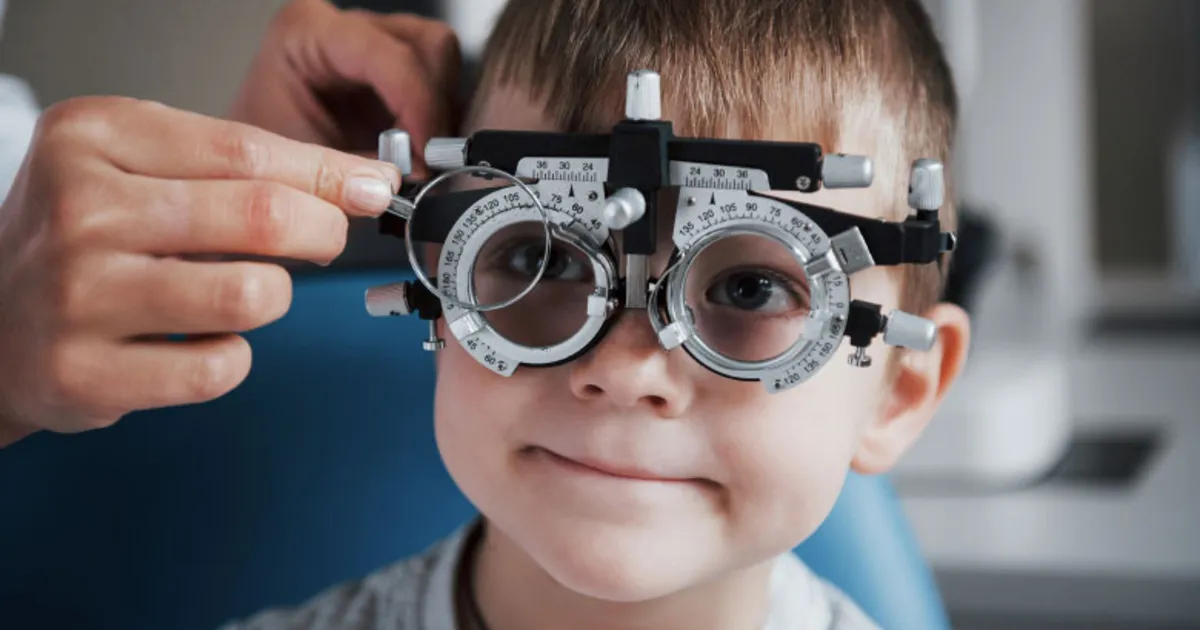
Research on autism and vision problems points to something families are rarely told: autistic children are more likely than other children to have an eye turn, a significant glasses prescription, or trouble with focusing and depth perception. The good news is that most of these can be measured without words and treated. They are also easy to miss, because a child who cannot sit through a school screening often never gets a full exam.
A note on words: many autistic adults prefer “autistic”, many professionals still write “person with autism”, and a large UK survey found no single term everyone accepts (Kenny et al., 2016). We use “autistic” and “on the autism spectrum” here, and in the exam room we use whatever your family uses.
Key takeaways
- A 2023 meta-analysis found strabismus (an eye turn) about 4.7 times as common in autistic people, along with more focusing difficulty and weaker depth perception (Perna et al., 2023).
- In a Taiwanese cohort of 20,688 autistic children, the risk of farsightedness, nearsightedness, astigmatism and strabismus was higher than in 2 million matched peers (Chen et al., 2025).
- Visual acuity is usually normal once any prescription is corrected, so “sees fine” does not rule out a problem with how the eyes aim or focus (Little, 2018).
- Treatment can make seeing clearer and more comfortable. Glasses, eye-turn care and vision therapy target the visual system; treating a vision problem does not treat autism.
- An eye exam can be done without the child reading or answering questions, and it can be adapted to a child’s sensory needs.
How common are vision problems in autistic children?
Vision problems are more common in autistic children than in other children, but how much more depends on who was studied. The table below puts the main studies side by side, because the difference in their numbers is itself informative.
| Study | Who was examined | What they found |
|---|---|---|
| Perna et al., 2023 | Meta-analysis of 46 studies | Strabismus OR 4.72; more focusing (accommodation) deficits; reduced stereoacuity and contrast sensitivity |
| Chen et al., 2025 | 20,688 autistic children vs 2.06 million controls, Taiwan | Higher risk of hyperopia (1.78x), myopia (1.27x), astigmatism (1.51x), strabismus (2.18x) |
| Ikeda et al., 2013 | 154 children seen by a pediatric ophthalmologist | 40% had eye findings: 29% significant refractive error, 21% strabismus, 10% amblyopia |
| Chang et al., 2019 | 380 autistic children referred to an eye clinic | 71% had a diagnosis: refractive error 42%, strabismus 32%, amblyopia 19% |
| Goetz et al., 2026 | US tertiary eye-center records | Strabismus and/or amblyopia in 35% of autistic children vs 29% of controls |
How to read this: the highest numbers come from children who were already referred to an eye clinic, so they overstate the rate across all autistic children. In the university study, only 15% of the autistic children seen at that institution ever reached the eye clinic (Chang et al., 2019). The US multicenter study compared autistic children with other children who were also in specialist eye care, which narrows the gap. The population cohort from Taiwan avoids referral bias but relies on insurance diagnosis codes rather than study exams.
Put together, the direction is consistent: eye turns and glasses-level prescriptions are more common with autism, and focusing and depth perception differ on average. For context, the CDC’s most recent surveillance estimated autism in about one in 31 eight-year-olds in 2022 (Shaw et al., 2025), so this is not a rare question for families or for eye doctors.
Sharp sight, different teamwork
One finding is easy to misread. Several studies find that visual acuity, the “20/20” number, is usually normal in autistic children (Little, 2018; Milne et al., 2009). The differences show up elsewhere: in eye alignment, in convergence (turning the eyes inward to look at something close), in focusing, and in depth perception. A chart test at a school or pediatric office measures acuity, which is exactly the part most likely to be fine. That is why we recommend a comprehensive developmental vision evaluation rather than relying on a screening; our post on vision screenings versus comprehensive exams explains the gap in more detail.
Why vision problems are easy to miss with autism
Three things stack up.
- Screenings depend on cooperation. Pointing at letters, matching shapes or wearing 3D glasses on request is hard for many autistic children, especially in a busy room. The authors of one study noted that cooperation with vision screening is “understandably limited” and recommended a full exam instead (Ikeda et al., 2013).
- Children do not report what they have never known. A child who has always seen the world slightly blurred, or has always had to work to keep two eyes together, has no reason to say so, and a child who communicates differently may not say so at all.
- Visual behaviors get attributed to autism alone. Side viewing, looking away, lining objects up or avoiding busy spaces may be part of how a child is wired, but some of these behaviors can also be made worse by an eye turn, a strong prescription or light sensitivity. They are worth checking rather than assuming.
Parents notice things clinicians miss. In a small 2024 pilot study of 32 autistic children, 97% of parents reported at least one atypical visual behavior, parents reported more of them than the clinicians did, and refraction and acuity alone did not capture all the visual problems present (Constable et al., 2024). Your observations are data. Bring them.
Sensory and visual behaviors: what they can and cannot tell you
Sensory differences are common in autism. A meta-analysis of 14 studies found sensory symptoms much more frequent in autistic children than typical peers, most of all under-responsivity, followed by over-responsivity and sensation seeking, with the biggest differences at ages 6 to 9 (Ben-Sasson et al., 2009). Vision is one of the senses involved.
Some visual behaviors families often describe:
- Side viewing: looking at people or objects from the corner of the eye.
- Looking away from faces, which we cover in the visual reasons behind avoiding eye contact.
- Distress in busy or visually cluttered places, discussed in anxiety in crowded or visually complex environments.
- Strong interest in lights, spinning or moving objects, or flicking fingers near the eyes.
- Clumsiness on stairs, curbs or playground equipment, or difficulty catching.
Here is the honest limit. These behaviors do not by themselves mean an eye problem, and an eye problem does not explain autism. The NIH working group that defined cerebral visual impairment (CVI), a brain-based vision condition, put it plainly: autism can co-occur with CVI and share some features, but abnormal visual function or processing alone cannot explain the difficulties autistic people experience (Chang & Merabet, 2024). What an exam can do is tell you whether a measurable eye or vision problem is adding to the load.
What treating a vision problem can do
Once a vision problem is found, there is usually a clear way to treat it:
- Glasses for a significant prescription give clearer, less effortful sight. That is a direct, well-understood effect, and for a child who has never seen clearly it can change how they engage with books, faces and play.
- Treating an eye turn or amblyopia protects visual development in the affected eye and supports the two eyes working together.
- Vision therapy for a diagnosed convergence or focusing problem can build the eye teaming and focusing that close work depends on. The trial evidence comes from children with convergence insufficiency in general, not specifically autistic children. Convergence insufficiency has some of the strongest trial evidence for office-based therapy of any vision condition; our convergence insufficiency guide covers it. In our practice we regularly see these children read, draw and do table-top tasks with more comfort and stamina once it is treated.
The practice also uses yoked or ambient prism selectively. In a 1998 double-blind crossover study of 18 autistic young people, behavior problems were fewer with ambient prism than with placebo at six and eight weeks, with some of that benefit fading by three and four months (Kaplan et al., 1998). A 2010 single-case experiment in one autistic adolescent found no difference between ambient prism, placebo lenses and no lenses (Chok et al., 2010). Where we try prism, it is because the child’s response during testing suggested it might help, and we check at follow-up whether any benefit holds. For how prism differs from active therapy, see prism glasses vs. vision therapy.
As the practice’s autism spectrum page says, treating a vision problem does not treat autism: these are eye and vision treatments that work alongside, not instead of, a child’s speech, occupational, behavioral and educational supports.
What happens at an adapted eye exam
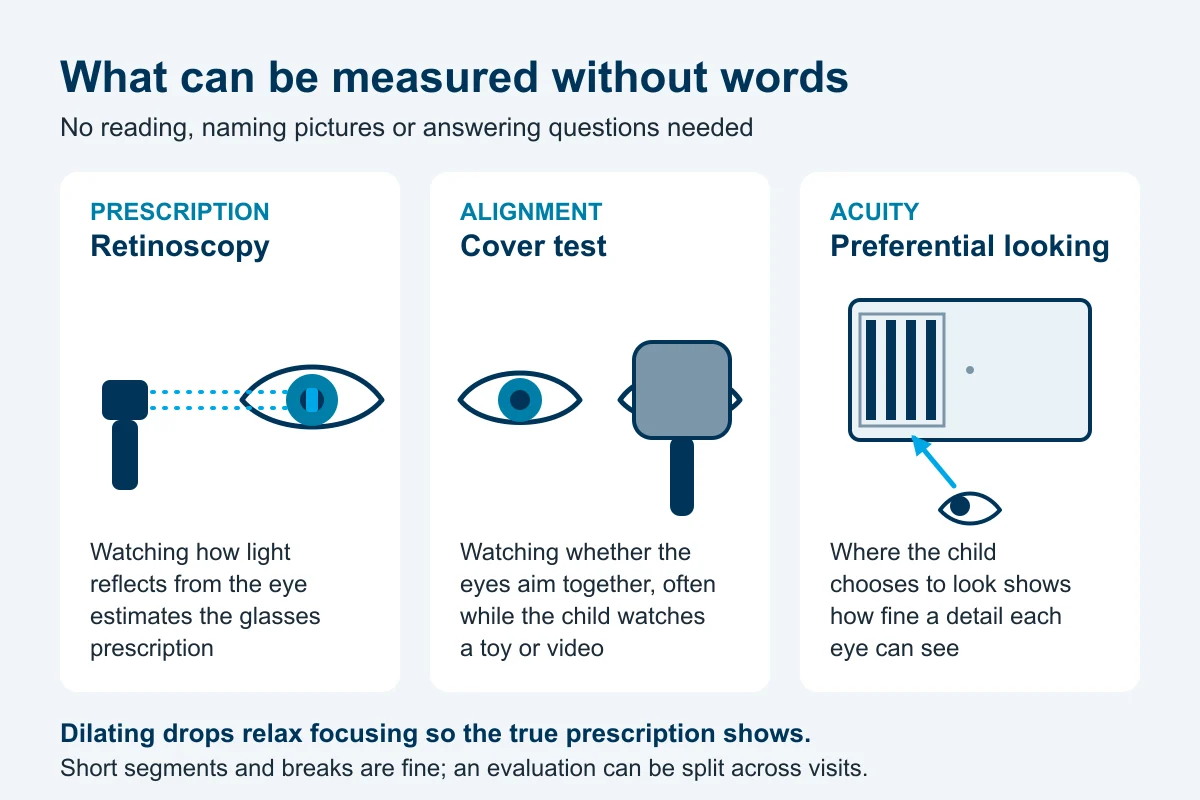
An eye exam can be adapted to how a child communicates and what their nervous system can tolerate. Most of what matters can be measured without the child reading, naming pictures or answering questions.
Before the visit
It helps us to know, ahead of time:
- How your child communicates (spoken words, signs, a device, pictures) and what “yes” and “stop” look like.
- Sensory triggers: bright lights, sounds, being touched near the face, waiting rooms.
- What calms or motivates them: a favorite video, object, snack or routine.
- The visual behaviors you have noticed at home or school, and when they happen.
- Previous eye results, if any, and any history of an eye turn in the family.
A social story or photos of the exam room can help some children know what to expect.
During the visit
- Prescription without answers. Retinoscopy estimates the glasses prescription by watching how light reflects from the eye. Dilating drops relax focusing so the true prescription shows, and they allow a full look at eye health.
- Eye alignment by observation. Cover tests and light reflexes show whether the eyes are aimed together, often while the child watches a toy or video.
- Acuity with pictures or looking behavior. Picture charts and preferential-looking cards estimate how clearly each eye sees without letters.
- Focusing and eye teaming as far as the child can manage, then more at a follow-up visit if needed.
- Short segments and breaks. It is fine to split an evaluation into more than one visit. A partial exam that goes well is more useful than a complete one that goes badly.
After the visit
You should leave knowing what was measured, what could not be measured yet, and what (if anything) needs treatment. If glasses are prescribed, the first weeks of wearing them can take patience; our post on why a child will not wear their glasses has practical steps. If your child is in OT, speech or ABA, we can share findings in plain language, because vision care works alongside other therapies, not instead of them.
Signs worth an eye exam
Consider booking an evaluation if your autistic child:
- Has an eye that turns in, out, up or down, even occasionally.
- Squints, tilts their head or covers one eye to look at things.
- Holds books, tablets or toys unusually close.
- Has never had a full eye exam, only screenings, or could not complete a screening.
- Rubs their eyes a lot, or seems bothered by light more than other sensory input.
- Has a new change in visual behavior, such as avoiding stairs or tripping more.
Our symptom checklist can help you organize what you are seeing before the visit.
Our clinical perspective
In our experience, the biggest risk for autistic children is not a rare eye disease. It is an ordinary, treatable problem, such as a strong prescription, an intermittent eye turn or a focusing difficulty, that stays hidden for years because the child could not do a screening and could not tell anyone. The research backs up that concern, and the encouraging part is how much can be done once it is found.
We examine and treat autistic children every week, and we adapt everything to them. Families often tell us their child is more at ease with books, screens, stairs or play once a prescription is corrected or eye teaming improves. Our job is to find out whether your child’s eyes are healthy, whether they see clearly and comfortably, and whether anything visual is making daily life harder than it needs to be. Then we treat what we find, at a pace your child can manage. We are not treating autism or changing who your child is; we are removing a visual load they should not have to carry.
If you would like that answer, read more on our autism spectrum page and special-needs eye care, find the nearest office on our locations page, or schedule an evaluation. Tell us about your child’s needs when you book, and we will plan the visit around them.
Common Questions About This Topic
Are vision problems more common in autistic children?
Yes, for several specific problems. A 2023 meta-analysis found strabismus (an eye turn) was about 4.7 times as common in autistic people, with more focusing difficulty and weaker depth perception. A Taiwanese cohort of more than 20,000 autistic children found higher rates of farsightedness, nearsightedness, astigmatism and strabismus. Visual acuity itself is usually normal once any prescription is corrected.
Can an eye exam diagnose autism?
No. Autism is diagnosed through a developmental and behavioral assessment, and no eye test can confirm or rule it out. An eye exam answers a different question: whether the eyes are healthy, whether the child needs glasses, and whether the two eyes aim, focus and work together. Those answers matter for any child, and they are harder to get in autistic children, who often cannot complete a standard school screening.
Will treating my child's vision problem help their autism?
Treating a vision problem can make seeing clearer and more comfortable, and families often tell us everyday tasks such as reading, stairs or play get easier once it is addressed. It does not treat autism itself, and no controlled trial shows that glasses, prism or vision therapy change the core features of autism. Evidence for yoked or ambient prism in autism comes from a few small studies with mixed results.
My child cannot read letters or answer questions. Can they still have an eye exam?
Yes. Most of what matters can be measured without words. Retinoscopy estimates the prescription by watching light reflected from the eye, eye alignment can be judged by watching the eyes, and eye health can be checked with dilating drops. Picture charts or preferential-looking cards can estimate acuity. The exam can be split into shorter visits if that works better for your child.
What visual behaviors are worth mentioning to the eye doctor?
Tell the doctor about side viewing (looking from the corner of the eye), an eye that drifts or turns, squinting or covering one eye, holding things very close, strong reactions to light or busy visual scenes, and difficulty with stairs, curbs or catching. A small 2024 study found parents reported more of these behaviors than clinicians did, so your observations add information the exam room can miss.
Where This Information Comes From
- Perna J, Bellato A, Ganapathy PS, et al. (2023). Association between Autism Spectrum Disorder (ASD) and vision problems. A systematic review and meta-analysis. Molecular Psychiatry; 28(12):5011-5023. : 49 studies reviewed and 46 pooled (15.6 million individuals across measures): strabismus more prevalent in autism (OR 4.72), with increased accommodation deficits, reduced stereoacuity, reduced contrast sensitivity and reduced peripheral vision. The authors flag methodological limitations in the included studies.
- Chen YL, Yen CF, Lai YH, et al. (2025). Higher risks of hyperopia, myopia, astigmatism, and strabismus in children with autism spectrum disorder: a nationwide, population-based cohort study. Brazilian Journal of Psychiatry; 47:e20233515. : Taiwanese birth cohort of 20,688 autistic children and 2,062,120 matched controls: adjusted hazard ratios of 1.78 for hyperopia, 1.27 for myopia, 1.51 for astigmatism and 2.18 for strabismus. Diagnosis codes from insurance data, not study examinations.
- Ikeda J, Davitt BV, Ultmann M, et al. (2013). Brief report: incidence of ophthalmologic disorders in children with autism. Journal of Autism and Developmental Disorders; 43(6):1447-1451. : Retrospective review; 154 of 407 children with autism or a related disorder completed a pediatric ophthalmology exam. 40% had ophthalmologic pathology: 29% significant refractive error, 21% strabismus, 10% amblyopia. The authors note cooperation with vision screening is limited in these children.
- Chang MY, Gandhi N, O'Hara M (2019). Ophthalmologic disorders and risk factors in children with autism spectrum disorder. Journal of AAPOS; 23(6):337.e1-337.e6. : Of 2,555 autistic children at one university over 10 years, the 380 (15%) seen in ophthalmology clinic had an ophthalmic diagnosis in 71%: significant refractive error 42%, strabismus 32%, amblyopia 19%. A referred sample, so rates are higher than in autistic children overall; co-occurring cerebral palsy added risk.
- Goetz J, Onwuka O, Moon JY, et al.; SOURCE Consortium (2026). A Systematic Analysis of Amblyopia and Strabismus in Children With Autism Spectrum Disorder Across Tertiary Referral Centers in the United States. Journal of Pediatric Ophthalmology and Strabismus; 63(5):335-340. : In a multicenter US database, strabismus and/or amblyopia was present in 35% of autistic patients versus 29% of age-matched controls (OR 1.33). Both groups were drawn from tertiary eye-care records.
- Little JA (2018). Vision in children with autism spectrum disorder: a critical review. Clinical and Experimental Optometry; 101(4):504-513. : Narrative review: expect normal visual acuity in autistic children, but likely atypical eye movements, subtle visuo-motor difficulties, more strabismus and astigmatism, and difficulty with attention, crowding and task complexity; argues for comprehensive vision care.
- Milne E, Griffiths H, Buckley D, Scope A (2009). Vision in children and adolescents with autistic spectrum disorder: evidence for reduced convergence. Journal of Autism and Developmental Disorders; 39(7):965-975. : Screening of 51 autistic and 44 typically developing young people: most visual functions, including acuity, were unaffected, but convergence stood out as an area needing further research.
- Constable T, Pilling RF, Woodhouse JM (2024). Testing the Hard to Test: A Pilot Study Examining the Role of Questionnaires in Eliciting Visual Behaviours in Children with Autistic Spectrum Disorder. Journal of Autism and Developmental Disorders. : Pilot study of 32 autistic children aged 4-11: 97% of parents reported at least one atypical visual behavior; parents reported more than clinicians did. Refraction and acuity alone did not capture all visual problems. Small sample.
- Ben-Sasson A, Hen L, Fluss R, et al. (2009). A meta-analysis of sensory modulation symptoms in individuals with autism spectrum disorders. Journal of Autism and Developmental Disorders; 39(1):1-11. : Across 14 studies, sensory symptoms were much more frequent in autistic than typical groups, most of all under-responsivity, then over-responsivity and sensation seeking; differences were largest at ages 6-9.
- Kaplan M, Edelson SM, Seip JA (1998). Behavioral changes in autistic individuals as a result of wearing ambient transitional prism lenses. Child Psychiatry and Human Development; 29(1):65-76. : Double-blind crossover in 18 autistic individuals aged 7-18: fewer behavior problems than placebo at 1.5 and 2 months, with some loss of benefit by 3 and 4 months. Very small sample.
- Chok JT, Reed DD, Kennedy A, Bird FL (2010). A single-case experimental analysis of the effects of ambient prism lenses for an adolescent with developmental disabilities. Behavior Analysis in Practice; 3(2):42-51. : In one autistic adolescent, scores rose across all conditions from practice, with no difference between ambient prism, placebo and no lenses. A single case.
- Kenny L, Hattersley C, Molins B, et al. (2016). Which terms should be used to describe autism? Perspectives from the UK autism community. Autism; 20(4):442-462. : Survey of 3,470 UK autistic people, families and professionals: 'autistic' was widely endorsed by autistic adults and parents, 'person with autism' more by professionals; no single term was universally preferred.
- Shaw KA, Williams S, Patrick ME, et al. (2025). Prevalence and Early Identification of Autism Spectrum Disorder Among Children Aged 4 and 8 Years - Autism and Developmental Disabilities Monitoring Network, 16 Sites, United States, 2022. MMWR Surveillance Summaries; 74(2):1-22. : CDC surveillance at 16 US sites: autism prevalence among 8-year-olds in 2022 was 32.2 per 1,000 (one in 31), with wide variation between sites.
- Chang MY, Merabet LB; CVI Working Group (2024). Special Commentary: Cerebral/Cortical Visual Impairment Working Definition: A Report from the National Institutes of Health CVI Workshop. Ophthalmology; 131(12):1359-1365. : NIH workshop definition of CVI. The full text notes that autism may co-occur with CVI and have overlapping features, and that abnormal visual function or processing alone cannot explain the difficulties autistic people experience.
Care We Provide
More From the Blog
Wondering If This Sounds Like Your Family?
A developmental vision evaluation measures the skills a routine eye exam does not. Our team sees children and adults in Coconut Creek, Boynton Beach, Boca Raton and West Palm Beach.