Why Won’t My Child Look at the Camera?

Every family has the photo. Birthday candles, first day of school, everyone smiling — except one child, who is looking at the floor, the ceiling, or somewhere just past the lens. The usual explanations are shyness, stubbornness, or a bad mood.
Sometimes that is exactly what it is. But holding a gaze is a demanding visual task, and some children look away because it is genuinely uncomfortable. That is worth checking before the behavior gets explained away.
Key takeaways
- Eye contact requires both eyes to aim at the same point, focus clearly, and stay steady on a moving face. If any part of that is strained, looking away is a sensible response.
- Convergence insufficiency, one of the eye-teaming problems behind that strain, screened as high-suspect or definite in about 13% of fifth- and sixth-graders in a US school-based study (Rouse et al., 1999). That is a screening classification, not a diagnosis.
- Looking away is also how brains manage effort: children avert their gaze more as questions get harder (Doherty-Sneddon & Phelps, 2005).
- Autistic children have higher measured rates of strabismus, and some focusing and convergence differences (Perna et al., 2023; Milne et al., 2009) — but an eye exam cannot diagnose or rule out autism.
- Avoiding the camera is a reason to have eye teaming, focusing and tracking examined. It is not a diagnosis on its own.
Eye contact is a visual workload, not only a social choice
To look someone in the eye, a child has to do four things at once: turn both eyes inward onto a target about an arm’s length away and hold them there, focus accurately at that distance and keep the image clear, keep the eyes steady while the face moves and changes expression, and process all of that while listening and answering.
When one link in that chain is weak, the whole task costs effort. Convergence insufficiency — trouble turning the eyes inward and holding them together at near — is the best studied example. In a school-based study of 453 fifth- and sixth-graders, about 13% met a high-suspect or definite classification for it, and most children with all three clinical signs also had trouble focusing (Rouse et al., 1999).
Children almost never describe this in words. On the validated symptom survey researchers use, children with convergence insufficiency averaged 30.8 points compared with 8.4 for children with normal binocular vision (Borsting et al., 2003). The discomfort is measurable — it just comes out as “I’m tired,” “this is boring,” or a turned-away head.
Some children and adults also report headaches, dizziness or nausea linked to a small misalignment between the two eyes, a pattern often called binocular vision dysfunction. Being straight about the evidence: it rests largely on uncontrolled case series from one practice, which reported roughly 19% to 61% reductions on headache, dizziness and anxiety measures after prism lenses (Rosner et al., 2016). We treat it as a clinical pattern worth examining for, not a proven diagnosis. Our post on binocular vision dysfunction in school-aged children explains what we look for.
Looking away is also how children think
Not every averted gaze is a vision problem. When thirty-six 8-year-olds were questioned face to face and over a live video link, they looked away far more as the questions got harder — in both conditions. The authors concluded that the main function of gaze aversion is to manage the mental load of processing what you are looking at (Doherty-Sneddon & Phelps, 2005).
So a child staring at the ceiling during mental math is doing something useful. The pattern that concerns us is different: looking away consistently, across situations, alongside other signs of visual strain.
What the research says about autism and eye contact
Reduced eye contact is one of the behaviors associated with autism, and parents often ask whether vision is part of it. Here is what has actually been measured.
Most autistic children see clearly. A critical review found visual acuity usually normal, while atypical eye movements, subtle visuo-motor difficulties, and higher rates of strabismus and astigmatism were more common (Little, 2018). A systematic review of 49 studies, 46 of them pooled statistically across more than 15 million people, found strabismus about 4.7 times more common in autistic people, along with poorer accommodation (focusing), reduced stereoacuity and reduced contrast sensitivity (Perna et al., 2023). Its authors flag methodological limitations in the studies they pooled, so read that figure as a strong association across varied, largely records-based samples rather than a precise risk for any one child. And a study that screened 51 children and adolescents with autism against 44 typically developing peers found most visual functions intact but singled out convergence as the aspect of vision deserving further research (Milne et al., 2009).
Two things follow. Vision testing cannot diagnose or rule out autism — that takes a developmental and behavioral assessment. And an autism diagnosis is not a reason to leave eye teaming and focusing unexamined; if anything, the numbers argue the opposite. See our pages on autism and vision and vision care for special needs.
Why a camera is harder than a face
A lens gives nothing back. A human face supplies constant feedback — moving eyes, changing expressions, a mouth to watch — and that feedback helps the visual system lock on. A camera is a small, fixed, high-contrast target that offers no reward for holding it. On a video call it is worse: the lens sits above the screen, so looking at the lens means looking away from the person.
Then add a flash, or a bright window behind the photographer. Light sensitivity is a symptom in its own right — common, still poorly understood, and seen across many eye and neurological conditions (Digre & Brennan, 2012). We know of no study of light sensitivity in children who avoid cameras, so treat this as something we ask about in the exam room rather than a measured effect. For a light-sensitive child, “look here and smile” arrives with a glare attached.
Signs worth paying attention to
Alongside camera avoidance, these are the things we ask parents about:
- Tilting or turning the head to look at something straight ahead
- Covering or closing one eye
- Squinting or blinking excessively
- Holding books or tablets unusually close
- Headaches, eye rubbing or fatigue after reading and homework
- Losing place when reading, or avoiding near work altogether
- Meltdowns during screen-based schoolwork or video lessons
- Clumsiness and trouble judging where things are, which we cover in vision problems that look like clumsiness
Any one of these can have an ordinary explanation. Several together, in a child who consistently avoids faces and screens, is a pattern worth investigating.
What helps
Start with information, not treatment. A comprehensive developmental vision evaluation goes beyond the eye chart to test how the two eyes team, focus, track and judge depth. The American Optometric Association recommends a comprehensive eye examination at 6 to 12 months, at least once between ages 3 and 5, and before first grade and yearly after that (AOA, 2017). For what typical visual development looks like stage by stage, start with what your baby can see.
If eye teaming or focusing turns out to be part of the picture, the treatment evidence is strongest for symptomatic convergence insufficiency: in the CITT trial of 221 children, 73% were successful or improved after 12 weeks of office-based therapy compared with 35% who received placebo therapy in the same office (CITT Study Group, 2008). The limits deserve equal billing. In the larger CITT-ART trial, eye-teaming measurements improved more with therapy while symptom scores improved similarly in both groups (CITT-ART Investigator Group, 2019), and no trial has tested vision therapy as a treatment for eye contact. Our clinical view, offered as our view: a child whose eyes are comfortable at arm’s length has one fewer reason to look away.
Small adjustments help in the meantime. Photograph in soft daylight instead of using a flash. Let your child look near the lens rather than straight at it. Keep video calls short, and move the video window to the top of the screen so the lens and the face sit closer together.
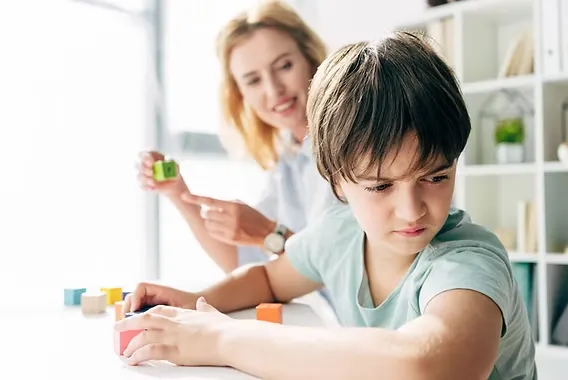
When a camera-shy child is telling you something
If your child looks away from every camera, it is worth asking whether the message is “this is hard for me” rather than “I don’t want to.” Sometimes the answer is personality, and that is a fine answer. Sometimes it is a visual system working harder than it should at something everyone assumes is effortless — and that we can measure.
A developmental vision evaluation will tell you whether a treatable vision problem is part of the picture. Schedule an evaluation at any of our four South Florida offices in Coconut Creek, Boynton Beach, Boca Raton or West Palm Beach.
Common Questions About This Topic
Does avoiding eye contact mean my child has a vision problem?
No. Looking away has many ordinary explanations, including shyness, mood, and the normal habit of averting your gaze while you think. A study of 8-year-olds found children looked away far more as questions got harder, whether the conversation was face to face or over video. What raises our suspicion is a consistent pattern across situations, especially alongside head tilting, covering one eye, squinting, headaches after homework, or trouble with reading.
Is avoiding eye contact a sign of autism?
Reduced eye contact is one of the behaviors associated with autism, but it is not specific to it, and no eye examination can diagnose or rule out autism. That takes a developmental and behavioral assessment. What we can say is that autistic children have higher measured rates of strabismus and some focusing and depth-perception differences, so a comprehensive vision evaluation is worth doing rather than skipping.
Why is a camera lens harder to look at than a person's face?
A face gives constant feedback: moving eyes, changing expressions, a mouth to watch. A lens is a small, fixed, high-contrast target that gives nothing back, and on a video call it sits above the screen, so looking at the lens means looking away from the person. Bright flashes or backlighting add to the load for a light-sensitive child.
What kind of eye exam should we ask for?
A comprehensive developmental vision evaluation, which adds testing of convergence, focusing, eye tracking and depth perception to the usual acuity, eye health and prescription checks. A 20/20 line on the eye chart does not tell you how the two eyes work together at arm's length.
Can vision therapy improve eye contact?
No trial has tested vision therapy as a treatment for eye contact, and we do not promise that. What is well studied is symptomatic convergence insufficiency: office-based therapy beat placebo therapy in the 2008 CITT trial, though in the larger CITT-ART trial that followed, eye-teaming measurements improved more with therapy while symptom scores improved about as much with placebo. Our clinical view is that a child whose eyes are comfortable at near has one fewer reason to look away.
Where This Information Comes From
- Rouse MW, Borsting E, Hyman L, et al.; CIRS Group (1999). Frequency of convergence insufficiency among fifth and sixth graders. Optometry and Vision Science. : About 13% of 453 fifth- and sixth-graders met a high-suspect or definite convergence insufficiency classification; 78.9% of three-sign children also had accommodative insufficiency.
- Borsting EJ, Rouse MW, Mitchell GL, et al.; CITT Group (2003). Validity and reliability of the revised convergence insufficiency symptom survey in children aged 9 to 18 years. Optometry and Vision Science. : Mean symptom-survey score was 30.8 in children with convergence insufficiency versus 8.4 in children with normal binocular vision.
- Doherty-Sneddon G, Phelps FG (2005). Gaze aversion: a response to cognitive or social difficulty? Memory & Cognition. : Thirty-six 8-year-olds averted their gaze more as questions got harder in both face-to-face and video conditions; the authors conclude gaze aversion mainly manages cognitive load.
- Little JA (2018). Vision in children with autism spectrum disorder: a critical review. Clinical and Experimental Optometry. : Visual acuity is usually normal in autistic children, but atypical eye movements, visuo-motor difficulties, strabismus and refractive error are more common.
- Perna J, Bellato A, Ganapathy PS, et al. (2023). Association between Autism Spectrum Disorder (ASD) and vision problems. A systematic review and meta-analysis. Molecular Psychiatry. : 49 studies reviewed and 46 pooled across 15.6 million people: strabismus about 4.7 times more common in autism, with reduced accommodation, stereoacuity and contrast sensitivity; the authors flag methodological limitations in the included studies.
- Milne E, Griffiths H, Buckley D, Scope A (2009). Vision in children and adolescents with autistic spectrum disorder: evidence for reduced convergence. Journal of Autism and Developmental Disorders. : In 51 individuals with autism versus 44 typically developing peers, most visual functions including acuity were unaffected, but convergence stood out as warranting further research.
- Rosner MS, Feinberg DL, Doble JE, Rosner AJ (2016). Treatment of vertical heterophoria ameliorates persistent post-concussive symptoms. Brain Injury. : Retrospective, uncontrolled series of 38 patients; prism lenses were followed by 19.1-61% reductions on headache, dizziness and anxiety measures.
- Digre KB, Brennan KC (2012). Shedding light on photophobia. Journal of Neuro-Ophthalmology. : Review of light sensitivity as a symptom in its own right: common, poorly understood, and seen across many eye and neurological disorders.
- American Optometric Association (2017). Evidence-Based Clinical Practice Guideline: Comprehensive Pediatric Eye and Vision Examination. : Recommends comprehensive eye examinations at 6-12 months, once between 3 and 5 years, and before first grade and annually thereafter.
- Convergence Insufficiency Treatment Trial Study Group (2008). Randomized clinical trial of treatments for symptomatic convergence insufficiency in children. Archives of Ophthalmology. : In 221 children, 73% were successful or improved after 12 weeks of office-based therapy versus 35% with office placebo.
- CITT-ART Investigator Group (2019). Treatment of Symptomatic Convergence Insufficiency in Children Enrolled in CITT-ART: A Randomized Clinical Trial. Optometry and Vision Science. : Eye-teaming measures improved more with therapy than placebo, but symptom scores improved similarly in both groups.
Care We Provide
More From the Blog
Wondering If This Sounds Like Your Family?
A developmental vision evaluation measures the skills a routine eye exam does not. Our team sees children and adults in Coconut Creek, Boynton Beach, Boca Raton and West Palm Beach.