The Benefits of Vision Therapy: What It Can and Can't Do
Most lists of vision therapy benefits read like a promise: better reading, better grades, better focus, better sports. Some of those claims have been tested and did not hold up. Others have solid trials behind them.
The benefits of vision therapy depend on what is being treated. So this article sorts them by condition and by how strong the evidence is, and then covers the practical questions: who benefits most, how long it takes, what it costs and how to tell whether it is working.
If you want the basics first, start with our plain-English guide to what vision therapy is.
Key takeaways
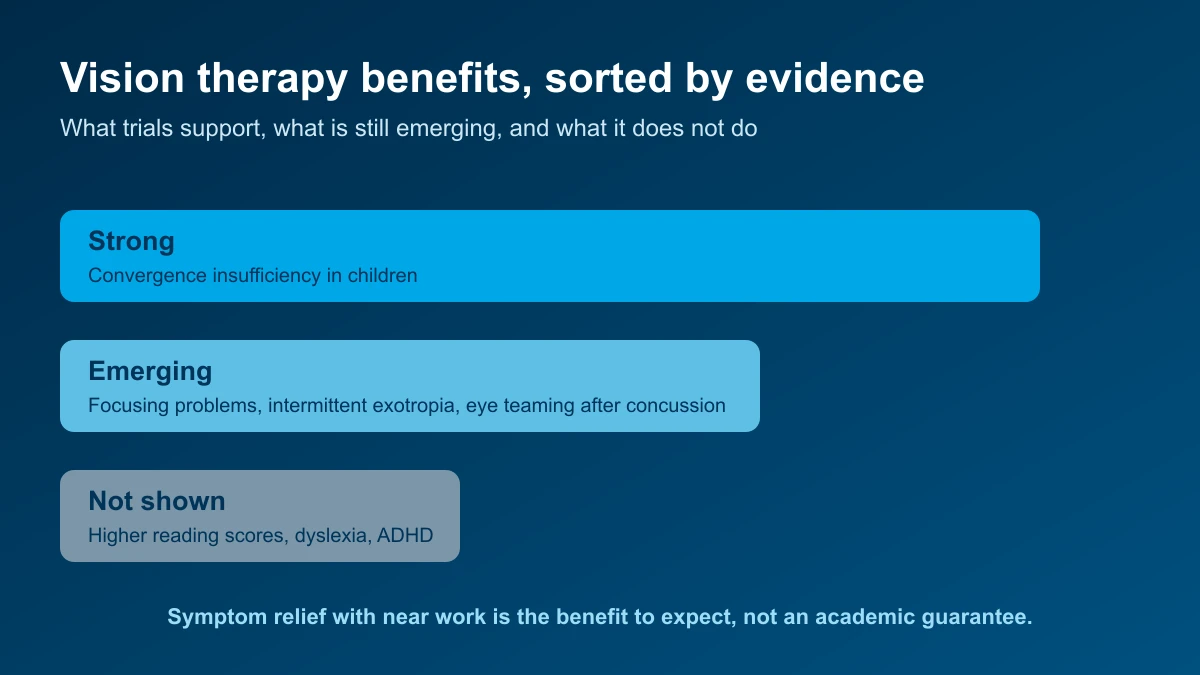
- The best-supported benefit is for children with symptomatic convergence insufficiency. Office-based therapy with home practice beat placebo therapy in a randomized trial and in a Cochrane review (CITT, 2008; Scheiman et al., 2020).
- Evidence for focusing problems, intermittent exotropia and eye teaming problems after a concussion is real but thinner: fewer trials, smaller groups, weaker comparisons.
- In amblyopia, glasses and patching remain the established treatment, and they can still help well past early childhood (PEDIG, 2005). Binocular approaches are still being worked out.
- Vision therapy does not treat dyslexia, ADHD or learning disabilities, and it did not raise reading scores in the largest trial that tested it (CITT-ART, 2019).
- The day-to-day benefit to expect is symptom relief with near work. It is not an academic guarantee.
Strong evidence: convergence insufficiency in children
Convergence insufficiency is trouble turning the eyes inward and holding them there at reading distance. It can cause eyestrain, headaches, blur and double vision with near work. Our convergence insufficiency page covers the signs.
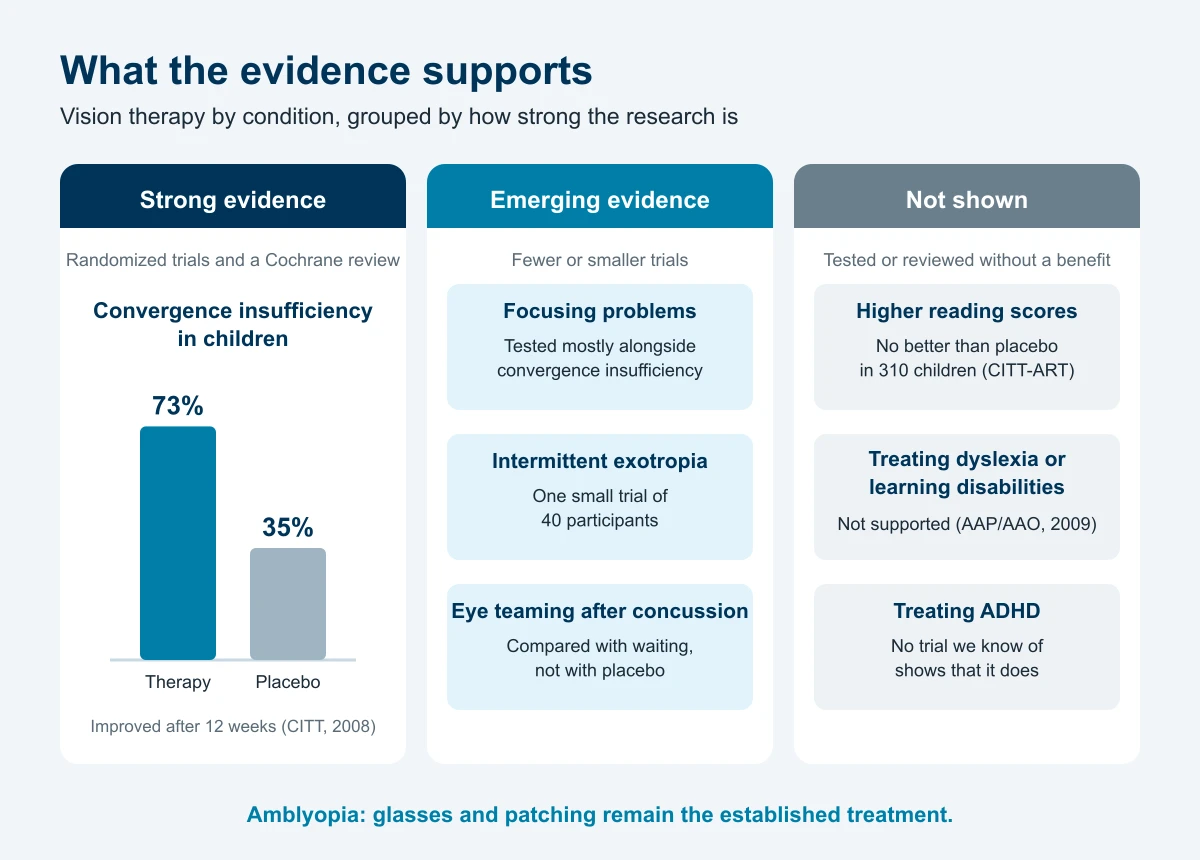
This is where the research is strongest. The Convergence Insufficiency Treatment Trial randomized 221 children aged 9 to 17. After 12 weeks, 73% of the children given office-based vergence and accommodative therapy with home practice were successful or improved, compared with 35% of the children given office-based placebo therapy (CITT, 2008).
A Cochrane network meta-analysis of 12 trials and 1,289 participants came to the same conclusion for children (Scheiman et al., 2020).
Two limits belong next to those numbers. A third of the placebo group also improved, so the benefit over placebo is smaller than 73%. And the same Cochrane review found the evidence in adults less clear than the evidence in children. Adults are treated for convergence insufficiency, but the proof is not as firm.
Reasonable or emerging evidence
These are conditions where studies point in a helpful direction but the research is smaller or less tightly controlled.
Focusing (accommodative) problems
Focusing problems make it hard to keep print clear or to shift focus between the board and the desk. They often travel with convergence insufficiency: 74% of the children in CITT had both. In that group, focusing strength improved 9.9 diopters with office-based therapy and 2.2 diopters with placebo therapy (Scheiman et al., 2011).
That result comes from children who also had convergence insufficiency. For a focusing problem that occurs by itself, the trial evidence is more limited.
Amblyopia (lazy eye)
This is the entry that needs the most care. The established treatment for amblyopia is glasses, then patching or atropine drops. It is not vision therapy.
What has changed is the old belief that nothing works after age 7 or so. In a randomized trial of children aged 7 to 17, 53% of the 7- to 12-year-olds responded to patching with near activities and atropine, compared with 25% given glasses alone. Among 13- to 17-year-olds who had never been treated, 47% responded to patching with near activities compared with 20% with glasses alone. Most were still left with some difference between the eyes (PEDIG, 2005).
Binocular approaches, which train the two eyes together instead of covering one, are an active research area. So far the results do not justify replacing standard care. An American Academy of Ophthalmology review of 20 studies found no top-level evidence that binocular treatment can substitute for patching or glasses (Pineles et al., 2020).
So the fair statement is this: older children and teens can still benefit from amblyopia treatment, and binocular work may add to glasses and patching but has not been shown to replace them. There is more on our lazy eye page.
Intermittent exotropia
Intermittent exotropia is an eye that drifts outward some of the time. One randomized trial tested 16 weekly sessions of office-based vergence and anti-suppression therapy with home practice in 40 participants aged 6 to under 18. Control of the drift at distance improved by at least one point in 75% of the therapy group and 25% of the group that was only observed (Ma et al., 2024).
That is encouraging, and it is one small trial at a single center, measured one week after treatment ended. It does not tell us how long the improvement lasts.
Eye teaming and focusing problems after a concussion
Some people are left with convergence and focusing problems after a concussion. The CONCUSS trial randomized 104 people aged 11 to 25 who still had symptoms and convergence insufficiency 4 to 24 weeks after injury. At six weeks, 88% of those who started office-based therapy right away were successful or improved on eye teaming measurements, compared with 8% of those whose therapy was delayed (Alvarez et al., 2026).
The limits matter here too. The comparison group waited instead of receiving a placebo therapy. The trial measured eye teaming, not overall concussion recovery. And once both groups had finished all 16 sessions, their results were equivalent. Starting sooner shortened the time people spent with the problem. See our concussions page for more.
What vision therapy does not do
It does not raise reading scores. CITT-ART randomized 310 children aged 9 to 14 with symptomatic convergence insufficiency to office-based therapy or placebo therapy. Reading comprehension improved 3.7 points with therapy and 3.8 points with placebo (CITT-ART, 2019). No difference.
It does not treat dyslexia or learning disabilities. The joint statement from the American Academy of Pediatrics, the American Academy of Ophthalmology and two other eye care organizations says that vision problems can interfere with learning but do not cause dyslexia, and that the evidence does not support vision therapy as a treatment for learning disabilities (AAP/AAO/AAPOS/AACO, 2009). We agree with that. Reading problems are treated with reading instruction.
It does not treat ADHD. We are not aware of a trial showing that it does, and we do not claim it.
A child can have dyslexia or ADHD and a real eye teaming problem at the same time. Treating the vision problem is still worthwhile for comfort. It is not a treatment for the other diagnosis, and the other diagnosis still needs its own care.
The benefits families notice day to day
When a measured vision problem is treated, these are the changes families and adult patients most often hope for:
- Less eyestrain and fewer headaches with reading, homework and screen work
- Less blur and less double vision at near
- Reading or working comfortably for longer before needing a break
- Steadier depth perception, for people whose two eyes were not working together well
These are symptom relief, not academic outcomes. A child who can read for 30 minutes without a headache has gained something real. Whether reading level rises depends on reading instruction and practice.
One more piece of honesty. In CITT-ART, the eye measurements improved much more with real therapy than with placebo, but symptom scores improved by similar amounts in both groups (CITT-ART, 2019). Feeling better is partly expectation and attention. That is the reason to track the measurements as well as the symptoms.
For our own patients: every year since 2020, between 88% and 96% of our patients who completed their program said they were successful in meeting their goals. That figure comes from our practice records, not from a research study, and it counts only patients who finished the program. It is not comparable to a trial result.
Who benefits most
The people most likely to benefit share three things:
- A measured problem. An evaluation found specific eye teaming, focusing or eye movement results outside the expected range. Symptoms alone are not a diagnosis. Our binocular vision dysfunction page explains what gets measured.
- Symptoms that match it. The complaints show up with the kind of visual work the measurements predict, usually sustained near work.
- A diagnosis the research supports treating. Children aged 9 to 17 with symptomatic convergence insufficiency have the strongest support.
Someone whose main difficulty is decoding, language or attention, with normal eye teaming and focusing, is unlikely to benefit. We go through this in who is a good fit for vision therapy. The symptom checklist is a reasonable first step if you are unsure.
How long it takes
The trials above measured their main results after 12 to 16 weeks of weekly office sessions with home practice.
In our offices, programs for binocular vision and visual processing usually run about 18 to 24 weeks. Programs for amblyopia, strabismus and brain injury often take longer. Patients come for one 45-minute session or two 30-minute sessions a week, and we recommend home practice 3 to 5 days a week.
Length is only part of it. Our programs draw on more than 100 activities, and what makes them therapy is doing them in the right order, at the right time, with the right amount of challenge for the visual system. That depends on an accurate diagnosis and on someone trained to know what to do next.
Home practice is not an extra. The therapy that beat placebo in CITT combined office sessions with home practice. For more detail, see how long vision therapy takes.
What it costs, in broad terms
Vision therapy is a commitment of money as well as time, and you should know the numbers before you start.
At Vision & Learning Center, the Developmental Vision Evaluation is $550 and takes about 100 minutes. Therapy sessions cost $110 to $200 each. We are out-of-network with insurance, and we give families the paperwork to request reimbursement from their plan.
Our cost and pricing page has the current details, and how much vision therapy costs and what changes the price explains what moves the total up or down.
How to know if it is working
You should not have to take anyone’s word for it. Three checks keep a program accountable:
- The measurements move. Convergence, eye teaming ranges and focusing strength are numbers. They were recorded at the evaluation and can be measured again. Ask what they were and what they are now.
- The symptoms move. Use the same symptom questions at the start and partway through, so you are comparing like with like instead of relying on memory.
- There is a point to reassess. Ask at the start when progress will be reviewed and what happens if the numbers have not changed. A plan with no stopping point is not a clinical plan.
If the measurements improve and the symptoms do not, or the reverse, that is worth a direct conversation. It can mean another cause needs attention.
Where to start
Deciding about vision therapy comes second. The first step is finding out whether a measurable vision problem is there at all. Sometimes the answer is no, and that is useful to know.
A developmental vision evaluation answers that question. Dr. Christina Murray, OD, FOVDR, founded Vision & Learning Center in 2017, and we have offices in Coconut Creek, Boynton Beach, Boca Raton and West Palm Beach. Evaluations are done at Boynton Beach and Boca Raton. For the full evidence review, read does vision therapy work, and our vision therapy page describes the program itself.
To book, schedule an evaluation or call (561) 462-1245.
Common Questions About This Topic
What are the benefits of vision therapy?
The benefits are specific to the diagnosis. For a measured eye teaming or focusing problem, the realistic benefits are better convergence and focusing measurements and more comfortable near work: less eyestrain, fewer headaches with reading, less blur or double vision. The strongest research is for symptomatic convergence insufficiency in children. Better grades and reading scores are not benefits the research supports.
What is vision therapy used for?
It is used to treat diagnosed problems with how the eyes aim, focus and work together. The best-studied use is convergence insufficiency. It is also used for focusing (accommodative) problems, intermittent exotropia, eye teaming and focusing problems after a concussion, and alongside glasses and patching in amblyopia, where the evidence is thinner.
How does vision therapy work?
A program is a series of supervised office sessions with practice at home, built around the specific skills that measured low at the evaluation. Activities are repeated and made harder in steps, and the same measurements are taken again to see whether they have changed. In the main trials, the version that beat placebo combined weekly office sessions with home practice.
Does vision therapy help with dyslexia or ADHD?
No. Dyslexia is treated with reading instruction and ADHD is treated by the child's physician or psychologist. In the largest trial to test reading, comprehension improved 3.7 points with vision therapy and 3.8 points with placebo therapy. A child with dyslexia or ADHD can also have a treatable vision problem, and treating it can make near work more comfortable, but it does not treat the other condition.
How long does it take to see benefits from vision therapy?
The research trials measured their main results after 12 to 16 weeks of weekly office sessions with home practice. In our offices, programs for binocular vision and visual processing usually run about 18 to 24 weeks, and programs for amblyopia, strabismus and brain injury often take longer. Progress should show up in repeat measurements along the way, not only at the end.
Where This Information Comes From
- Convergence Insufficiency Treatment Trial Study Group (2008). Randomized clinical trial of treatments for symptomatic convergence insufficiency in children. Archives of Ophthalmology; 126(10):1336-1349. : In 221 children aged 9-17, 73% were successful or improved after 12 weeks of office-based vergence and accommodative therapy with home reinforcement, versus 35% with office placebo therapy.
- Scheiman M, Kulp MT, Cotter SA, Lawrenson JG, Wang L, Li T (2020). Interventions for convergence insufficiency: a network meta-analysis. Cochrane Database of Systematic Reviews; 12:CD006768. : Across 12 trials and 1,289 participants, office-based therapy with home reinforcement was more effective than placebo in children (RR 3.04); the evidence in adults is less clear.
- Scheiman M, Cotter S, Kulp MT, et al.; CITT Study Group (2011). Treatment of accommodative dysfunction in children: results from a randomized clinical trial. Optometry and Vision Science; 88(11):1343-1352. : 74% of the children in CITT also had accommodative dysfunction, and accommodative amplitude improved 9.9 D with office-based therapy versus 2.2 D with placebo therapy.
- Scheiman MM, Hertle RW, Beck RW, et al.; Pediatric Eye Disease Investigator Group (2005). Randomized trial of treatment of amblyopia in children aged 7 to 17 years. Archives of Ophthalmology; 123(4):437-447. : 53% of 7- to 12-year-olds responded to patching with near activities and atropine versus 25% with glasses alone; among 13- to 17-year-olds never treated before, 47% versus 20%. Most were left with some residual deficit.
- Pineles SL, Aakalu VK, Hutchinson AK, et al. (2020). Binocular treatment of amblyopia: a report by the American Academy of Ophthalmology. Ophthalmology. : Review of 20 studies that found no level I evidence that binocular treatment can substitute for patching or optical treatment of amblyopia.
- Ma MM, Kang Y, Scheiman M, et al. (2024). Office-based vergence and anti-suppression therapy for the treatment of small-to-moderate angle intermittent exotropia: A randomised clinical trial. Ophthalmic and Physiological Optics; 44(2):356-377. : In 40 participants aged 6 to under 18, 75% improved by at least one point on distance control after 16 weekly sessions with home reinforcement, versus 25% with observation. Single centre, measured one week after treatment.
- Alvarez TL, Scheiman M, Hajebrahimi F, Noble M, Gohel S, Baro R, Bachman JA, Master CL, Goodman A; CONCUSS Investigator Group (2026). CONCUSS randomised clinical trial of vergence/accommodative therapy for concussion-related symptomatic convergence insufficiency. British Journal of Sports Medicine; 60(5):340-354. : In 104 participants aged 11-25, 88% were successful or improved on eye teaming measures at six weeks with immediate office-based therapy versus 8% with delayed therapy. The comparison group waited rather than receiving a sham, and outcomes were equivalent once both groups finished 16 sessions.
- CITT-ART Investigator Group (2019). Treatment of Symptomatic Convergence Insufficiency in Children Enrolled in the CITT-Attention & Reading Trial: A Randomized Clinical Trial. Optometry and Vision Science; 96(11):825-835. : Near point of convergence improved 10.4 cm with therapy versus 6.2 cm with placebo and fusional vergence 23.2 versus 8.8 prism diopters, but symptom scores improved by similar amounts in both groups.
- CITT-ART Investigator Group (2019). Effect of Vergence/Accommodative Therapy on Reading in Children with Convergence Insufficiency: A Randomized Clinical Trial. Optometry and Vision Science; 96(11):836-849. : In 310 children aged 9-14, reading comprehension improved 3.7 points with office-based therapy and 3.8 points with placebo therapy, so therapy was no better than placebo for reading.
- American Academy of Pediatrics, American Academy of Ophthalmology, AAPOS, AACO (2009). Joint statement - Learning disabilities, dyslexia, and vision. Pediatrics; 124(2):837-844. : Holds that vision problems can interfere with learning but do not cause dyslexia, and that evidence does not support eye exercises or behavioral vision therapy as treatments for learning disabilities.
Care We Provide
More From the Blog
Wondering If This Sounds Like Your Family?
A developmental vision evaluation measures the skills a routine eye exam does not. Our team sees children and adults in Coconut Creek, Boynton Beach, Boca Raton and West Palm Beach.