Sensory Processing and Vision: Where the Two Overlap
Your child squints in the grocery store, slides off the chair at homework time and covers one eye to look at a book. An occupational therapist is working on sensory processing, and you wonder whether the eyes are part of it.
It is a fair question. Vision is one of the sensory systems, so sensory processing and vision do overlap. The overlap is also easy to overstate. This article explains where the two meet, which behaviors are worth a vision check, and what vision care can and cannot add.
Key takeaways
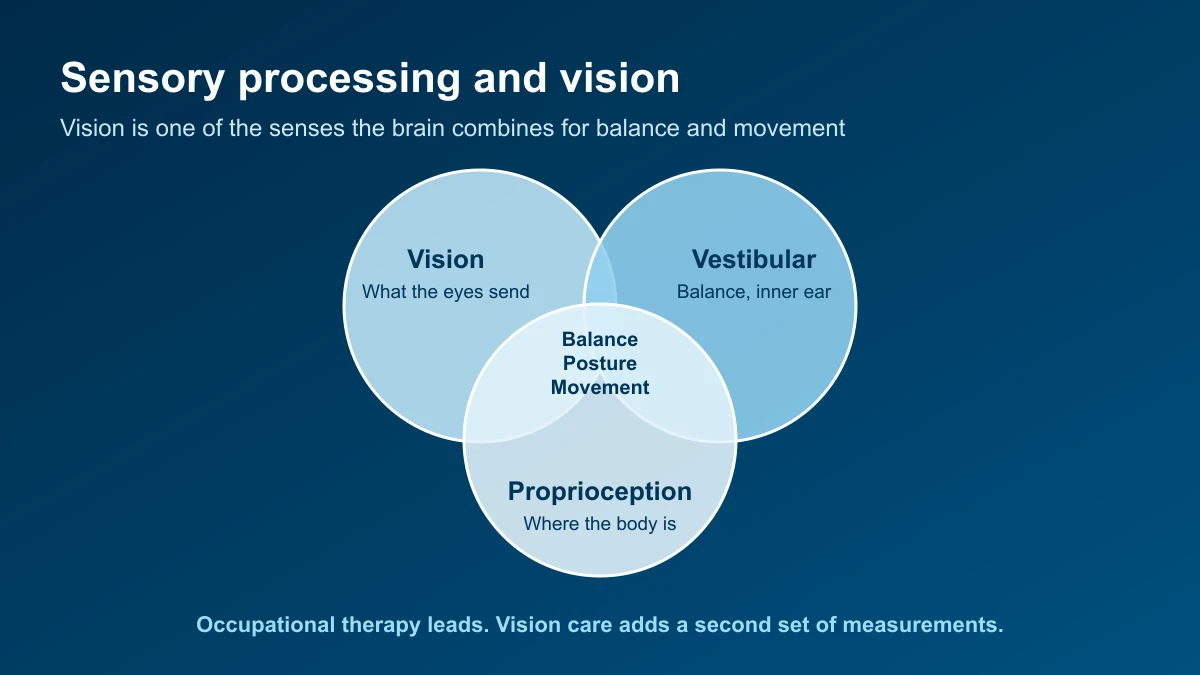
- Vision is a sensory system. The brain combines it with the vestibular (inner ear) and proprioceptive (body position) senses to manage balance, posture and movement (Cullen, 2012).
- “Vision” covers three different things: eyesight, visual skills and visual processing. A child can have 20/20 eyesight and still have a measurable eye teaming or focusing problem.
- Behaviors such as covering an eye, tilting the head or avoiding tabletop work can have a visual contribution. None of them diagnoses a vision problem, and each has non-visual causes.
- Sensory processing disorder is not a separate diagnosis in DSM-5 (Grobelna et al., 2025). The difficulties families describe are real all the same.
- Research directly linking eye teaming problems to sensory processing differences is limited. Vision therapy treats measured vision problems. It does not treat sensory processing differences, autism, ADHD or dyslexia.
- Occupational therapy is the lead service for sensory processing. Vision care is a second set of measurements that your therapy team can use.
Vision is one of the sensory systems
Most of us learn five senses. Occupational therapists usually work with two more. The vestibular system, in the inner ear, senses head position, movement and gravity. Proprioception is the body’s sense of where its parts are without looking.
These systems do not work one at a time. Signals from the inner ear are combined with visual, body-position and motor signals, and that combination is what lets the eyes stay steady on a target while the head moves (Cullen, 2012).
So when a child seems unsure of where their body is in space, vision is one of several systems that could be involved. We cover the seven senses in Learning to Learn Part 3: Sensory Systems.
Eyesight, visual skills and visual processing
“Her vision is fine” after a screening usually means her eyesight is fine. There are three layers, and they are checked in different ways.
Eyesight (acuity). How small a letter or picture the child can see clearly, with or without glasses. This is the 20/20 number, and it is what most screenings test.
Visual skills. How the two eyes aim together (eye teaming), how they focus and hold focus up close, and how accurately they move from one spot to the next. These are measured in numbers and compared with expected ranges. Problems here are called binocular vision, focusing and eye movement problems, and they can be treated.
Visual processing (perception). What the brain does with the picture once it arrives: telling similar shapes apart, remembering what was seen, judging where things are, and guiding the hands.
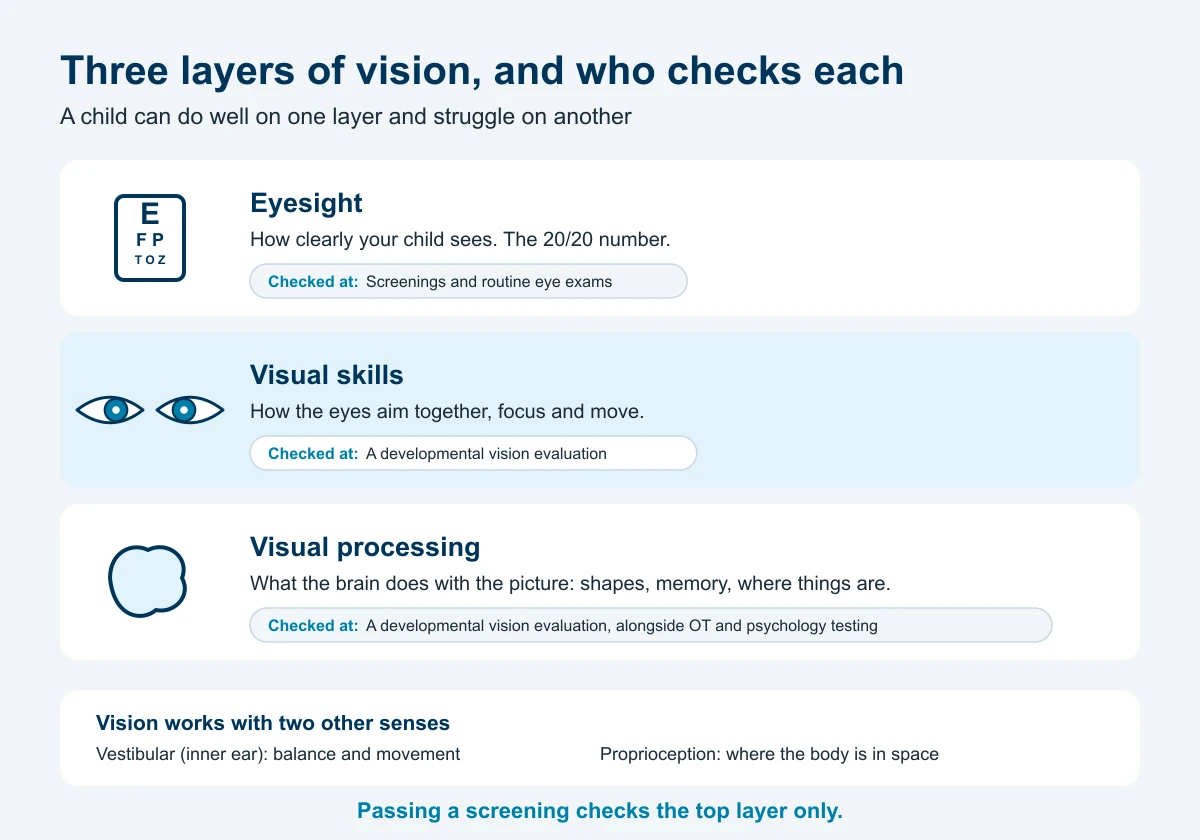
A child can do well on one layer and struggle on another. A child can have 20/20 vision and still struggle with reading, and why a developmental exam looks at more than a routine one.
Behaviors that can have a visual contribution
Each behavior below can have a visual piece. Each also has causes that have nothing to do with the eyes, and an occupational therapist is better placed to work those out.
- Avoiding tabletop or close-up work. Visual possibility: near work is blurry, double or tiring. Other causes: fine motor difficulty, posture and core strength, attention, or the task being too hard.
- Covering or closing one eye. Visual possibility: the two eyes are not teaming, and shutting one makes the picture single. Other causes: glare, habit, or a way to cut down how much there is to look at.
- Sensitivity to light. Visual possibility: an eye health or focusing problem that needs checking. Other causes: migraine, or a general pattern of sensory over-responsivity.
- Being overwhelmed in busy visual spaces. Visual possibility: difficulty keeping a single, steady picture while the eyes and head move. Other causes: noise and crowds arriving together, or anxiety.
- Clumsiness or misjudging distance. Visual possibility: reduced depth perception from poor eye teaming. Other causes: motor planning, balance, or developmental coordination disorder. See our motor skills page and our post on vision problems that look like clumsiness.
- Losing place when reading. Visual possibility: inaccurate eye movements or unstable eye teaming. Other causes: decoding difficulty, language or attention.
- Head tilt or turn. Visual possibility: the child has found the head position where the eyes line up best. Other causes: tight neck muscles, hearing, or posture.
- Looking from the side of the eyes. Visual possibility: an uncorrected glasses prescription or an eye turn. Other causes: a sensory preference, which is common in autistic children.
A list like this cannot tell you which cause applies to your child. A behavior is a reason to measure and never a diagnosis. Our speech and ABA referral page has the short checklist therapists use, and the symptom checklist is a starting point for parents.
Is sensory processing disorder a diagnosis?
Sensory processing disorder is not listed as a separate diagnosis in DSM-5 or in the ICD classification (Grobelna et al., 2025). The American Academy of Pediatrics has a policy statement on this. It says that because there is no universally accepted framework for diagnosis, sensory processing disorder generally should not be diagnosed, and that a thorough evaluation should look for other conditions. Difficulty tolerating or processing sensory information is seen in autism, ADHD, developmental coordination disorder and childhood anxiety (Zimmer & Desch, AAP, 2012).
None of that means the difficulties are imagined. A child who cannot bear the cafeteria or the seams in their socks is having a real experience. The debate is about how to classify it.
The same statement says occupational therapy using sensory-based approaches may be acceptable as one part of a comprehensive plan, and asks that families be told the research on effectiveness is limited and inconclusive. Since then, a systematic review concluded that Ayres Sensory Integration can be considered an evidence-based practice for autistic children aged 4 to 12, while drawing on a small number of studies (Schoen et al., 2019).
What the research shows about vision and sensory processing
Very little, so far.
One study compared children aged 7 to 11 who were grouped by a parent questionnaire. The 68 children in the sensory processing group scored lower on eye movement tests than the 60 typically developing children (Walker et al., 2019). A later eye-tracking study found less accurate tracking and fixation in children with sensory processing difficulties. It included only 10 of them (Hodgson et al., 2025).
Both studies looked at eye movements. Neither shows that a vision problem causes sensory differences or that treating one changes the other. We are not aware of a controlled trial that answers that question.
What is well studied is the treatment of eye teaming problems themselves. In a randomized trial of children with symptomatic convergence insufficiency, 73% were successful or improved with office-based therapy and home practice, compared with 35% with placebo therapy (CITT, 2008). Those children were not selected for sensory processing differences, so the result does not tell us about them specifically.
What a developmental vision evaluation adds
For a child with sensory differences, the evaluation answers one narrow question: is the visual system adding to the load, or is it working well?
A developmental vision exam checks how the eyes aim, focus and work together, with no reading or talking needed. We go at your child’s pace, and with your permission we share findings your therapy team can use.
A normal result is useful too. It tells you and your occupational therapist that the eyes are not the reason for the behavior, and the therapy plan can go ahead on that basis.
At Vision & Learning Center the Developmental Vision Evaluation takes about 100 minutes and costs $550. We are out-of-network with insurance and provide paperwork for reimbursement. We accept Florida FES-UA scholarships through Step Up For Students. See our examinations, special needs and autism spectrum pages for more.
How vision therapy and occupational therapy work together
Occupational therapy is the lead discipline for sensory processing. An occupational therapist evaluates how a child handles touch, sound, movement and body awareness, and works on regulation, motor planning, posture and daily routines. An occupational therapist does not diagnose eye teaming or focusing problems or prescribe lenses.
A developmental optometrist diagnoses and treats problems in the visual system, with glasses, prism or vision therapy. A developmental optometrist does not diagnose or treat sensory processing differences, and vision therapy does not replace sensory-based occupational therapy.
When a child needs both, the two plans support each other. Dr. Murray works closely with occupational, physical and speech therapists, and her post-graduate study has focused on primitive reflexes, syntonic (light) therapy and how the brain processes visual information. Our primitive reflexes page has more on reflexes.
For more on how the two professions differ, read vision therapy vs occupational therapy. Families sent by a therapist can start at our referred by an OT page.
What vision therapy cannot do
- It does not treat sensory processing differences themselves.
- It does not treat autism. An autistic child can have a treatable vision problem like anyone else, and treating it does not change autism.
- It does not treat ADHD.
- It does not treat dyslexia. Pediatric and ophthalmology organizations state that vision problems do not cause dyslexia and that vision therapy is not a treatment for learning disabilities (AAP/AAO/AAPOS/AACO, 2009). We agree.
When a measured vision problem is found, programs for binocular vision and visual processing usually run about 18 to 24 weeks. Programs for amblyopia, strabismus and brain injury often take longer. Our programs draw on more than 100 activities, and our clinical view is that what matters is doing them in the right order, at the right time, with the right amount of stress on the visual system. That takes an accurate diagnosis and someone trained to know what to do next. We cannot promise an outcome for any child.
Who to see first
- Concerns about regulation, touch, sound, movement, feeding, sleep or daily routines: your pediatrician and an occupational therapist.
- Concerns that cluster around looking (covering an eye, a head tilt, losing place when reading, misjudging steps and curbs): add a developmental vision evaluation.
- Already in occupational therapy with slow progress on visual tasks: ask your therapist whether a vision evaluation would help.
You do not have to finish one before starting the other. To find therapists and other providers, see our referral network.
Red flags that need same-day medical care
Do not wait for a routine appointment. Call your pediatrician or an eye doctor the same day, or go to an emergency department:
- An eye turn or double vision that starts suddenly
- A droopy eyelid or one pupil larger than the other that is new
- A white or gray pupil, in person or in photos
- Sudden loss of vision
- A red, painful eye with strong light sensitivity
- New light sensitivity with a severe headache, fever, stiff neck or vomiting
- Any of the above after a head injury
Where to start
If your child has sensory processing differences and some of the behaviors above, a developmental vision evaluation will tell you whether vision is part of the picture.
Vision & Learning Center has offices in Coconut Creek, Boynton Beach, Boca Raton and West Palm Beach. Evaluations are done at Boynton Beach and Boca Raton. To book, schedule an evaluation or call (561) 462-1245.
Common Questions About This Topic
Is vision part of sensory processing?
Yes. Vision is one of the sensory systems, and the brain combines it with signals from the inner ear (vestibular) and from the muscles and joints (proprioception) to manage balance, posture and movement. A child can have sensory processing differences with a visual system that measures well, or with one that does not. An evaluation is the way to find out which.
Can a vision problem look like a sensory processing problem?
Some behaviors overlap. Avoiding tabletop work, covering an eye, tilting the head, being bothered by light or misjudging distance can each have a visual contribution, and each also has causes that have nothing to do with the eyes. None of these behaviors diagnoses a vision problem. They are reasons to have the visual system measured.
Is sensory processing disorder a real diagnosis?
The difficulties are real, and families and occupational therapists see them every day. Sensory processing disorder is not listed as a separate diagnosis in DSM-5, and the American Academy of Pediatrics advises that it generally should not be diagnosed as a stand-alone condition because there is no universally accepted framework for doing so. Sensory differences are often part of autism, ADHD, developmental coordination disorder or anxiety, so a thorough evaluation matters.
Does vision therapy help sensory processing disorder?
Vision therapy does not treat sensory processing differences. It treats measured problems with eye teaming, focusing and eye movements. If a child has one of those problems as well as sensory differences, treating it can make looking more comfortable, while occupational therapy remains the lead service for sensory processing.
Should my child see an occupational therapist or a developmental optometrist first?
If the main concerns are regulation, touch, sound, movement or daily routines, start with your pediatrician and an occupational therapist. If the concerns cluster around looking, such as covering an eye, a head tilt, losing place when reading or trouble judging distance, add a developmental vision evaluation. The two do not compete, and your child does not need to finish one before starting the other.
Where This Information Comes From
- Zimmer M, Desch L; American Academy of Pediatrics Section on Complementary and Integrative Medicine; Council on Children with Disabilities (2012). Sensory integration therapies for children with developmental and behavioral disorders. Pediatrics; 129(6):1186-1189. : AAP policy statement: sensory processing disorder generally should not be diagnosed because there is no universally accepted framework; sensory difficulties are seen in autism, ADHD, developmental coordination disorder and anxiety; occupational therapy using sensory-based therapies may be acceptable within a comprehensive plan, with research on effectiveness limited and inconclusive.
- Grobelna N, Rutkowski R, Rybakowski F, Rybakowski J, Ferensztajn-Rochowiak E (2025). The phenomenon of sensory processing: historical overview, theoretical models, and neurophysiological underpinnings. Acta Neurobiologiae Experimentalis; 84(4):359-370. : Review tracing sensory processing from A. Jean Ayres' sensory integration work in the 1960s and 70s through later models, noting the lack of a formal diagnosis in the DSM-5 and ICD classifications.
- Cullen KE (2012). The vestibular system: multimodal integration and encoding of self-motion for motor control. Trends in Neurosciences, 35(3):185-196. : Review concluding that vestibular processing is multimodal: inner-ear signals are combined with other sensory and motor information to support functions from gaze-stabilizing reflexes to voluntary movement.
- Walker K, Redman-Bentley D, Remick-Waltman K, Armstrong DC (2019). Differences in Oculomotor Function between Children with Sensory Processing Disorder and Typical Development. Optometry and Vision Science; 96(3):172-179. : Of children aged 7 to 11 grouped by a parent questionnaire (the Short Sensory Profile), the 68 in the sensory processing group scored lower on clinical tests of saccades and pursuits than the 60 typically developing children. Cross-sectional; children with strabismus were excluded; it does not show cause or treatment benefit.
- Hodgson TL, Cartwright P, Dodd J, Hippisley A (2025). Oculomotor deficits in children with sensory processing difficulties. British Journal of Occupational Therapy; 88(6):352-361. : Eye-tracking study of 10 children with sensory processing difficulties: more directional errors on an anti-saccade task and less accurate smooth pursuit and fixation than age-matched controls. Very small sample; the authors call for further research.
- Schoen SA, Lane SJ, Mailloux Z, et al. (2019). A systematic review of Ayres Sensory Integration intervention for children with autism. Autism Research, 12(1):6-19. : Of 19 studies identified, 6 met inclusion criteria and 3 were quality-appraised; the authors conclude Ayres Sensory Integration can be considered an evidence-based practice for autistic children aged 4-12. The supporting evidence base is small.
- Convergence Insufficiency Treatment Trial Study Group (2008). Randomized clinical trial of treatments for symptomatic convergence insufficiency in children. Archives of Ophthalmology; 126(10):1336-1349. : In 221 children aged 9-17 with symptomatic convergence insufficiency, 73% were successful or improved after 12 weeks of office-based therapy with home reinforcement, versus 35% with office placebo therapy. The trial did not study children selected for sensory processing differences.
- American Academy of Pediatrics, American Academy of Ophthalmology, AAPOS, AACO (2009). Joint statement - Learning disabilities, dyslexia, and vision. Pediatrics; 124(2):837-844. : Holds that vision problems can interfere with learning but do not cause dyslexia, and that evidence does not support eye exercises or behavioral vision therapy as treatments for learning disabilities.
Care We Provide
More From the Blog
Wondering If This Sounds Like Your Family?
A developmental vision evaluation measures the skills a routine eye exam does not. Our team sees children and adults in Coconut Creek, Boynton Beach, Boca Raton and West Palm Beach.