Intermittent Exotropia: Watch or Treat?
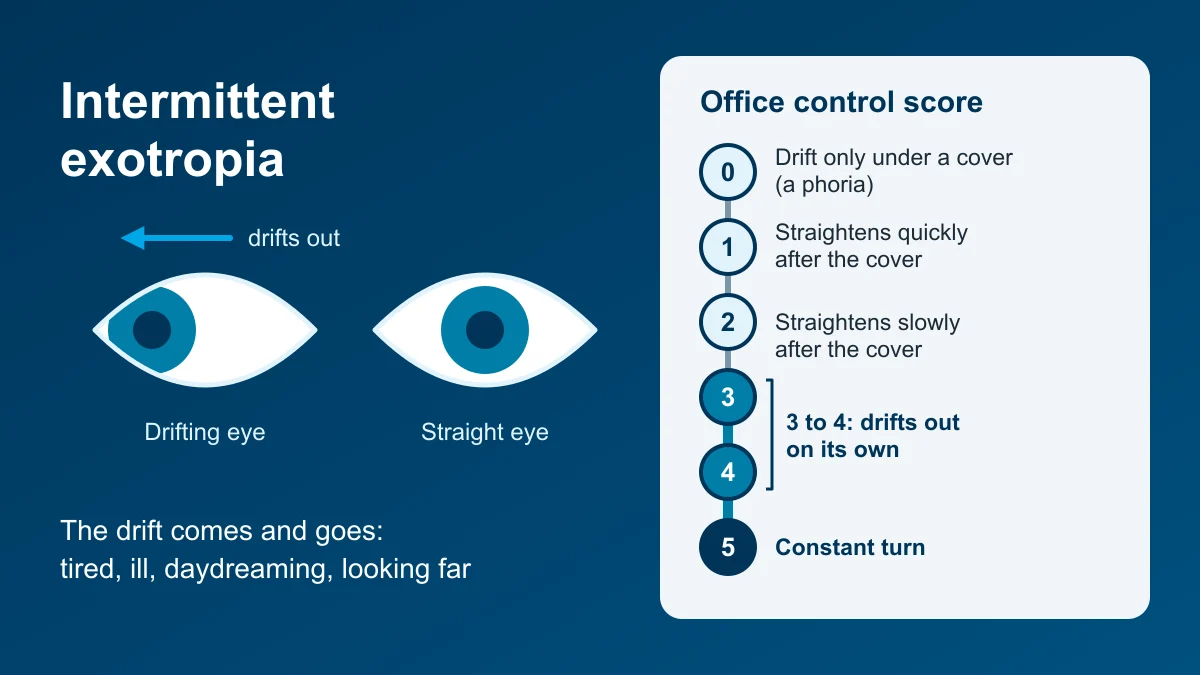
Intermittent exotropia is an outward drift of one eye that comes and goes. A parent notices it in photos, when a child is tired or daydreaming, or when they are looking at something far away, and then the eyes look perfectly straight again. The natural question is whether intermittent exotropia treatment is needed now, or whether it is safe to wait.
That question has unusually good answers, because the Pediatric Eye Disease Investigator Group (PEDIG) has run a series of trials on exactly this. This guide walks through what they found about watching, patching, overminus glasses, vision therapy and surgery, and the signs that tip the balance toward acting.
Key takeaways
- Most young children with good control stay stable. Over three years without treatment, only 1 of 132 untreated 3- to 10-year-olds who finished a PEDIG study met the criteria for deterioration at the last visit (PEDIG, 2019).
- Long-term, many drifts do grow. In a 20-year population cohort, the angle increased by 10 prism diopters or more in 52.8% of children (Nusz et al., 2006). Monitoring matters.
- Patching helps a little. Deterioration over six months was 0.6% with patching versus 6.1% with observation, and the trial called both reasonable (PEDIG, 2014).
- Overminus glasses improve control while worn, then the benefit fades, and they add a myopic shift that was still present three years later (Chen et al., 2021; PEDIG, 2024).
- Vision therapy improved control in two recent randomized trials. With 16 weeks of office-based therapy, 75% of children improved by at least a point on the control scale, versus 25% with observation; long-term follow-up is still to come (Ma et al., 2024; Jing et al., 2026).
- Surgery is for progression, not a guaranteed cure. Eight years after surgery, a suboptimal result had been recorded in 53% to 68% of children, depending on the operation (Donahue et al., 2024).
What is intermittent exotropia?
Intermittent exotropia is a form of strabismus in which one eye sometimes drifts outward, toward the ear, while the other looks straight ahead. The American Academy of Ophthalmology (AAO) guideline describes it as usually appearing before age three, though it may be noticed later. The drift tends to show when the brain’s effort to keep the eyes together slips: with fatigue, inattention or illness. A child may also close or cover one eye in bright light (AAO, 2023).
Because the brain usually suppresses the drifting eye’s image, most children do not report double vision, and the guideline notes that severe amblyopia is uncommon with this condition (AAO, 2023). That is one reason it is less urgent than an eye that turns in. For the causes of true doubling, see double vision in children.
It is common. Pooled across 56 studies, exotropia affects about 1.23% of people (Hashemi et al., 2019), and in a US population study intermittent exotropia made up 16.9% of new childhood strabismus cases (Mohney, 2007).
A related pattern, where the eyes drift out mainly at reading distance, overlaps with convergence insufficiency and is managed differently.
How is control measured?
Control is how well a child keeps the eyes together, and it drives most treatment decisions. PEDIG trials use a 0 to 5 office control score, where 0 means the drift only appears when one eye is covered (a phoria) and 5 means the eye is turned out constantly (Jenewein et al., 2026).
| Score | What the examiner sees |
|---|---|
| 0 | Drift appears only under a cover and the eyes straighten normally |
| 2 | Drift appears after covering and is slow to straighten again (Hatt et al., 2023) |
| 3 to 5 | The eye drifts out on its own during a 30-second observation; 5 is constant (Jenewein et al., 2026) |
The score is measured at distance and at near, usually more than once, because control varies from moment to moment. Your observations at home count too: the AAO guideline asks for an estimate of how much of the waking day the eye drifts, when it happens (tired, ill, daydreaming, looking far away) and whether it is becoming more frequent (AAO, 2023). A stereo depth test is also done before anything else disturbs the eyes. More on what stereo tests measure in the three grades of binocular vision.
Does intermittent exotropia get worse?
Sometimes, slowly, and the answer depends on the time frame.
Over three years, most children are stable. PEDIG followed 183 untreated children aged 3 to 10 whose drift did not need immediate surgery. The cumulative rate of deterioration was 15%, which the investigators judged an overestimate, because nearly half of those events were families or doctors starting treatment without the criteria being met. Among the 132 untreated children who completed the study, only one met the criteria at three years, and on average control, depth perception and the size of the drift improved slightly (PEDIG, 2019).
Toddlers are a little less predictable. In 97 children aged 12 to 35 months, the three-year deterioration rate was 28%, and the rate of progression to a constant turn was 10%. The authors still concluded that watchful waiting may be a reasonable approach at this age (Cotter et al., 2020).
Over decades, many drifts grow. In every child diagnosed in one Minnesota county between 1975 and 1994, the drift resolved in only 4% over a median of 9.2 years, and by 20 years the angle had increased by 10 prism diopters or more in 52.8%. The chance of having surgery within 20 years was 74%, though that partly reflects how the condition was managed in that era (Nusz et al., 2006).
Quality of life is reassuring during a watch period. In 111 children observed without treatment for three years, the children’s own quality-of-life scores stayed stable, and their parents’ scores improved (Holmes et al., 2021).
How is intermittent exotropia treated?
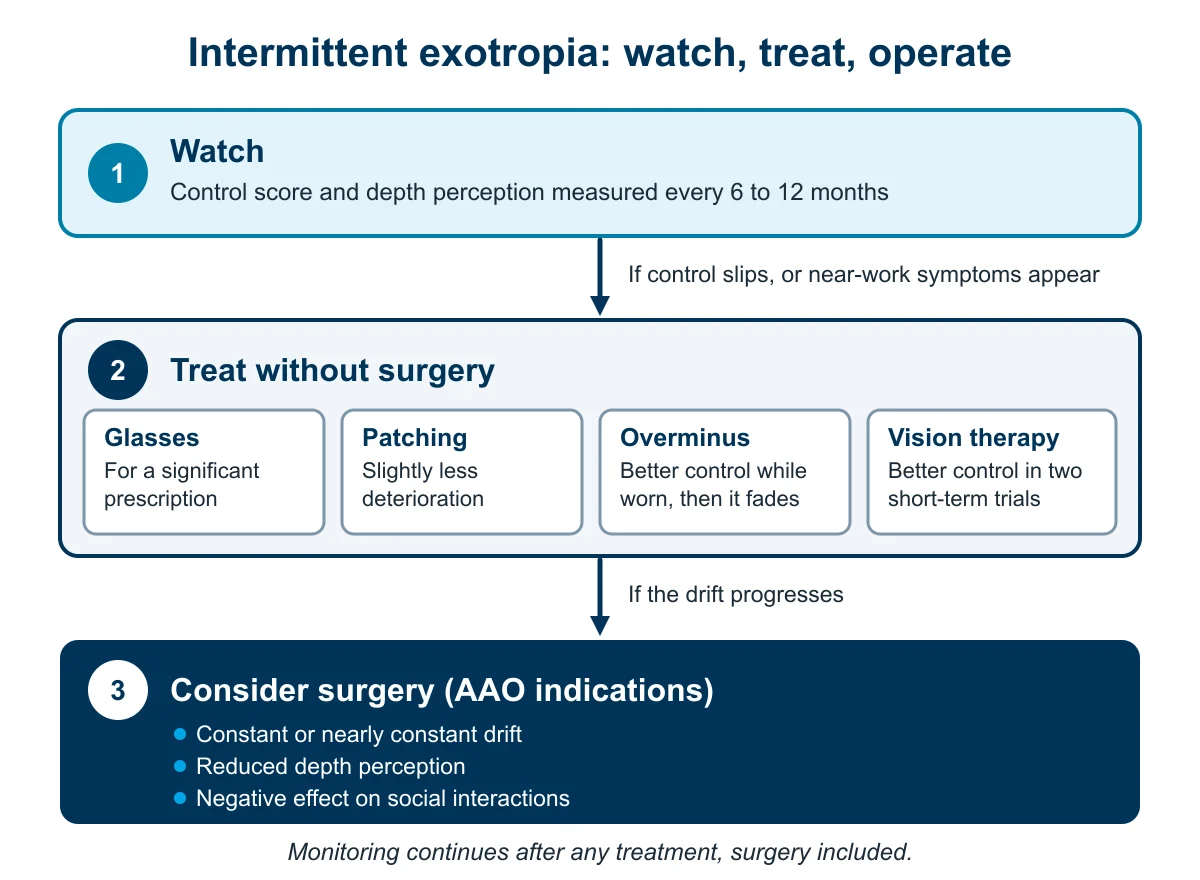
Treatment ranges from observation to surgery, and the choice depends on control, age, depth perception, symptoms and how the drift affects the child socially. Here is what the evidence shows for each option.
Watchful waiting
For young children with good control, the AAO guideline recommends following without surgery, with examinations typically every 6 to 12 months (AAO, 2023). Watching is not doing nothing: it means measured control scores and depth perception at each visit, so a change is caught early.
Glasses for a real prescription
Any significant prescription should be corrected, and the guideline notes that a clearer image often improves control. It also advises that mild to moderate farsightedness is not generally corrected in these children, because relaxing focusing can weaken the drive that holds the eyes together (AAO, 2023).
Patching
Part-time patching of the straight eye is thought to discourage suppression.
- In 358 children aged 3 to 10, deterioration over six months occurred in 0.6% of those patched three hours a day and 6.1% of those observed. The investigators concluded that deterioration is uncommon either way and that both approaches are reasonable (PEDIG, 2014).
- In 201 toddlers aged 12 to 35 months, the difference (2.2% versus 4.6%) was not significant, and there was insufficient evidence to recommend patching at that age (PEDIG, 2015).
- A 2021 Cochrane review found high-certainty evidence that patching improves alignment measurements at six months, but little or no difference in depth perception (Pang et al., 2021).
- In a newer 73-child trial, three months of full-time alternate patching improved the distance control score by 0.9 points versus 0.2 with observation. Children actually wore the patch about 4 to 7 hours a day, and whether the gain lasts has not been studied (Jenewein et al., 2026).
Overminus glasses
Overminus lenses add extra minus power, which makes the eyes focus harder and pulls them inward.
In 386 children aged 3 to 10, control after 12 months was better with overminus than with regular glasses (1.8 versus 2.8). Three months after the lenses were tapered off, the difference had largely disappeared (2.4 versus 2.7). The cost was a faster shift toward nearsightedness: 17% of the overminus group shifted by more than 1 diopter, versus 1% (Chen et al., 2021). At three years that extra shift was still there, and the investigators advise discussing it with parents (PEDIG, 2024). A network meta-analysis ranked overminus first among non-surgical options for control, while noting none of them improved depth perception (Song et al., 2024).
Vision therapy
Vision therapy has some of the most encouraging recent results for intermittent exotropia. Office-based therapy trains the brain to notice and correct the drift, using vergence, focusing and anti-suppression activities, and two randomized trials now show it improves control:
- Office-based therapy. In 40 children and teens aged 6 to 17, 16 weekly sessions with home practice improved the distance control score by 0.9 points more than observation, and 75% improved by at least a point, versus 25% of those observed (Ma et al., 2024).
- Home virtual-reality therapy. In 177 children aged 6 to 18, 12 weeks improved control overall, with larger gains in children who completed more than 75% of sessions and in those who started with poorer control (Jing et al., 2026).
The AAO guideline also notes that children and adults whose exotropia is larger at near and who have reading symptoms may be good candidates for orthoptic therapy (AAO, 2023). Therapy also has a role alongside surgery: in a randomized trial of children with intermittent exotropia, therapy after surgery halved suboptimal outcomes at 12 months (Xu et al., 2023); our post on combining strabismus surgery and vision therapy covers that evidence.
Both new trials report short-term results so far (the office trial measured one week after treatment, at one centre, and the VR trial’s 12-month follow-up is under way), and a network meta-analysis pooling earlier trials did not find a significant effect of binocular training on control (Song et al., 2024).
Surgery
The AAO lists progression to a constant or nearly constant drift, reduced depth perception, or a negative effect on social interactions as indications for surgery, and considers both standard operations effective (AAO, 2023).
PEDIG’s surgical trial shows why families should expect monitoring to continue afterward. In 197 children, a suboptimal outcome by three years occurred in 46% after operating on both outer muscles and 37% after operating on two muscles of one eye, a difference that was not statistically significant (PEDIG, 2019). By eight years the figures were 68% and 53%, reoperation 30% and 11%, and complete or near-complete resolution 15% and 37% (Donahue et al., 2024). The Cochrane review judged the evidence insufficient to choose firmly between procedures (Pang et al., 2021).
The options side by side
| Option | What the best evidence shows | Watch-outs |
|---|---|---|
| Observation | Most children aged 3 to 10 stable over 3 years | Needs visits every 6 to 12 months; drift can grow over decades |
| Part-time patching | Slightly less deterioration; better alignment at 6 months | No clear effect on depth perception; not shown to help toddlers |
| Overminus glasses | Better control while worn | Benefit fades after stopping; faster shift toward myopia |
| Vision therapy | Better control in two randomized trials; 75% vs 25% improved with office therapy | Long-term follow-up still to come |
| Surgery | Standard care when the drift progresses | Suboptimal result in about half or more by 8 years; reoperation possible |
When should you consider more than watching?
These signs, from the AAO criteria and the PEDIG definitions of deterioration, suggest it is time to talk about treatment:
- The eye is drifting more of the day, or is out nearly all the time
- The drift now shows at near as well as far
- Depth perception has dropped on repeat testing
- Your child reports double vision, or closes one eye often
- The drift is affecting how your child feels about themselves, or how others treat them; we discuss that side in the social implications of eye turns
- Your child has eye strain or headaches with reading
Questions to ask at each visit
- What are the distance and near control scores today, and how do they compare with last time?
- Has depth perception changed?
- Is there any amblyopia or uncorrected prescription?
- If we watch, what change would make you recommend treatment?
- If you recommend treatment, what are the realistic odds it lasts?
Our clinical perspective
We see intermittent exotropia as a condition to measure rather than to fear. For a young child with good control and normal depth perception, the PEDIG evidence supports careful observation, and we say so. We track control scores and stereo depth at each visit, correct any meaningful prescription, and make sure there is no amblyopia (see what the PEDIG amblyopia trials show).
When control is slipping, or a child has near-work symptoms, office-based vision therapy is often our first active step, and one we see work regularly. Families often tell us the drift shows up less in photos and when their child is tired, and children find reading and close work more comfortable as eye teaming strengthens. Two recent randomized trials now back the control part of that experience with measured short-term gains. For a look at what strong eye teaming and depth perception can mean to one child, our graduate Amelia, whose eye turn and suppression gave way to depth perception after vision therapy, and the stories on our success stories page are a good place to start.
When the drift is becoming constant or depth perception is falling, we coordinate with a pediatric strabismus surgeon, and therapy works alongside that plan rather than competing with it. Every child’s course is different, so we keep measuring after treatment, whichever path you choose.
If you have noticed your child’s eye drifting out, read about our amblyopia and strabismus care and comprehensive examinations, or schedule an evaluation. Our locations page has directions.
Common Questions About This Topic
Does intermittent exotropia go away on its own?
Occasionally, but rarely. In a population-based cohort followed for a median of 9.2 years, the drift resolved in about 4% of children. Over shorter periods most children stay stable: in a PEDIG study of 3- to 10-year-olds followed without treatment for three years, only 1 of 132 untreated children who finished met the criteria for deterioration at the final visit, and control and depth perception improved slightly on average.
Is intermittent exotropia serious?
It is usually not urgent. The American Academy of Ophthalmology guideline says young children with good control can be followed without surgery because deterioration to a constant turn or reduced depth perception is uncommon, and severe amblyopia is uncommon with this condition. It does need regular monitoring, typically every 6 to 12 months, because a minority of children do get worse.
Does patching help intermittent exotropia?
Modestly. In a PEDIG trial of 3- to 10-year-olds, the drift deteriorated in 0.6% of children patched three hours a day versus 6.1% of those observed over six months, and the trial called both approaches reasonable. A 2021 Cochrane review found patching improved alignment measurements but made little or no difference to depth perception. In toddlers aged 12 to 35 months, patching showed no clear benefit.
Can vision therapy fix intermittent exotropia?
It can improve control, according to two recent randomized trials, though an earlier pooled analysis did not find a significant effect and long-term results are still to come. In 40 children and teens, 16 weeks of office-based vergence and anti-suppression therapy improved the distance control score more than observation, and 75% improved by at least a point versus 25% of those observed. A home virtual-reality program also improved control in 177 children, most in those who used it consistently. Long-term follow-up from both trials is still to come.
When does intermittent exotropia need surgery?
The American Academy of Ophthalmology lists progression to a constant or nearly constant turn, reduced depth perception, or a negative effect on social interactions as indications. Surgery is not a guaranteed permanent fix: in a PEDIG trial followed for eight years, a suboptimal result was recorded in 53% to 68% of children depending on the operation, and 11% to 30% needed a second operation.
Where This Information Comes From
- Sprunger DT, Lambert SR, Hercinovic A, et al.; American Academy of Ophthalmology Preferred Practice Pattern Pediatric Ophthalmology/Strabismus Panel (2023). Esotropia and Exotropia Preferred Practice Pattern. Ophthalmology; 130(3):P179-P221. : AAO guideline (approved 2022): intermittent exotropia usually appears before age 3, shows with fatigue, inattention or illness, and a child may close one eye in bright light; young children with good control can be followed without surgery; follow-up every 6 to 12 months; surgery indicated for progression to constant deviation, reduced stereopsis or negative social effect; overminus is effective but often not maintained and causes myopic shift. Represents ophthalmology's consensus.
- Hashemi H, Pakzad R, Heydarian S, et al. (2019). Global and regional prevalence of strabismus: a comprehensive systematic review and meta-analysis. Strabismus; 27(2):54-65. : Across 56 studies and 229,396 people, pooled prevalence was 1.93% for any strabismus and 1.23% for exotropia. Heterogeneity above 95%.
- Mohney BG (2007). Common forms of childhood strabismus in an incidence cohort. American Journal of Ophthalmology; 144(3):465-467. : Of 627 new cases of childhood strabismus in Olmsted County, Minnesota (1985-1994), intermittent exotropia was the second most common form at 16.9%. Single US county.
- Pediatric Eye Disease Investigator Group; Mohney BG, Cotter SA, Chandler DL, et al. (2019). Three-Year Observation of Children 3 to 10 Years of Age with Untreated Intermittent Exotropia. Ophthalmology; 126(9):1249-1260. : 183 untreated children: cumulative protocol-defined deterioration by 3 years was 15%, likely an overestimate (12 of 25 events were treatment started without meeting criteria); only 1 of 132 untreated completers met deterioration criteria at 3 years; control, stereoacuity and deviation size stayed stable or improved slightly. Children for whom surgery was not immediately needed.
- Cotter SA, Mohney BG, Chandler DL, et al.; Pediatric Eye Disease Investigator Group (2020). Three-year observation of children 12 to 35 months old with untreated intermittent exotropia. Ophthalmic and Physiological Optics; 40(2):202-215. : 97 toddlers observed without treatment: cumulative deterioration by 3 years 28% (including treatment prescribed without meeting criteria); motor deterioration to a constant turn 10%. Authors conclude watchful waiting may be reasonable.
- Nusz KJ, Mohney BG, Diehl NN (2006). The course of intermittent exotropia in a population-based cohort. Ophthalmology; 113(7):1154-1158. : 184 children diagnosed 1975-1994 in Olmsted County: the drift resolved in 4% over a median 9.2 years; the Kaplan-Meier rate of worsening by 10 or more prism diopters was 23.1% at 5 years and 52.8% at 20 years; probability of surgery within 20 years 74%. Retrospective, older era of care.
- Pediatric Eye Disease Investigator Group; Cotter SA, Mohney BG, Chandler DL, et al. (2014). A randomized trial comparing part-time patching with observation for children 3 to 10 years of age with intermittent exotropia. Ophthalmology; 121(12):2299-2310. : 358 children randomized: over 6 months, deterioration in 6.1% (10/165) observed vs 0.6% (1/159) patched 3 hours daily; authors conclude deterioration is uncommon either way and both approaches are reasonable.
- Pediatric Eye Disease Investigator Group; Mohney BG, Cotter SA, Chandler DL, et al. (2015). A Randomized Trial Comparing Part-time Patching with Observation for Intermittent Exotropia in Children 12 to 35 Months of Age. Ophthalmology; 122(8):1718-1725. : 201 toddlers randomized: deterioration 4.6% observed vs 2.2% patched over 6 months, not statistically different; insufficient evidence to recommend patching at this age.
- Hatt SR, Kraker RT, Leske DA, et al.; Pediatric Eye Disease Investigator Group (2023). Improved control of intermittent exotropia with part-time patching. Journal of AAPOS; 27(3):160-163. : Post hoc analysis of 306 children with a distance control score of 2 or worse: patching improved distance control by 0.4 points more than observation at 3 months and 0.3 points at 6 months. Subgroup analysis; needs confirmation.
- Pang Y, Gnanaraj L, Gayleard J, Han G, Hatt SR (2021). Interventions for intermittent exotropia. Cochrane Database of Systematic Reviews; 9(9):CD003737. : Six RCTs, 890 participants: patching improved alignment at near and distance compared with active observation at 6 months (high-certainty evidence) but made little or no difference to near stereoacuity; insufficient evidence to choose between surgical procedures.
- Jenewein EC, Christiansen SP, Zhu Y, et al.; Pediatric Eye Disease Investigator Group (2026). A randomized clinical trial of full-time alternate patching therapy for intermittent exotropia in children. Optometry and Vision Science; 103(2):e70015. : 73 children aged 3 to under 9 on a 0-5 control scale (0 phoria, 5 constant): 3 months of prescribed full-time alternate patching improved distance control by 0.9 points vs 0.2 with observation, despite actual wear of about 4 to 7 hours a day. Small; durability not yet studied.
- Chen AM, Erzurum SA, Chandler DL, et al.; Pediatric Eye Disease Investigator Group (2021). Overminus Lens Therapy for Children 3 to 10 Years of Age With Intermittent Exotropia: A Randomized Clinical Trial. JAMA Ophthalmology; 139(4):464-476. : 386 children: distance control at 12 months was 1.8 with overminus vs 2.8 with regular glasses, but little different 3 months after weaning (2.4 vs 2.7); myopic shift -0.42 D vs -0.04 D, with 17% vs 1% shifting more than 1.00 D.
- Writing Committee for the Pediatric Eye Disease Investigator Group; Chen AM, Erzurum SA, Chandler DL, et al. (2024). Refractive Error Change and Overminus Lens Therapy for Childhood Intermittent Exotropia. JAMA Ophthalmology; 142(5):417-428. : Extension of the overminus trial to 3 years (205 completers): myopic shift -0.74 D after overminus vs -0.44 D, with 26.8% vs 15% shifting more than 1 D; the extra shift from the treatment year persisted. Authors advise discussing myopic shift with parents.
- Song D, Ma Y, Ji H, Zhou Q, Cheng H (2024). Non-surgical therapy for intermittent exotropia: a systematic review and network analysis. BMC Ophthalmology; 24(1):527. : Network meta-analysis of 11 RCTs (1,411 patients): overminus ranked first for improving control; patching, binocular vision training and base-in prism showed no significant effect on control or angle; none of the four improved near stereoacuity. Indirect comparisons.
- Ma MM, Kang Y, Scheiman M, et al. (2024). Office-based vergence and anti-suppression therapy for the treatment of small-to-moderate angle intermittent exotropia: A randomised clinical trial. Ophthalmic and Physiological Optics; 44(2):356-377. : 40 participants aged 6 to under 18: after 16 weekly sessions with home reinforcement, distance control was 0.9 points better than observation, and 75% vs 25% improved by at least 1 point. Single centre, examiner-masked, outcome 1 week after treatment.
- Jing Y, Li L, Li Z, et al. (2026). Virtual Reality-Based Vision Therapy for Intermittent Exotropia: A Randomized Clinical Trial. JAMA Network Open; 9(3):e260631. : 177 children aged 6-18: 12 weeks of home VR therapy improved distance control modestly vs observation (median difference -0.33 points), more with over 75% adherence (-0.71) and in children starting at a score of 2 or more; 12-month follow-up ongoing.
- Pediatric Eye Disease Investigator Group; Donahue SP, Chandler DL, Holmes JM, et al. (2019). A Randomized Trial Comparing Bilateral Lateral Rectus Recession versus Unilateral Recess and Resect for Basic-Type Intermittent Exotropia. Ophthalmology; 126(2):305-317. : 197 children aged 3 to under 11: suboptimal surgical outcome by 3 years in 46% after bilateral recession vs 37% after recess-resect, not statistically different.
- Donahue SP, Chandler DL, Wu R, et al.; Pediatric Eye Disease Investigator Group (2024). Eight-Year Outcomes of Bilateral Lateral Rectus Recessions versus Unilateral Recession-Resection in Childhood Basic-Type Intermittent Exotropia. Ophthalmology; 131(1):98-106. : 123 of 197 continued to 8 years: suboptimal outcome 68% after bilateral recession vs 53% after recess-resect (P = 0.08); complete or near-complete resolution 15% vs 37%; reoperation 30% vs 11%.
- Holmes JM, Hercinovic A, Melia BM, et al.; Pediatric Eye Disease Investigator Group (2021). Health-related quality of life in children with untreated intermittent exotropia and their parents. Journal of AAPOS; 25(2):80.e1-80.e4. : 111 children observed without treatment for 3 years: child and proxy quality-of-life scores stayed stable while parents' scores improved.
- Xu M, Peng Y, Zheng F, et al. (2023). The Effects of Orthoptic Therapy on the Surgical Outcome in Children with Intermittent Exotropia: Randomised Controlled Clinical Trial. Journal of Clinical Medicine; 12(4):1283. : 136 children aged 7-17, successfully aligned one month after surgery, randomized to at least 8 weeks of hospital-based therapy (1-2 sessions a week) plus home practice, or follow-up only: suboptimal outcome by 12 months 20.5% versus 42.6%, with better stereopsis and fusional control. Single center, masked examiners, no sham therapy, and fewer than half of the therapy group fully completed the protocol.
Care We Provide
More From the Blog
Wondering If This Sounds Like Your Family?
A developmental vision evaluation measures the skills a routine eye exam does not. Our team sees children and adults in Coconut Creek, Boynton Beach, Boca Raton and West Palm Beach.