Color Blindness in Children: Signs and Testing
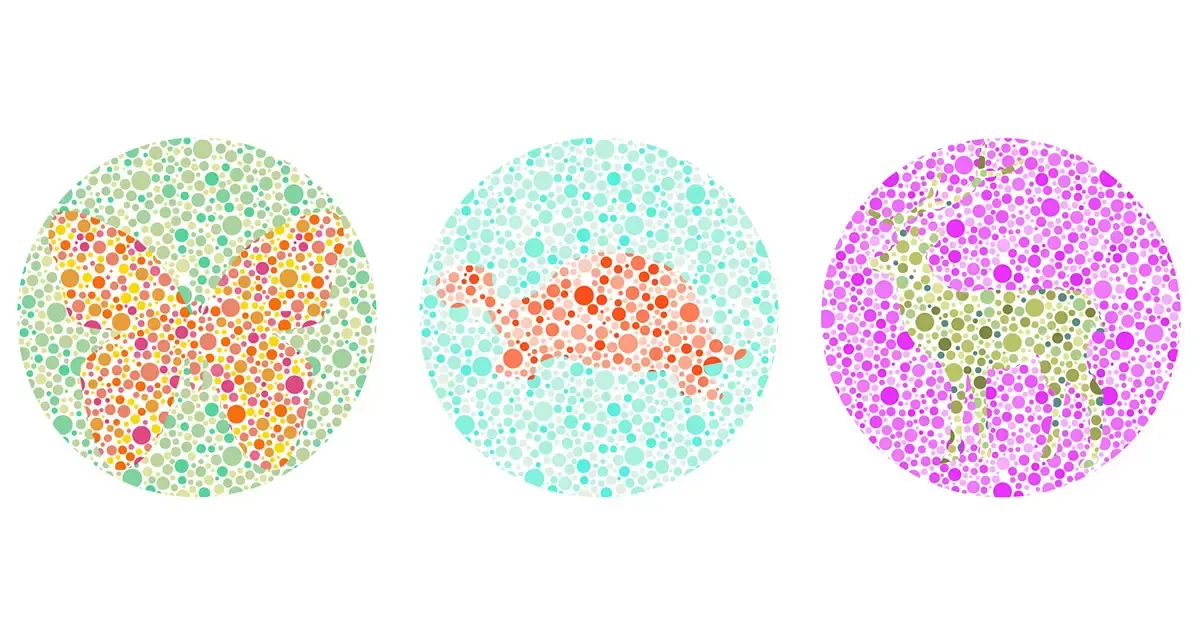
Most children who see color differently have no idea anything is unusual. They learned the word “green” for whatever they see when adults point at grass, and the system works until a worksheet, a science lab or a map depends on telling red from green. That is why color vision deficiency — still commonly called color blindness — is often discovered late, or by accident. Here is what parents can watch for, what home observation can and cannot tell you, and what happens when we test color vision properly.
Key takeaways
- Color vision deficiency is inherited far more often in boys: as many as 8% of males and 0.5% of females (Simunovic, 2010).
- Rates differ by ancestry. Among preschool boys in one large US study, 5.6% of non-Hispanic white boys were affected versus 1.4% of Black boys (Xie et al., 2014).
- Home clues are worth noticing, but only clinical color plates identify the type and severity.
- Most children can be tested reliably by about age 5 (AOA, 2017).
- There is no treatment that restores normal color vision (Simunovic, 2010). Good school accommodations and everyday strategies do the real work.
What color vision deficiency actually is
Color perception starts with cone photoreceptors in the retina. When one type of cone pigment is missing or shifted, certain colors become hard to tell apart. The most common inherited form affects red and green; blue-yellow deficiency is less common (AOA, 2017). Most children who have it still see plenty of color; the difficulty is with particular pairs, not with color itself.
The pattern of inheritance explains the lopsided sex ratio. The most common forms are carried on the X chromosome in a recessive pattern, which is why they affect as many as 8% of males and about 0.5% of females (Simunovic, 2010). Boys inherit the trait from their mother’s side; a boy with a color blind maternal grandfather is worth testing.
Color vision deficiency can also be acquired later rather than inherited (Simunovic, 2010). That matters, because a color vision deficiency may indicate an eye health problem, and testing may need to be repeated when an acquired deficiency is suspected (AOA, 2017). A child whose color perception seems to change is a different situation from one who has always seen this way, and deserves an eye health examination. We cover that side of care on our eye health page.
How common is it, and in whom
The clearest US pediatric numbers come from the Multi-Ethnic Pediatric Eye Disease Study, in which 4,177 of 5,960 Southern California children aged 30 to 72 months completed color vision testing. Among boys, color vision deficiency was found in 5.6% of non-Hispanic white children, 3.1% of Asian children, 2.6% of Hispanic children and 1.4% of Black children; among girls it ranged from 0% to 0.5% across every group (Xie et al., 2014).
The 8% male figure quoted earlier is an upper-bound estimate from the wider literature — as many as one boy in twelve (Simunovic, 2010). These US preschool rates are lower. They work out to roughly one affected boy for every one to two classrooms of 25 children in the highest-rate group, and one for every five or six classrooms in the lowest. Either way, it is usually a boy — and usually a child nobody has ever told.
Signs parents notice at home
None of these confirms anything on its own. They are simply worth mentioning at your child’s next eye exam.
- Color naming stays wobbly long after other children have it down, especially red and green, or brown and green.
- Unexpected colors in drawings — brown grass, purple leaves, gray skin tones.
- Sorting by brightness instead of hue. A child may group a dark red and a dark green crayon together because they look similar in lightness.
- Trouble with color-coded schoolwork — reading graphs, following “circle the red ones” instructions, matching a key on a map.
- Frustration with games and clothes that depend on color matching, sometimes expressed as avoidance rather than complaint.
Why home observation and online tests only go so far
Home checks and free online plate tests can raise a useful question. They cannot answer it. Screen brightness, color profile and room lighting all change how the plates render, and no quiz can tell you which type of deficiency is present or how severe it is. Severity matters: among the affected boys in the preschool study above, 32% were classified as mild, 15% as moderate and 41% as severe (Xie et al., 2014).
It also helps to know that routine vision screening is not designed to catch this. The US Preventive Services Task Force recommends screening at least once between ages 3 and 5, but the target is amblyopia and its risk factors (USPSTF, 2017). A child can pass a school screening with flying colors and still have a color vision deficiency.
How color vision is tested in the office
We use pseudoisochromatic plates — the familiar pages of colored dots with a number or shape hidden inside — with child-friendly versions using symbols, animals and winding trails for children who are not yet reading numbers. If a child misses plates, a diagnostic set such as the HRR test sorts out the type (red-green versus blue-yellow) and the severity.
These plate tests hold up well in young children. In a study of 33 children with reduced visual acuity and 38 controls, aged 3 to 10, all but two completed pseudoisochromatic plate and Mollon-Reffin testing, while a computerized color test was less successful and less reliable in the youngest ones (Pfäffli et al., 2020). Testability also climbs steeply with age: 17% of children under 37 months, 89% at 49 to 60 months and 98% by 61 to 72 months (Xie et al., 2014).
Color vision testing belongs inside a full eye examination, alongside acuity, refraction, eye teaming and eye health. The American Optometric Association recommends a comprehensive examination at 6 to 12 months, at least once between ages 3 and 5, and before first grade and annually after that (AOA, 2017).
Not correctable, but very manageable
We want to be direct about this: inherited color vision deficiency is managed with counselling and practical adaptation, not corrected. Vision therapy does not treat it, and we do not offer it as a treatment for color vision. Visual aids may help with particular tasks, but the evidence is that they do not give wearers normal color discrimination (Simunovic, 2010) — and a laboratory study of EnChroma tinted lenses found they changed how colors looked without improving results on standard diagnostic tests (Gómez-Robledo et al., 2018).
What does help is removing the places where color carries information alone. Almost everyone with abnormal color vision reports everyday and workplace difficulty with color-coded systems, color naming and searching by color (Cole, 2004).
At school
- Ask teachers to pair color with a label, pattern, shape or written word on charts, graphs, maps and grouping systems.
- Request black-on-white printing rather than colored text on colored backgrounds.
- Ask that “the red group” also be “the red group with the star.”
- Put the deficiency in writing with the school so it follows your child year to year.
At home and out in the world
- Teach traffic lights by position, not color.
- Label the inside of clothing, or organize outfits together.
- Let older children use color-identifier apps and high-contrast display settings.
- Keep it matter-of-fact. Children who know why a task is hard stop assuming they are bad at it.
Color confusion also sits alongside treatable problems more often than parents expect, such as uncorrected refractive error or eye-teaming difficulty. Our guides to common eye problems in children 6 to 12, choosing the right glasses and screen time cover the rest of the picture.
If you suspect your child sees color differently, a comprehensive eye examination can answer the question and check everything else at the same time. Schedule an evaluation at our Boynton Beach or Boca Raton office, or learn what our examinations include.
Common Questions About This Topic
How common is color blindness in children?
Congenital color vision deficiency affects as many as 8% of males and 0.5% of females, because the most common forms are inherited in an X-linked recessive pattern. In the Multi-Ethnic Pediatric Eye Disease Study, in which 4,177 of 5,960 Southern California preschoolers completed testing, the rate among boys was 5.6% in non-Hispanic white children, 3.1% in Asian children, 2.6% in Hispanic children and 1.4% in Black children. Among girls it was 0% to 0.5% across all groups.
At what age can my child be tested for color vision?
Testability rises quickly with age. In the Multi-Ethnic Pediatric Eye Disease Study, 17% of children under 37 months could complete color vision testing, rising to 57% at 37 to 48 months, 89% at 49 to 60 months and 98% at 61 to 72 months. The American Optometric Association's pediatric guideline says most children can be reliably evaluated for color vision deficiency after 60 months, or about age 5.
Are online color blindness tests accurate?
They can raise a question, but they cannot answer it. Screen brightness, color settings and ambient light all change how the plates look, and an online quiz cannot tell you which type of deficiency your child has or how severe it is. Treat a failed online test as a reason to book an eye exam, not as a diagnosis.
Can vision therapy or glasses cure color blindness?
No. Inherited color vision deficiency comes from the color-sensing cone photopigments in the retina, and management is counselling and practical adaptation rather than correction. Visual aids may help with particular tasks, but the evidence is that they do not give wearers normal color discrimination, and a laboratory study of EnChroma tinted lenses found no improvement on standard diagnostic color vision tests.
Should I tell my child's school?
Yes. Teachers use color constantly for grouping, charts, maps, graphs and worksheets, and almost all people with abnormal color vision report difficulty with color-coded information. A short note to the teacher, asking for labels, patterns, shapes or written words alongside color, removes many of the everyday classroom barriers and costs nothing.
Where This Information Comes From
- Xie JZ, Tarczy-Hornoch K, Lin J, Cotter SA, Torres M, Varma R; Multi-Ethnic Pediatric Eye Disease Study Group (2014). Color vision deficiency in preschool children: the Multi-Ethnic Pediatric Eye Disease Study. Ophthalmology. : Of 5,960 Southern California children aged 30-72 months, 4,177 completed testing; color vision deficiency affected 5.6% of non-Hispanic white boys, 3.1% Asian, 2.6% Hispanic and 1.4% Black boys, and 0% to 0.5% of girls; testability rose from 17% under 37 months to 98% at 61-72 months.
- Simunovic MP (2010). Colour vision deficiency. Eye (London). : Review: congenital colour vision deficiency affects as many as 8% of males and 0.5% of females because the commonest forms are X-linked recessive; it can also be acquired; management is chiefly counselling, and visual aids do not give wearers normal colour discrimination.
- Cole BL (2004). The handicap of abnormal colour vision. Clinical and Experimental Optometry. : Review: almost all people with abnormal colour vision report everyday and workplace problems, particularly with colour-coded information, colour naming and colour-based visual search.
- Pfäffli OA, Tamási B, Hanson JVM, Gerth-Kahlert C (2020). Colour vision testing in young children with reduced visual acuity. Acta Ophthalmologica. : In 33 patients with reduced visual acuity and 38 controls aged 3-10, all but two children completed pseudoisochromatic plate and Mollon-Reffin testing, while the computerised Cambridge Colour Test was less successful and less reliable in younger children.
- Gómez-Robledo L, Valero EM, Huertas R, Martínez-Domingo MA, Hernández-Andrés J (2018). Do EnChroma glasses improve color vision for colorblind subjects? Optics Express. : Laboratory and simulation study: the lenses changed perceived color but neither improved results on diagnostic color vision tests nor gave observers with colour vision deficiency more normal colour vision.
- US Preventive Services Task Force; Grossman DC, Curry SJ, Owens DK, et al. (2017). Vision Screening in Children Aged 6 Months to 5 Years: USPSTF Recommendation Statement. JAMA. : Recommends vision screening at least once at ages 3 to 5 to detect amblyopia and its risk factors; the target of screening is amblyopia, not color vision.
- American Optometric Association (2017). Evidence-Based Clinical Practice Guideline: Comprehensive Pediatric Eye and Vision Examination. : Recommends a comprehensive eye examination at 6-12 months, at least once between ages 3 and 5, and before first grade and annually thereafter; notes red-green deficiency is the most common form, that most children can be reliably tested after 60 months, and that a color vision deficiency may indicate an ocular health problem.
Care We Provide
More From the Blog
Wondering If This Sounds Like Your Family?
A developmental vision evaluation measures the skills a routine eye exam does not. Our team sees children and adults in Coconut Creek, Boynton Beach, Boca Raton and West Palm Beach.