Book Review: Active Baby, Healthy Brain
A question we hear often in our Coconut Creek, Boynton Beach and West Palm Beach offices is, “What can I do at home to support my child’s development?” It comes up most when an older sibling has already been diagnosed with a vision or learning problem and a parent wants to give the younger child every advantage.
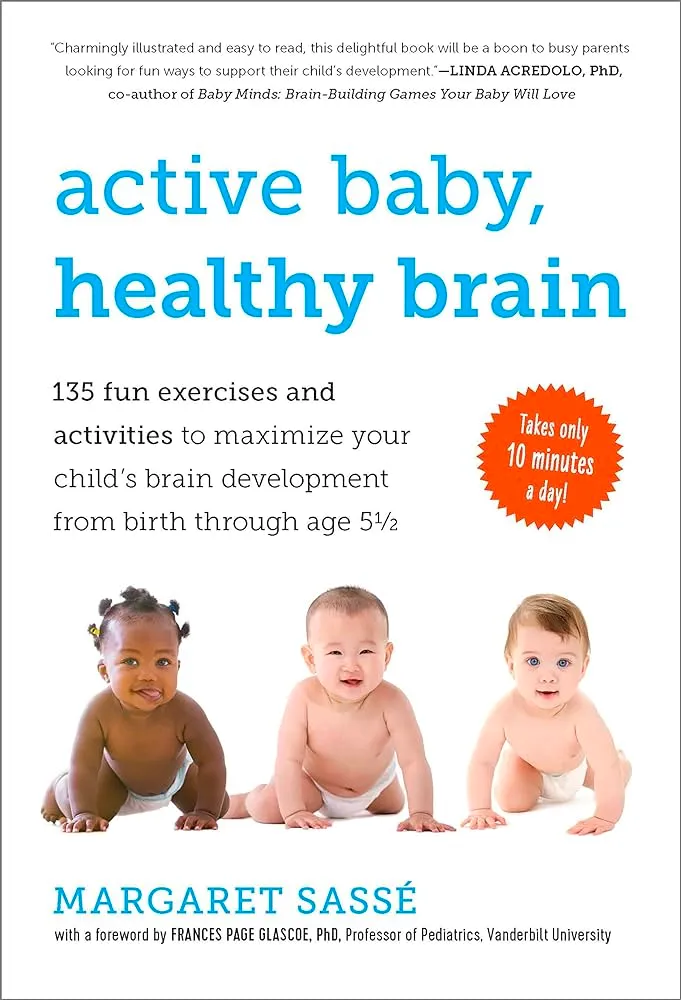
Our honest answer is that no book, program or exercise can guarantee “perfect” development. What we can do is help families create the conditions a young nervous system needs: movement, floor play, face-to-face interaction and regular eye care. Active Baby, Healthy Brain by Margaret Sassé is the book we most often hand to caregivers who want a structured, playful way to do that.
Key takeaways
- The book offers 135 short, illustrated movement activities organized by age from birth through 5½, at about ten minutes a day.
- Its emphasis on floor play and tummy time matches World Health Organization guidance and a systematic review linking tummy time to gross-motor development.
- The theory behind some activities (integrating primitive reflexes) rests on small, low-certainty studies. We recommend the book as good play, not as treatment or a proven way to prevent a diagnosis.
- If you have concerns, or a sibling has a diagnosis, a developmental vision evaluation is the right next step.
What the book is
Active Baby, Healthy Brain: 135 Fun Exercises and Activities to Maximize Your Child’s Brain Development from Birth Through Age 5½ was published in 2010 by The Experiment. It collects massages, exercises and games grouped by developmental stage, each taking about two minutes or less, for roughly ten minutes a day. The activities target balance, cross-pattern movement, vestibular (inner-ear) stimulation, laterality, visualization, and fine and gross motor skills (The Experiment Publishing, 2010).
Sassé founded Toddler Kindy GymbaROO, a parent-and-child movement program, in Australia in 1982, and the book distills that experience into a format families can use on the living-room floor (The Experiment Publishing, 2010).
What we like about it
- It is organized by stage. Open to your child’s age and start.
- Instructions are short, clear and illustrated, so caregivers with no background in child development can follow along.
- The activities are play. The publisher describes them as targeting balance, cross-pattern movement, laterality and fine and gross motor skills (The Experiment Publishing, 2010) — rolling, crawling, balancing and similar floor games. Children enjoy them, and the caregiver is down on the floor too, which strengthens the relationship as much as the muscles.
- It treats movement, sensory experience and emotional connection as one system. That fits how we think about development at Vision & Learning Center.
Why movement matters in the first years
The book’s central message, that babies should move on the floor every day, is well supported. The World Health Organization recommends that infants under one be “physically active several times a day in a variety of ways, particularly through interactive floor-based play,” including at least 30 minutes of tummy time spread through the day for babies who are not yet mobile, and it does not recommend screen time at this age (WHO, 2019).
A systematic review of 16 studies with 4,237 infants found that tummy time was positively associated with gross-motor and overall development and with prevention of a flattened skull shape (brachycephaly). Just as important is what it did not find: no association with fine-motor or communication development, and indeterminate cognitive findings (Hewitt et al., 2020). Movement helps babies move; it is not a shortcut to a “smarter” brain.
Vision develops alongside movement. In the first two months a baby’s eyes may appear to cross or wander; by about three months the eyes should work together to focus and track, and depth perception matures more fully around five months (American Academy of Ophthalmology, 2026). By age two, eye-hand coordination and depth perception should be well developed (American Optometric Association). Our clinical view is that the two systems grow up together: reaching, rolling and crawling give a baby reasons to aim both eyes at one target. The milestone guidance above sets out the timeline, not that mechanism. See What Can My Baby See? and Learning to Learn Part 4: Motor Systems.
An honest word about primitive reflexes
Several of the book’s activities rest on the idea that early reflex movement patterns need to be “integrated” for later learning to go smoothly. We find that framework clinically useful and screen for retained reflexes in our own evaluations. Parents also deserve to know how thin the research is.
- A double-blind randomized trial of 60 children aged 8 to 11 with reading difficulties found that a movement program replicating primary-reflex movements reduced the asymmetrical tonic neck reflex, while placebo movements did not (McPhillips et al., 2000). It is one small trial, and the outcome measured was the reflex itself.
- A later study of 409 children found more persistent reflexes among the poorest readers, but the same authors concluded that reflex persistence “cannot be used as a causal model for reading difficulties” (McPhillips & Sheehy, 2004).
- A 2026 systematic review found small, mostly observational studies linking persisting reflexes with poorer balance, dexterity, reading and math, and five intervention studies it called “promising” rather than proven (Provazník et al., 2026). A separate meta-analysis pooled four small studies (229 participants) and found moderate correlations between retained neck reflexes and ADHD symptoms (Wang et al., 2023). Correlation is not causation.
Our clinical perspective: this is emerging, low-certainty evidence. A retained reflex is a screening observation that tells us where to look, not a diagnosis, and reflex-based activities with a healthy baby have not been shown to prevent a later learning or vision problem. You can read more in Learning to Learn Part 2: Primitive Reflexes and on our primitive reflexes page.
How we use the book in our practice
We recommend Active Baby, Healthy Brain the way we would recommend a good playground: as developmentally appropriate, enjoyable activity that families can actually keep up. We do not present it as therapy or as evidence, and we never suggest it in place of an evaluation when a parent is worried.
If an older child has a diagnosed vision problem, the most useful step for a younger sibling is a first comprehensive eye examination at about six months of age, which is what the American Optometric Association recommends. The AOA also notes that participating doctors of optometry provide a no-cost infant eye assessment between 6 and 12 months through its InfantSEE program (American Optometric Association); it is worth asking any office whether it takes part. Regular exams after that, plus attention to milestones, let us catch problems early. Our developmental delays page lists the signs we watch for.
We have no financial interest in the book; find it through the publisher, a bookstore or your library.
If you have questions about your baby’s development, or simply want a baseline before concerns arise, learn about our developmental vision evaluations or Schedule an evaluation.
Common Questions About This Topic
What ages does Active Baby, Healthy Brain cover?
The book is organized by developmental stage from birth through age 5½. Each of the 135 massages, exercises and activities takes about two minutes or less, and the author suggests roughly ten minutes a day.
Will the activities in this book prevent or treat a vision or learning problem?
No. We recommend the book as enjoyable, developmentally appropriate play, not as therapy. The research behind reflex-integration programs is small and low-certainty, and no home activity has been shown to prevent a diagnosis. If you have concerns, a comprehensive developmental vision evaluation is the right next step.
My older child has a diagnosed vision problem. What should I do for the baby?
Keep up daily floor play and tummy time, watch the visual milestones (eyes working together by about 3 months, depth perception around 5 months), and book a first comprehensive eye examination at about 6 months of age, as the American Optometric Association recommends. Regular exams after that let us catch problems early.
How much tummy time does a baby need?
The World Health Organization recommends that infants under one be physically active several times a day through interactive floor-based play, including at least 30 minutes of tummy time spread through the day for babies who are not yet mobile, and it does not recommend screen time for this age group.
Does Vision & Learning Center earn anything from recommending this book?
No. We have no financial interest in the book or its publisher. We recommend it because families find it practical and easy to keep up.
Where This Information Comes From
- The Experiment Publishing (2010). Active Baby, Healthy Brain: 135 Fun Exercises and Activities to Maximize Your Child's Brain Development from Birth Through Age 5½ (publisher's book page). : Publisher's description of the book: 135 activities from birth through 5½, about two minutes each and ten minutes a day, targeting balance, cross-pattern movement, vestibular stimulation, laterality and motor skills; author founded Toddler Kindy GymbaROO in 1982. Not a research source.
- World Health Organization (2019). To grow up healthy, children need to sit less and play more (news release summarizing the WHO Guidelines on physical activity, sedentary behaviour and sleep for children under 5 years of age). : Infants under 1 should be physically active several times a day through interactive floor-based play, with at least 30 minutes of tummy time spread through the day for those not yet mobile; screen time is not recommended.
- Hewitt L, Kerr E, Stanley RM, Okely AD (2020). Tummy Time and Infant Health Outcomes: A Systematic Review. Pediatrics. : Across 16 studies (4,237 infants), tummy time was positively associated with gross motor and total development, lower BMI-z and prevention of brachycephaly; no association with fine motor or communication development, and indeterminate for cognition.
- American Academy of Ophthalmology (Boyd K, reviewed by Lipsky SN) (2026). Vision Development: Newborn to 12 Months. aao.org EyeSmart patient education page. : For the first 2 months a baby's eyes may appear crossed or wander; by 3 months the eyes should work together to focus and track; depth perception has developed more fully at around 5 months.
- American Optometric Association. Infant Vision: Birth to 24 Months of Age. aoa.org patient education page. : Eyes become capable of working together for a three-dimensional view around the fifth month; eye-hand coordination and depth perception should be well developed by 2 years; first thorough eye exam at about 6 months; participating doctors of optometry provide a no-cost InfantSEE assessment between 6 and 12 months.
- McPhillips M, Hepper PG, Mulhern G (2000). Effects of replicating primary-reflex movements on specific reading difficulties in children: a randomised, double-blind, controlled trial. Lancet. : In 60 children aged 8-11 with reading difficulties, a reflex-replication movement program significantly reduced the asymmetrical tonic neck reflex while placebo-movement and no-movement groups did not change; single small trial, outcome was the reflex itself.
- McPhillips M, Sheehy N (2004). Prevalence of persistent primary reflexes and motor problems in children with reading difficulties. Dyslexia. : Among 409 children aged 9-10, the poorest readers had more persistent ATNR, but the authors conclude reflex persistence cannot be used as a causal model for reading difficulties, including dyslexia.
- Provazník A, Musálek M, Bob P, Větrovský T, Malambo C, Silva AF, Anderson D (2026). Persisting primitive reflexes and motor and cognitive development in children: A systematic review. Acta Psychologica. : Small, heterogeneous, mostly observational studies link persisting reflexes with poorer balance, dexterity, reading, spelling and math; five intervention studies were 'promising' rather than conclusive.
- Wang M, Yu J, Kim HD, Cruz AB (2023). Attention deficit hyperactivity disorder is associated with (a)symmetric tonic neck primitive reflexes: a systematic review and meta-analysis. Frontiers in Psychiatry. : Pooling four studies (229 participants), ADHD symptoms correlated moderately with retained ATNR (r=0.48) and STNR (r=0.39); correlation only, no treatment evidence.
Care We Provide
More From the Blog
Wondering If This Sounds Like Your Family?
A developmental vision evaluation measures the skills a routine eye exam does not. Our team sees children and adults in Coconut Creek, Boynton Beach, Boca Raton and West Palm Beach.